
Font size
 Worksheets
1st Nine Weeks Extra Credit Opportunity
Total questions: 45
Worksheet time: 50mins
1-4.
Answer the questions below after watching the video
What is homeostasis?
The process of adapting to external changes.
The maintenance of a constant internal state in a changing environment.
The ability of an organism to grow and reproduce.
The interaction between different organ systems.
What is the approximate internal body temperature that healthy individuals maintain?
32 degrees Fahrenheit
70 degrees Fahrenheit
98.6 degrees Fahrenheit
105 degrees Fahrenheit
Which organs are primarily responsible for maintaining the correct water balance in the human body?
Heart
Lungs
Kidneys
Brain
How do plants maintain proper water levels for photosynthesis?
By changing the color of their leaves.
By adjusting their root growth.
By opening and closing stomata on their leaves.
By producing more chlorophyll.
Understanding Prokaryotes and Eukaryotes
Prokaryotes and eukaryotes are two fundamental types of cells that differ in structure and complexity. Prokaryotic cells are simpler and lack a nucleus, while eukaryotic cells are more complex and contain a nucleus where genetic material is stored. Additionally, eukaryotic cells have membrane-bound organelles, which are absent in prokaryotic cells. These differences are key to understanding how organisms function and evolve.
The structure of prokaryotic cells is straightforward and efficient. They are typically smaller in size and consist of a cell membrane, cytoplasm, and genetic material that floats freely within the cell. Prokaryotes often have a rigid cell wall for protection and may include structures like flagella for movement. Despite their simplicity, prokaryotic cells are highly adaptable and can thrive in diverse environments.
Eukaryotic cells, on the other hand, are characterized by their specialized organelles. These include the mitochondria, which generate energy, and the endoplasmic reticulum, which helps in protein and lipid synthesis. The Golgi apparatus is responsible for packaging and transporting materials, while lysosomes aid in breaking down waste. These organelles work together to ensure the cell operates efficiently, making eukaryotic cells suitable for forming complex multicellular organisms.
What is a key structural difference between prokaryotic and eukaryotic cells?
Prokaryotic cells have a nucleus, eukaryotic cells do not.
Eukaryotic cells have membrane-bound organelles, prokaryotic cells do not.
Prokaryotic cells are larger than eukaryotic cells.
Eukaryotic cells lack genetic material.
Which organelle is responsible for generating energy in eukaryotic cells?
Golgi apparatus
Mitochondria
Lysosomes
Endoplasmic reticulum
What structure in prokaryotic cells aids in movement?
Cytoplasm
Flagella
Nucleus
Cell membrane
What is the role of the Golgi apparatus in eukaryotic cells?
Generating energy
Breaking down waste
Packaging and transporting materials
Synthesizing proteins
Why are prokaryotic cells highly adaptable?
They have a nucleus.
They contain specialized organelles.
They thrive in diverse environments.
They are multicellular.
Sunlight provides what type of energy?
chemical energy
thermal energy
radiant energy
The products of photosynthesis are...
glucose and oxygen
carbon dioxide and water
Sunlight provides what type of energy?
chemical energy
thermal energy
radiant energy
The reactants to photosynthesis are...
glucose and oxygen
carbon dioxide and water
The products of photosynthesis are...
glucose and oxygen
carbon dioxide and water
What part of the plant absorbs carbon dioxide?
stomata of leaves
the roots
the flower
What gives the leaf its green color and absorbs sunlight?
stomata
chlorophyll
roots
flowers
The process of photosynthesis transforms _______ energy to _______ energy
radiant : thermal
thermal : chemical
radiant : chemical
chemical : radiant
What is the source of the water as a reactant to photosynthesis?
the soil
the air
the clouds
What is the source of carbon dioxide as a reactant in photosynthesis?
the soil
the air
the clouds
What acts as the radiant energy collector in a plant?
leaves
flowers
roots
How many water molecules are used as a reactant in photosynthesis?
6
12
18


Where does cellular respiration take place?
Endoplasmic reticulum
Ribosomes
Mitochondria
Nucleus
What is the main product of cellular respiration?
Glucose
ATP
Water
Carbon dioxide
What is ATP?
A type of cell
A sugar molecule
A protein
Adenosine Triphosphate
What are the inputs for cellular respiration?
Glucose and oxygen
Oxygen and carbon dioxide
Carbon dioxide and water
ATP and glucose
What is released as a byproduct or an output of cellular respiration?
Oxygen
Nitrogen
Hydrogen
Carbon dioxide
What are the products of cellular respiration? Choose 3.
water
ATP
Oxygen
Sunlight
Carbon Dioxide
Which organelle in a cell produces a large amount of ATP through cellular respiration?
chloroplast
mitochondrion
nucleus
ribosome
During cellular respiration, energy is released from food. What else does the cell need for this process to take place.
carbon dioxide
oxygen
sunlight
nitrogen
How can energy from the sun be transferred to animals?
The sun's energy is transformed into food by plants, and animals eat plants so that they can transform that food into energy.
Plants produce energy using the sun's energy, and animals then eat that energy.
Plans transform the sun's energy into gases that animals can breath in to use as energy.
Animals produce their own food using energy from the sun. They don't need plants.
Which type of organism would MOST likely benefit directly from increased levels of CO2?
mushroom
tree
bird
fish
What is the point of a feedback loop?
To provide the body with more energy
To provide the body with more food
To make sure the conditions in the body are always changing
To make sure the conditions in the body remain stable
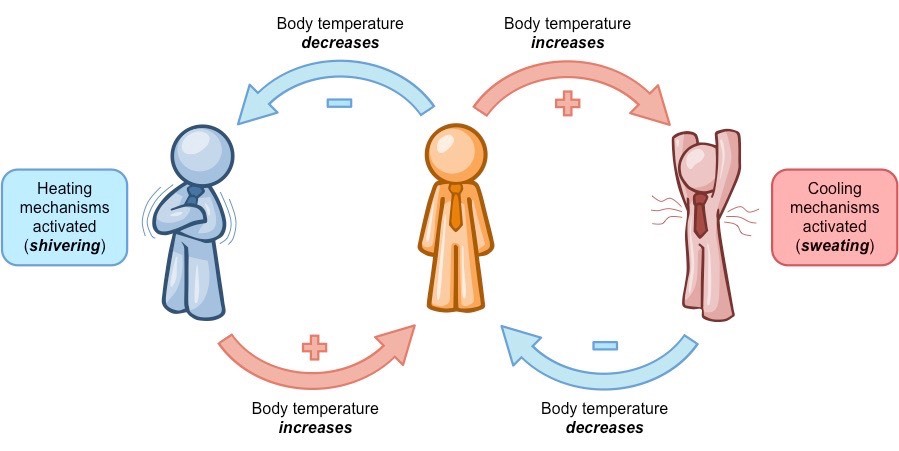
In this body temperature feedback loop, predict what would happen if cooling mechanisms were NOT activated?
The body would not warm up.
The body would not cool down.
Your body would get colder and colder.
Your body would release lots of heat.
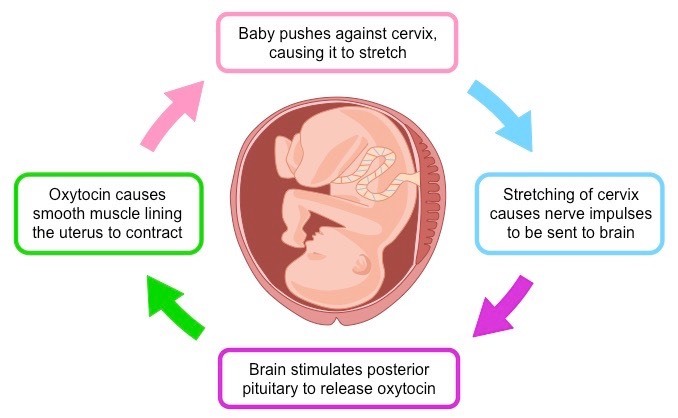
What type of feedback loop is shown?
negative
neutral
positive

