
 Worksheets
Chapter 3 Test Readiness Practice
Total questions: 65
Worksheet time: 33mins
When two species change over time due to back and forth adjustments to one another.
coevolution
adaptation
mutation
speciation
The study of populations using statistics is _________________
demography
geology
zoology
astronomy
A group of all the different organisms in the same place at the same time is a _____________________.
community
population
ecosystem
habitat
A group of organisms of the same species in a common area at the same time is a _________________
population
community
ecosystem
habitat
The act of one organism killing another organism for food.
predation
photosynthesis
mutualism
herbivory
A chemical produced by a plant that is used to deter predation from herbivores.
secondary compound
enzyme
hormone
vitamin
Top predators are important because they decrease ____________ and also increase _____________.
prey populations; biodiversity
biodiversity; prey populations
competition; extinction rates
nutrient levels; pollution
Number of individuals in a population per a given area _________________. How packed in the population is.
population density
carrying capacity
birth rate
immigration rate
The way that individuals within a population are arranged is _________________
dispersion
mutation
adaptation
speciation
Number of individuals in a population: _______________.
population size
population density
population growth
population structure
When two or more species live together in a close, long-term relationship.
symbiosis
predation
competition
parasitism
A group of organisms that are closely related to each other and naturally mate to produce fertile offspring: _______________.
species
genus
family
population
A graphical way to represent a population that shows a breakdown by gender, age, and can help determine if populations will be growing, shrinking or staying the same: _________________
population pyramid
scatter plot
bar graph
line chart
The amount of change a population undergoes compared to its starting population is its _________________
growth rate
carrying capacity
limiting factor
biotic potential
Three types of population dispersion: _______________, _______________, _______________
clumped, uniform, random
linear, scattered, grouped
circular, spiral, even
patchy, regular, uneven
The average population size that an environment can sustain is its _____________________.
carrying capacity
population density
biotic potential
limiting factor
Four factors that affect growth rate: _______, _______, _______, _______
birth rate, death rate, immigration, emigration
temperature, rainfall, sunlight, soil type
predation, competition, adaptation, mutation
food chain, habitat, camouflage, mimicry
Organisms that produce few young, longer life-spans, and give lots of parental care, and stable populations sizes at carrying capacity (if healthy population) are _____-strategists.
K
r
C
S
Organisms that produce lots of young, shorter life-spans that mature quickly but die rapidly too (unstable population sizes), and give no parental care are _____-strategists.
r
K
S
Q
R-strategist population sizes are greatly impacted by density-______________ factors such as: _______________
independent; weather, climate, natural disasters
dependent; competition, predation, disease
dependent; food supply, space, mates
independent; migration, birth rate, death rate
K-strategist population sizes are impacted mostly by density-______________ factors such as: _______________
dependent; competition, predation, disease
independent; weather, natural disasters, temperature
neutral; migration, mutation, adaptation
random; sunlight, rainfall, soil type
A form of symbiosis in which one organism benefits and the other is harmed.
parasitism
mutualism
commensalism
neutralism
Symbiosis where one organism benefits and the other is neither harmed nor helped.
Commensalism
Parasitism
Mutualism
Predation
A form of symbiosis in which both organisms benefit from the relationship.
Mutualism
Parasitism
Commensalism
Predation
The general term given to an organism in which another organism lives and/or feeds on.
Host
Parasite
Predator
Producer
In a commensalism, both species will likely coevolve.
True
False
In parasitism, both species will likely coevolve.
True
False
When two species use the same resource, a biological interaction called ____________________ results.
Competition
Mutualism
Predation
Parasitism
The role, or “job,” an organism performs within an ecosystem is its _____________________.
Niche
Habitat
Population
Community
An entire range an organism is potentially able to occupy is called its _____________________________.
Fundamental niche
Realized niche
Habitat
Territory
The range in which an organism actually occupies is called its _______________________________.
Realized niche
Fundamental niche
Habitat
Territory
When two organisms engage in competition, one of the species may be eliminated. This is called _______________________________.
Competitive exclusion
Mutualism
Commensalism
Resource partitioning
33. A general rule in ecology is that no two species can occupy _________________________________.
the same niche
the same habitat
the same population
the same ecosystem
A population that grows without bounds has a “J” shaped curve and shows ___________________ growth.
exponential
logistic
linear
cyclical
A population that grows until reaching its carrying capacity has an “S” shaped curve and shows a ________________ growth model.
logistic
exponential
arithmetic
cyclical
Living (______________) factors and non-living (______________) factors interacting is all part of an _____________________. The study of these factors and their interactions is called ________________.
biotic; abiotic; ecosystem; ecology
abiotic; biotic; community; biology
biotic; abiotic; population; zoology
biotic; abiotic; habitat; botany
You observe two bacteria that appear to be similar, they do not interbreed with each other but instead asexually reproduce. The two bacteria are...
Different species
Same Species
Unable to use Mayr definition
Your friend has a dog they call a labor-doodle. He explains that the parents were a black lab and a poodle. The black lab and the poodle are...
Different species
Same Species
Unable to use Mayr definition
Population Studies: 2c. You are reading a book about deer and it describes the elk deer (Cervus canadensis) and red deer (Cervus elaphus). Looking at the pictures in the book, you can’t tell the difference between them. You read that they can interbreed in captivity, but because of differences in mating behaviors they do not naturally interbreed. You also read that their mitochondrial DNA is very different from each other. The elk deer and red deer are...
Different species
Same Species
Unable to use Mayr definition
Population Studies: 2d. You are at the zoo and you observe large, beautiful birds with brilliant colored plumes (tails), you know these are peacocks. You also observe some interesting birds with green head/neck areas but no colorful plume and a flock of baby birds following. A zookeeper points out that the less colorful bird is a peahen with her babies and points to the robust peacock as being the father. The peacock and peahen are...
Different species
Same Species
Unable to use Mayr definition
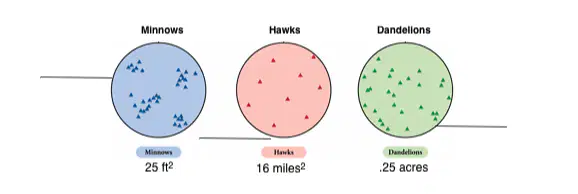
The circles above appear to be the same size area, according to the information are they? If not, explain:
No. The areas are different: Minnows (25 ft²), Hawks (16 miles²), Dandelions (0.25 acres).
Yes. All circles have the same area.
No. The areas are different: Minnows (16 miles²), Hawks (0.25 acres), Dandelions (25 ft²).
No. The areas are different: Minnows (0.25 acres), Hawks (25 ft²), Dandelions (16 miles²).
What is the formula used to calculate population density?
Population Density = Number of individuals / Area
Population Density = Area / Number of individuals
Population Density = Number of individuals × Area
Population Density = Number of individuals + Area
Explain how the population of one area compared to another can be greater, while its density is less.
Because the area with the greater population is much larger in size, resulting in fewer people per unit area.
Because the area with the greater population has more people living in a smaller space.
Because both areas have the same number of people but different land sizes.
Because the area with the greater population is more crowded overall.
What is the formula used to calculate the growth rate (r) of a population in percent?
Growth rate (r) = [(births + immigration) - (deaths + emigration)] / total population × 100
Growth rate (r) = [(deaths + emigration) - (births + immigration)] / total population × 100
Growth rate (r) = (births + deaths + immigration + emigration) / total population × 100
Growth rate (r) = (births - deaths) / total population × 100
There is a population of Emperor penguins in a small colony in Antarctica that has 12,000 individuals. The birth rate was 400 penguins while the death rate was 150. The immigration rate was 2 and the emigration rate was 4. What was the growth rate? (show your calculation set-up)
r = (400 + 2 - 150 - 4)/12,000
r = (400 - 150 + 4 - 2)/12,000
r = (400 + 150 + 2 + 4)/12,000
r = (400 - 150 - 2 + 4)/12,000
Which of the following diagrams best represents a logistical population growth model?
A graph showing an S-shaped curve with carrying capacity labeled.
A graph showing a straight line increasing indefinitely.
A graph showing a J-shaped curve with no carrying capacity.
A graph with random fluctuations and no clear pattern.
Which graph is more common for K-strategists? ______________ r-strategists? ________________
Logistical; Exponential
Exponential; Logistical
Linear; Exponential
Logistical; Linear
Give an example of something that would have a logistical growth model:
A population of rabbits in a fenced reserve
The temperature of boiling water
The speed of a car on a highway
The height of a building under construction
Give an example of something that would have an exponential growth model: _________________
Population growth of bacteria
Linear increase in temperature
Constant speed of a car
Decrease in water level
Give 2 examples of density-dependent factors affecting pop. size: ____________________________
Competition and predation
Temperature and sunlight
Natural disasters and climate
Rainfall and soil type
Give 2 examples of density-independent factors affecting pop. size:
Natural disasters and weather changes
Competition and predation
Disease and parasitism
Food availability and shelter
What factors (examples) might influence the carrying capacity of a deer population in Michigan to go up?
Increase in available food resources
Decrease in water sources
Increase in predator population
Reduction in suitable habitat
Which of the following factors might influence the carrying capacity of a deer population in Michigan to go down?
Increase in available food sources
Decrease in habitat space
Decrease in predator population
Improvement in water quality
Give 3 example of K-strategists not already mentioned in your packet or in class: What makes these all good examples:
Examples of K-strategists could include elephants, whales, and humans. These are good examples because they have long lifespans, produce fewer offspring, and invest more in parental care.
Examples of K-strategists could include mice, rabbits, and insects. These are good examples because they have short lifespans and produce many offspring.
Examples of K-strategists could include frogs, salmon, and butterflies. These are good examples because they lay many eggs and provide little parental care.
Examples of K-strategists could include bacteria, algae, and mold. These are good examples because they reproduce rapidly and have minimal parental investment.
Give 3 example of r-strategists not already mentioned in your packet or in class: ________________ ____________________ What makes these all good examples: ________________________________ ____________________________________________________________________________________
Examples of r-strategists could include mosquitoes, dandelions, and mice. These are good examples because they reproduce quickly, produce many offspring, and have short lifespans.
Examples of r-strategists could include elephants, whales, and humans. These are good examples because they reproduce slowly, produce few offspring, and have long lifespans.
Examples of r-strategists could include oak trees, tortoises, and eagles. These are good examples because they invest heavily in parental care and have long lifespans.
Examples of r-strategists could include penguins, wolves, and giraffes. These are good examples because they form complex social groups and have low reproductive rates.
Describe the most common outcomes of competition due to overlapping niches:
a. Competitive exclusion (one species outcompetes the other) b. Resource partitioning (species divide resources to coexist)
c. Mutualism (both species benefit equally)
d. Parasitism (one species harms the other)
e. Extinction of both species
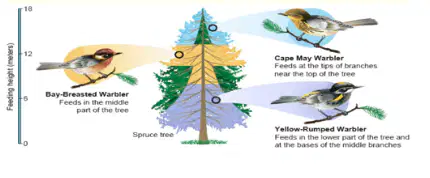
Describe how different species of warbler birds (below) can co-exist in the presence of competition and still continue exist:
Different species of warbler birds can co-exist by feeding at different parts of the tree, reducing direct competition for food resources.
Different species of warbler birds can co-exist by migrating to different continents every season.
Different species of warbler birds can co-exist by only feeding during the night.
Different species of warbler birds can co-exist by eating only insects found on the ground.
The Yunnan lake newt, went extinct in China in 1979 in part due to the introduction of exotic frogs in their habitats. The newly introduced frogs consume the same foods and exist in the same habitats as the Yunnan lake newt. This is an example of how invasive species can cause extinction by…
competition for resources.
increasing genetic diversity.
improving habitat conditions.
providing additional food sources.
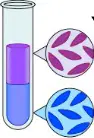
Explain what the infographic is about at the right: ____________________________
The infographic shows how two species (X and Y) can survive when grown separately, but when grown together, one species (Y) dies due to competition, illustrating the concept of competitive exclusion.
The infographic shows how two species (X and Y) can thrive better when grown together due to mutualism.
The infographic shows how two species (X and Y) both die when grown together due to lack of resources.
The infographic shows how two species (X and Y) can survive together without any impact on each other.
Plants and pollinators have evolved closely with each other. What type of symbiotic relationship do they have _________________?
mutualism
parasitism
commensalism
competition
A cow that has bacteria in its intestines has what type of relationship, if the bacteria gains a stable supply of nutrients from the cow and the bacteria produces a compound that helps the cow to digest its food?
mutualism
parasitism
commensalism
predation
A tapeworm can be found living in a human’s intestine. The tapeworm is getting food and shelter from the human host and the human is harmed from lack of nutrition due to the tapeworm consuming the nutrients. This is an example of what type of symbiotic relationship?
parasitism
mutualism
commensalism
competition
Lone golden jackals of India that have been expelled from their pack will form a relationship with a tiger. The jackal will trail the tiger at a safe-distance and feed on any left-overs from the tiger’s big kill. The tiger generally gets nothing from the jackal, and if a jackal gets too close the relationship may be over. This is an example of which type of symbiotic relationship?
commensalism
mutualism
parasitism
competition
A sea lamprey will latch onto a fish and uses its teeth to hold on and rasp away the skin, leaving an open wound for the lamprey to feed on. The lamprey will then drop off, without killing the host fish. Which type of symbiotic relationship is this?
parasitism
mutualism
commensalism
predation
Cuckoo birds were described in your application pages. Explain what type of a relationship a European cuckoo bird has with other particular bird species.
A European cuckoo bird has a parasitic relationship with other particular bird species.
A European cuckoo bird has a mutualistic relationship with other particular bird species.
A European cuckoo bird has a commensal relationship with other particular bird species.
A European cuckoo bird has a competitive relationship with other particular bird species.

