
 Worksheets
Extra credit quizziz December
Total questions: 92
Worksheet time: 2hrs 49mins
Subatomic particles with a negative charge
Electrons
Neutrons
Protons
Quarks

Which part of the diagram represents the proton?
a
b
c
d


Compounds are made up of elements and can be chemically separated. Elements cannot be separated.
Elements make up compounds. Elements can be separated but compounds cannot be separated.
Elements are found on the periodic table and compounds are found on the dining room table.
What is air classified as?
A compound
A solution
A mixture
An element

Element, mixture, or compound?
element
mixture
compound

Element, mixture, or compound?
element
mixture
compound

What do you see in this picture?
A pure element
A pure compound
A mixture of two elements
A mixture of two compounds
A mixture of an element and a compound

What do you see in this picture?
A pure element
A pure compound
A mixture of two elements
A mixture of two compounds
A mixture of an element and a compound
Is salt (NaCI) a compound or an element?
Compound
element
Air is a ________ mixture in which different substances are _______ mixed.
A. heterogeneous - evenly
B. heterogeneous - not evenly
C. homogeneous - not evenly
D. homogeneous - evenly
A pure substance
elements
mixtures
compounds
elements and compounds
elements and mixtures
A physical property can be observed __________ a chemical reaction
during
without
A chemical property can be observed __________ a chemical reaction
during
without
A chemical change (a)

Is this an example of a physical or chemical change?
physical
chemical

Is this an example of a physical or chemical change?
physical
chemical

Is this an example of a physical or chemical change?
physical
chemical

Is this an example of a physical or chemical change? Hint: Wax is melting in the question not burning
physical
chemical

Is this an example of a physical or chemical change?
physical
chemical

Is this an example of a physical or chemical change?
physical
chemical

Is this an example of a physical or chemical change?
physical
chemical

Is this an example of a physical or chemical change?
physical
chemical

Is this an example of a physical or chemical change?
physical
chemical
Matter goes through a change resulting in a different shape. What type of change is most likely occurring?
Chemical
Physical
Acids
Bases
Coefficients in chemical formulas...
Multiply just the first atom
Add to the subscripts at the end of the molecule
Multiply elements without subscripts
Multiply EVERYTHING!

Dissolving Sugar
Physical Change
Chemical Change

Compounds

Molecules

How many atoms of Iron are in this compound?
1
2
3
4
How many atoms of hydrogen are in
C6H12O6
6
12
18
2
How many different elements are present in H2COCH2
5
4
3
2
Calculate the number of Oxygen atoms in Al(OH)3
1
2
3
4
C3H5(NO3)3
C = 3, H = 5, N = 3, O = 9
C = 3, H = 5, N = 1, O = 9
C = 9, H = 15, N = 3, O = 9
C = 9, H = 15, N = 1, O = 3
How many TOTAL atoms are in this formiula?
HNO3
(a)
How many Hydrogen atoms are in this formiula?
Mg(OH)2
(a)

In a solution the _____ is dissolved.
solvent
solute

Look at the solution of tea and water. What do you think the terms diluted or concentrated could mean?
Diluted means more water, concentrated means less water
Diluted means less water, concentrated means more water
Diluted means more tea, concentrated means less tea
Diluted means less tea, concentrated means more tea

What is the rate of dissolution?
how quickly a substance dissolves
How cold a substance is
How many particles are in a substance
The color of the substance

A saturated solution has reached its maximum _______ capacity.
Solvent
Solute
Pressure
Volume

Which would NOT increase the rate of dissolution?
Ice
Heat
Agitation
Small Particle Size

In an aqueous solution the ___________ is water.
Solute
Solvent
Solution
What is agitation?
Heating
Size
Stirring
Color

The salt is the ________.
Solute
Solvent
Solution
A solution that contains all of the solute that it can hold at a given temperature.
unsaturated solution
homogeneous solution
You can make a solution more concentrated by adding more __________.
solution
Which factor does NOT affect the rate of dissolution of a solid solute in an aqueous solution?
Temperature
Surface area
Agitation
Color of the solute
If you increase the temperature of a solution, what generally happens to the rate of dissolution of a solid solute?
It decreases
It increases
It remains the same
It doubles
How does increasing the surface area of a solid solute affect its rate of dissolution?
It increases the rate
It decreases the rate


Green object is moving at a faster constant speed than Red
Red object is moving at a faster constant speed than Green
Green object is moving at a slower constant speed than Red
Red object is moving 2 times faster than Green


Which graph represents slowing down?
A
B
C
D


Match the description to the graph:
"The car is stopped."


Which scene matches the graph?
Jonathon walked to his girlfriends house - stayed a while then walked home
Justice rode her bike to the mall
Yeshua walked home from school

How will this object move?
It will not move
It will move in both directions
It will move to the right
It will move to the left

How will this object move?
It will not move
It will move in both directions
It will move to the right
It will move to the left

What is net force?
(a)

What is the net force?
(a)

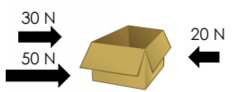


What is the unit for force?
Joules (J)
seconds (s)
Newtons (N)
meters (m)
Inertia is Newton's _______ Law of Motion.
First
Second
Third
Objects with MORE mass have...
MORE inertia
LESS inertia
the SAME amount of intertia
Complete the excerpt of Newton's First Law of Motion
"An object in motion will ________ until it is acted on by an unbalanced force."
...stay in motion...
...stop its motion...
...increase its motion...
...decrease its motion...
Complete the excerpt of Newton's First Law of Motion
"...and an object at rest will ________ until acted on by an unbalanced force."
...stay at rest...
...start an increasing motion...
...start a decreasing motion...
Newton's first law states that an object in motion stays in motion and an object at rest stays at rest unless acted on by ______________________________.
a balanced force
an unbalanced force

