
 Worksheets
Power Tool Supplies
Total questions: 38
Worksheet time: 19mins
Which voltage level is standard for domestic (mains) power and is not allowed on construction sites due to higher danger?
110v
230v
24v
12v
On a construction site, why is 110v preferred over 230v for corded power tools?
It delivers more power to tools
It possesses less risk and is commonly supplied through transformers
It is cheaper to install than batteries
It eliminates the need for transformers and cables
Which feature enables a rotary hammer drill to drill into masonry and other building materials?
High rotational speed
Hammer action
Cordless operation
Diamond-tipped bits
When securing a drill bit in a rotary hammer drill, what may be required?
A torque wrench
A chuck key
A Phillips screwdriver
No tool is ever required
Safety and maintenance for the rotary hammer drill include keeping the chuck well oiled and ensuring the chuck key is _______.
kept safe
discarded after use
left in the chuck
cleaned only monthly
What does the SDS hammer drill’s Secure Drill System (SDS) primarily do?
Reduces drill vibration
Automatically changes bits
Locks the drill bit in place
Measures hole depth
Beyond drilling, an SDS hammer drill can also be used to:
Polish metal surfaces
Chisel
Cut timber
Paint walls
Using core bits on an SDS hammer drill makes it suitable for:
Drilling larger holes
Only drilling small pilot holes
Driving screws only
Sanding surfaces
Which voltage range is typical for cordless drills described?
6v to 12v
14v to 36v
24v to 48v
110v to 240v
A key advantage of cordless drills in plumbing work is that they:
Have higher torque than all corded drills
Create no trip hazards because they are battery operated
Always include an SDS function
Do not require maintenance

Which task is a circular saw particularly useful for in construction work?
Cutting out profiles in worktops
Lifting floorboards and notching joists
Finishing plaster on patrician walls
Drilling pilot holes in joists

What is a key safety requirement when using a circular saw?
Remove the blade guard for deeper cuts
Set the blade at the correct height and keep the guard in place
Use only 230v models to ensure stability
Hold the material by hand while cutting

Which statement best describes jig saw use and safety?
Jig saws are only for straight cuts and have no guard
Jig saws require the correct blade for the material and their blade guard must be kept in place
Jig saws should be used without a guard to see the cut line clearly
Jig saws are not available in cordless versions
Which power supply options are mentioned for both circular saws and jig saws?
240v only
110v and corded only
230v, 110v, and cordless
Battery only
Before using any power tool, which check ensures the tool can cut or drill effectively and safely?
Confirm the guard is in place
Verify the tool is sharp
Look for frayed lead
Check the PAT sticker date
Which item is specifically checked to confirm electrical safety compliance prior to using a power tool?
Tool body
Plug pins
PAT sticker
Safety guard
According to the pre-use checklist, which of the following is NOT a recommended check?
Check for damage to the tool body
Ensure the guard is in place
Inspect for damage to the plug
Confirm the tool is painted
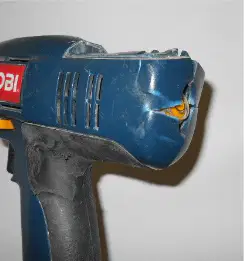
A drill shows cracks and dents in its casing. Which fault category does this represent?
Frayed lead
Mechanical damage
Damaged plug
Missing safety guard
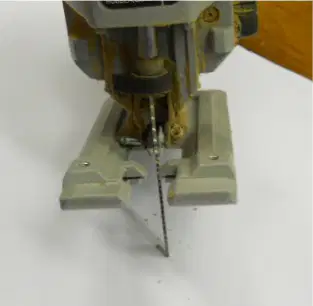
A jigsaw is pictured without its protective cover around the blade. Identify the fault.
Damaged plug
Missing safety guard
Frayed lead
Mechanical damage
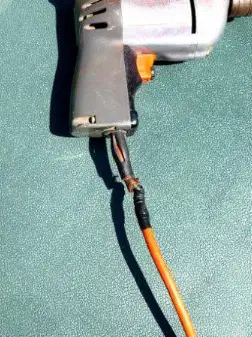
Which image shows an electrical cord with the outer insulation worn away exposing inner layers? What is the fault called?
Damaged plug
Frayed lead
Mechanical damage
Missing safety guard
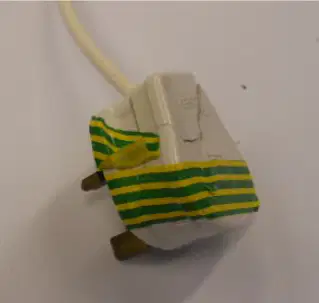
An electrical plug is taped and visibly cracked. What is the correct fault identification?
Frayed lead
Damaged plug
Mechanical damage
Missing safety guard
Which pair of faults from the images are most likely to cause electric shock risk?
Mechanical damage and missing safety guard
Frayed lead and damaged plug
Missing safety guard and sharp tool
Mechanical damage and PAT out-of-date
From the inspection list, what should you look for on the tool body itself?
PAT sticker in-date
Any damage
Presence of a GFCI
Manufacturer’s logo
Under which legislation do workers have a duty of care to themselves, their employer, and others who may be affected by their actions when using power tools?
Personal Protective Equipment Regulations
Health and Safety at Work Act
Manual Handling Operations Regulations
Control of Substances Hazardous to Health
Which statement best captures the core message of safe working practices with power tools?
Use safe practices only when accidents occur.
Safe working practices are important at the start and end of tasks.
Safe working practices must be used all the time.
Safe practices are optional if you are experienced.
Who is included in your duty of care when operating power tools?
Only yourself
Yourself and your employer
Your employer and equipment suppliers
Yourself, your employer, and others who may be affected
Which action directly applies the controls identified to reduce hazards before starting a job with power tools?
Selecting the appropriate tool
Following the risk assessment
Reading the warranty
Storing tools after use
What is the main reason to follow the manufacturer’s instructions when using power tools?
To obtain discounts on replacement parts
To ensure correct and safe operation as designed
To avoid cleaning the tool
To reduce the need for PPE
Which guideline specifically focuses on preventing injuries from flying debris, noise, or vibration during power tool use?
Select the appropriate tool for the task
Follow the risk assessment
Select and use the correct personal protective equipment
Inspect the equipment before use
Which check ensures a power tool has been recently verified as electrically safe before use?
Visual inspection of paintwork
Portable Appliance Test (PAT) is current
Tool is stored in its case
User has a licence
What device should be in place to reduce the risk of electric shock when using power tools?
Transformer
Residual Current Device (RCD)
Voltage regulator
Extension reel
When inspecting a power tool, which component must have the correct rating to avoid overheating or fire?
Battery pack
Fuse
Switch
Grip
Select the best action if a tool’s cable shows visible damage.
Continue working cautiously
Wrap with tape and carry on
Remove from service and report
Ignore unless it sparks
Which statement about RCD placement is correct for power tool use?
RCD must only be inside the tool
RCD can be at the consumer unit or plug-in
RCD is not needed if a fuse is present
RCD should be installed on the cable sheath
Identify the common electrical danger most likely to trip people in a busy workspace.
Incorrect fuse rating
Trailing leads
PAT label missing
Property wiring
Which of the following is listed as a common electrical danger?
Newly installed cables
Damaged/worn cables
Charged batteries
Dry flooring
Which check is specifically listed as part of the required safety checks before using power tools?
Confirm battery chemistry
Inspect for damage to plug
Check brand of tool
Measure motor RPM
Which item from the dangers list relates to cables left across walkways?
Faulty equipment
Trailing leads
Property wiring
Correct fuse rating

