
 Worksheets
Radiology Basics-Review 1
Total questions: 55
Worksheet time: 28mins
Different wavelengths correspond to different colors in white light.
True
False
What is radiology also called?
Diagnostic imaging
Therapeutic imaging
Surgical imaging
None of the above
Radiology is a series of different tests that take pictures or images of various parts of the (a) ?
Which of the following is NOT an imaging exam used in radiology?
X-ray
MRI
Ultrasound
Blood test
Which of the following imaging exams are mentioned as examples in the passage?
Ultrasound
MRI
X-ray
PET scan
CT scan
Radiology is essential to the diagnosis of many diseases, particularly which medical specialty?
Cardiology
Orthopedics
Dermatology
Neurology
Which of the following statements is true based on the information provided?
Radiology is not important for diagnosis.
Diagnostic imaging technology delays diagnosis.
Without diagnosis, there can be no treatment or cure.
Radiology is only used in cardiology.
Name the two major divisions of radiology.
Diagnostic radiology and Interventional radiology
Therapeutic radiology and Preventive radiology
Nuclear radiology and Pediatric radiology
Surgical radiology and Emergency radiology
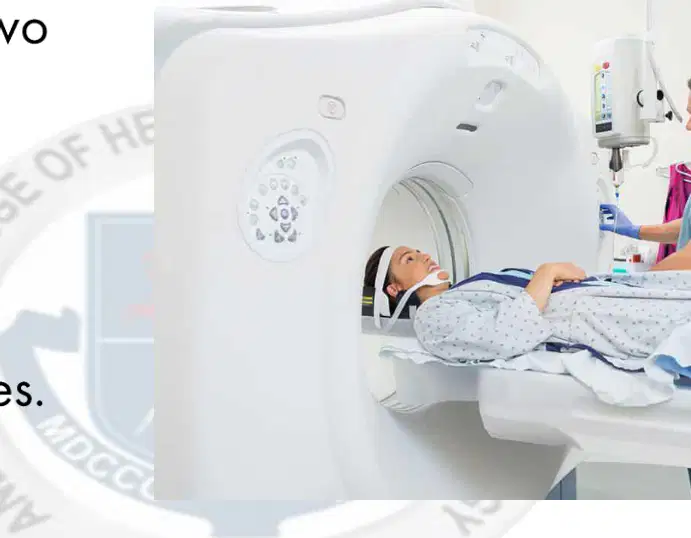
Both diagnostic radiology and interventional radiology use ______ energy to diagnose and treat diseases.
Radiation
Hydraulic
Wind
Chemical
What is at the core of clinical decision-making in modern medicine?
Diagnostic radiology
Physical therapy
Surgery
Pharmacology
Diagnostic imaging tests can include which of the following?
X-rays
CT scans
MRI scans
All of the above
Fill in the blank: X-rays are also known as Plain Radiography.
True
False
What does CT stand for in medical imaging?
(a)
MRI stands for Metallic Resonance Imaging.
True
False
Ultrasound examinations are also known as what?
(a)
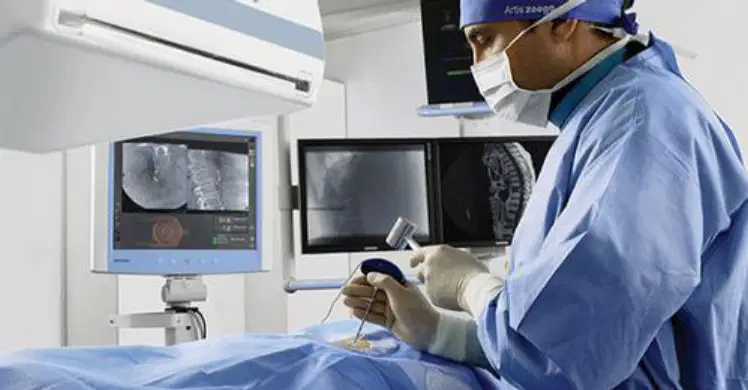
What is the main role of an interventional radiologist?
To prescribe medication
To use imaging techniques or procedures that make it possible to see internal organs in motion
To perform surgeries
To provide physical therapy

Radiology: Interventional radiologists perform procedures such as treating tumours, taking organ biopsies, or placing stents by inserting tiny instruments and thin plastic tubes (catheters) into the body via an artery or vein.
True
False
Most diagnostic imaging tests are performed by a certified medical radiation technologist, or an medical lab technologist.
True
False
Who performs specialized diagnostic imaging tests, particularly interventional radiology procedures?
Medical radiation technologist
Ultrasound technologist
Radiologist
Nurse
A radiologist reads, or interprets diagnostic imaging tests to help in diagnosis
True
False

What do radiologists use to diagnose disease and injury?
Blood tests
Medical imaging equipment
Physical therapy
Surgery
Some imaging techniques involve the use of radiation, so safety and protection procedures have no big importance in daily working.
True
False
Radiation can be described as energy or particles from a source that travel through space or other mediums.
True
False
Which of the following are all forms of radiation?
Light, heat, microwaves, and radio waves
Sound, water, and wind
Electricity, magnetism, and gravity
None of the above
Radiation can be either ionizing or non-ionizing, depending on how it affects matter.
True
False
Which of the following is NOT an example of non-ionizing radiation?
Visible light
Heat
X-rays
Radio waves
Non-ionizing radiation includes visible light, heat, radar, microwaves, and radio waves.
True
False
This type of radiation deposits energy in the materials through which it passes, but it does not have sufficient energy to break molecular bonds or remove electrons from atoms. What type of radiation is being described?
(a)
Ionizing radiation (such as x-rays and cosmic rays) is more energetic than non-ionizing radiation.
True
False
When ionizing radiation passes through material, what does it do?
It cools the material
It deposits enough energy to break molecular bonds and displace electrons from atoms
It makes the material glow
It has no effect
The electron displacement creates two electrically charged particles (ions), which may cause changes in living cells of plants, animals, and people. This process is called reionization.
True
False
Which of the following is an example of non-ionizing radiation?
Gamma rays
X-ray
Microwave
Ultraviolet
Which type of radiation can damage DNA?
Radio waves
Infrared
Gamma rays
Microwave
Match the following sources to their type of radiation:
Non-ionizing
Electricity
Non-ionizing
Microwave oven
Non-ionizing
Tanning booth
Ionizing
Medical X-ray
Radio waves induce high currents and cause heating.
True
False
What did Wilhelm Conrad Röntgen call the unknown rays transmitted throughout the room?
(a)
Who discovered the ability of certain rays to act on photographic film?
Marie Curie
Wilhelm Conrad Röntgen
Einstein
Rutherford
What type of radiation are X-rays?
Electromagnetic radiation
Sound waves
Mechanical waves
Nuclear radiation
What are the images created by X-rays called?
Photographs
Radiographs
Sonograms
Tomographs
What happens to the x-ray beam during its interaction with the patient before it reaches the x-ray detector?
It is absorbed and scattered
It is reflected and refracted
It is only absorbed
It is unchanged
The x-ray image ranges between
bright white to dark black with hundreds of shades of grey in between.
True
False
Different tissues absorb x-rays differently based upon their molecular structure. Which of the following factors affect x-ray absorption?
Molecular structure
Density
Thickness of the tissue
All of the above
The differential absorption of the incident x-ray beam results in the differential detection of the x-ray beam after exposure of the detector.
True
False
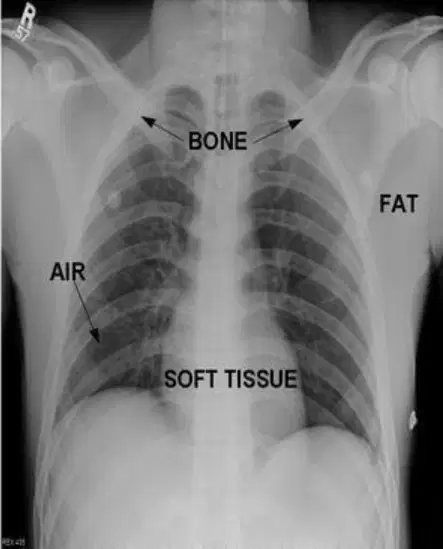
Which of the following x-ray opacities lets x-rays pass through and looks black (such as in lungs or stomach gas)?
Air
Fat
Bone
Metal
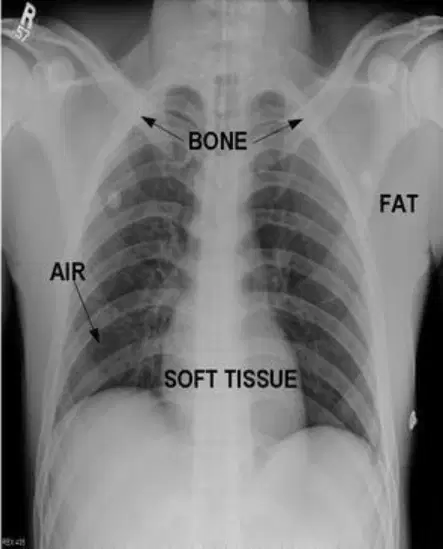
Which x-ray opacity absorbs a little and looks dark gray?
Air
Fat
Bone
Metal
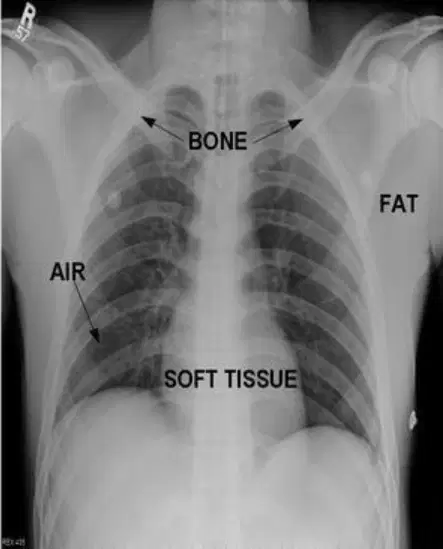
Which x-ray opacity absorbs more and looks light gray (such as muscle or organs)?
Air
Fat
Soft Tissue / Fluid
Metal
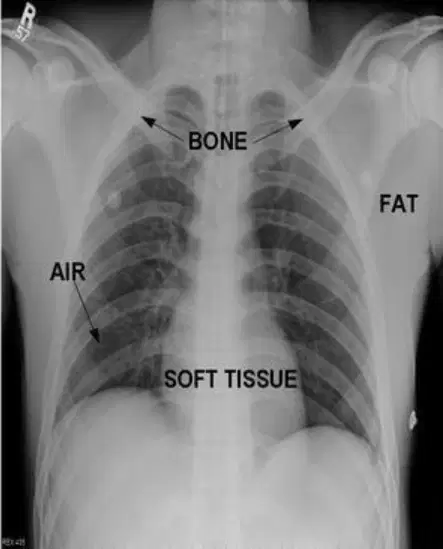
Which x-ray opacity absorbs most and looks white?
Air
Fat
Bone
Metal
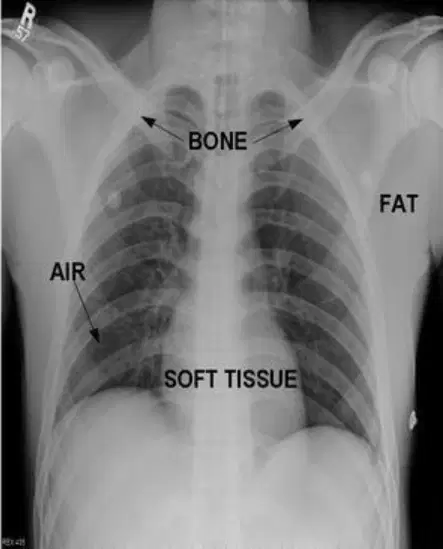
Which x-ray opacity blocks x-rays completely and looks bright white?
Air
Fat
Bone
Metal

Match the following x-ray opacities with their appearance on an x-ray:
Looks black
Air
Looks dark gray
Fat
Looks light gray
Soft Tissue / Fluid
Looks white
Bone
Looks bright white
Metal
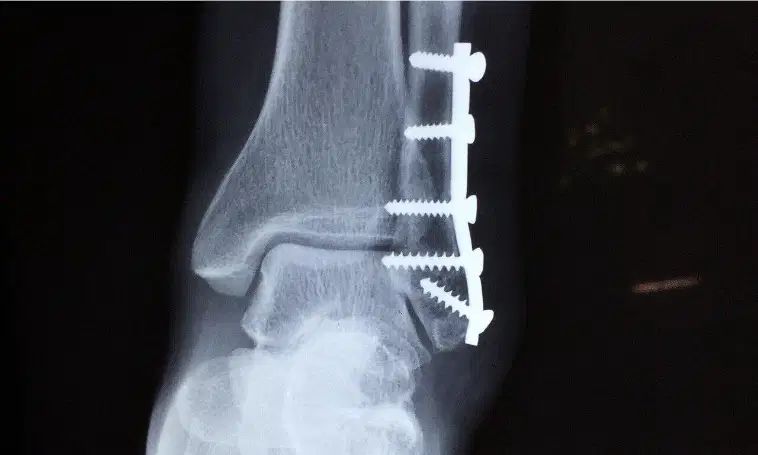
Which of the following statements is true about metal in X-ray imaging?
Metal absorbs a small proportion of the incident x-ray beam.
Metal absorbs, or scatters, a large proportion of the incident x-ray beam.
Metal is depicted on images as dark black.
Metal absorbs less of the incident x-rays than bone.
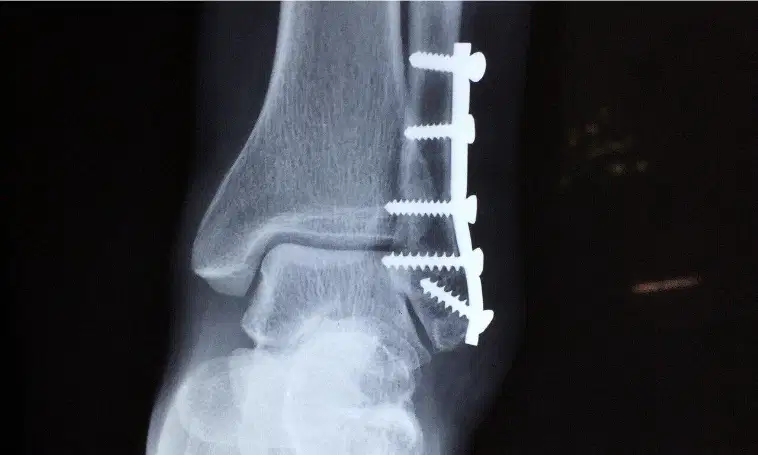
Metal absorbs more of the incident x-rays than bone and therefore, is whiter than bone on the resulting image.
True
False
What does 'opaque (opacity)' mean in the context of x-rays for medical imaging?
An area that allows all x-rays to pass through
An area that absorbed or scattered a large amount of the incident x-ray beam prior to it reaching the detector
An area that reflects x-rays away from the detector
An area that emits x-rays
Based on the resulting gray-scale image on x-ray, which of the following is the correct order from darkest to lightest?
Metal, Bone, Soft Tissue, Fat, Air
Air, Fat, Soft Tissue, Bone, Metal
Fat, Air, Bone, Soft Tissue, Metal
Bone, Metal, Air, Fat, Soft Tissue
What does 'Lucent (lucency)' mean in x-ray medical imaging?
An area where the x-ray beam is blocked
An area where a larger amount of the x-ray beam passes through unimpeded to reach the detector (blacker on the x-ray image)
An area that appears white on the x-ray image
An area with metal
On x-ray imaging, air is described as (a) .

