
Font size
 Worksheets
CBA 2 RETAKE
Total questions: 42
Worksheet time: 1hrs 5mins

Which numbered location on the phylogenetic tree identifies characteristics shared by Species B, C, and D?
Location 1
Location 2
Location 3
Location 4
Fossil records are useful tools in studying how organisms have changed over time. Why then, are fossil records still considered an incomplete record of life’s history?
While there is a sudden explosion of fossil record availability during the Jurassic period, the relative lack of fossil record prior to the era prevents a comprehensive analysis of life’s history.
Due to a heavy level of recent fraudulent activity, scientists have agreed that fossil records are an invalid method to correctly determine life’s history.
Formation of any fossil depends on a precise combination of conditions, which only a
small fraction of organisms meet at any given point in time, while others die without
leaving a trace.
The two main techniques used to determine the age of fossils, relative dating and
radioactive dating, are incompatible with each other and produce contradictory
results.
As one of the evidences of evolution supported by Darwin, structures that have different mature forms but arise from the same embryonic tissues are called:
Upper limb structures
Vestigial structures
Analogous structures
Homologous structures
Birds and reptiles are similar in that they are vertebrates and lay eggs. They differ in that reptiles have teeth and birds have beaks. Some birds do possess teeth. However, these teeth are present only in the embryonic stage. Which conclusion is best supported by the presence of teeth in bird embryos?
A) Birds and reptiles share a common ancestor.
B) Modern reptiles are the ancestors of modern birds.
C) Birds and reptiles eat similar types of food.
D) Ancestors of reptiles had beaks similar to those of birds.

What scientific claim can be made based upon the similarities evident in the larvae of two different species, and what evidence from the images supports this claim?
The similarities suggest a common ancestry, as both larvae share similar structures.
The similarities indicate that the species are identical in all life stages.
The similarities show that the larvae will develop into the same adult species.
The similarities prove that the environment has no effect on development.
The abrupt appearance of new organisms is evidence of an increase in (a) and (b)
Which environmental condition would most likely RESULT in the appearance of punctuated equilibrium in the fossil record?
An environment that remains in a state of stasis
An environment that undergoes steady changes over time
An environment that experiences rapid large-scale destructive change
An environment with many transitional fossils
Looking through the fossil record, there are times when numerous fossils appear suddenly with similar characteristics. What is the BEST explanation for this pattern?
The environment changed very slowly, allowing species to adapt gradually.
The environment remained stable for long periods, so species did not change much.
New species appeared gradually over many generations as the environment slowly changed.
Sudden changes in the environment caused new species to appear quickly.
Farmers spray pesticides on their plants to protect the plants from being eaten by insects. Some individual insects have a genetic mutation that makes them resistant to the toxins in the pesticides. Which statement best describes how only a few resistant individuals resulted in the pesticide becoming ineffective?
The resistant insects change the toxin on the plants, making it safe for others.
The resistant insects grow larger and eat less of the plants.
The resistant insects eat the contaminated surface and leave the rest for others.
The resistant insects are able to survive to reproduce and create a population that is also resistant.
Most deer mice have a dark brown coat of hair and live in forests. But the deer mice in the Nebraska Sand Hills have a lighter brown coat. The difference in the color is due to a single gene. Which reason is least likely for the lighter hair color in the Sand Hills?
The deer mice in the Sand Hills needed a lighter coat to avoid being detected, so they started making a new gene for lighter colored hair.
A gene of a single mouse living in the Sand Hills randomly mutated resulting in lighter colored hair which was less visible to predators in a sandy environment.
The deer mice that first migrated into the Sand Hills had light and dark-haired
varieties, but predators ate less of the mice that blended into their surroundings.
The ancestors of the Sand Hills mice had genes for dark and light hair, but more of
the light brown ones survived after a climate change turned a wooded area into an
arid habitat.

What is the best explanation for the different types of beaks in the finches?
Each species of finch was brought to the islands by explorers over the course of several decades.
The finches are capable of adjusting their beak type depending on what predators are hunting them.
The type of beak on each individual finch depends on what mutations that finch receives during reproduction.
Natural selection caused each species of finch to have the type of beak best suited for survival in its environment.
Blue flying fish live in the upper layers of the ocean. Blue flying fish have enlarged pectoral fins that enable them to glide for 400 meters above the ocean surface and appear to fly. Which statement best describes how natural selection led to enlarged pectoral fins in blue flying fish?
Fish were able to glide out of the ocean and into other bodies of water to mate with other species.
Fish were able to live both on land and in the water as a result of their larger pectoral fins.
Fish with enlarged pectoral fins were able to glide out of the ocean to escape predators, increasing their fitness.
Fish changed their DNA to express enlarged pectoral fins, changing the allele frequency of the population.

The male African long-tailed widowbird, Euplectes progne, has tail feathers about half a
meter long. The males are territorial, each defending a territory of about the same size. The
females build their nest in the territory of their mate and provide food and care for the
young.
A researcher treated the tails of four groups of E. progne males by either clipping their tail
feathers, gluing more feathers to their tail, or both. Each group contained nine E. progne
males. The birds were then released and their territories observed for active nests. The graph
shows a summary of the results.
Based on the graph, which group of E. progne males had the highest mean number of new active nests in their territory after treatment?
Males with a longer tail are better able to defend their territory than males with a
shorter tail.
Males with a longer tail are more capable of finding food than males with a shorter
tail.
Males with a longer tail mate with more females and pass their genes to more
offspring than males with a shorter tail.
Males with a longer tail have more dominant characteristics than males with a
shorter tail.
The apple maggot fly (Rhagoletis pomonella) provides an example of sympatric speciation.
Sympatric speciation occurs without geographic isolation. The apple maggot fly originally laid
its eggs only on hawthorn trees but in the mid-1800s, some flies began laying eggs on apple
trees. Apple trees and hawthorn trees produce fruit at different times of the year. The
population of the flies that preferred hawthorn and those that preferred apples began to
diverge over time.
The shift from hawthorn trees to apple trees contributed to speciation in this population of flies in terms of timing because:
Apple trees fruit earlier than hawthorn trees, causing flies to mate at different times.
Hawthorn trees and apple trees have identical fruiting times, so flies did not change mating times.
Flies on apple trees and hawthorn trees mate at the same time of year.
The shift caused flies to migrate to a new region, not affecting timing.
Darwin’s finches on the Galápagos Islands are often cited as an example of natural selection leading to speciation. These finches evolved different beak shapes suited to the types of food available on different islands. What is the most likely reason that these finch populations developed into distinct species?
Darwin’s finches were selectively bred by humans to produce different beak shapes, resulting in new species.
The finches intentionally chose to adapt their beaks based on their dietary needs.
The finches on all islands were exposed to identical environments, but genetic drift caused them to evolve different traits by chance.
The finches on each island experienced different environmental pressures, leading to adaptations like beak shape that suited their specific food sources.
Cross-pollination of flowers from different populations of the same species will most likely result in —
gene flow as new alleles are introduced
evolution of a different species as alleles mix
hybrid sterility as gametes from different individuals are incompatible
a decrease of genetic variation among individuals

The graph shows a change in population of cacti. What does the number of spines on cacti in a population indicate?
Having more spines in an adaptation, and it increases reproductive fitness.
Having more spines is an adaptation, and it decreases reproductive fitness.
Having more spines is not an adaptation, and it increases reproductive fitness.
Having more spines is not an adaptation, and it decreases reproductive fitness.
As part of a wildlife conservation program, researchers take a small population of wolves and relocate them to an island. After several generations, researchers analyze the genomes of the wolves in the population and determine that there is little genetic variation in the population. Which evolutionary mechanism BEST explains the low level of genetic variation of these wolves?
Gene flow
Founder effect
Mutation
Recombination
A phenotype that improves an organism’s chance of survival in their environment is considered a(n) ____________.
natural selection
adaption
speciation

Many different groups of organisms have wings, even though they do not share a recent common ancestor. This is because they evolved in environments with similar selective pressures. Wings are an example of a(n) ______________ structure.
vestigial
analogous
homologous
Which best describes the phrase survival of the fittest?
strongest in a population are most successful
fastest in a population are most successful
those that can survive and reproduce are most successful
those that can live the longest are most successful
Match the following pictures with the words they represent

Analogous Structure

Homologous Structure

Artificial selection

Natural selection
The female birds of paradise tend to look for the most colorful, best dancing males to make babies together.
Genetic Drift
Non-random mating
Gene flow
Mutation
What is speciation?
when a population reaches a balance and change is no longer occuring
when populations move away from each other
when species begin to pass on acquired traits and change their behavior
when two species can no longer interbreed
There was a forest fire that wiped out birch trees randomly and left a few dispersed throughout the forest. The surviving trees evolve overtime changing the gene pool. This is an example of?
genetic drift
gene flow
bottleneck effect
founders effect
genetic flow
How do populations change due to genetic drift?
A random event occurs that reduces the population, and the new surviving population has a different allele frequency from the original population.
The population undergoes competition with each other for limited resources changing allele frequency from the original population.
The organism/animal with the most favorable trait will be able to produce more offspring than others creating the new population.
organisms within a population undergo symbiotic relationships with each other due to mutations
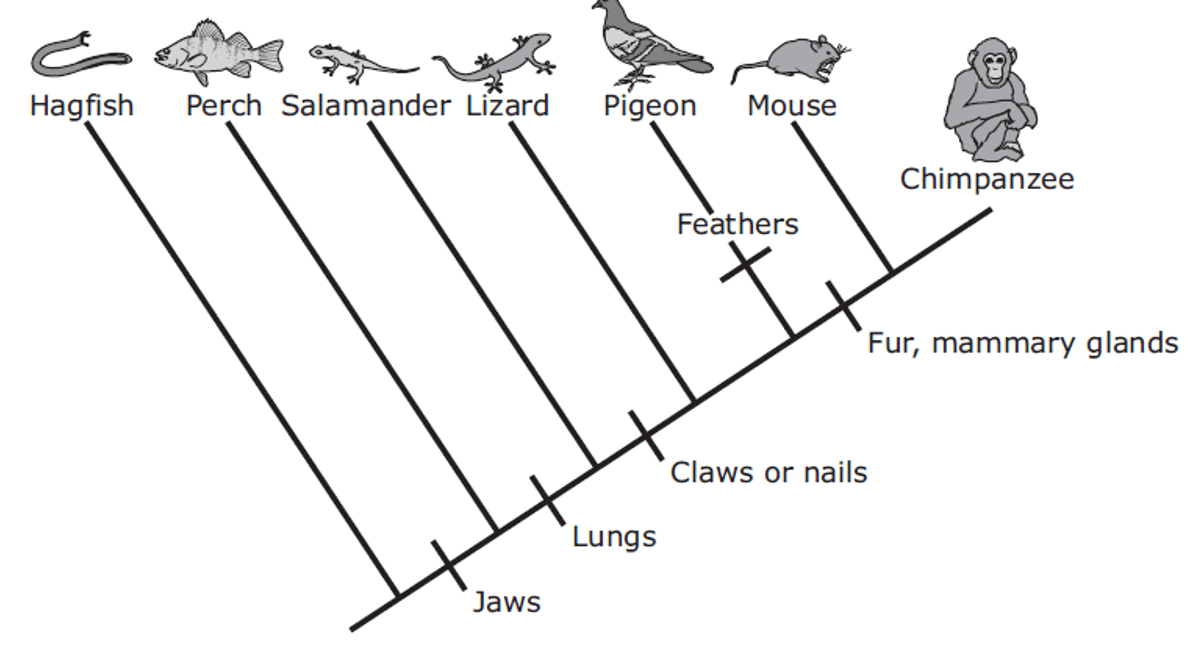
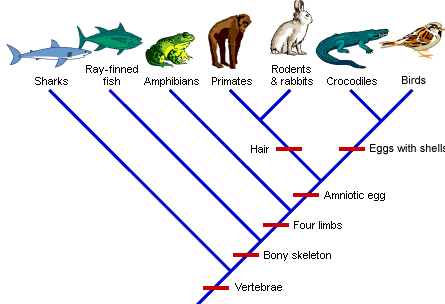
According to this cladogram, sharks are MOST closely related to which organism?
Amphibians
Ray finned fish
Crocodiles
Birds
Unit 8
A cladogram of 5 species is shown.
Looking at the labels in the diagram, highlight the area with the words that identifies what 2 traits the ancestral species most likely had.


The formation of new species is a process known as ____________________, which is typically the product of divergence.
gradualism
speciation
reproductive isolation
subspecies

In this example, the variation is the (a) and the adaptation is the (b) . This is because of the selecting agent, the (c) . Therefore, the short neck giraffes will be (d) . On the other hand, the long neck giraffes will be (e)
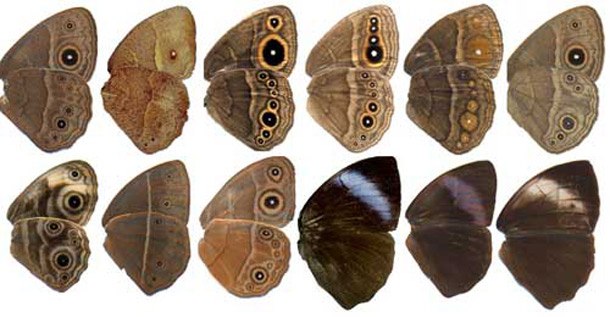
The differences between the wings of these moths, which are all the same species, is an example of (a)
Natural Selection
Variation
Homeostasis
Extinction

Charles Darwin observed that finches of different species on the Galápagos Islands have many similar physical characteristics, this supports the hypothesis that these finches
are twins
acquired traits through use and disuse.
all eat the same type of food.
descended from a common ancestor.
In a population of ladybugs, black bugs are more successful in escaping predators. Overtime, this gene becomes more popular in the population and the ladybug population loses its red color. This is an example of?
Natural Selection
Mutation
Genetic Drift
Gene Flow

