
Font size
 Worksheets
BIOLOGY etc review (exam 3)
Total questions: 121
Worksheet time: 1hrs 5mins
In the chemical reaction sucrose + H2O --> glucose + fructose, what are the reactants?
sucrose and H2O
glucose and fructose
sucrose and glucose
fructose and H2O
In the chemical reaction sucrose + H2O --> glucose + fructose, what are the products?
glucose and fructose
sucrose and water
glucose and sucrose
fructose and water
What is the sum total of all chemical reactions occurring in a biological system at a given time called?
Metabolism
Homeostasis
Diffusion
Osmosis
What are reactions that involve energy changes called?
Metabolic Reactions
Physical Changes
Neutralization Reactions
Displacement Reactions
What is defined as the capacity to do work, or the capacity for change, and can be potential or kinetic?
Energy
Matter
Force
Mass
What type of energy is stored in bonds and is considered potential energy?
Chemical energy
Kinetic energy
Thermal energy
Electrical energy
What type of energy is associated with membrane gradients and is considered potential energy?
Electrical energy
Thermal energy
Mechanical energy
Sound energy
What type of energy is described as 'useful waste products' and is kinetic energy?
Heat
Light
Sound
Chemical
What type of energy is used for photosynthesis and is a form of kinetic energy?
Light energy
Chemical energy
Sound energy
Nuclear energy
What type of energy is involved in muscle movement and can be both potential and kinetic?
Mechanical energy
Thermal energy
Chemical energy
Electrical energy
Fill in the blank: ________ metabolism requires energy and involves converting simple molecules to complex molecules.
Anabolic
Catabolic
Aerobic
Anaerobic
Fill in the blank: An example of anabolic metabolism is the formation of a protein from _________.
Amino Acids
Fatty Acids
Monosaccharides
Nucleotides
Fill in the blank: ________ metabolism releases energy and involves breaking down complex molecules to simple molecules.
Catabolic
Anabolic
Photosynthetic
Synthetic
Fill in the blank: An example of catabolic metabolism is the digestion of carbohydrates, proteins, or ________.
Lipids
Vitamins
Water
Minerals
Energy from catabolic reactions fuels anabolic reactions.
True
False
What does the First Law of Thermodynamics state?
Energy is neither created or destroyed.
Energy can be created from nothing.
Energy is always increasing in the universe.
Energy is only present in living things.
What does the Second Law of Thermodynamics state?
When energy is converted from one form to another, some of that energy becomes unavailable to do work.
Energy can be created or destroyed in any process.
The total energy of the universe is constantly increasing.
All processes occur with 100% efficiency.
What is Entropy (S)?
The measure of the disorder in the system. Energy in a system keeps order, without energy, a system will be randomly disordered. Unusable energy.
The total energy of a system, including kinetic and potential energy.
The amount of heat required to raise the temperature of a substance by one degree Celsius.
The force that holds atoms together in a molecule.
Which law of thermodynamics states that energy is neither created nor destroyed?
First Law
Second Law
Law of Entropy
Law of Conservation
According to the Second Law of Thermodynamics, all energy transformations are 100% efficient and no energy is lost as unusable energy.
True
False
Total energy is called ________ (H).
Enthalpy
Entropy
Gibbs Free Energy
Internal Energy
Change in energy can be measured by which units?
Calories or joules
Meters or liters
Volts or amperes
Pounds or ounces
Usable energy is called ________ (G).
Free Energy
Potential Energy
Activation Energy
Kinetic Energy
At chemical equilibrium, what is the value of ΔG?
Greater than 0
Less than 0
0
Cannot be determined
ΔG values near 0 are characteristic of reactions that are ________ reversible.
readily
never
barely
completely
What is the equation for Gibbs free energy?
ΔG = ΔH + TΔS
ΔG = ΔH - TΔS
ΔG = ΔH × TΔS
ΔG = ΔH / TΔS
If ΔG is negative, what will happen?
A) Energy will be required
B) Energy will be released
C) No reaction will occur
D) Temperature will increase
If there is no energy, a reaction will not occur.
True
False
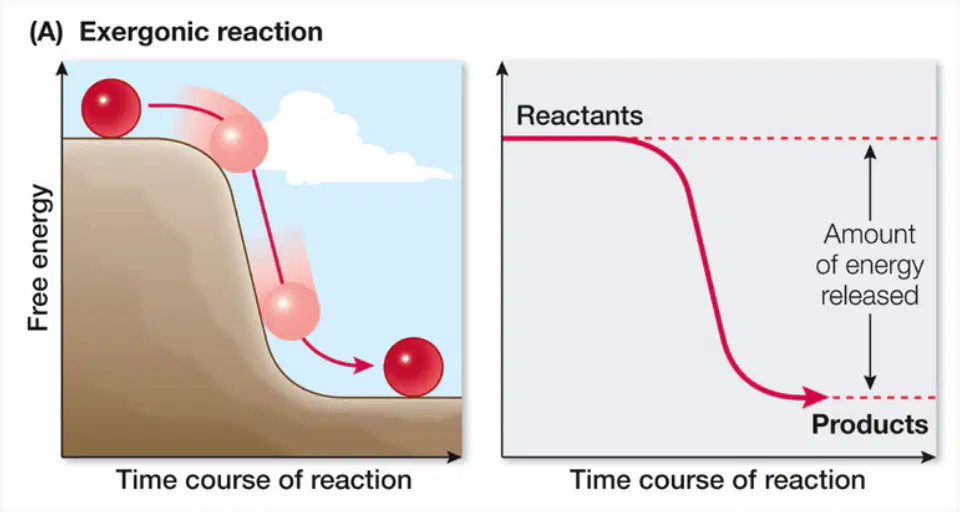
Which of the following best describes an exergonic reaction?
The consumption of free energy (+ΔG)
The release of free energy (-ΔG)
Anabolism: simple to complex
The formation of ATP
Which of the following best describes an endergonic reaction?
The release of free energy (-ΔG)
Catabolism: complex to simple
The consumption of free energy (+ΔG)
The hydrolysis of ATP
Fill in the blank: Catabolism is a process in which ______ molecules are broken down into ______ molecules.
complex, simple
simple, complex
large, larger
simple, smaller
Fill in the blank: Anabolism is a process in which ______ molecules are built from ______ molecules.
complex, simple
simple, complex
large, large
small, complex
The formation of ATP is an endergonic process.
True
False
Which of the following equations represents the formation of ATP?
ATP + H2O --> ADP + Pi + free energy
ADP + Pi + free energy --> ATP + H2O
Glucose + O2 --> CO2 + H2O
ATP --> ADP + Pi
Cells use the energy released by ATP hydrolysis to fuel which type of reactions?
Exergonic
Endergonic
Catabolic
None of the above
What type of reaction is ATP hydrolysis, as shown in the diagram?
Exergonic reaction
Endergonic reaction
Isomerization reaction
Redox reaction
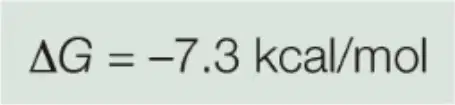
Fill in the blank: The ΔG value for ATP hydrolysis is ______ kcal/mol.
-7.3
+7.3
-3.4
-12.0
Which molecule is formed when glucose undergoes phosphorylation in the presence of energy, as shown in the diagram?
Glucose 6-phosphate (G6P)
Fructose
Sucrose
Ribose

Fill in the blank: The net ΔG for the coupled reactions shown in the diagram is ______ kcal/mol.
-3.3
0.0
+7.3
-10.6
The phosphorylation of glucose to glucose 6-phosphate is an endergonic reaction, as shown in the diagram.
True
False
Catalysts increase the rates of ________ reactions.
chemical
physical
nuclear
mechanical
Catalysts are altered by the reactions they participate in.
True
False
Most catalysts are ________.
proteins
lipids
carbohydrates
nucleic acids
The amount of energy required to start a reaction is called ________ Energy (Ea).
Activation
Potential
Thermal
Kinetic
Where does the activation energy (Ea) required to start a reaction usually come from?
Heating the system
Adding a catalyst
Increasing pressure
Decreasing volume
Enzymes actually ________ the energy barrier needed for a reaction.
lower
increase
maintain
ignore
The 3D shape of an enzyme determines its ________.
specificity
color
mass
temperature
Reactants in enzyme-catalyzed reactions are called ________.
substrates
products
cofactors
enzymes
The active site of an enzyme is where ________ bind.
substrates
products
cofactors
inhibitors
ΔG changes when a catalyst is used in a reaction.
True
False
The final equilibrium of a reaction changes when a catalyst is used.
True
False
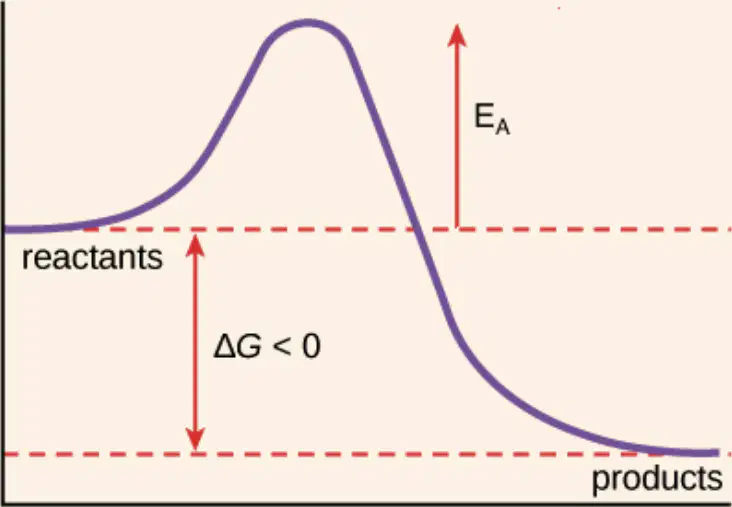
What does the peak of the curve represent in terms of energy?
Activation energy (Ea)
Potential energy of products
Bond energy of reactants
Enthalpy change (ΔH)
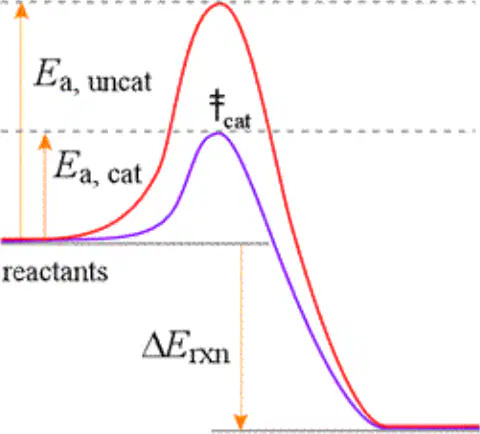
Refer to the second diagram. Which curve represents the catalyzed reaction: the one with lower or higher activation energy?
The curve with lower activation energy represents the catalyzed reaction.
The curve with higher activation energy represents the catalyzed reaction.
Both curves represent the catalyzed reaction equally.
Neither curve represents the catalyzed reaction.
What types of bonds can hold an enzyme-substrate complex together?
hydrogen bonds, electrical attraction, or covalent bonds
peptide bonds, disulfide bridges, or glycosidic bonds
ester bonds, phosphodiester bonds, or metallic bonds
ionic bonds, van der Waals forces, or hydrophobic interactions
Fill in the blanks for the enzyme-substrate reaction: E + S -> __ -> E + __
ES, P
EP, S
ES, S
E, P
To catalyze a reaction, enzymes can: Which of the above are mechanisms by which enzymes catalyze reactions?
Orient substrates so that they can react
Induce strain by stretching substrates, making their bonds unstable
Temporarily add chemical groups
Shape of active site allows a specific substrate to bind: ________
Induced Fit
Lock and Key
Competitive Inhibition
Allosteric Regulation
The concentration of an enzyme is usually _______ than the substrate.
lower
higher
equal
similar
Enzyme activity can be made in two ways: Which of the above are ways enzyme activity can be regulated?
Gene expression - more enzyme molecules are made
Enzymes change shape or are blocked by regulators
Inhibitors are molecules that bind to an enzyme to slow reaction rates.
True
False
Irreversible inhibitors bind to enzymes covalently.
True
False
Name the three types of enzyme inhibitors mentioned in the text.
Competitive, Uncompetitive, Noncompetitive
Allosteric, Covalent, Irreversible
Hydrolytic, Oxidative, Reductive
Substrate, Product, Feedback
What mechanism is illustrated by the enzyme Citrate synthase in the diagram?
Orientation
Physical strain
Chemical charge
Which enzyme is associated with the mechanism of Physical strain as shown in the diagram?
Citrate synthase
Lysozyme
Chymotrypsin
The mechanism of Chemical charge in the diagram is demonstrated by which enzyme?
Citrate synthase
Lysozyme
Chymotrypsin
Refer to the diagram labeled (A) Normal enzyme–substrate binding. What is the role of the substrate in this interaction?
It inhibits the enzyme
It binds to the enzyme's active site
It changes the enzyme's shape
It prevents the enzyme from functioning
Refer to the diagram labeled (B) Competitive inhibition. What is the main characteristic of a competitive inhibitor?
It binds to a different site than the substrate
It has the same shape as the normal substrate
It prevents the substrate from being released
It changes the shape of the enzyme's active site
Refer to the diagram labeled (C) Uncompetitive inhibition. What does an uncompetitive inhibitor do?
Binds to the active site
Prevents normal substrates from being released
Changes the shape of the active site
Has the same shape as the substrate
Refer to the diagram labeled (D) Noncompetitive inhibition. What is the effect of a noncompetitive inhibitor?
It binds to the active site
It prevents the substrate from binding
It changes the shape of the active site (allostery)
It has the same shape as the substrate
Metabolic Pathways: What is the first reaction in a metabolic pathway called?
commitment step
termination step
feedback inhibition
activation energy
Metabolic Pathways: Feedback inhibition occurs when the final product is a ________ inhibitor of the first enzyme, shutting down the pathway. (Fill in the blank)
noncompetitive
competitive
allosteric
irreversible
Metabolic Pathways: Every enzyme is most active at a certain pH and an optimal temperature. Human enzymes are usually adapted to which type of temperatures?
Colder temperatures
Warmer temperatures
Neutral temperatures
Variable temperatures
What is metabolism?
The sum total of all chemical reactions occurring in a biological system at a given time.
The process of converting light energy into chemical energy.
The breakdown of complex molecules into simpler ones.
The synthesis of complex molecules from simpler ones.
Which of the following is an example of potential energy?
Muscle movement
Light for photosynthesis
Chemical bonds
Heat
What type of reaction is the synthesis of sucrose from glucose and fructose?
Catabolic
Anabolic
Exergonic
Metabolic
Which law of thermodynamics states that energy cannot be created or destroyed?
First law
Second law
Third law
Fourth law
What is entropy?
The total energy in a system
The usable energy that can do work
A measure of disorder in a system
The energy required to start a reaction
Which molecule captures and transfers free energy in cells?
ADP
AMP
ATP
Pi
What is the role of enzymes in biochemical reactions?
Increase the activation energy
Decrease the activation energy
Alter the equilibrium of the reaction
Increase the total energy of the reaction
What is the commitment step in a metabolic pathway?
The first reaction
The last reaction
The reaction that releases the most energy
The reaction that consumes the most energy
Which enzyme activity regulation method involves changing the shape of the enzyme?
Gene expression regulation
Competitive inhibition
Allosteric regulation
Feedback inhibition
Which type of reaction releases free energy?
Endergonic (anabolic)
Exergonic (catabolic)
Anabolic
Metabolic
What is the main product of ATP hydrolysis?
ADP and Pi
AMP and Pi
Glucose and Pi
NADPH and Pi
What is the effect of high temperatures on enzyme activity?
Increase activity
Decrease activity
Denature the enzyme
No effect
What is the effect of feedback inhibition on a metabolic pathway?
Speeds up the pathway
Slows down the pathway
Shuts down the pathway
No effect
The very end product of metabolic pathways goes back to the start and inhibits; stops the pathway from happening
(a)
Which process is anaerobic?
Glycolysis
Cellular Respiration
Pyruvate Oxidation
Citric Acid Cycle
What is the NET ATP produced by glycolysis?
8 ATP
4 ATP
6 ATP
2 ATP
Which molecule is a key electron carrier in redox reactions?
NAD+
FAD
ATP
ADP
What is the final electron acceptor in the electron transport chain?
NADH
FADH2
Oxygen
Carbon Dioxide
Where does glycolysis take place?
Mitochondrial matrix
Cytosol
Inner mitochondrial membrane
Intermembrane space
What is the starting point of the citric acid cycle?
Pyruvate
Acetyl CoA
Glucose
NADH
Which process produces lactate as a byproduct?
Glycolysis
Cellular respiration
Lactic Acid Fermentation
Alcoholic fermentation
Which molecule is regenerated to keep glycolysis going during fermentation?
NAD+
FAD
ATP
ADP
Which process occurs in the mitochondrial matrix?
Glycolysis
Pyruvate oxidation
Electron transport chain
Fermentation
What is the role of ATP synthase in oxidative phosphorylation?
Transport electrons
Synthesize ATP
Oxidize NADH
Reduce FADH2
What is the main product of alcoholic fermentation?
Lactate
Glucose
Acetate
Ethanol
Which process yields the most ATP?
Glycolysis
Fermentation
Cellular respiration
Pyruvate oxidation
What is the role of chemiosmosis in oxidative phosphorylation?
Transport electrons
Create a proton gradient
Synthesize ATP
Oxidize NADH
Which molecule is a product of the citric acid cycle?
CO2
Lactate
Glucose
Ethanol
What is the main product of glycolysis?
Pyruvate
Acetate
Lactate
Ethanol
Which process converts light energy to chemical energy as ATP and NADPH?
Calvin cycle
Light-independent reaction
Light reaction
Glycolysis
What is the main pigment involved in photosynthesis?
Chlorophyll a
Carotenoids
Phycobilin
Chlorophyll b
Where do the light reactions take place in the chloroplast?
Stroma
Thylakoid membrane
Cytoplasm
Mitochondrial matrix
What is the product of the Calvin cycle?
ATP
NADPH
Glyceraldehyde 3-phosphate (G3P)
H2O
Which molecule is the carbon dioxide acceptor in the Calvin cycle?
RuBP
G3P
NADPH
ATP
What is the role of accessory pigments in photosynthesis?
Absorb light in other wavelengths
Convert light energy to chemical energy
Transport electrons
Fix carbon dioxide
What is photophosphorylation?
The synthesis of ATP using light energy
The reduction of NADP+ to NADPH
The fixation of CO2 to carbohydrates
The oxidation of water to oxygen
Where does CO2 fixation occur in the chloroplast?
Thylakoid membrane
Stroma
Cytoplasm
Mitochondrial matrix
Which enzyme is the most abundant protein in the world and involved in the Calvin cycle?
Hexokinase
ATP synthase
Rubisco
NADP+ reductase
Which pathway involves storing CO2 in a 4-carbon molecule when stomata are closed?
C3 pathway
C4 pathway
Calvin cycle
Glycolysis
Which molecule is reduced to NADPH in the light reactions?
NAD+
FAD
NADP+
ATP
What is the main product of the light-independent reactions?
ATP
NADPH
Carbohydrates
Oxygen
Can be released by chemical reactions, altering the internal temperature of an organism
(a)
Released during the hydrolysis of polymers
(a)
Captured by pigments in the eye and by plant pigments in photosynthesis
(a)
Helps drive the movement of ions through channels
(a)
Used in muscle movements and movements within cells
(a)
Same shape as normal substrate
(a)
Changes shape of active site (allostery)
(a)
Prevents normal substrates from being released
(a)

