
 Worksheets
🚀Climb the Mountain: 10.28
Total questions: 100
Worksheet time: 1hrs 3mins

Positively RIGHT vs. Negatively WRONG
Classify each of these items as a RIGHT choice or a WRONG choice.
Talking when the Teacher Talks.
Asking Ms. Hickson for Permission to Speak.

Coming to School Everyday.


NOT having a CHARGED Laptop.

Match each of these definitions with its term.
Pure substance made of one type of atom.
element
Two or more different elements chemically combined.
compound
Two or more different substances physically combined.
mixture
Exactly Measurable.
definite
Another term for homogeneous mixture.
solution

Identifying the States of Matter.
Accurately select characteristics of each State of Matter.
Defintion: Definite, Definite
Definition: Indefinite, Definite
Definition: Indefinite, Indefinite
Particles: Packed Close
Movement: Vibrates
Intermolecular Force: Strongest

Temperature: Coolest
Particles: Loosely Touching
Movement: Slide Past One Another
Intermolecular Forces: Medium

Particles: Farthest apart
Movement: Zippy Bumper Cars
Intermolecular Forces: Weakest

Temperature: Warm
Temperature: Hottest
Labeling the Heating Curve.
Indicate the parts of this Heating Curve.
Place your Label on each numbered part.
L -> G (Boiling)
Solid
Liquid
Gas
S -> L (Melting)
Labeling the Cooling Curve.
Indicate the parts of this Cooling Curve.
Place your Label on each numbered part.
L -> S (Freezing)
G -> L (Condensation)
Solid
Liquid
Gas
Labeling the Triple-Point Diagram.
Indicate the parts of this Phase Diagram.
Place your Label on each lettered part.
Solid
Liquid
Triple-Point
Gas
Labeling the State Change Triangle.
Indicate the parts of this State Change Triangle.
Place your Label on each numbered part.
Freezing
Sublimation
Deposition
Boiling/Evaporation
Condensation
Melting

Understanding the Atom's Structure.
Accurately identify the property of each subatomic particle.
Negatively charged subatomic.
e-
Located in the Electron Cloud.
Smallest of the three subatomics.
Positively charged subatomic.
p+
Located in the Nucleus with n0.
Unique to each element.
Neutrally charged subatomic.
n0
Located in the Nucleus with p+.
Does not affect the charge of the Nucleus.

Blue subatomic particle

Green subatomic particle

Red subatomic particle

Match the following.
Subatomic particle with +1 Charge.
Proton
Subatomic particle with -1 Charge.
Electron
Subatomic particle with 0 Charge.
Neutron
Center Region of Atom, Positively Charged.
Nucleus
Outer Region of Atom, Negatively Charged.
Electron Cloud
Match the following.
Center Region of Atom, Positively Charged.
Nucleus
Outer Region of Atom, Negatively Charged.
Electron Cloud
The Number of Protons.
Atomic Number
The amount of Nucleons.
Mass Number
Occurs with different amounts of Neutrons.
Isotope

H2SO4


How many Carbon atoms are in this compound? H2C3O4

Match the term with its meaning.
Subscript
Lowered number in formula, indicates how many of each element is present.
Coefficient
Large number in FRONT of molecule, used as a multiplier.
Chemical Formula
Symbols and subscripts that tell what's in a molecule.
Symbol
The Letter Abbreviation of each Element - starts with a capital letter.
Bond
Interaction between 2 or more Elements' electrons.

Match each of these Transformations of State with its correct State Change.
G → S
Deposition
S → G
Sublimation
G → L
Condensation
L → G
Vaporization
S → L
Melting

Select the State Changes that are Endothermic.
L → G
G → L
S → G
S → L
G → S
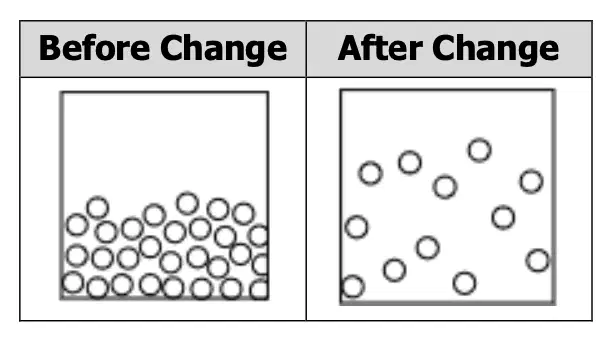
The models imaged show how the spacing between particles changes due to an increase in temperature.
Which statement describes what else occurs to the particles due to the increase in temperature?
The average kinetic energy among the particles increases, and the intermolecular forces become weaker.
The average kinetic energy among the particles decreases, and the intermolecular forces become weaker.
The average kinetic energy among the particles increases, and the intermolecular forces become stronger.
The average kinetic energy among the particles decreases, and the intermolecular forces become stronger.

Match each of these definitions with its term.
Forces of attraction.
Intermolecular Forces
State of Matter, STRONGEST Forces of Attraction.
Solid
State of Matter, WEAKEST Forces of Attraction.
Gas
Pure Substance, 1 Kind of Atom.
Element
Pure Substance, 2 or More Different Atoms.
Compound
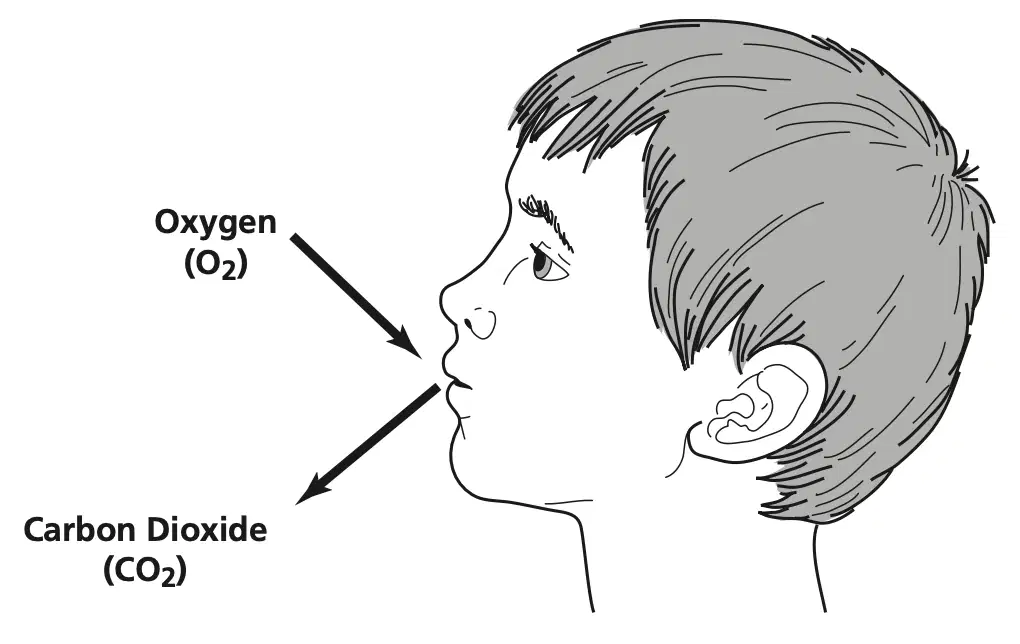
The picture shows gases being inhaled and exhaled.
Which BEST identifies the substances in this picture?
O2 is an element and CO2 is a compound.
O2 is a compound and CO2 is an element.
Both O2 and CO2 are elements.
Both O2 and CO2 are compounds.
Labeling the Metalloids.
Place a dot on each of these 4 Metalloids.
Astatine
Polonium
Boron
Arsenic
Labeling the Metalloids.
Place a dot on each of these 4 Metalloids (start with the higher atomic numbers, so you'll be able to see all 4).
Silicon
Antimony
Tellurium
Germanium
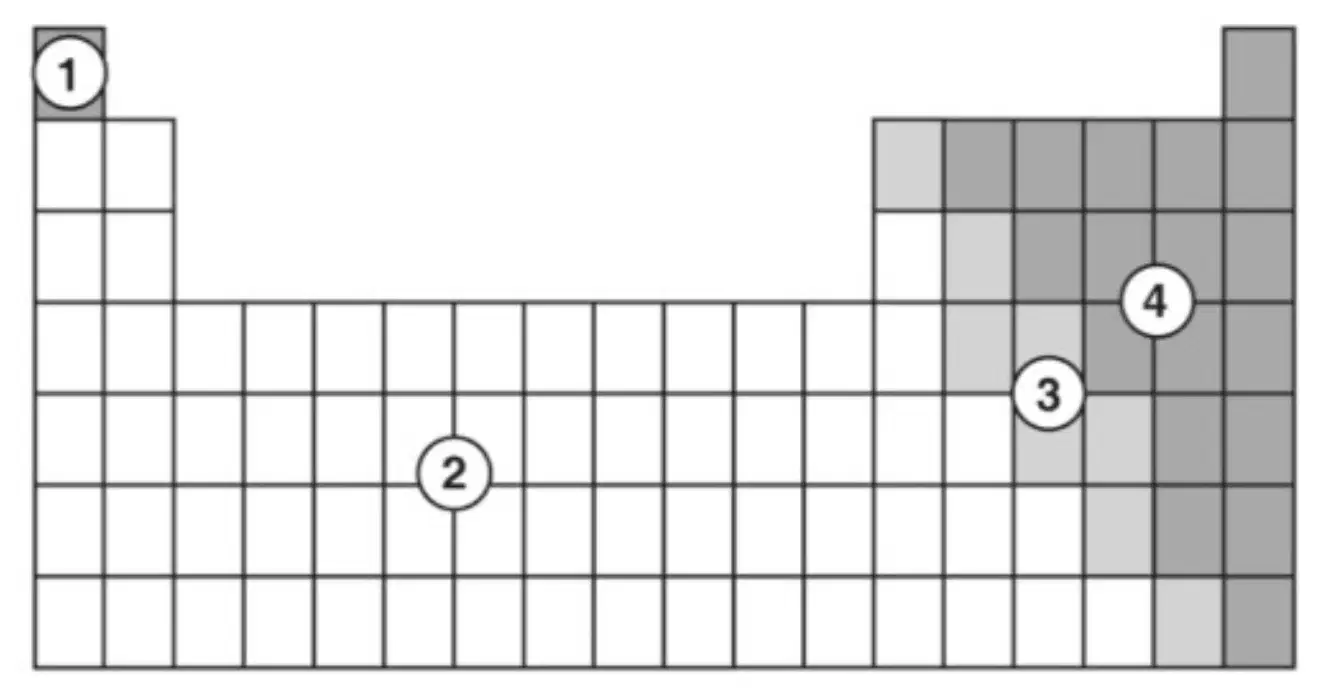
Review this partial periodic table. You are making observations of an unknown metal. In which section of the periodic table should the unknown metal be located?
Section 1
Section 2
Section 3
Section 4

a
b
c
d

a
b
c
d

a
b
c
d

a
b
c
d

Balanced or NOT: 2Al + Fe2O3 → 2Fe + Al2O3
Balanced Equation
NOT Balanced Equation
Balanced or NOT: 2Na2O2 + H2SO4 → 3Na2SO4 + H2O2
Balanced Equation
NOT Balanced Equation

What is the Law of Conservation of Mass?
It states that no matter can be created or destroyed.
It states that no energy can be created or destroyed.
It states that matter can be created or destroyed.
It states that no sound can be created or destroyed.



Match each of these functions with its organelle.
Brain of the cell; controls all cellular functions.
Nucleus
Site of photosynthesis; process that converts carbon dioxide and water to glucose.
Chloroplasts
Detoxifiers of the cell; trashman.
Lysosomes
Jelly of the cell; maintains organelle motility and cellular shape.
Cytoplasm
Powerhouse of the cell; converts cellular food into cellular energy (ATP).
Mitochondria


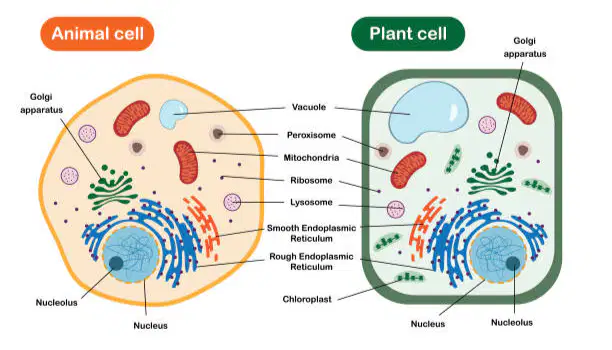


Which of statement best describes the function of the cell membrane?
It allows things to freely enter and exit the cell.
It controls which substances enter and exit the cell.
It prevents substances from entering the cell.
It prevents substances from leaving the cell.

Match each of these functions with its organelles.
Factory that prepares proteins for distribution throughout the cell.
Endoplasmic Reticulum
Located in the center of the nucleus; most concentrated area of DNA.
Nucleolus
Synthesizes proteins.
Ribosomes
Provides structure and supports cellular pressure.
Cell Wall
Flatten-sacs that are packaging agents; shipping proteins and lipids in and out of the cell.
Golgi Body

Which organelles are not present in an animal cell:
A. Cell membrane
B. Chloroplast
C. Cell wall
D. Mitochondria
A and B
B and C
A and D
B and D


Eukaryotic cells can include _______ (Select all that apply).
protists
plants
animals
fungi

Match each term with its correct definition.
Prokaryote
A single-celled organism that does not have a nucleus or membrane-bound organelles.
Eukaryote
Organism made of cells that have nucleus enclosed by membrane.
Cell
Basic building block of living things.
Organism
One individual living thing; anything that can carry out life processes independently.
Organelle
Tiny parts of a cell with a specific function.


Cells with a nucleus and membrane-bound organelles are called _____.

Match each of these organelles with its specific function (job).
Vacuole
Stores water, food and waste
Mitchondria
Converts cell food into cell energy (ATP)
Nucleolus
Location of MOST of cell DNA
Golgi Body
Packages and ships substances in and out of cell
Cell Wall
Provides rigid structure and maintains plant pressure
Match each of these organelles with its specific function (job).
Mitchondria
Converts cell food into cell energy (ATP)
Nucleus
Controls all cell activity
Golgi Vesicles
"Fedex Trucks". Shipper of the substances in and out of cell
Lysosome
Removes waste and toxins from cell
Plasma Membrane
Regulates which substances may come in and out of cell

Determine the number of electrons for these neutral elements.

6

54

22

8

7
Match the following.
Center Region of Atom, Positively Charged.
Nucleus
Outer Region of Atom, Negatively Charged.
Electron Cloud
The Number of Protons.
Atomic Number
The amount of Nucleons.
Mass Number
Occurs with different amounts of Neutrons.
Isotope
Match each of these organelles with its specific function (job).
Vacuole
Stores water, food and waste
Mitchondria
Converts cell food into cell energy (ATP)
Nucleolus
Location of MOST of cell DNA
Golgi Body
Packages and ships substances in and out of cell
Cell Wall
Provides rigid structure and maintains plant pressure

Match each term with its correct definition.
Thylakoids
Flat sacs inside chloroplast
Cristae
Zig-zag folds of the mitochondria
Photosynthesis
Process of converting sunlight to plant food
Cytoplasm
Jelly of cell; Maintains pressure and allows organelles to move
ATP
Cellular energy molecule
Match each of these organelles with its specific function (job).
Mitchondria
Converts cell food into cell energy (ATP)
Nucleus
Controls all cell activity
Golgi Vesicles
"Fedex Trucks". Shipper of the substances in and out of cell
Lysosome
Removes waste and toxins from cell
Plasma Membrane
Regulates which substances may come in and out of cell
Which statement is part of the cell theory?
All cells react to stimulus
The cell is the basic unit of all organisms
The cell can be large or small
The cell is either prokaryotic or eukaryotic
Which statement is part of the cell theory?
All cells can reproduce
All organisms are either unicellular or multicellular
All organisms are made of 1 or more cells
All cells grow and develop
Which statement is part of the cell theory?
All cells come from existing cells
All cells are prokaryotic or eukaryotic
All cells can make a tissue
All cells grow and develop

Match each of these organelles with its relatable role.
Lysosome
Trashman
Nucleus
Mayor
Vacuole
Ziploc Bag
Cell/ Plasma Membrane
Doorman
Golgi Body
Fedex Shipper
Match each of these organelles with its relatable role.
Ribosomes
Small Protein Factory
Cytoplasm
Jelly
SER
Factory for Lipids
Cell/ Plasma Membrane
Doorman
Golgi Body
Fedex Shipper
Labeling Plant Cell.
Place a DOT on the organelle.
Ribosomes
Cell Wall
Cell/Plasma Membrane
Central Vacuole
Chloroplast
Labeling the Animal Cell.
Place a dot on the organelle.
RER
SER
Nucleolus
Nucleus
Cytoplasm
Golgi Body
Labeling the Animal Cell.
Place a dot on the organelle.
RER
SER
Nucleolus
Nucleus
Cytoplasm
Golgi Body
Labeling the Animal Cell.
Place a dot on the organelle.
Plasma Membrane
Lysosome
Mitochondria
RER
SER
Nucleolus
Labeling the Animal Cell.
Place a dot on the organelle.
Plasma Membrane
Lysosome
Mitochondria
RER
SER
Nucleolus
Labeling Plant Cell.
Place a DOT on the organelle.
Ribosomes
Cell Wall
Cell/Plasma Membrane
Central Vacuole
Chloroplast


The largest division used to classify living things
Class
Domain
Genus
Species

What is the order of the taxonomic levels from least specific to most specific?
Kingdom, Family, Species, Order, Class, Phylum, Genus
Kingdom, Phylum, Class, Order, Family, Genus, Species
Species, Order, Kingdom, Family, Genus, Phylum, Class
Species, Genus, Family, Order, Class, Phylum, Kingdom

Match each of these terms with its definition.
Domain
Highest Taxonomic Ranking; Most Biodiversity
Kingdom
Taxonomic Ranking that comprises Domain
Genus
Taxonomic Ranking above Species; First part of Binomial Nomenclature
Species
Smallest Taxonomic Ranking; Least Biodiversity
Scientific Name
Two-Part Name; Provides each organism with unique name

Which of these statements is true (Select all that apply)?
Scientific name has two parts.
Organisms in the same genus can mate and produce fertile offspring.
Scientific names are unique to each organism.
Scientific names are made of domain and kingdom.
Scientific names are made of genus and species.

Balanced or NOT:
Balanced
NOT
Match each of these functions with its organelle.
Brain of the cell; controls all cellular functions.
Nucleus
Site of photosynthesis; process that converts carbon dioxide and water to glucose.
Chloroplasts
Detoxifiers of the cell; trashman.
Lysosomes
Jelly of the cell; maintains organelle motility and cellular shape.
Cytoplasm
Powerhouse of the cell; converts cellular food into cellular energy (ATP).
Mitochondria

A rock with the mass of 60 g is broken into 2 pieces. What are possible masses for the two pieces of rock?

What is the minimal goal accuracy (WITH COMPLETION OF THE TASK) for all homework assignments?
80%
34%
85%
50%
Match each of these organelles with its specific function (job).
Mitchondria
Converts cell food into cell energy (ATP)
Nucleus
Controls all cell activity
Golgi Vesicles
"Fedex Trucks". Shipper of the substances in and out of cell
Lysosome
Removes waste and toxins from cell
Plasma Membrane
Regulates which substances may come in and out of cell

What is #6?
Plasma membrane
Ribosomes
Centriole
Chloroplast
Mitochondria

What is #5?
Cell wall
Cell membrane
Mitochondria
Chloroplast
What is #11?
Golgi bodies
smooth endoplasmic reticulum
rough endoplasmic reticulum
Nucleus
Nucleolus

Place these Hierarchical Levels in order, from MOST members to LEAST members.
Kingdoms
Phylum
Family
Genus
Species

What is #3?
Central vacuole
Nucleus
Nucleolus
Cytoplasm
Match each of these organelles with its specific function (job).
Vacuole
Stores water, food and waste
Mitchondria
Converts cell food into cell energy (ATP)
Nucleolus
Location of MOST of cell DNA
Golgi Body
Packages and ships substances in and out of cell
Cell Wall
Provides rigid structure and maintains plant pressure
Match each of these terms with its correct definition.
ATP
Energy Molecule of the cell
Homeostasis
Maintenance of the internal environment
DNA
Blueprint of creation for the cell
Internal
Means "inside"
Chloroplast
Location of photosynthesis
What is #3?
Plasma membrane
Ribosome
Centriole
Chloroplast
Mitochondria

