
 Worksheets
GC solar systems Motions*
Total questions: 130
Worksheet time: 1hrs 5mins
Which statement best describes the Celestial Sphere as presented in the lesson?
A solid dome covering Earth where stars are attached
A model used to represent the real sky with the Earth at the center
A physical boundary between Earth and outer space
What is the Zenith in the Celestial Sphere model?
The point on the horizon due west
The noon meridian line
The point directly above an observer on Earth
Which definition correctly matches Altitude?
Angular distance above the horizon measured in degrees
The boundary between the sky and Earth
The observer’s meridian at noon
Azimuth is measured from which reference direction and in which manner?
From North, clockwise
From East, counterclockwise
From West, clockwise
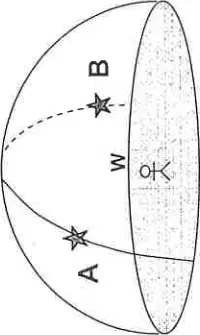
According to the example diagram, what are the altitude and azimuth of Star A?
Altitude = 45°, Azimuth = 120°
Altitude = 15°, Azimuth = 310°
Altitude = 60°, Azimuth = 90°
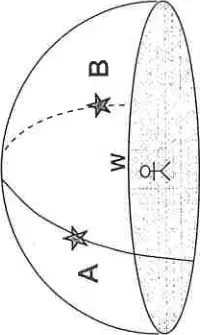
According to the example diagram, what are the altitude and azimuth of Star B?
Altitude = 45°, Azimuth = 120°
Altitude = 15°, Azimuth = 310°
Altitude = 75°, Azimuth = 45°
Altitude = 15°, Azimuth = 120°
Which statement about Earth’s rotation is correct based on the material?
Earth rotates counterclockwise once every 24 hours
Earth revolves counterclockwise once every 24 hours
Earth’s rotation rate varies with the seasons
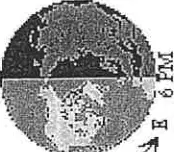
What is Earth’s rate of rotation expressed in degrees per hour?
1°/hour
12°/hour
15°/hour
What is the best definition of revolution as used in Earth science?
The spinning of Earth on its axis
The orbiting of one celestial object around another
The tilting of Earth's axis relative to its orbit
According to the material, how long does it take Earth to complete one full revolution around the Sun?
24 hours
30 days
365 days (about 1 year)
What is the stated rate of Earth's revolution around the Sun?
15° per hour
1° per day
23.5° per day
360° per day
As Earth revolves around the Sun during the year, why do the constellations visible at night change?
Constellations move rapidly through space
Earth's nighttime side faces different directions in space during its orbit
The Moon blocks certain constellations each month
Which observation about the Big Dipper is emphasized in the material?
It is visible all night at the equator
Its position in the sky changes in a yearly cycle
It disappears during summer
Which pair correctly matches a cause and an effect of Earth's revolution described in the material?
Cause: Earth's revolution; Effect: changing constellations at night over the year
Cause: Moon's revolution; Effect: leap years
Which factor primarily causes Earth’s seasons as it revolves around the Sun?
Earth’s axial tilt of about 23.5°
Variations in Sun’s energy output
What does the phrase parallelism of the axis mean in the context of seasons?
Earth’s axis flips direction every six months
Earth’s axis always points in the same direction in space during its revolution
Earth’s axis points toward the Sun only in June
During June in the Northern Hemisphere, which condition is most accurate?
The Sun’s direct rays are over the Tropic of Capricorn, giving shorter days
The Northern Hemisphere is tilted toward the Sun, producing longer days
The Earth is closest to the Sun, causing warmer temperatures
Which date pair best represents an equinox when day and night are approximately equal?
June 21 and December 21
March 21 and September 23
January 3 and July 4
According to the concept of circumpolar constellations, how does the Big Dipper appear from New York State?
It is always above the horizon and circles around Polaris
It appears only at midnight
Because Earth’s axis is tilted by about 23.5°, what happens to the daylight length at different locations throughout the year?
Daylight length stays constant everywhere
Daylight length varies with the seasons
Daylight length only changes at the equator
Only the Northern Hemisphere experiences daylight changes
In the Northern Hemisphere, which season occurs when the Sun’s direct rays are in the Southern Hemisphere?
Summer
Autumn
Winter
Spring
Which statement correctly connects Earth’s revolution and rotation to seasonal change?
Seasons are caused by Earth’s rotation once every 24 hours
Seasons result from Earth’s revolution around the Sun combined with its tilted, parallel axis
Seasons occur because Earth’s orbit is a perfect circle
Seasons are produced by changes in the Sun’s brightness across the year
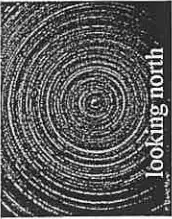
When observing star trails while facing north in the Northern Hemisphere, what pattern is typically seen?
Straight lines rising in the east and setting in the west
Concentric circles centered near Polaris
Random zigzag paths across the sky
Vertical lines that move only upward
Which statement best explains why stars appear to move across the night sky over a single night?
Earth revolves around the Sun once per year
Earth rotates on its axis once every 24 hours
Stars orbit Earth once per day
The Moon’s gravity pulls stars across the sky
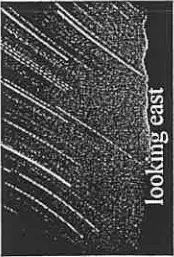
Looking east, how do star trails typically appear in a long-exposure photograph?
Arcs curving upward from the horizon
Concentric circles around a point on the eastern horizon
Straight vertical lines
Arcs curving downward toward the horizon
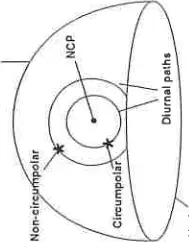
What are circumpolar stars?
Stars that cross the meridian at midnight
Stars that never rise or set and are always above the horizon
Stars visible only during certain seasons
Stars that are visible only from the equator
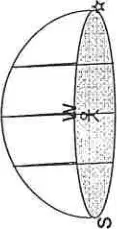
Which location has no circumpolar stars according to the material?
North Pole (90° N)
New York (~43° N)
Equator (0°)
South Pole (90° S)
How does the number of circumpolar stars change with latitude in the Northern Hemisphere?
It stays the same at all latitudes
It increases as you move from the equator toward the North Pole
It decreases as you move toward higher latitudes
It is greatest near 30° N and least at the poles
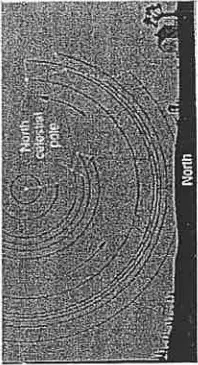
Which statement about Polaris in the Northern Hemisphere is supported by the diagrams?
Polaris rises and sets like other stars
Polaris is located near the center of circular star trails
Polaris is directly overhead at the equator
Polaris is below the horizon at 43° N
Which observation describes retrograde motion as used to support Earth's rotation?
A planet’s daily rising and setting due to Earth’s spin
A planet’s backward (westward) motion against the background stars
The Moon’s phases over a month
Seasonal changes in daylight length
According to the description of retrograde motion, why did early models need to account for it?
It showed planets moved in perfectly circular orbits around Earth
It made planets appear to wander against background stars
It proved the Sun orbited Earth once per day
It explained eclipses of the Sun and Moon
What key idea does the Foucault Pendulum demonstrate about Earth's rotation?
The pendulum’s plane of swing appears to change because Earth rotates beneath it
The pendulum’s period increases as seasons change
In the Foucault Pendulum evidence, which statement is emphasized?
The pendulum’s plane of swing does not change direction
The pendulum is pushed by winds to rotate
What is the Coriolis Effect as described in the material?
A change in star color due to motion
The apparent curved paths of projectiles, winds, and ocean currents because Earth rotates beneath them
The bending of light in Earth’s atmosphere
A force that increases gravity at the poles
In which direction do paths appear to curve in the Northern Hemisphere due to the Coriolis Effect?
To the left
To the right
Toward the equator
Toward the poles
In which direction do paths appear to curve in the Southern Hemisphere due to the Coriolis Effect?
To the right
To the left
Toward the equator
Toward the poles
Which combination best lists the three lines of evidence for Earth’s rotation presented together in this section?
Moon phases, eclipses, and tides
Retrograde motion, Foucault Pendulum, and Coriolis Effect
Seasons, star colors, and plate tectonics
Auroras, earthquakes, and volcanoes
Which statement best explains why one half of Earth experiences daylight while the other half experiences night at any moment?
Earth revolves around the Sun in an elliptical orbit
Earth’s rotation causes one half to be lit by the Sun while the other half is in shadow
Cloud cover blocks sunlight from reaching half of Earth
At approximately what local time is the Sun highest in the sky (solar noon) according to the material?
6 a.m.
12 noon
6 p.m.
12 midnight
According to the diagram of a day-and-night clock, which time corresponds to the Sun being near the eastern horizon just after sunrise?
6 a.m.
10 a.m.
2 p.m.
8 p.m.
What is the term for the apparent path the Sun follows across the sky?
Equator
Meridian
Ecliptic
Celestial pole
How fast does the Sun appear to move across the sky due to Earth’s rotation?
1 degree per minute
15 degrees per hour
360 degrees per day only during summer
Which statement about the Sun’s position at solar noon is supported by the material for the local region shown?
The Sun is directly overhead at solar noon
The Sun is always due south at solar noon
The Sun is always due north at solar noon
The Sun rises due north and sets due south
What causes the Sun’s rising and setting positions to change during different seasons?
Changes in Earth’s distance from the Sun
Earth’s tilt on its axis
Variations in the Sun’s energy output
Daily weather patterns
Which observation about the apparent motion of stars is illustrated by circular star trails around a point in the sky?
Stars appear to circle around the celestial pole due to Earth’s rotation
Star trails show the actual orbits of stars around Earth
Stars remain fixed and do not show any trails in long-exposure images
Which statement best describes the geocentric model presented in the lesson?
Earth is at the center and the Sun, Moon, and stars revolve around Earth.
The Sun is at the center and the stars orbit the Sun.
Earth orbits the Moon while the Sun is fixed far away.
In the geocentric system, epicycles were introduced primarily to account for which observed phenomenon?
Phases of the Moon
Retrograde motion of planets
Solar eclipses
According to the material, which observation the geocentric model cannot explain?
Day and night on Earth
Seasons
Foucault pendulum demonstrating Earth’s rotation
Tides
Which feature is central to the heliocentric model described in the lesson?
Earth is stationary at the universe’s center.
The Sun is at the center of the solar system and planets revolve around it.
Stars orbit Earth on deferents.
Planets move on epicycles around Earth.
What does the term deferent refer to in the geocentric framework shown?
The large circle around which an epicycle’s center moves
The path of Earth around the Sun
A fixed point off-center used by Copernicus
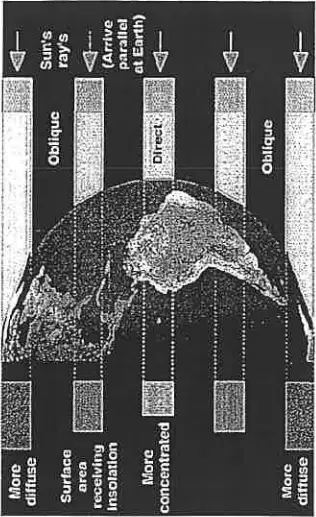
Which statement best describes how Earth's shape affects insolation?
Because Earth is spherical, sunlight strikes different latitudes at different angles, changing intensity.
Because Earth is flat, all places receive the same angle of sunlight.
Earth’s oval shape makes the Sun closer in winter than in summer.
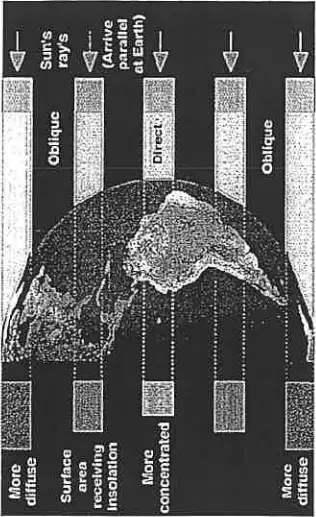
At low latitudes, what is the typical angle and intensity of insolation?
High angle, high intensity
Low angle, high intensity
High angle, low intensity
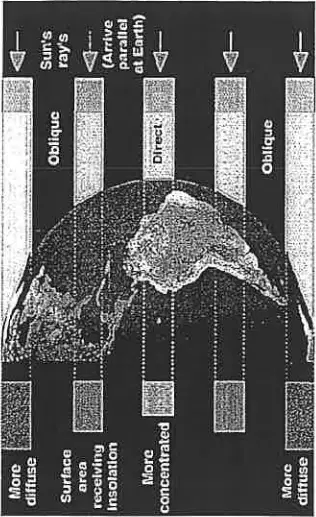
What happens to the angle and intensity of insolation as latitude increases from the equator toward the poles?
Angle increases and intensity increases
Angle increases and intensity decreases
Angle decreases and intensity decreases
Angle decreases and intensity increases
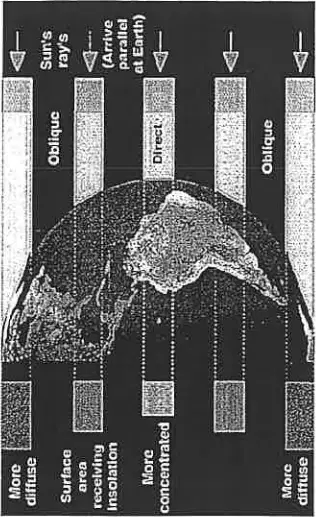
Which term describes sunlight that hits Earth at a low angle, spreading energy over a larger area?
Direct rays
Diffuse rays
Oblique rays
Refracted rays
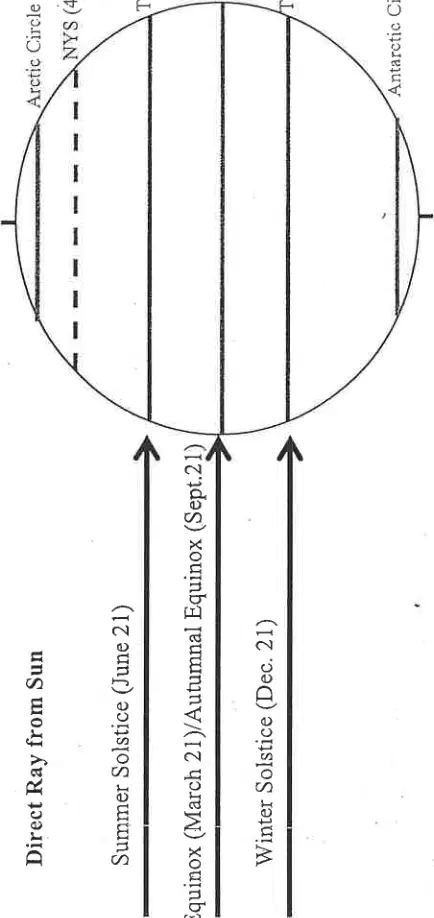
On which date does the direct ray from the Sun strike the equator, marking an equinox?
June 21
December 21
March 21 or September 21
July 4
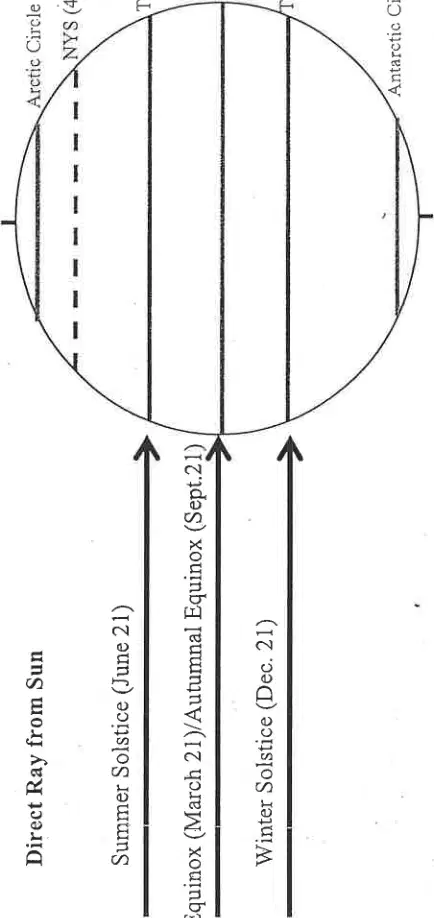
Which latitude line is located at approximately 23.5° N?
Arctic Circle
Tropic of Cancer
Equator
Tropic of Capricorn
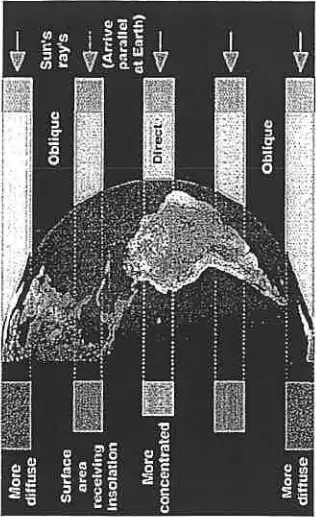
High latitudes are most accurately characterized by which combination?
High angle, high intensity
Low angle, low intensity
High angle, low intensity
Low angle, high intensity
Which time of day typically has the greatest intensity of insolation at a location?
Sunrise
Mid-morning
Noon
Late afternoon
According to the relationship between Sun height and shadows, when are shadows the shortest?
When the Sun is lowest in the sky
When the Sun is highest in the sky
At midnight
During sunset
What does duration of insolation describe?
How strong the Sun’s rays are at noon
How long the Sun is above the horizon
How fast Earth rotates
How much heat is stored in oceans
On days when the Sun is high in the sky and the days are long, what kind of days result?
Cold days
Warm days
Windy days
Cloudy days
On days when the Sun is low in the sky and the days are short, what kind of days result?
Warm days
Cold days
Stormy days
Which statement best describes temperature lag as explained in the section?
Maximum temperature occurs exactly at the time of maximum insolation
Maximum and minimum temperatures occur after the times of maximum and minimum insolation because the surface keeps heating or cooling until energy in equals energy out
During the year in the Northern Hemisphere, when does maximum insolation occur and when are the warmest days typically experienced?
Max insolation in June; warmest days in July
Max insolation in March; warmest days in April
Max insolation in September; warmest days in October
Which statement about energy gain and loss best explains why late afternoon is usually cooler than mid-afternoon?
After noon, the amount of energy received is less than the amount of energy lost, so temperature decreases
After noon, the Sun is closer to Earth, so temperature decreases
After noon, Earth rotates faster, causing cooling
At high latitudes, how does the Sun’s apparent height in the sky generally compare between summer and winter?
Higher in summer and lower in winter
Higher in winter and lower in summer
Same height year-round
Which statement best describes the Sun’s apparent path at the equator across seasons?
Always low in the sky throughout the year
Always high in the sky throughout the year
High in summer only, low in winter
During the summer solstice in the Northern Hemisphere, the Sun’s direct rays are located at which latitude?
Tropic of Capricorn (23.5° S)
Tropic of Cancer (23.5° N)
During the winter solstice in the Northern Hemisphere, where do the Sun’s direct rays strike?
Equator (0°)
Tropic of Cancer (23.5° N)
Tropic of Capricorn (23.5° S)
Arctic Circle (66.5° N)
On the equinoxes, which sunrise and sunset directions are correctly paired for a Northern Hemisphere observer?
Rises NE, sets SW
Rises E, sets W
Rises SE, sets NW
Rises due N, sets due S
Which choice correctly compares noon Sun altitude and shadow length between summer and winter for a mid‑latitude Northern Hemisphere location?
Higher noon Sun and shorter shadows in summer
Same noon Sun altitude and equal shadows year‑round
As the year progresses from June 21 to December 21, how do the Sun’s direct rays migrate?
From the Tropic of Capricorn to the Tropic of Cancer
From the Equator to the Arctic Circle
From the Tropic of Cancer to the Tropic of Capricorn
Remain fixed at the Equator
At a mid‑latitude Northern Hemisphere site, which season has the shortest period of daylight and the Sun rising the farthest southeast?
Summer
Winter
Spring
Fall
According to Kepler's First Law, what is the general shape of a planet’s orbit around the Sun?
Circle
Ellipse
Parabola
Straight line
Which definition best matches orbital eccentricity as presented: E = d/L equals what ratio?
Distance between a focus and the center divided by orbital period
Distance between foci divided by length of major axis
Length of minor axis divided by length of major axis
As the distance between the foci of an ellipse increases while the major axis length stays the same, how does the ellipse change?
It becomes more circular
It becomes more oval (more elongated)
Its area stays the same and shape does not change
It becomes a straight line
Which labeled eccentricity value corresponds to a perfect circle?
E = 0.0
E = 0.25
E = 0.5
What does E = 1.0 represent in the context of orbital shapes shown?
A circle
A highly elongated ellipse
A parabola
A straight line (degenerate ellipse)
Kepler's Second Law states that a planet sweeps out equal areas in equal times. What consequence does this have for a planet’s speed?
Speed is fastest at perihelion and slowest at aphelion
Speed is fastest at aphelion and slowest at perihelion
Speed is random and unrelated to position
Which statement about gravity in the section is supported by the notes?
Only large objects have gravity
All objects have mass and therefore gravity
Gravity depends only on temperature
Why does a planet move fastest when it is closest to the Sun, according to the material?
Because the gravitational force of the Sun is greater at smaller distances
Because the planet gains mass near the Sun
Because the orbit becomes circular near perihelion
According to Kepler's Third Law (Orbital Periods), how does the orbital period of a planet change with its distance from the Sun?
It increases as distance increases
It stays constant regardless of distance
Which group is correctly identified as terrestrial planets?
Mercury, Venus, Earth, Mars
Jupiter, Saturn, Uranus, Neptune
Earth, Jupiter, Saturn, Mars
Mercury, Earth, Jupiter, Neptune
Which characteristic best distinguishes Jovian planets from terrestrial planets?
They are small and rocky
They are close to the Sun
They are large, low density, gas giants
They have no moons
Based on the summary, which statement about orbital speed is correct?
Planets farther from the Sun have faster orbital speeds
Planets closer to the Sun have slower orbital speeds
Planets closer to the Sun have faster orbital speeds
Which planet is not a Jovian planet?
Jupiter
Saturn
Mars
Neptune
From the solar system data and classifications, which planet type typically has many moons and rings?
Terrestrial planets
Jovian planets
Dwarf planets
Which description matches terrestrial planets according to the section?
Large, mostly hydrogen and helium, far from the Sun
Small, rocky, dense, close to the Sun
Low density, slow rotation
Many moons and rings
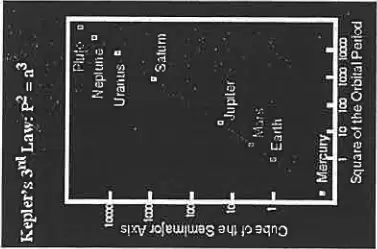
The graph of Kepler's 3rd Law relates which two quantities on its axes?
Orbital speed and planet mass
Cubic of the semimajor axis and square of the orbital period
Planet diameter and distance from the Sun
Number of moons and orbital speed
Which group of planets rotates relatively slowly?
Terrestrial planets
Jovian planets
Both groups rotate at the same rate
Which statement aligns with the section’s summary of orbital periods?
Closer planets have longer orbital periods
Farther planets have longer orbital paths and periods
What is the primary cause of tides on Earth as described in the lesson?
Wind-driven currents in the oceans
The Moon’s gravitational pull as it revolves around Earth
Earth’s rotation causing water to slosh
Volcanic activity on the seafloor
If there were no Moon (or Sun), what would be true about ocean water height on Earth?
It would form a permanent bulge on one side
It would be the same height everywhere at all times
It would rise and fall only once per year
Why does a water bulge also occur on the side of Earth opposite the Moon?
Because the Sun pulls harder there
Due to centrifugal force from the Earth–Moon system
Because mountains block water on the near side
Due to heating by the Sun
During which lunar phases do Spring Tides occur, producing the highest high tides and the lowest low tides?
First Quarter and Third (Last) Quarter
New Moon and Full Moon
Waxing Crescent and Waning Crescent
Only during eclipses
What causes Spring Tides to be stronger than average?
The Sun’s gravitational pull adds to the Moon’s in the same direction
Earth’s rotation stops temporarily
Centrifugal force is reduced to zero
The Moon is farther from Earth
Neap Tides occur when which relationship between the Sun and Moon is true?
They are aligned in a straight line
They are at a right angle to each other’s pull
The Moon is directly overhead at the equator
During Neap Tides, what is observed about the tidal range?
It is the greatest of the month
There is no change in sea level
The difference between high and low tide is minimized
Only one high tide occurs
Which location is highlighted as an example of dramatic tides in the material?
Gulf of Mexico, USA
Bay of Fundy, Nova Scotia, Canada
Mediterranean Sea, Europe
Great Barrier Reef, Australia
What is an eclipse in astronomy?
The brightening of a star due to a planet
The blocking of one celestial body by another
A change in the Moon’s phases
During which lunar phase does a lunar eclipse occur?
New Moon
First Quarter
Full Moon
Which shadow region produces a partial eclipse?
Antumbra
Penumbra
In a total lunar eclipse, what color can the Moon appear and why?
Blue, due to scattering by Earth’s oceans
Deep red, due to sunlight refracted through Earth’s atmosphere
White, because it reflects full sunlight
Green, from auroras reaching the Moon
Which alignment is required for a solar eclipse to occur?
Sun–Earth–Moon
Earth–Sun–Moon
Sun–Moon–Earth
Moon–Sun–Earth
What condition allows a total solar eclipse to happen?
The Moon is near its closest distance to Earth and appears the same angular size as the Sun
The Moon is far from Earth and appears smaller than the Sun
It is always possible at any New Moon regardless of distance
It only occurs during a Full Moon
Which term refers to the darkest central part of a shadow during an eclipse?
Corona
Umbra
Penumbra
Terminator
What is seen during a partial solar eclipse?
A ring of sunlight around the Moon
A larger, fainter penumbral shadow hits Earth
Why doesn’t an eclipse occur at every New Moon and Full Moon?
Earth’s rotation is too fast
The Moon’s orbit is tilted so its shadow usually passes above or below Earth
The Sun’s brightness varies
Clouds usually block the view
When does an annular solar eclipse occur?
When the Moon is too far from Earth to completely block the Sun, leaving a ring
When the Moon is at perigee and covers the Sun entirely
During a Full Moon
When Earth passes into the Moon’s umbra
Which phase is required for any solar eclipse (total or annular)?
First Quarter
New Moon
Full Moon
Third Quarter
Which statement about the Moon’s motion explains why we always see the same lunar face from Earth?
The Moon does not rotate
The Moon’s rate of rotation equals its rate of revolution around Earth
The Moon rotates twice as fast as it orbits
The Moon keeps one side dark permanently
According to the seasonal summary, on the Vernal Equinox (Mar 21) where does the Sun rise and set?
NE and NW
Due E and Due W
SE and SW
ESE and WSW
Which season has the longest day length (about 15 hours of daylight and 9 hours of night) and the highest noon Sun altitude (about 71°)?
Vernal Equinox
Summer Solstice (June 21)
Autumnal Equinox (Sept 21)
Winter Solstice (Dec 21)
On which date is the noon Sun altitude the lowest (about 23°) with short days (about 9 hours of daylight) and long nights (about 15 hours)?
Mar 21
June 21
Sept 21
Dec 21
During the equinoxes, what is the location of the vertical ray and the length of day and night?
Equator; equal 12-hour day and 12-hour night
Equator; long day, short night
Which season is associated with moderate insolation intensity and a noon Sun altitude midway around 47°?
Vernal Equinox (Mar 21)
Summer Solstice (June 21)
Autumnal Equinox (Sept 21)
What phase occurs directly opposite the New Moon in its orbit around Earth?
First Quarter
Full Moon
Third Quarter
What causes the phases of the Moon?
Moon’s rotation changing its color
Moon’s revolution around Earth changing the sunlit portion we see
Which sequence correctly lists the phases from New Moon to Full Moon as shown: 1 → 5?
New Moon, Waxing Crescent, First Quarter, Waxing Gibbous, Full Moon
New Moon, Waning Crescent, Third Quarter, Waning Gibbous, Full Moon
New Moon, First Quarter, Waxing Crescent, Waxing Gibbous, Full Moon
Which statement best explains why Earth has seasons?
Seasons result from changes in the angle and intensity of insolation during the year.
Earth spins faster in summer than in winter.
According to the material, Earth is closest to the Sun during which month?
January
April
October
In the northern hemisphere, when Earth is closest to the Sun, which season is occurring there?
Spring
Summer
Winter
Which factor increases the intensity of insolation at a location?
Higher angle of insolation
Greater distance from the Sun
Longer shadow length
A flashlight held at 90° to a surface creates a bright, concentrated spot. What does this demonstrate about sunlight on Earth?
Low angles produce high intensity energy.
Perpendicular rays deliver direct, high-intensity energy.
Angle has no effect on energy intensity.
Which list names four factors that affect the intensity of insolation at Earth’s surface?
Shape of the Earth, observer’s latitude, season of the year, time of day
Ocean currents, plate tectonics, cloud type, air pressure
At which time of day is the angle of insolation generally highest, producing the shortest shadows?
Solar noon (midday)
Midnight
During an equinox, what daylight condition occurs at the Equator and across Earth?
12 hours of day and 12 hours of night everywhere
24 hours of daylight everywhere
On which date are direct rays of the Sun at their most northern point (23.5° N)?
June 21
December 21
On December 21, where are the Sun’s direct rays located?
Tropic of Capricorn (23.5° S)
Arctic Circle (66.5° N)
Which statement correctly describes day length at high latitudes in the Northern Hemisphere during the Summer Solstice?
Equal day and night
Long days/short nights

