
Font size
 Worksheets
Work, Energy, and Power Worksheet
Total questions: 92
Worksheet time: 46mins
What is the formula for calculating work when a force is applied at an angle to the direction of displacement?
W = Fdcosθ
W = F + d
W = Fd/θ
W = Fdθ
According to the work-energy theorem, what does the total work done on a system equal?
The change in kinetic energy (ΔKE)
The sum of force and displacement
The product of mass and acceleration
The difference between potential and kinetic energy
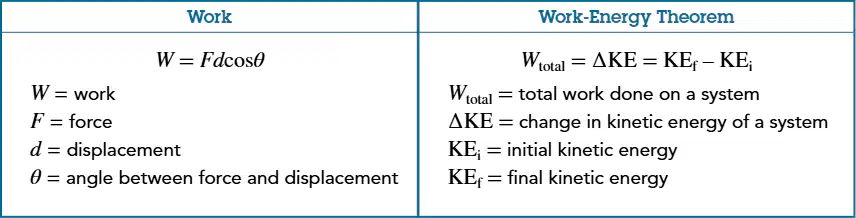
Which component of force contributes to useful work when a force is applied at an angle to the direction of motion?
The component parallel to the direction of motion (Fₚₛcosθ)
The component perpendicular to the direction of motion
The total force applied
The gravitational force only
What is the formula for power in terms of work and time?
P = W/Δt
P = W × Δt
P = W + Δt
P = W - Δt
If a person carrying a box lets it go and it falls to the ground, is work being done on the box as it falls? Explain your reasoning.
Yes, because gravity does work on the box as it falls.
No, because the box is not moving.
Yes, because the box is being pushed by the air.
No, because only lifting the box counts as work.
Which of the following is NOT a way to increase the power of a broom stroke?
Increase the force applied
Increase the displacement per stroke
Increase the time taken for each stroke
Decrease the time taken for each stroke
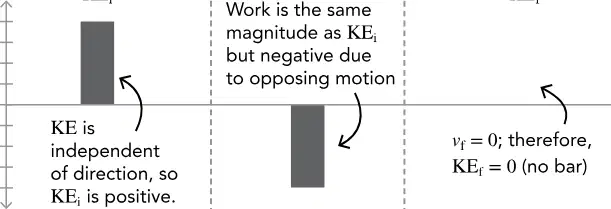
Which of the following best describes the purpose of an energy bar chart in physics?
To visualize the effect of work on a real-world system
To measure the speed of a moving object
To calculate the mass of an object
To determine the color of an object
According to the energy bar chart, what happens to the kinetic energy (KE) of the car when the final velocity (vf) is zero?
KE is positive
KE is negative
KE is zero
KE is doubled
What is the correct mathematical equation for the work-energy theorem as shown in the material?
KEi + W = KEf
KEi - W = KEf
KEi × W = KEf
KEi / W = KEf
When constructing an energy bar chart, what is the first step you should take?
Draw a bar for each form of energy
Define the system and identify the forms of energy present in the initial and final states
Use the energy bar chart to write a mathematical equation
Analyze the forces that act on the system
If the work done by the brakes is in the opposite direction of the car’s motion, what sign should be assigned to the work done by friction (fk)?
Positive
Negative
Zero
It does not matter
Which of the following is NOT a step in constructing an energy bar chart?
Define the system and identify energy forms
Analyze the forces acting on the system
Draw a bar for each form of energy and work
Calculate the speed of the car
Why is the work done by the brakes considered negative in the energy bar chart example?
Because it increases the car’s speed
Because it is in the same direction as the car’s motion
Because it is in the opposite direction of the car’s motion
Because it has no effect on the car’s energy
How can energy bar charts be used for more complex systems?
By ignoring external forces
By representing only kinetic energy
By including more than one external force or work that converts potential energy to kinetic energy
By using only one bar for all forms of energy
Which scenario will have the greatest amount of total work done by the system?
a roller coaster going from 20 m/s to 35 m/s
a roller coaster going from 35 m/s to 20 m/s
a roller coaster going from 40 m/s to 50 m/s
a roller coaster going from 50 m/s to 40 m/s
A 2.08-kg dinner platter is initially at rest on a dining table. The platter is then pushed in the positive direction with a constant force of 2.6 N. Friction with a magnitude of 1.04 N is exerted on the moving platter by the surface of the table. Determine the final velocity of the platter after it has been pushed 0.30 meters across the table.
-3.3 m/s
-0.7 m/s
0.7 m/s
3.3 m/s
Which of the following is the correct formula for elastic potential energy stored in a spring?
PEₑ = ½kₛx²
PEₑ = mgh
PEₑ = mgx
PEₑ = ½mv²
What does the variable "kₛ" represent in the formula for elastic potential energy?
Spring constant
Mass
Displacement
Acceleration due to gravity
Which type of potential energy is associated with an object’s position above the ground in Earth’s gravitational field?
Gravitational potential energy
Elastic potential energy
Chemical potential energy
Magnetic potential energy
A recoiling spring and a falling apple are both examples of what kind of system?
Mechanical system
Electrical system
Chemical system
Nuclear system
What is the value of acceleration due to gravity (g) used in the gravitational potential energy formula?
9.8 m/s²
8.9 m/s²
10.8 m/s²
7.8 m/s²
Which of the following best describes how work is done on a spring to change its potential energy?
By compressing or stretching the spring, energy is stored as elastic potential energy.
By heating the spring, its potential energy increases.
By rotating the spring, its potential energy changes.
By painting the spring, its potential energy increases.
If a ball is dropped from a tree, which type of energy transformation primarily occurs?
Gravitational potential energy transforms into kinetic energy.
Elastic potential energy transforms into chemical energy.
Kinetic energy transforms into nuclear energy.
Chemical energy transforms into gravitational potential energy.
A student compresses a spring by 0.2 meters with a spring constant of 100 N/m. What is the elastic potential energy stored in the spring?
2 Joules
4 Joules
1 Joule
0.5 Joules
A 2 kg apple falls from a height of 5 meters. What is the change in gravitational potential energy?
98 Joules
10 Joules
49 Joules
20 Joules
Which of the following is NOT something that the drawing of the rollercoaster system helps you identify?
The system
Where the rollercoaster has potential or kinetic energy
The color of the rollercoaster car
Quantities needed to calculate energies and work
What is the purpose of constructing an energy bar chart in the context of mechanical systems?
To visualize the initial and final energies of the system and how external work affects the system
To determine the speed of the rollercoaster
To measure the temperature of the system
To calculate the length of the rollercoaster track
What does the equation (21mvi2+mghi)+Wbrakes=0 represent in the context of the rollercoaster system?
The total distance traveled by the rollercoaster
The sum of initial energies and external work equals the final energy of the system
The maximum height reached by the rollercoaster
The time taken for the rollercoaster to stop
Why is the final energy of the rollercoaster system considered zero in the given scenario?
Because the rollercoaster is at its highest point
Because the brakes have applied an external force to bring the car to rest at the bottom of the hill
Because the rollercoaster is moving at maximum speed
Because there is no external work done on the system
Which of the following best describes the role of external work in the rollercoaster scenario?
It increases the potential energy of the system
It opposes the motion of the car, bringing it to a stop
It accelerates the rollercoaster car
It has no effect on the system's energy
Which scenario has a positive change in potential energy? (Select all that apply.)
a frisbee tossed from arm level that gets caught in a tree
a rubber band around some pens that stretches to fit 5 more pens
a spring that recoils after just being released
a pencil sitting on a desk that falls to the ground
A friend stands in a treehouse 6.00 m off the ground. He drops a bowling ball of mass 3.81 kg onto a highly elastic trampoline 20.9 cm above the ground. The bowling ball lands on the trampoline, which stretches downward until the ball stops, just barely before touching the ground. What is the elastic spring constant of the trampoline fabric?
110 N/m
150 N/m
200 N/m
250 N/m
A friend stands in a treehouse 5.55 m off the ground. She drops a bowling ball of mass 6.00 kg onto a highly elastic trampoline 2.89 m above the ground. The bowling ball lands on the trampoline, which stretches downward until the ball stops, just barely before touching the ground. What is the elastic spring constant of the trampoline fabric?
13.4 N/m
22.6 N/m
73.7 N/m
78.1 N/m
What does the law of conservation of energy state?
Energy can be created and destroyed.
Energy is only created, never destroyed.
Energy is neither created nor destroyed.
Energy is always lost in a system.
Which equation represents the conservation of energy for a closed system?
Ei + W = Ef
Ei - W = Ef
Ei = Ef + W
Ei = Ef - W
What is the main difference between an open and a closed system?
Closed systems can exchange both matter and energy with surroundings.
Open systems can only exchange energy, not matter.
Closed systems can exchange energy but not matter with surroundings.
Open systems cannot exchange energy or matter.
Which of the following is included in the expanded work-energy theorem for open systems?
Only kinetic energy
Only gravitational potential energy
Kinetic, gravitational potential, and elastic potential energies
Only elastic potential energy

In the puck-spring-Earth system shown in the diagram, why is no external work done on the system?
Because the table is included in the system
Because the system is open
Because the system is closed and isolated from external forces
Because energy is created within the system
Why are the spring, puck, and Earth each included when defining the system shown in the diagram, while the table is not?
Because the table does not interact with the system
Because the spring, puck, and Earth are involved in energy transformations within the system
Because the table is an energy source
Because the table is part of the surroundings
When solving mechanical problems, what must you first define to correctly apply the conservation of energy and the work-energy theorem?
The type of friction involved
The system of interest
The speed of the object
The mass of the object
What happens when the motorcycle alone is defined as the system while it slows to a stop?
The system is closed and energy is conserved
The system is open and energy is not conserved
The system is closed and energy is not conserved
The system is open and energy is conserved
Which of the following equations represents the work done within the system when the motorcycle and pavement together are defined as the system?
W = mgh
21mv2
W = f_k d
W = v/t
If the motorcycle and pavement are considered together as the system, what can be said about the energy in the system?
Energy is not conserved
Energy is lost to the environment
Energy is conserved
Energy is only partially conserved
What does the friction force (fk) from the pavement do in the context of the motorcycle slowing to a stop?
It increases the kinetic energy of the motorcycle
It does work on the motorcycle, causing it to lose kinetic energy
It has no effect on the motorcycle's energy
It increases the potential energy of the motorcycle
Why is energy not conserved when only the motorcycle is defined as the system?
Because the system is closed
Because external work is done on the system
Because the motorcycle gains energy from the pavement
Because the system is isolated
When the motorcycle and pavement are defined as the system, which of the following statements is true?
The system is open and energy is not conserved
The system is closed and energy is conserved
The system is open and energy is conserved
The system is closed and energy is not conserved
Based on the law of conservation of energy, if the final energy of a system is less than the initial energy of a system, what do we know about the system?
Energy has been created within the system.
The system has lost energy to its surroundings.
The system is isolated and no energy transfer occurred.
The system gained energy from its surroundings.
Which of the following scenarios is an example of a system that can exchange both matter and energy with its surroundings?
Hot coffee in an insulated flask
A beaker full of boiling water
Soup heating in an uncovered pot on a stove
A bottle of water with the cap on
An 860-kg roller coaster car drops from rest at a height of 184.0 m along a frictionless track. What average force is required to bring the car to a stop along a 180 m stretch of horizontal track at 1.4 m above the ground at the end of the ride?
8620 N
8600 N
8700 N
8800 N
What is the formula for linear momentum (p) of a moving object?
p = m + v
p = m/v
p = m × v
p = v/m
Which of the following best describes how momentum is treated when multiple objects are in a system?
The largest momentum is used as the total.
The momenta are subtracted from each other.
The momenta add to give the total momentum.
Only the fastest object's momentum is considered.
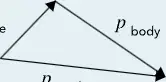
What does the diagram illustrate about the momentum of the rocket system?
The momentum of the nose and body are unrelated.
The total momentum is the sum of the nose and body momenta using vector addition.
The nose has more momentum than the body.
The body and nose have equal momentum.
What is the product of the moment of inertia (I) and the angular velocity (ω) called?
Linear momentum
Impulse
Angular momentum
Torque
Which statement best explains the concept of impulse (J)?
Impulse is the product of mass and velocity.
Impulse is the product of the average force and the time interval over which the force is applied.
Impulse is the sum of all forces acting on an object.
Impulse is the change in velocity divided by time.
If a torque is exerted for a certain amount of time, what is the resulting change in angular momentum (ΔL)?
ΔL = F × t
ΔL = τ × Δt
ΔL = m × v
ΔL = I × ω
Which factor increases the moment of inertia of a rotating object?
Decreasing the mass
Distributing mass closer to the axis of rotation
Distributing mass farther from the axis of rotation
Reducing the angular velocity
Write an equation to find the magnitude of the total momentum of the objects in the rocket system.
p_total = p_nose + p_body (vector sum)
p_total = p_nose - p_body
p_total = p_nose × p_body
p_total = p_nose / p_body
What is the initial velocity of the boulder when it leaves the catapult in the sample problem?
20 m/s
25 m/s
30 m/s
35 m/s
What is the mass of the boulder fired by the catapult?
25 kg
50 kg
75 kg
100 kg
What is the angle at which the catapult fires the boulder?
30°
60°
90°
45°
What is the total momentum of the boulder when it leaves the catapult?
1061 kg·m/s
1500 kg·m/s
1326 kg·m/s
800 kg·m/s
How long does the collision between the boulder and the castle wall last?
0.5 seconds
1.0 seconds
0.8 seconds
2.0 seconds
What is the horizontal component of the boulder's momentum when it leaves the catapult?
1500 kg·m/s
1061 kg·m/s
1326 kg·m/s
800 kg·m/s
What is the average force applied to the castle wall by the boulder during the collision?
1061 N
1500 N
1326 N
800 N
Why is only the horizontal component of velocity considered when calculating the momentum at the peak of the boulder's trajectory?
The vertical component is greater than the horizontal component.
The vertical component of velocity is zero at the peak.
The horizontal component is always zero.
Both components are always equal.
Which equation is used to calculate the impulse applied to the boulder?
F = ma
p = mv
F_avg Δt = Δp_x
v = d/t
What is the purpose of drawing a labeled picture when solving momentum problems?
To make the problem look more interesting
To identify knowns and unknowns and recognize the trajectory
To avoid using equations
To increase the difficulty of the problem
Which of the following best describes the relationship between linear momentum, moment of inertia, and angular momentum?
Linear momentum and angular momentum are unrelated; moment of inertia only affects linear momentum.
Linear momentum is the product of mass and velocity, while angular momentum depends on moment of inertia and angular velocity.
Moment of inertia is the same as linear momentum.
Angular momentum is not affected by moment of inertia.
The impulse of a force can be found with the equation $ J = F_{avg} \Delta t $. What does this equation mean in relation to momentum?
Impulse is unrelated to momentum.
Impulse is the change in momentum of an object.
Impulse is the same as force.
Impulse only applies to stationary objects.
If a collision stops a moving object, what does this say about the impulse delivered to the object?
The impulse is zero.
The impulse is equal to the initial momentum of the object.
The impulse is negative.
The impulse is unrelated to the object's motion.
How can engineers minimize the impact force during a car collision in a crash test?
By increasing the time over which the collision occurs.
By decreasing the mass of the car.
By making the collision happen faster.
By increasing the speed of the car.
Which of the following adjustments will increase the momentum of a truck when it is in motion? (Select all that apply.)
Increase the potential velocity of the truck
Decrease the potential velocity of the truck
Increase the mass of the truck
Decrease the mass of the truck
A player kicks a 0.412-kg ball at a net that launches it at a 42.3° angle. The initial velocity of the ball is 13.4 m/s. The ball collides with the net’s upper post at the peak of its trajectory. If the collision of the ball with the post takes 0.56 seconds, what force is applied to the post?
9.86 N
7.12 N
5.43 N
3.21 N
A 0.02-kg top spins in a circle 10.2 cm wide. The linear velocity of the top is 2.41 m/s and it leans at an angle of 87.7°. What is the angular momentum of the top?
2.46 × 10⁻³ kg·m²/s
4.91 × 10⁻³ kg·m²/s
1.23 × 10⁻³ kg·m²/s
3.12 × 10⁻³ kg·m²/s
A T-shirt cannon launches a 0.192-kg shirt into the stands at a sports arena. It launches the shirt at a 75.7° angle. The initial velocity of the shirt as it leaves the cannon is 34.8 m/s. The shirt is grabbed by a fan at the peak of its trajectory. If the force applied to the person grabbing the shirt is 1.31 N, how long was the shirt in flight?
1.26 seconds
2.16 seconds
4.19 seconds
8.87 seconds
What does the law of conservation of linear momentum state?
The total linear momentum of a system does not change if no external force acts on it.
The total energy of a system always increases.
The total mass of a system remains constant.
The total velocity of a system is always zero.
Which of the following best describes an isolated system in the context of momentum?
A system where no external forces act on the objects within it.
A system where energy is constantly added.
A system where objects are always at rest.
A system where only one object is present.
According to the impulse-momentum theorem, what causes a change in the momentum of a system?
A net external impulse acting on the system.
The color of the objects in the system.
The temperature of the environment.
The shape of the objects in the system.
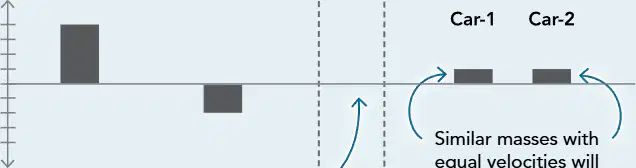
If two cars of similar mass and equal velocity collide in an isolated system, what can be said about their momenta?
They will have similar momenta.
Their momenta will be zero.
Their momenta will be negative.
Their momenta will be unrelated.
What happens to the kinetic energy of objects in an isolated system during a collision?
It can change, even though total momentum remains constant.
It always remains constant.
It always increases.
It always becomes zero.
Which of the following is NOT a possible transformation of kinetic energy during a collision?
Kinetic energy transforming into sound energy.
Kinetic energy transforming into thermal energy.
Kinetic energy transforming into work.
Kinetic energy transforming into mass.
Why is the total momentum conserved when examining the collision of two cars in an isolated system?
Because the forces acting on the cars are internal to the system.
Because the cars are moving at the same speed.
Because the cars are identical.
Because the system is not isolated.
What is the mass of the test car used in the sample problem?
2500 kg
2000 kg
1500 kg
3000 kg
During the crash test, what is the change in velocity of the test car?
15 m/s
10 m/s
25 m/s
5 m/s
What is the average impact force on the test car if the time to crumple is 0.4 s?
93,750 N
25,000 N
50,000 N
10,000 N
Which direction does the engineer assign as positive when analyzing the test car's motion?
The test car’s forward direction
The test car’s backward direction
The direction of the external impulse
The direction of the crumple
What does the momentum bar chart help represent in the context of the sample problem?
The change in momentum and impulse during the collision
The color of the car
The speed of light
The temperature of the test facility
Why is the impulse provided by the red car considered negative in the system?
Because it is external to the system and opposite to the assigned positive direction
Because it is larger than the initial momentum
Because it is equal to the final momentum
Because it is the same as the crumple time
Which equation is used to solve for the average impact force in the sample problem?
F_{2 on 1} = - (m_1 v_{1f} - m_1 v_{1i}) / Δt
F = ma
p = mv
F = Δp / Δt
If the crumple time was increased, what would happen to the average impact force, assuming all other factors remain the same?
It would decrease
It would increase
It would stay the same
It would become zero
Fill in the blanks. A ________ system of a totally ________ car collision will result in the largest external impulse.
2-car; inelastic
2-car; elastic
1-car; inelastic
1-car; elastic
In a ballistic pendulum, a pellet with a mass of 0.040 kg is fired with an initial speed of 28 m/s at a pendulum block that is at rest. The block has a mass of 1.8 kg and is suspended from a rod of length 0.28 m. After the pellet collides with the block, they both stick together and swing upward. Determine the maximum height reached by the pellet-and-block system.
0.019 m
0.034 m
0.13 m
0.28 m

