
 Worksheets
Metabolism, Photosynthesis & Respiration
Total questions: 94
Worksheet time: 1hrs 24mins

What are the reactants (substrates) for the reaction?
Glucose & ATP
hexokinase
Glucose-P & ADP
△G
What are the products for the reaction?
Glucose & ATP
hexokinase
Glucose-P & ADP
△G
What is the name of the enzyme that catalyzes this reaction?
Glucose & ATP
hexokinase
Glucose-P & ADP
△G
This reaction is considered to be:
exergonic
endergonic
spontaneous
non-spontaneous
The above reaction can best be described as an ________________ reaction that
______________ energy.
exergonic, releases
endergonic, takes in
exergonic, takes in
endergonic, releases
The enzyme for this reaction requires Mg2+ (an inorganic metal ion) in order to function properly. Mg2+ would be considered to be a ____________.
cofactor
inhibitor
vitamin
coenzyme
The reaction above happens at the beginning of glycolysis. The enzyme in this reaction functions best at neutral pH. Based on this information, where would you expect to find this enzyme in human red blood cells?
cytoplasm
intermembrane space of mitochondria
lysosome
inside thylakoid disks
What would likely happen if you exposed the enzyme to a strongly acidic pH environment?
reaction would run in reverse
denaturation of the enzyme
△G would change to +7.98 kcal/mol
increase in enzyme activity
Glycolysis is an example of a metabolic pathway that can release stored energy by breaking
down larger molecules into smaller ones. For that reason, glycolysis can be labeled as ________.
catabolic
enzymatic
inhibitor
anabolic
The second law of thermodynamics states that all energy conversions are inefficient, and some energy is always lost as which biologically unusable form?
ATP
potential energy
thermal energy (heat)
chemical energy
The hydrolysis of ATP to ADP + Pi can best be described as an ________________ reaction that ______________ energy.
exergonic; releases
endergonic; requires
exergonic; requires
endergonic; releases
Which of the following statements best describes the relationship between photosynthesis and cellular respiration?
Photosynthesis stores energy in carbohydrates, while cellular respiration releases it.
Cellular respiration is anabolic, and photosynthesis is catabolic.
ATP molecules are produced in photosynthesis, but not in cellular respiration.
Photosynthesis occurs only in heterotrophs, and cellular respiration occurs only in
autotrophs.
NADP+ + 2H+ + 2e- → NADPH + H+
The reaction above takes place during photosynthesis and illustrates the role of NADP+. In photosynthesis, NADP+ serves as a ___________ to transfer ____________.
catalyst; oxygen
membrane channel; carbon
motor protein; ATP
coenzyme; electrons
Where are ATP synthase complexes located in plant cells?
thylakoid membrane only
thylakoid membrane and plasma membrane
thylakoid membrane and inner mitochondrial membrane
inner mitochondrial membrane only
In autumn, the leaves of deciduous trees change colors. This is because, at this time of year,
chlorophyll production drops, and
water supply to the leaves has been greatly increased
the cells of the leaves begin to reproduce
chlorophyll changes color
the carotenes, xanthophylls, and other pigments now become visible
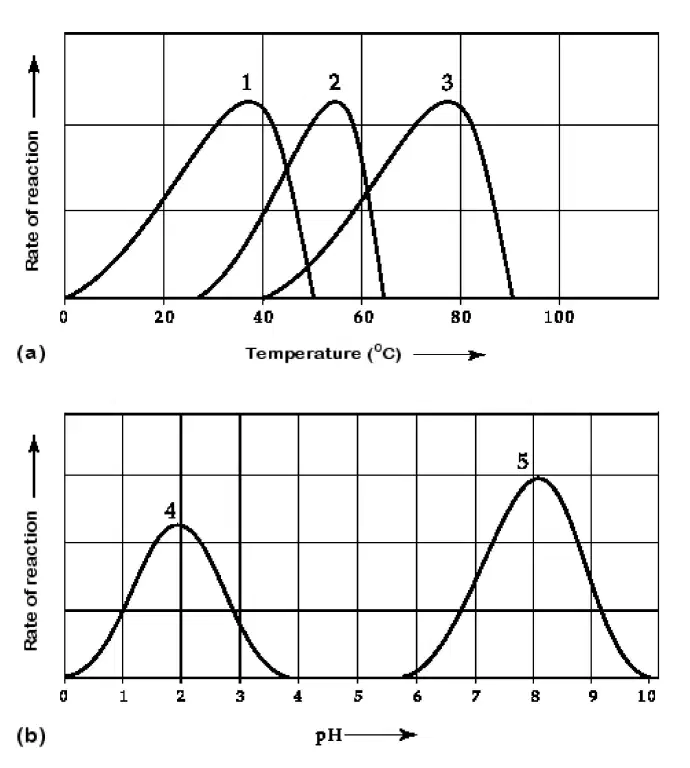
Which curve represents the profile of an enzyme taken from a bacterial species that lives in hot springs at temperatures of ~75°C
curve 1
curve 2
curve 3
curve 4
curve 5
Which curve represents the profile of an enzyme taken from the human stomach where conditions are strongly acidic?
curve 1
curve 2
curve 3
curve 4
curve 5
Which curve represents the profile of an enzyme that would be best suited to function at normal human body temperature?
curve 1
curve 2
curve 3
curve 4
curve 5
Which of the following statements regarding enzymes is TRUE?
Enzymes are NOT reusable.
Enzymes alter the free energy change (△G) of a reaction.
Enzymes increase the rate of a reaction by lowering the activation energy (EA)
Enzymes are permanently changed by the reactions they catalyze.

How would a noncompetitive inhibitor interfere with a reaction involving the enzyme shown
above in Figure 2?
It would bind to a.
It would bind to d.
It would bind to c.
It would bind to b.
Which of the following represents the active site of the enzyme shown above in Figure 2?
a
b
c
d
e
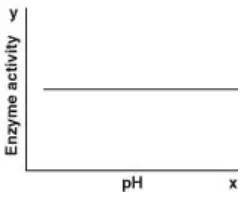
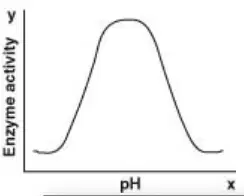
Which of the following graphs most likely describes the effect of pH on the function of the enzyme catalase in human cells?


Which of the following is true for anabolic reactions?
They are spontaneous and breakdown molecules.
They are nonspontaneous and breakdown molecules.
They are spontaneous and build molecules.
They are nonspontaneous and build molecules.
A catalyst works by
changing the order of the reaction
increasing the temperature
lowering the activation energy
making the activated complex
Which of the following is a correct association?
non-spontaneous reaction --- exergonic
spontaneous reaction --- endergonic
non-spontaneous --- endergonic
spontaneous reaction --- isogonic
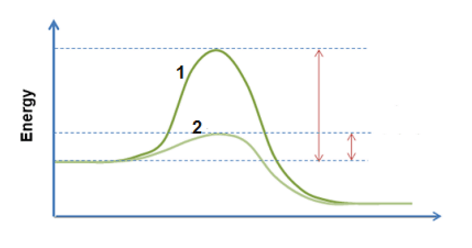
Which line represents an enzyme-catalyzed reaction?
Line 1
Line 2

Which TWO of the following best describes this reaction?
endergonic
exergonic
spontaneous
non-spontaneous

In Figure 6.2, why does the reaction rate plateau at higher reactant concentrations?
Feedback inhibition by product occurs at high reactant concentrations.
Most enzyme molecules are occupied by substrate at high reactant concentrations.
The reaction nears equilibrium at high reactant concentrations.
The activation energy for the reaction increases with reactant concentration.
Which reaction shows the chemical equation for photosynthesis?
C6H12O6 + 6O2
→
6CO2 + 6H2O + 32 ATP
6CO2 + 6H2O + light energy
→
C6H12O6 + 6O2
C6H12O6
→
2 Lactic Acid + 2 ATP
C6H12O6
→
2 Ethanol + 2CO2 + 2 ATP
What type of reaction is this?
6CO2 + 6H2O + light energy → C6H12O6 + 6O2
endergonic
exergonic
What type of reaction is this?
C6H12O6 + 6O2 → 6CO2 + 6H2O + 32 ATP
endergonic
exergonic
What type of reaction is this?
C6H12O6 + 6O2 → 6CO2 + 6H2O + 32 ATP
catabolic
anabolic
Which of the following statements describes the results of this reaction?
C6H12O6 + 6O2 → 6CO2 + 6H2O + 32 ATP
O2 is reduced, and CO2 is oxidized
C6H12O6 is oxidized, and O2 is reduced.
C6H12O6 is reduced, and CO2 is oxidized.
O2 is oxidized, and CO2 is reduced
What type of reaction is this?
6CO2 + 6H2O + light energy → C6H12O6 + 6O2
catabolic
anabolic
Which reaction shows the chemical equation for cellular respiration?
C6H12O6 + 6O2
→
6CO2 + 6H2O + 32 ATP
6CO2 + 6H2O + light energy
→
C6H12O6 + 6O2
C6H12O6
→
2 Lactic Acid + 2 ATP
C6H12O6
→
2 Ethanol + 2CO2 + 2 ATP
Which category of biological macromolecules does NOT feed into a metabolic pathway to serve as an energy (food) source?
proteins
nucleic acids
lipids
carbohydrates
The carbon atoms in a glucose molecule produced during photosynthesis ultimately come from what source?
CO2
ethanol (CH3CH2OH)
H2O
proteins
Where does the Calvin cycle take place in eukaryotic cells that are capable of photosynthesis?
thylakoid membrane
stroma of the chloroplasts
chlorophyll molecules
mitochondria
Which of the following correctly lists the sequence of stages for aerobic cellular respiration?
citric acid cycle
glycolysis
oxidative phosphorylation
glycolysis
citric acid cycle
oxidative phosphorylation
oxidative phosphorylation
citric acid cycle
glycolysis
glycolysis
oxidative phosphorylation
citric acid cycle
Which of the following processes produces the most ATP molecules when one glucose molecule is completely broken down during aerobic cellular respiration?
oxidative phosphorylation
citric acid cycle
glycolysis
lactic acid fermentation
Why is glycolysis considered to be one of the first metabolic pathways to have evolved?
It depends upon photosynthesis, a metabolic pathway present in eukaryotes, but not prokaryotes.
It occurs in the cytoplasm and is performed, in some form, by nearly all organisms in the biosphere.
It produces much more ATP compared to oxidative phosphorylation.
It is performed by prokaryotic cells but not eukaryotic cells.
Where does the citric acid cycle take place in eukaryotes?
mitochondrial matrix
cytoplasm
cristae of mitochondria
stroma of chloroplasts
Approximately what percentage of the energy of glucose is captured in ATP as a result of the complete oxidation of glucose during cellular aerobic respiration?
10%
60%
34%
25%
You have a friend who lost 7 kg (about 15 pounds) of fat on a "low carb" diet. How did the fat leave his body?
Chemical energy was converted to heat and then released.
It was converted to ATP, which weighs much less than fat.
It was converted to urine and eliminated from the body.
It was released as CO2 and H2O.
Which metabolic pathway is common to both aerobic cellular respiration and fermentation?
The electron transport chain, which uses high-energy electrons to pump H⁺ ions and generate ATP.
Glycolysis, which breaks down glucose into pyruvate in the cytoplasm and produces a small amount of ATP and NADH in both aerobic and anaerobic conditions.
The Krebs cycle, which occurs in the mitochondrial matrix and requires oxygen to proceed.
Oxidative phosphorylation, which produces the majority of ATP using ATP synthase in the mitochondria.
The reaction shown below is performed by baker's yeast (S. cerevisiae). Which of the following is true about this reaction?
C6H12O6 --> 2C2H5OH + 2 CO2 + 2ATP
Glucose --> Ethanol
This process requires O₂, which acts as the final electron acceptor in the formation of ethanol and CO₂.
Yeast cells do not produce carbon dioxide during this reaction, as CO₂ is not a byproduct of fermentation.
Human muscle cells also perform this reaction to produce ethanol and CO₂ during exercise.
This process occurs anaerobically, allowing yeast to regenerate NAD⁺ so glycolysis can continue in the absence of oxygen.
Starting with one molecule of glucose, glycolysis results in the net production of which of the
following sets of energy-containing products?
2 NADH
2 pyruvate
2 ATP
which are generated in the cytoplasm as glucose is broken down during glycolysis.
2 NAD+
2 pyruvate
2 ATP
which incorrectly lists the oxidized form of the electron carrier instead of NADH.
4 NADH
2 pyruvate
4 ATP
counting all ATP produced without subtracting the ATP used in glycolysis.
6 CO2
2 pyruvate
2 ATP
which are products of complete glucose oxidation in the Krebs cycle.
A woman takes a deep breath and dives underwater to gather shells from the bottom of a
shallow ocean pool. Soon, her muscles begin to burn as her cells are deprived of oxygen and
begin to perform what process?
aerobic cellular respiration
alcoholic fermentation
photosynthesis
lactic acid fermentation

If one glyceraldehyde-3-phosphate (G3P) molecule is the net product of each turn of this cycle, how many turns of this cycle are required to make one glucose molecule?
1
2
3
4
What is the function of Rubisco in this cycle shown here?
Rubisco is the enzyme that catalyzes the fixation of carbon dioxide to RuBP, initiating the conversion of CO₂ into organic molecules like G3P.
Rubisco splits water molecules during the light reactions to produce electrons, protons, and oxygen.
Rubisco regenerates ATP from ADP and phosphate during chemiosmosis in the Calvin cycle.
Rubisco converts G3P directly into glucose in a single step after carbon fixation.
What type of biological molecule is Rubisco?
A carbohydrate substrate, which is acted upon by another enzyme to produce G3P.
An enzyme, which catalyzes the fixation of CO₂ to RuBP in the Calvin cycle.
A coenzyme, which transfers electrons or functional groups during photosynthesis.
An inorganic cofactor, such as Mg²⁺, required for enzyme activity

A series of enzymes catalyzes the above reaction. Product Z binds to enzyme 1 (which converts W to X). It binds at a location far from the active site. This binding decreases the activity of enzyme 1.
Product Z functions as
A non-competitive (allosteric) inhibitor that binds to a site other than the active site and decreases enzyme activity.
A competitive inhibitor that binds to the active site and prevents the substrate from binding to the enzyme.
A coenzyme that binds to the enzyme and transfers electrons or functional groups to assist in the reaction.
A substrate that binds to the enzyme to be converted into the next product in the metabolic pathway.
A series of enzymes catalyzes the above reaction. Product Z binds to enzyme 1 (which converts W to X). It binds at a location far from the active site. This binding decreases the activity of enzyme 1.
The mechanism in which the end product of a metabolic pathway (such as Product Z above)
temporarily inhibits an earlier step in the pathway is known as
Feedback inhibition, in which the end product binds to an earlier enzyme and temporarily decreases its activity to regulate the pathway.
Irreversible inhibition, in which the product permanently binds and deactivates the enzyme in the pathway.
Metabolic activation, in which the product increases the activity of an earlier enzyme to speed up the pathway.
Allosteric activation, in which the product binds to an enzyme at a site other than the active site and increases its activity.
HIV is the virus that causes AIDS. In the mid-1990s, researchers discovered an enzyme in HIV
called protease. Once the enzyme's structure was known, researchers began looking for drugs
that would non-covalently bind to the active site and block access to it. Such drugs would be
examples of
Competitive, reversible inhibitors that bind temporarily to the enzyme’s active site, preventing the substrate from binding without permanently altering the enzyme.
Noncompetitive, irreversible inhibitors that bind to a site other than the active site and permanently deactivate the enzyme.
Noncompetitive, reversible inhibitors that bind to a site other than the active site and temporarily reduce enzyme activity.
Competitive, irreversible inhibitors that bind covalently to the active site and permanently prevent substrate binding.
During a laboratory experiment, you calculate that an enzyme-catalyzed reaction of interest has a △G of -20 kcal/mol. If you double the amount of enzyme in the reaction, what will be the △G for the new reaction?
The ΔG will remain -20 kcal/mol because enzymes do not change the free energy of a reaction, they only speed up the rate at which equilibrium is reached.
The ΔG will become more negative, approximately -40 kcal/mol, because increasing enzyme concentration releases additional free energy.
The ΔG will become less negative, approximately -10 kcal/mol, because more enzyme reduces the energy available from the reaction.
The ΔG will become zero, because doubling the enzyme drives the reaction to equilibrium immediately.
Each individual turn of the citric acid cycle produces three molecules of CO2. How many CO2 molecules would be produced if the products from the breakdown of two glucose molecules were fed into the citric acid cycle?
6 CO₂ molecules, assuming each glucose produces one pyruvate and one turn of the cycle occurs per pyruvate.
12 CO₂ molecules, because two glucose molecules produce four pyruvate molecules, and each pyruvate produces 3 CO₂ per turn of the cycle.
3 CO₂ molecules, assuming only one pyruvate from one glucose enters the cycle once.
20 CO₂ molecules, assuming additional CO₂ is generated from other metabolic reactions besides the cycle.
Which of the following are products of the light reactions of photosynthesis that are utilized in the Calvin Cycle?
CO2 and glucose
ATP and NADPH
ADP, P and NADP+
H2Oand O2
The process of using electrons to pump H+ to create an electrochemical gradient that must flow through a protein is called:
Chemiosmosis
Fantasia
Induced Fit
Electrolysis
During the light reactions, what is the purpose of passing electrons during the electron transport chain?
To create a proton gradient
To split water
To produce sugar
To produce oxygen gas
Which of the following are products of the light reactions of photosynthesis that are utilized in the Calvin Cycle?
CO2 and glucose
ATP and NADPH
ADP, P and NADP+
H2Oand O2

Which pigment would be more favorable in green light?
Pigment A (Graph I)
Pigment B (Graph II)
Which reaction moves the cellular respiration process from the cytoplasm to the mitochondria?
glycolysis ---> pyruvate
pyruvate ---> acetyl CoA
acetyl CoA ---> PGA
PGA ---> PGAL
Which of the following is a product of the Electron Transport Chain?
CO2
O2
C6H1206
H2O
What is the main job of the electron carrier molecules (NADH and FADH2) in cellular respiration?
What is the main job of the electron carrier molecules (NADH and FADH2) in cellular respiration?
A weightlifter is using heavy weights in short bursts for a competition. Because his muscle cells are not able to take in enough oxygen to make very much ATP the weightlifter begins to get fatigue in his muscles. Which of the following processes is most likely going on in the muscles of the weightlifter as he competes in his event?
As the cells run out of oxygen they switch to anaerobic respiration (fermentation), which allows the cell to make small amounts of ATP in the absence of oxygen.
As the cells run out of oxygen, they die off gradually and the weightlifter's muscles have fewer contracting muscle cells.
The cells will never run out of oxygen if the weightlifter is breathing.
As the cells run out of oxygen, they will continue to make the same amount of ATP, since oxygen is not required to make ATP.

What is the correct equation for cellular respiration?
6O2 + C6H12O6 -> 6CO2 + 6H2O + Energy
6O2 + C6H12O6 + Energy -> 6CO2 + 6H2O
6CO2 + 6H2O -> 6O2 + C6H12O6 + Energy
6CO2 + 6H2O + Energy -> 6O2 + C6H12O6
Which of the following statements about the electron transport chain (ETC) is true?
It consists of a series of redox reactions that transfer electrons through protein complexes in the inner mitochondrial membrane.
It includes a series of hydrolysis reactions associated with the mitochondrial membranes, which release energy used to directly form water and ATP in the matrix.
It is driven by the hydrolysis of ATP molecules, which provides energy for the movement of electrons through the chain of proteins in the membrane.
It occurs in the cytoplasm of both prokaryotic and eukaryotic cells, where protein complexes freely float and shuttle electrons during cellular respiration.
______________________ is the enzyme that attaches a phosphate to a glucose molecule at the beginning of aerobic cellular respiration.
ATP Synthase
Rubisco
Hexokinase
NADP+ Reductase
What happens when electrons are passed from one atom to a more electronegative atom?
The more electronegative atom is reduced, and energy is released.
The more electronegative atom is oxidized, and energy is consumed.
The more electronegative atom is reduced, and energy is consumed.
The more electronegative atom is oxidized, and energy is released.
In yeast, what product of fermentation is lethal when it builds up?
carbon dioxide
lactate
alcohol
Aerobic respiration takes place in
the cytoplasm.
the mitochodria.
both the cytoplasm and mitochondria.
Which other organic molecules can also be used for aerobic respiration? (Choose all that apply)
lipids
nucleic acids
proteins
The product of anaerobic respiration in animals is
2 ATP and lactic acid.
36 ATP and lactic acid.
2 ATP and ethanol.
36 ATP and ethanol.
The first step of aerobic respiration breaks down glucose into
mRNA strands
oxygen and water
2 pyruvates
carbon dioxide and sugar
What is the primary function of the Calvin cycle?
regenerate ATP for use in the light reactions of photosynthesis
produce carbon dioxide for use in the light reactions of photosynthesis
produce oxygen by oxidizing water
produce simple sugars from carbon dioxide
The H+ concentration gradient is formed to
make NADPH
split a water molecule
generate ATP
form water
What is the primary function of the light reactions of photosynthesis?
To produce glucose
To produce NADPH and ATP
To use ATP
To produce RuBP
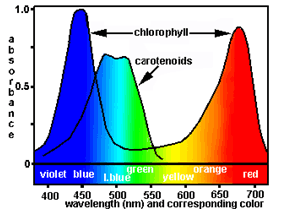
What is one function of the other pigments besides chlorophyll, in the chloroplast?
to block damaging wavelengths of light
to absorb different wavelengths than the chloroplasts
to provide different colors to the leaves
to transfer energy to a separate photosystem beside the one using chlorophyll a and b.
The splitting of carbon dioxide to form oxygen gas and carbon compounds occurs during ______
photosynthesis
respiration
neither photosynthesis or respiration
both photosynthesis and respiration
The accumulation of free oxygen in Earth's atmosphere began _____
with the origin of life and respiratory metabolism
with the origin of photosynthetic bacteria that had photosystem I
with the origin of cyanobacteria that had both photosystem I and photosystem II
with the origin of land plants
During photosynthesis, electrons travel downhill in which sequence?
food → NADH → electron transport chain → oxygen
glucose → pyruvate → ATP → oxygen
water → photosystem II → electron transport chain → NADPH
light → electron transport chain → chlorophyll --> ATP
Where did photosynthesis originate?
Algae
Cyanobacteria
Plants
Protists
Photosynthesis is a redox reaction. This means that water is ______ during the light reactions and carbon dioxide is ______ during the Calvin cycle.
consumed; reduced
consumed; reduced
oxidized; reduced
reduced; reduced
When a substace gains electrons, it has been ___.
Reduced
Oxidized
Electrified
Which of the following molecules REDUCES other molecules?
NADPH
ATP
RUBISCO
G3P
Which of the following is the sugar molecule DIRECTLY produced during the calvin cycle?
Glucose
ATP
G3P
RuBP
ATP is made during the light reaction using all of the following EXCEPT
proton pump
hydrogen ion gradient
electron energy from photosystem II
NADPH donating electrons

