
 Worksheets
Labs 28, 29, 30 - Digestion
Total questions: 100
Worksheet time: 50mins
Sequence the organs of the digestive tract from the mouth to the anus.
Mouth, esophagus, stomach, small intestine, large intestine, anus.
Mouth, stomach, esophagus, large intestine, small intestine, anus.
Mouth, esophagus, large intestine, stomach, small intestine, anus.
Mouth, small intestine, esophagus, stomach, large intestine, anus.
State the contribution of each organ, if any, to the process of chemical digestion.
Mouth: Begins digestion with enzymes in saliva. Stomach: Secretes acid and enzymes to digest proteins. Small intestine: Main site for digestion and absorption, with enzymes from pancreas and intestine. Large intestine: Absorbs water and forms feces. Anus: Expels waste.
Mouth: Only chews food, no enzymes involved. Stomach: Absorbs nutrients directly. Small intestine: No role in digestion, only absorption. Large intestine: Digests proteins. Anus: Secretes digestive enzymes.
Mouth: Breaks down fats with bile. Stomach: Produces insulin for digestion. Small intestine: Absorbs water and forms feces. Large intestine: Main site for chemical digestion. Anus: Begins digestion with enzymes.
Mouth: Absorbs nutrients. Stomach: No role in digestion. Small intestine: Secretes acid to digest proteins. Large intestine: Begins digestion with enzymes in saliva. Anus: Absorbs water.
Associate the enzyme pepsin with the ability of the stomach to digest protein.
Pepsin is an enzyme in the stomach that digests proteins into smaller peptides.
Pepsin is a hormone that regulates blood sugar levels.
Pepsin is an enzyme in the mouth that breaks down carbohydrates.
Pepsin is a vitamin that helps in the absorption of calcium.
Explain why stomach contents are acidic and how a warm body temperature aids digestion.
Stomach contents are acidic due to hydrochloric acid, which activates pepsin and helps break down food. Warm body temperature increases enzyme activity, aiding digestion.
Stomach contents are acidic because of bile, and warm body temperature slows down enzyme activity.
Stomach contents are acidic due to amylase, and warm body temperature has no effect on digestion.
Stomach contents are acidic because of mucus, and warm body temperature denatures all digestive enzymes.
Associate the enzyme lipase with the ability of the small intestine to digest fat.
Lipase is an enzyme that breaks down fats into fatty acids and glycerol in the small intestine.
Lipase is an enzyme that breaks down carbohydrates into glucose in the small intestine.
Lipase is an enzyme that breaks down proteins into amino acids in the small intestine.
Lipase is an enzyme that synthesizes vitamins in the small intestine.
Explain why the emulsification process assists the action of lipase.
Emulsification breaks fat into small droplets, increasing surface area for lipase to act and digest fats more efficiently.
Emulsification changes the chemical structure of fats, making them water-soluble for lipase.
Emulsification increases the temperature of fats, speeding up lipase activity.
Emulsification neutralizes stomach acid, allowing lipase to work.
Explain why a change in pH indicates that fat digestion has occurred.
Fat digestion produces fatty acids, which lower the pH, indicating that digestion has occurred.
Fat digestion produces glucose, which raises the pH, indicating that digestion has occurred.
Fat digestion produces amino acids, which do not affect pH, indicating that digestion has occurred.
Fat digestion produces water, which increases the pH, indicating that digestion has occurred.
Explain the relationship between time and enzyme activity.
Enzyme activity generally increases with time until the substrate is depleted or the enzyme becomes inactive.
Enzyme activity decreases steadily with time regardless of substrate availability.
Enzyme activity remains constant over time, unaffected by substrate or enzyme conditions.
Enzyme activity is unrelated to time and depends only on temperature.
Associate the enzyme pancreatic amylase with the ability of the small intestine to digest starch.
Pancreatic amylase breaks down starch into simpler sugars in the small intestine.
Pancreatic amylase breaks down proteins into amino acids in the small intestine.
Pancreatic amylase breaks down fats into fatty acids in the small intestine.
Pancreatic amylase is responsible for absorbing vitamins in the small intestine.
Assuming a specific enzyme, list four factors that can affect the activity of all enzymes.
Temperature, pH, substrate concentration, enzyme concentration.
Light intensity, humidity, air pressure, wind speed.
Color, shape, taste, smell.
Magnetism, gravity, sound, vibration.
Explain why the operative procedure that reduces the size of the stomach causes an individual to lose weight.
Reducing the size of the stomach limits food intake and absorption, leading to weight loss.
It increases the metabolic rate, causing rapid fat burning.
It enhances the body's ability to store more fat.
It causes the stomach to produce more digestive enzymes.
The stomach has a very low pH. Does this indicate that pepsin works effectively in an acidic or a basic environment?
acidic
basic
neutral
alkaline
This is the pH that allows the enzyme to maintain its normal shape so that it will combine with the substrate. A warm temperature causes molecules to move about more rapidly and increases the encounters between enzyme and substrate. Therefore, you would hypothesize that the yield from this enzymatic reaction will be higher if the pH is _________ and the temperature is __________ (body temperature 37°C).
acidic, 37°C
basic, 10°C
neutral, 50°C
alkaline, 20°C
Explain your results in Table 28.1 by giving an explanation why digestion did or did not occur. To be complete, consider all the requirements for an enzymatic reaction as listed in Table 28.4. Now show here that tube 1 met all the requirements for digestion: Pepsin is the correct ___________.
enzyme
substrate
temperature
buffer
Explain your results in Table 28.1 by giving an explanation why digestion did or did not occur. To be complete, consider all the requirements for an enzymatic reaction as listed in Table 28.4. Now show here that tube 1 met all the requirements for digestion: Albumin is the correct ___________.
substrate
enzyme
product
buffer
Explain your results in Table 28.1 by giving an explanation why digestion did or did not occur. To be complete, consider all the requirements for an enzymatic reaction as listed in Table 28.4. Now show here that tube 1 met all the requirements for digestion: 37°C is the optimum ___________.
temperature
pressure
pH level
enzyme concentration
Explain your results in Table 28.1 by giving an explanation why digestion did or did not occur. To be complete, consider all the requirements for an enzymatic reaction as listed in Table 28.4. Now show here that tube 1 met all the requirements for digestion: HCl provides the optimum ___________.
pH
temperature
enzyme concentration
substrate
Explain your results in Table 28.1 by giving an explanation why digestion did or did not occur. To be complete, consider all the requirements for an enzymatic reaction as listed in Table 28.4. Now show here that tube 1 met all the requirements for digestion: 1½ hours provides ___________ for the reaction to occur.
sufficient time
insufficient substrate
excess enzyme
low temperature
Which tube was the negative control?
Tube 1
Tube 2
Tube 3
Tube 4
If this control tube had given a positive result for protein digestion, what could you conclude about this experiment?
The experiment may be flawed because the control should not show protein digestion.
The experiment was successful and the control worked as expected.
Protein digestion occurred only in the control tube, not in the test tube.
The control tube result confirms the accuracy of the protein digestion test.
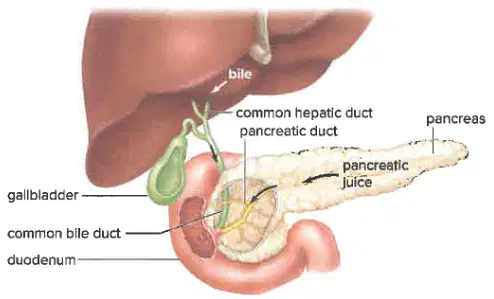
With regard to the second step, the pH of the solution would be lower before or after the enzymatic reaction.
Lower before the enzymatic reaction
Lower after the enzymatic reaction
No change in pH
pH increases after the enzymatic reaction
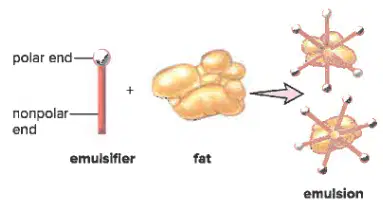
Fill in the blank: In the first step of fat digestion, fat is broken down by bile (emulsifier) to form ________.
fat droplets
amino acids
glucose molecules
protein chains
What role does phenol red play in this experiment?
It acts as a pH indicator.
It serves as a nutrient source.
It is used as a preservative.
It functions as a catalyst.
What role does lipase play in this experiment?
Lipase breaks down fats into fatty acids and glycerol.
Lipase synthesizes proteins from amino acids.
Lipase converts starch into glucose.
Lipase acts as a buffer to maintain pH.

Explain your results in Table 28.2 by giving an explanation why digestion did or did not occur.
Digestion occurred because the necessary enzymes and conditions were present.
Digestion did not occur because the table was incomplete.
Digestion occurred because the food was not present.
Digestion did not occur because the experiment was not performed.
What role did bile salts play in this experiment?
Bile salts acted as emulsifiers to break down fats.
Bile salts served as a source of energy for the reaction.
Bile salts inhibited enzyme activity in the experiment.
Bile salts functioned as a pH buffer in the solution.
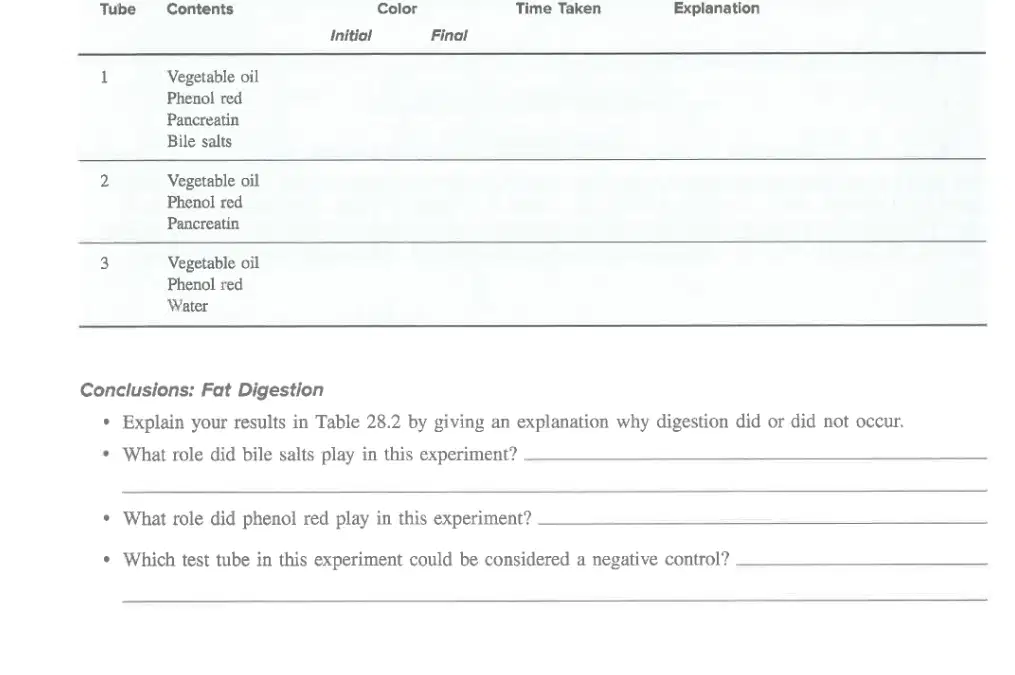
Which test tube in this experiment could be considered a negative control?
Tube 3 (Vegetable oil, Phenol red, Water) is the negative control because it does not contain lipase or bile salts.
Tube 1 (Vegetable oil, Phenol red, Lipase) is the negative control because it contains lipase.
Tube 2 (Vegetable oil, Phenol red, Bile salts) is the negative control because it contains bile salts.
Tube 4 (Vegetable oil, Phenol red, Lipase, Bile salts) is the negative control because it contains both lipase and bile salts.
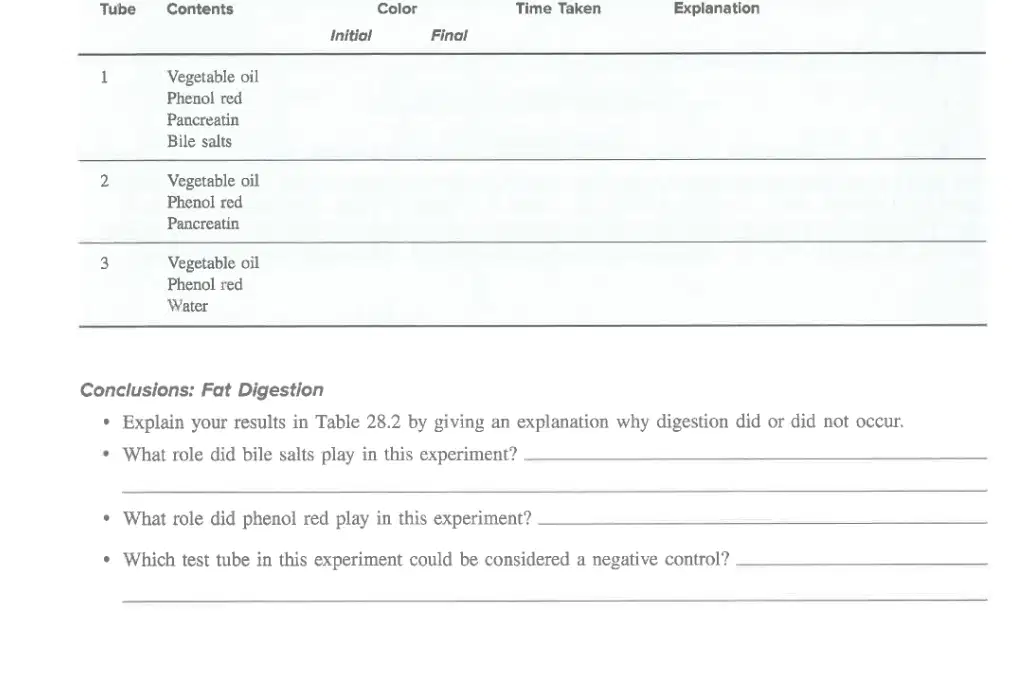
What are the contents of Tube 1 in Table 28.2?
Vegetable oil, Phenol red, Pancreatin, Bile salts
Vegetable oil, Water, Amylase, Bile salts
Vegetable oil, Phenol red, Lipase, Water
Vegetable oil, Phenol red, Trypsin, Bile salts
If digestion does not occur, which will be present—starch or maltose?
starch
maltose
glucose
sucrose
If digestion does occur, which will be present—starch or maltose?
maltose
starch
glucose
cellulose
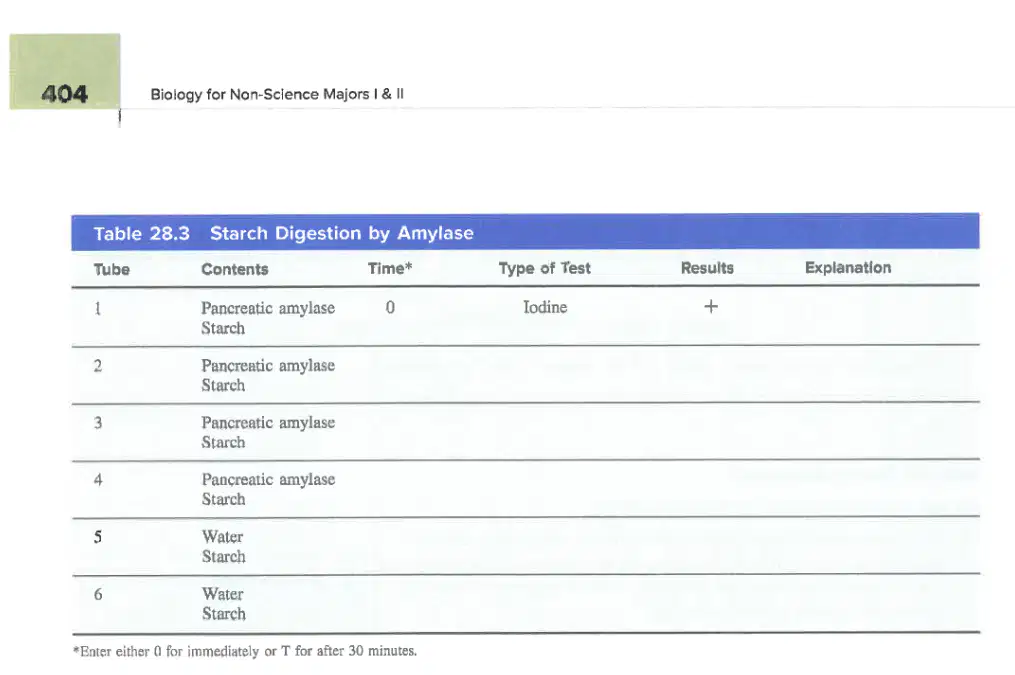
Considering tubes 1 and 2, this experimental procedure showed that __________ must pass for digestion to occur.
time
water
air
light

Considering tubes 5 and 6, this experimental procedure showed that an active __________ must be present for digestion to occur.
enzyme
cell
hormone
vitamin
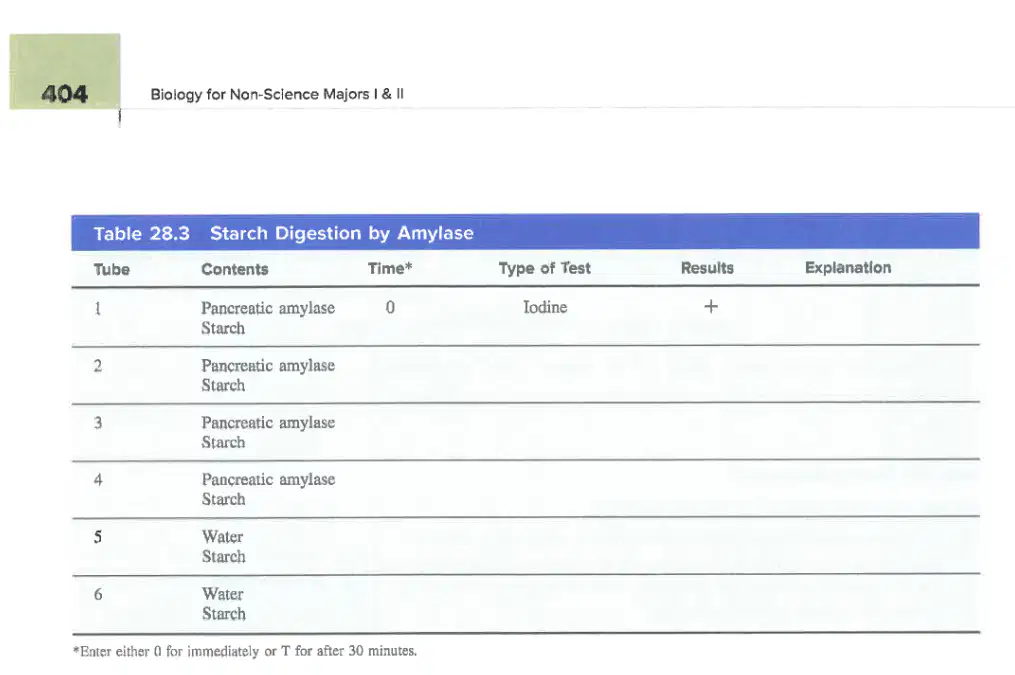
Why would you not recommend doing the test for starch and the test for sugar on the same tube?
Because the results of one test may interfere with the results of the other.
Because both tests require different temperatures.
Because both tests require different chemicals.
Because both tests must be done in the dark.
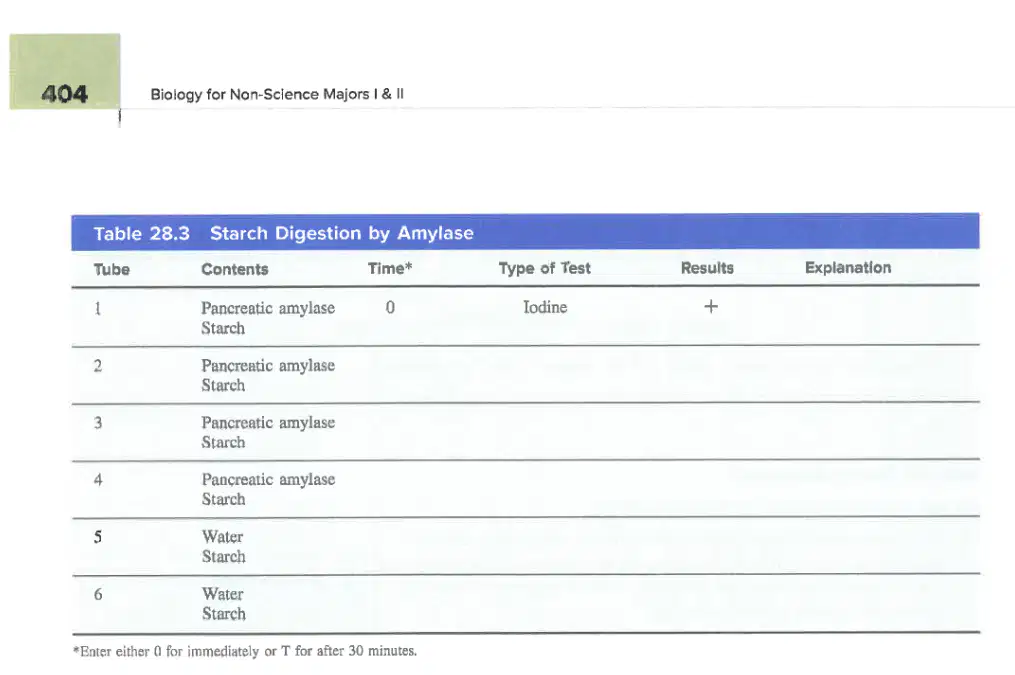
Which test tubes served as a negative control in this experiment? Explain your answer.
Test tubes containing only water and no reactants served as a negative control.
Test tubes with all reactants present served as a negative control.
Test tubes with only enzymes served as a negative control.
Test tubes with only substrate served as a negative control.
Explain how each of the following requirements influences effective digestion: Requirement: Specific enzyme
Specific enzymes catalyze the breakdown of food molecules, making digestion possible.
Specific enzymes prevent the absorption of nutrients in the digestive tract.
Specific enzymes slow down the movement of food through the digestive system.
Specific enzymes increase the acidity of the stomach beyond safe levels.
Explain how each of the following requirements influences effective digestion: Requirement: Specific substrate
Enzymes act only on specific substrates, so the presence of the correct substrate is necessary for digestion.
Enzymes can act on any substrate, so specificity is not important for digestion.
Specific substrates slow down the digestion process.
The presence of any substrate increases enzyme activity regardless of specificity.
Explain how warm temperature influences effective digestion:
Warm temperature increases enzyme activity and speeds up digestion.
Warm temperature decreases enzyme activity and slows down digestion.
Warm temperature has no effect on enzyme activity or digestion.
Warm temperature destroys enzymes and stops digestion.
Explain how each of the following requirements influences effective digestion: Requirement: Specific pH
Enzymes function best at specific pH levels, so the correct pH is necessary for optimal digestion.
Specific pH prevents food from being absorbed in the stomach.
Specific pH increases the temperature of digestive organs.
Specific pH causes food to move faster through the digestive tract.
Explain how each of the following requirements influences effective digestion: Requirement: Time
Adequate time is needed for enzymes to act on substrates and complete digestion.
Time is only important for absorption, not digestion.
Time has no effect on the action of digestive enzymes.
Shorter digestion time always leads to better nutrient absorption.
Explain how each of the following requirements influences effective digestion: Requirement: Fat emulsifier
Fat emulsifiers break down large fat globules into smaller droplets, aiding fat digestion.
Fat emulsifiers increase the acidity of the stomach, speeding up protein digestion.
Fat emulsifiers neutralize digestive enzymes, slowing down carbohydrate absorption.
Fat emulsifiers absorb water, making digestion slower.
The amount of substrate is reduced by which process?
It is converted into product during a chemical reaction.
It is increased by enzyme activity.
It is destroyed by external factors.
It remains unchanged during reactions.
The amount of digestive enzymes is reduced by:
decreased secretion from digestive glands
increased secretion from digestive glands
enhanced absorption in the intestines
improved blood circulation in the stomach
To lose weight, some people with obesity undergo an operation in which (1) the stomach is reduced to the size of a golf ball, and (2) food bypasses the duodenum (first 2 feet) of the intestine. How is time reduced?
Food spends less time in the digestive tract.
The operation takes less time to perform.
Patients recover more quickly after surgery.
Meals take less time to prepare.
What makes the pH of the small intestine higher than before?
The secretion of bile and pancreatic juices
The absorption of nutrients
The presence of stomach acid
The movement of food by peristalsis
Fat emulsification is reduced by:
decreased bile production
increased bile production
enhanced pancreatic enzyme activity
higher stomach acidity
How does surgery to reduce obesity sometimes result in malnutrition?
By reducing the body's ability to absorb nutrients
By increasing appetite for unhealthy foods
By causing excessive weight gain
By improving nutrient absorption
What part of an enzyme allows it to bind to a specific substrate?
The active site.
The cofactor.
The inhibitor site.
The allosteric site.
What two environmental conditions can alter the shape of an enzyme?
Temperature and pH.
Light and sound.
Pressure and gravity.
Salinity and humidity.
Where are carbohydrates first digested by an enzyme?
In the mouth.
In the stomach.
In the small intestine.
In the large intestine.
What organ produces the lipase and amylase that perform digestion in the small intestine?
The pancreas.
The liver.
The stomach.
The gallbladder.
What is the name given to a sample that contains the factor being tested and that goes through all the steps of the experiment?
The experimental group (or test sample).
The control group.
The placebo group.
The variable group.
Describe the environment in which pepsin functions.
Pepsin functions in an acidic environment (low pH, such as in the stomach).
Pepsin functions in a neutral environment (pH around 7, such as in the small intestine).
Pepsin functions in an alkaline environment (high pH, such as in the pancreas).
Pepsin functions in a dry environment (such as outside the digestive tract).
What are the end products of protein digestion?
Amino acids.
Fatty acids.
Glucose.
Nucleotides.
What are the end products of fat digestion?
Fatty acids and glycerol.
Amino acids and glucose.
Starch and cellulose.
Peptides and nucleotides.
What molecule emulsifies fats in the small intestine?
Bile.
Amylase.
Pepsin.
Insulin.
What organ stores bile?
The gallbladder.
The liver.
The pancreas.
The stomach.
What component of foods is digested by pancreatic amylase?
Starch (carbohydrates).
Proteins.
Fats (lipids).
Vitamins.
What molecule is present after pancreatic amylase digests starch?
Maltose (or glucose, depending on the stage of digestion).
Sucrose
Cellulose
Lactose
What two tests were done to test for starch digestion?
Iodine test and Benedict's test.
Biuret test and Sudan III test.
Fehling's test and Barfoed's test.
Millon's test and Xanthoproteic test.
What structures absorb the products of digestion in the small intestine?
Villi (or microvilli).
Alveoli.
Nephrons.
Bronchioles.
It is beneficial to have amylase in two different locations because:
it allows starch digestion to begin in the mouth and continue in the small intestine
it prevents starch from being digested too quickly
it helps in the absorption of proteins
it increases the production of saliva
16. The removal of the gallbladder would impact the digestion of fat in which of the following ways?
Fat digestion would become less efficient due to reduced bile storage.
Fat digestion would improve due to increased bile production.
Fat digestion would not be affected at all.
Fat digestion would stop completely.
Consuming excess antacids might affect protein digestion because:
Antacids neutralize stomach acid, reducing the effectiveness of protein-digesting enzymes.
Antacids increase stomach acid, enhancing protein digestion.
Antacids have no effect on protein digestion.
Antacids directly break down proteins in the stomach.
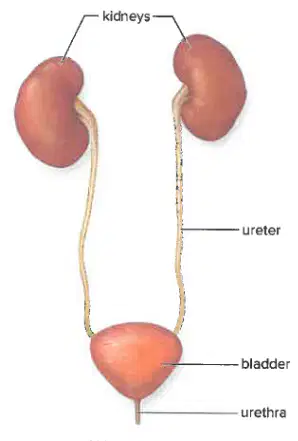
Refer to the labeled diagram of the urinary system. Identify the organ labeled as 'kidneys'.
Kidneys
Bladder
Ureter
Urethra
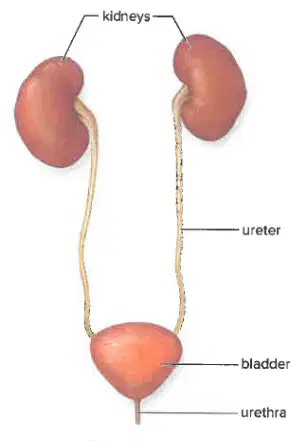
What is the function of the bladder?
The bladder stores urine before it is released to the exterior of the body.
The bladder produces digestive enzymes.
The bladder absorbs nutrients from food.
The bladder pumps blood throughout the body.
State a function of the kidneys in the urinary system.
The kidneys produce urine and regulate the volume and composition of blood, maintaining water and salt balance and acid-base balance.
The kidneys secrete digestive enzymes to break down food.
The kidneys are responsible for pumping blood throughout the body.
The kidneys help in the absorption of nutrients from the small intestine.
What are the male gonads in the mammalian reproductive system?
Testes
Ovaries
Prostate gland
Seminal vesicles
What are the female gonads in the mammalian reproductive system?
Ovaries
Testes
Uterus
Fallopian tubes
Compare the function of the testes and ovaries in the mammalian reproductive system.
The testes produce sperm, and the ovaries produce oocytes (eggs).
The testes produce oocytes, and the ovaries produce sperm.
Both the testes and ovaries produce only hormones.
The testes and ovaries have no role in reproduction.
The urinary system and reproductive system are often considered together as the urogenital system in mammals.
True
False
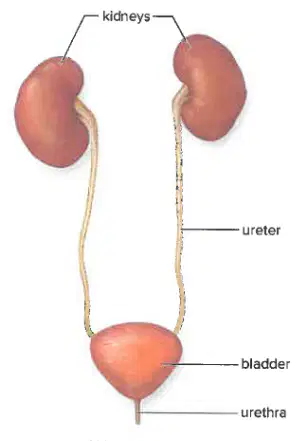
Match the following organs to their functions:
Stores urine
A-2
Produces urine and regulates blood composition
B-1
Transports urine from kidneys to bladder
C-3
Releases urine to the exterior of the body
D-4
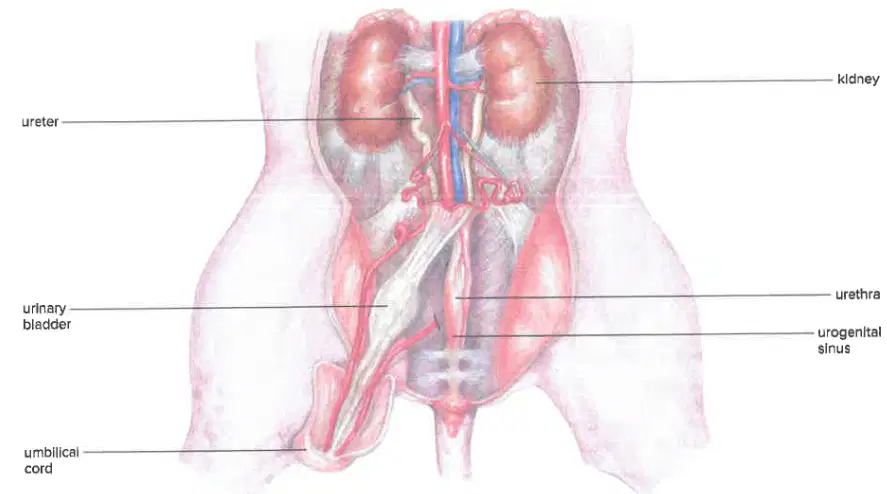
In the female fetal pig, what is the name of the organ labeled as the structure that filters blood and produces urine?
kidney
liver
heart
lung
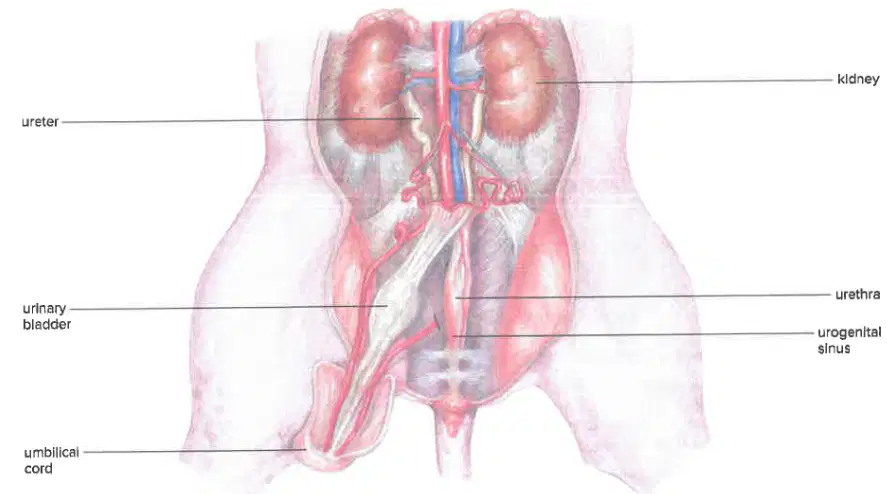
In the female fetal pig, what is the name of the tube that carries urine from the kidney to the bladder?
ureter
urethra
oviduct
vas deferens

In the female fetal pig, what is the name of the organ that stores urine before it is excreted?
urinary bladder
ovary
large intestine
gallbladder
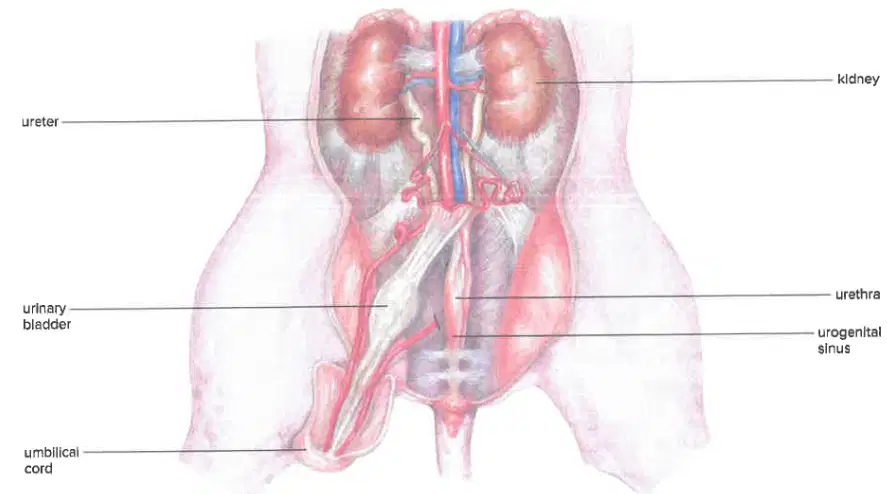
In the female fetal pig, what is the name of the tube through which urine is excreted from the body?
urethra
oviduct
esophagus
rectum
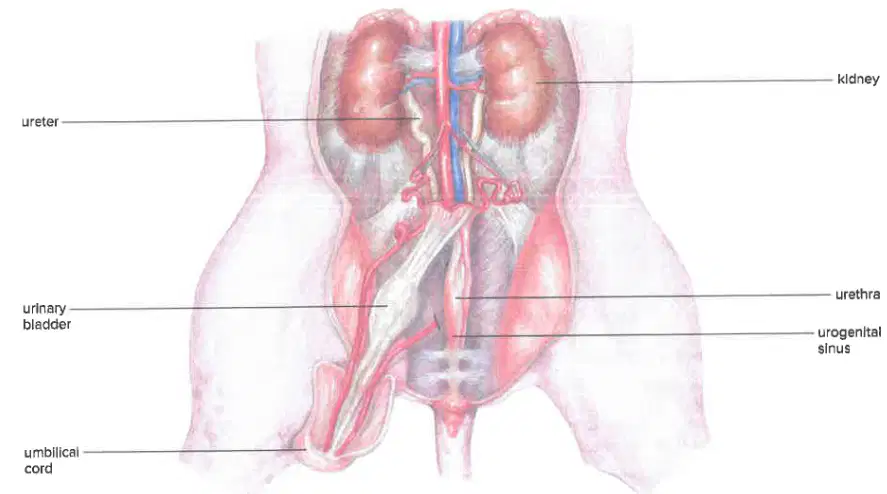
In the female fetal pig, what is the name of the structure that connects the fetus to the placenta?
umbilical cord
fallopian tube
oviduct
uterus
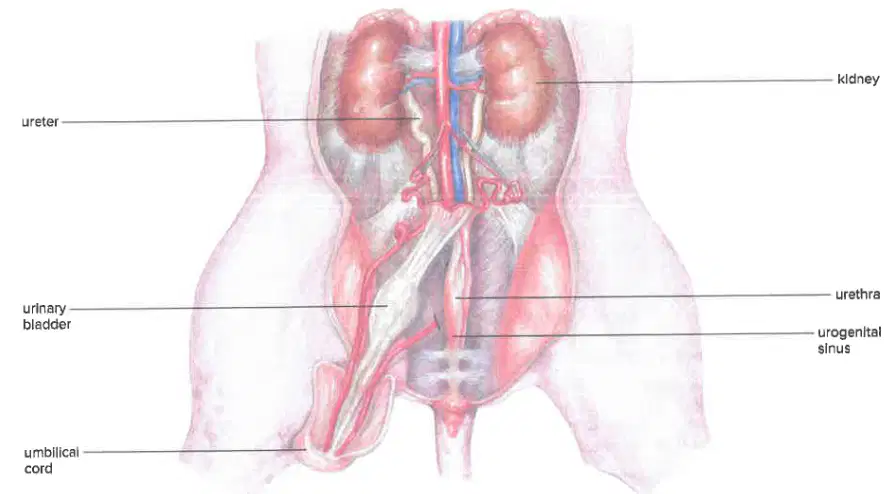
In the female fetal pig, what is the name of the cavity into which the urethra opens?
urogenital sinus
vagina
rectum
oviduct
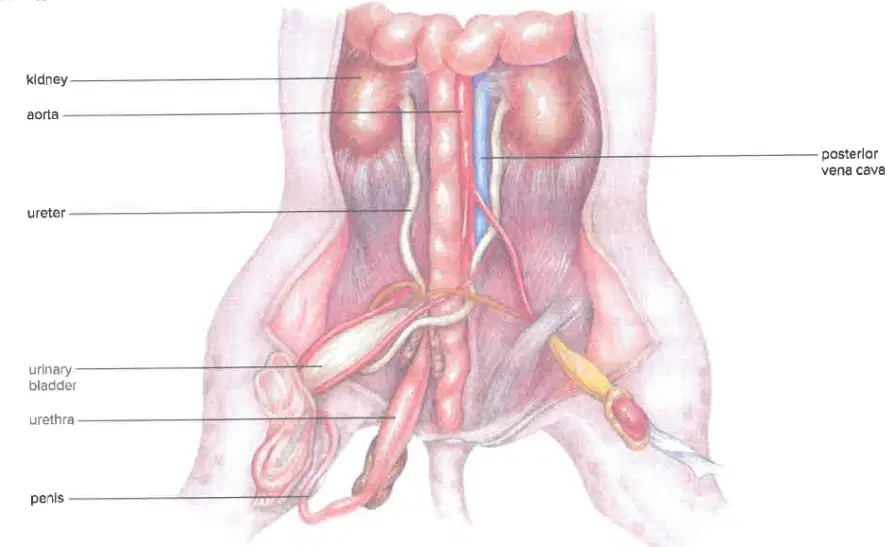
In the male fetal pig, what is the name of the organ labeled as the structure that filters blood and produces urine?
kidney
liver
heart
lung
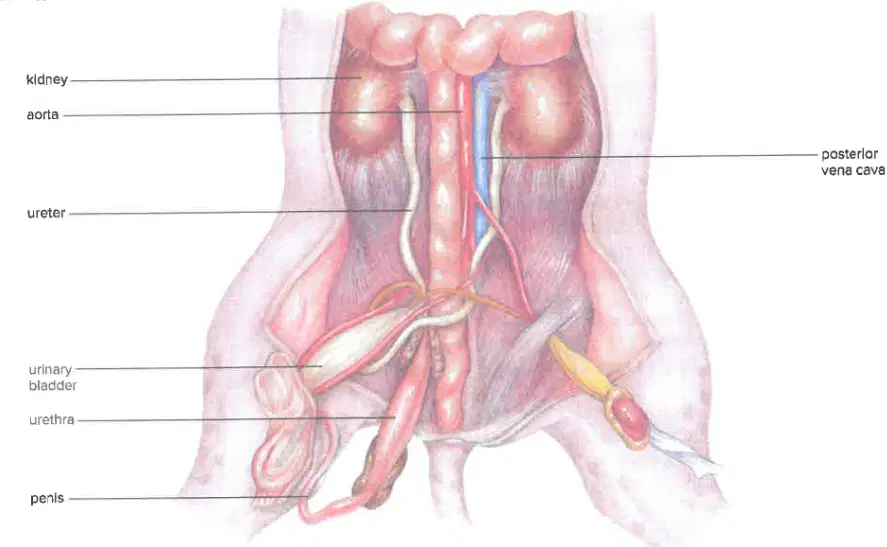
In the male fetal pig, what is the name of the large artery that carries blood from the heart to the rest of the body?
aorta
pulmonary vein
vena cava
carotid artery
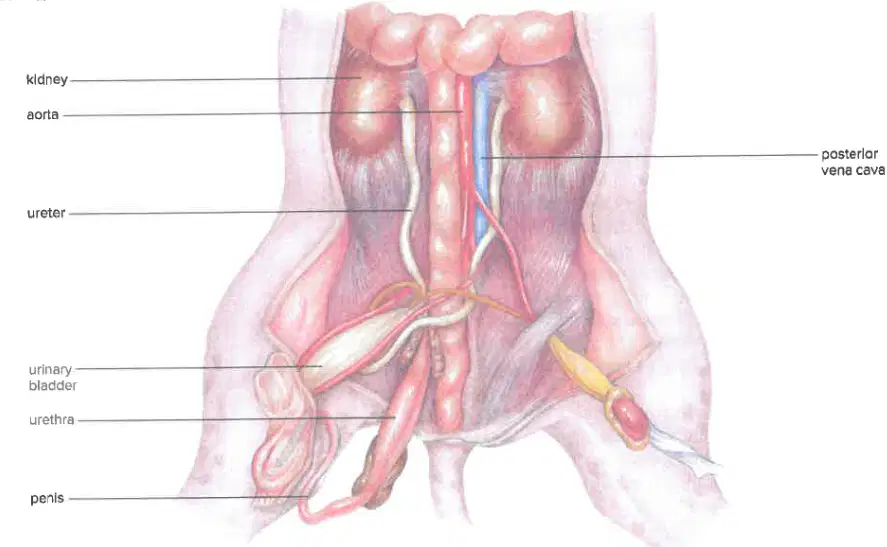
In the male fetal pig, what is the name of the tube that carries urine from the kidney to the bladder?
ureter
urethra
vas deferens
fallopian tube
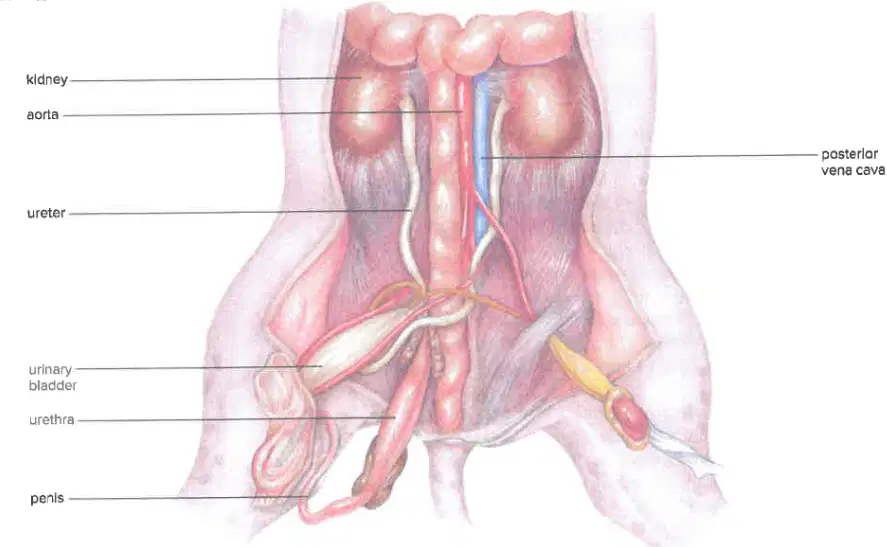
In the male fetal pig, what is the name of the organ that stores urine before it is excreted?
urinary bladder
kidney
ureter
testis
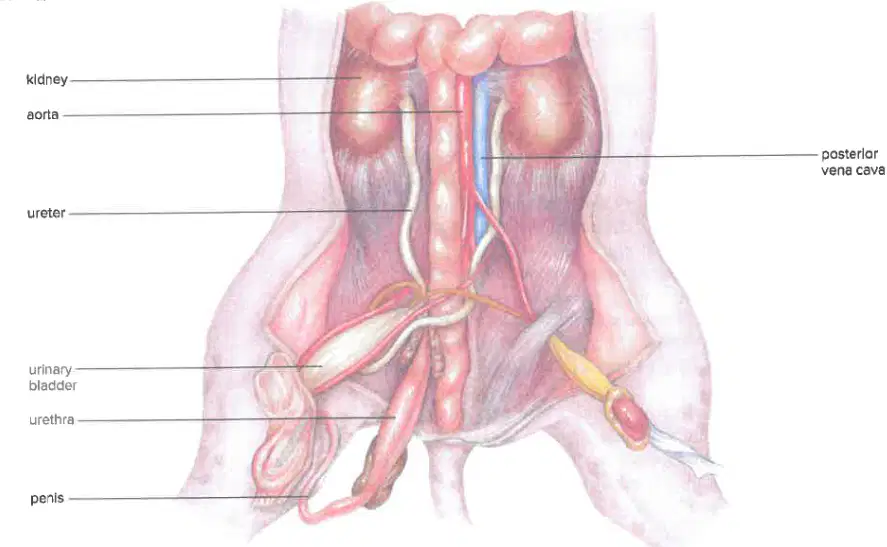
In the male fetal pig, what is the name of the tube through which urine is excreted from the body?
urethra
vas deferens
esophagus
trachea
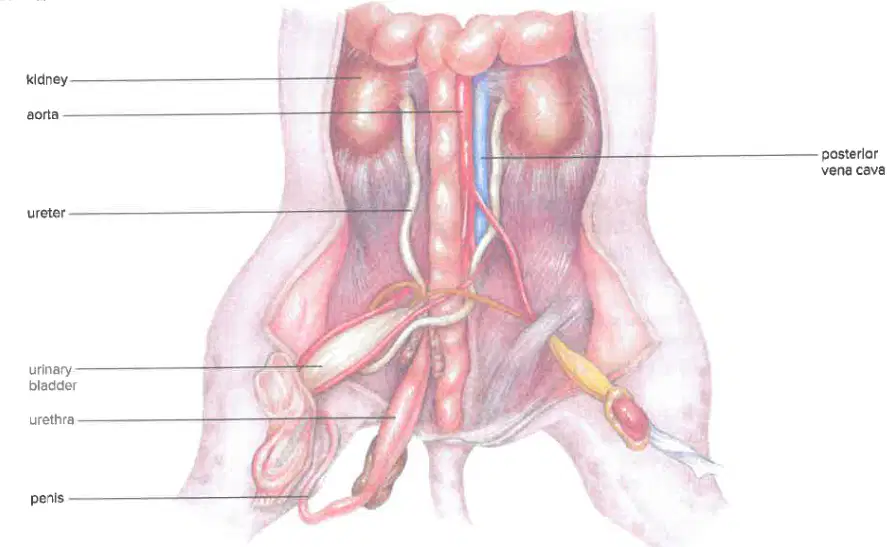
In the male fetal pig, what is the name of the organ that is part of the reproductive system and is labeled in the diagram?
penis
liver
heart
kidney
In the male fetal pig, what is the name of the large vein that returns blood to the heart from the lower body?
posterior vena cava
aorta
pulmonary vein
hepatic vein

Match the following anatomical terms with their correct description as shown in Figure 29.2 Anatomy of the kidney:
Renal cortex
The outermost portion of the kidney
Renal medulla
The inner region containing renal pyramids
Renal pelvis
The cavity-like reservoir at the center of the kidney
Ureter
The tube that carries urine from the kidney to the bladder
Nephrons
Microscopic tubules that produce urine
Fill in the blank: The urinary system consists of the kidneys, which produce urine; the ________, which transport urine to the urinary bladder; where urine is stored; and the ________, which transports urine to the outside.
ureters, urethra
urethra, ureters
bladder, ureters
ureters, bladder
Which part of the kidney contains many small striations perpendicular to the outer surface?
Renal pelvis
Renal cortex
Renal medulla
Ureter
The function of nephrons in the kidney is:
to filter blood and form urine
to produce insulin
to transport oxygen
to digest proteins
Fill in the blank: The large, paired kidneys are reddish organs covered by ________, a membrane that anchors them to the dorsal wall of the abdominal cavity.
peritoneum
pleura
meninges
pericardium
The urinary bladder normally lies in the ventral portion of the abdominal cavity.
True
False
Match the male reproductive organs with their functions as listed in Table 29.1:
Produces sperm and sex hormones
Testis
Stores sperm as they mature
Epididymis
Conducts and stores sperm
Vas deferens
Contributes secretions to semen
Seminal vesicle
Contributes secretions to semen
Prostate gland
The _______ is the male organ of sexual intercourse.
penis
uterus
ovary
vagina
Which organ stores sperm as they mature?
Testis
Epididymis
Vas deferens
Urethra
Which gland contributes secretions to semen and is located on the dorsal surface of the urethra, just posterior to the urinary bladder?
Seminal vesicle
Prostate gland
Bulbourethral gland
Epididymis
The vas deferens conducts and stores sperm.
True
False
Fill in the blank: The descent of the testes from the body cavity into the scrotal sacs is called the _______.
descent of the testes
ascent of the testes
migration of the ovaries
rotation of the scrotum
Trace the urethra as it leaves the bladder. When it nears the end of the abdominal cavity, it turns rather abruptly and runs anteriorly just under the skin where you have just dissected it. This portion of the urethra is within the penis.
This portion of the urethra is within the penis.
This portion of the urethra is within the rectum.
This portion of the urethra is within the kidney.
This portion of the urethra is within the stomach.
Now, you should be able to see the vasa deferentia enter the urethra. If necessary, free these structures from surrounding tissue to see them enter the urethra near the location of the prostate gland. In males, the urethra transports sperm and urine to the urogenital opening.
In males, the urethra transports sperm and urine to the urogenital opening.
In males, the urethra only transports urine to the urogenital opening.
In males, the urethra only transports sperm to the urogenital opening.
In males, the urethra transports blood to the urogenital opening.
Sequence the organs in the male reproductive system to trace the path of sperm from the organ of production to the penis.
Testes → Epididymis → Vas deferens → Urethra → Penis
Testes → Vas deferens → Epididymis → Urethra → Penis
Penis → Urethra → Vas deferens → Epididymis → Testes
Epididymis → Testes → Vas deferens → Urethra → Penis
Complete Table 29.2, which compares the location of the penis in these two mammals:
Fetal Pig: The penis lies beneath the skin and exits at the urogenital opening. Human: The penis is external and exits at the urogenital opening.
Fetal Pig: The penis is external and exits at the urogenital opening. Human: The penis lies beneath the skin and exits at the urogenital opening.
Fetal Pig: The penis is external and does not exit at the urogenital opening. Human: The penis is beneath the skin and does not exit at the urogenital opening.
Fetal Pig: The penis lies beneath the skin and does not exit at the urogenital opening. Human: The penis is external and does not exit at the urogenital opening.

