
 Worksheets
Layers of the Earth and Tectonic Plates Review
Total questions: 68
Worksheet time: 35mins
Scientists separate Earth's layers in two different ways. Which pair correctly names these two classification methods?
Chemical and Thermal Layers
Compositional Layers and Mechanical (Structural) Layers
Crustal and Core Layers
Surface and Deep Layers
Which classification focuses on what materials each layer is made of?
Mechanical (Structural) layers
Compositional layers
Tectonic layers
Seismic layers
Which classification describes the nature or physical behavior of a layer (rigid, plastic-like, liquid, solid)?
Compositional layers
Mechanical (Structural) layers
Geologic time layers
Radiometric layers
Which set of elements is characteristic of Earth's crust?
Silica, Oxygen, Aluminum, Iron
Silica, Oxygen, Magnesium, Iron
Iron and Nickel
Carbon, Hydrogen, Nitrogen, Oxygen
Which set of elements is characteristic of Earth's mantle?
Silica, Oxygen, Aluminum, Iron
Silica, Oxygen, Magnesium, Iron
Iron and Nickel
Silica, Oxygen, Sodium, Potassium
Which elements dominate Earth's core?
Silica and Oxygen
Iron and Nickel
Magnesium and Calcium
Aluminum and Silicon
What is a key importance of Earth's core?
It forms most of Earth's crustal rocks
It creates the magnetic field that shields Earth from solar winds
It stores most of Earth's surface water
It powers plate tectonics directly through rigid motion
Which description of the mechanical layers are correct?
Outer Core: 2900–5100 km; Asthenosphere: 100–350 km; Inner Core: 5100–6370 km; Lithosphere: 0–100 km; Mesosphere: 350–2900 km
Outer Core: 100–350 km; Asthenosphere: 2900–5100 km; Inner Core: 0–100 km; Lithosphere: 350–2900 km; Mesosphere: 5100–6370 km
Outer Core: 0–100 km; Asthenosphere: 350–2900 km; Inner Core: 2900–5100 km; Lithosphere: 100–350 km; Mesosphere: 5100–6370 km
Which order of the mechanical layers are correct?
Outer Core: 2900–5100 km; Asthenosphere: 100–350 km; Inner Core: 5100–6370 km; Lithosphere: 0–100 km; Mesosphere: 350–2900 km
Outer Core: 100–350 km; Asthenosphere: 2900–5100 km; Inner Core: 0–100 km; Lithosphere: 350–2900 km; Mesosphere: 5100–6370 km
Lithosphere: 100–350 km; Asthenosphere: 350–2900 km; Mesosphere: 5100–6370 km; Outer Core: 0–100 km;
Inner Core: 2900–5100 km;
Which mechanical layer is described as rigid?
Lithosphere
Asthenosphere
Mesosphere
Outer Core
Which mechanical layer is described as soft plastic-like?
Lithosphere
Asthenosphere
Inner Core
Outer Core
Which mechanical layer is liquid?
Inner Core
Outer Core
Asthenosphere
Lithosphere
Which mechanical layer is solid?
Outer Core
Asthenosphere
Inner Core
Mesosphere
Which types of rocks are stated to form typically in the crust?
Granite and obsidian
Peridotite and eclogite
Basalt and gabbro only
Sandstone and limestone only
Which types of rocks are stated to form typically in the mantle?
Granite and obsidian
Peridotite and eclogite
Sandstone and shale
Basalt and rhyolite
How are magnetic fields produced in Earth's core according to the material?
By the evaporation of water in the mantle
By molten iron colliding and moving, along with Earth's rotation
By radioactive decay in the crust only
By friction between tectonic plates
Which mechanical layer causes plate movement according to the material?
Lithosphere
Asthenosphere
Mesosphere
Inner Core
In which mechanical layer(s) does convection occur according to the material?
Lithosphere only
Asthenosphere and Mesosphere
Mesosphere and Outer Core
Inner Core only
Why is the inner core supposedly solid according to the material?
It is the coldest part of Earth
It has a large amount of pressure from the upper layers
It contains mostly silica which crystallizes
It is isolated from Earth's rotation
What two pieces of evidence lead scientists to infer characteristics of layers we cannot reach directly?
Volcanoes and glaciers
Ocean tides and wind patterns
Meteorites and earthquakes
Mountains and river erosion

Refer to the diagram labeled “Compositional Properties.” Which compositional layer is the thin, outermost shell indicated by the arrow labeled 20?
Crust
Mantle
Core
Asthenosphere
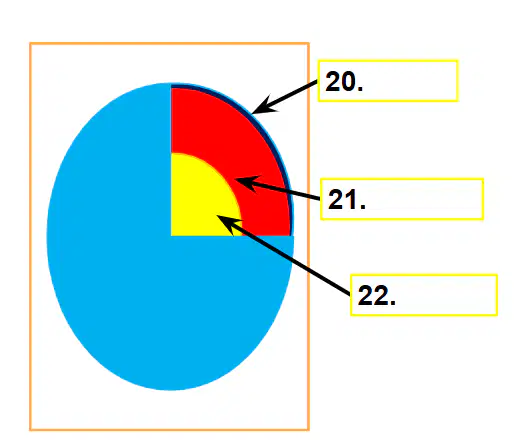
In the “Compositional Properties” diagram, which layer occupies the largest volume between the crust and the core and is labeled 21?
Crust
Mantle
Core
Lithosphere
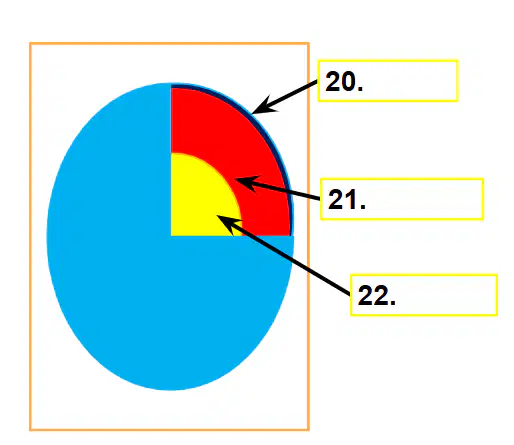
Using the “Compositional Properties” diagram, which layer is located at the very center of Earth and is labeled 22?
Crust
Mantle
Core
Mesosphere
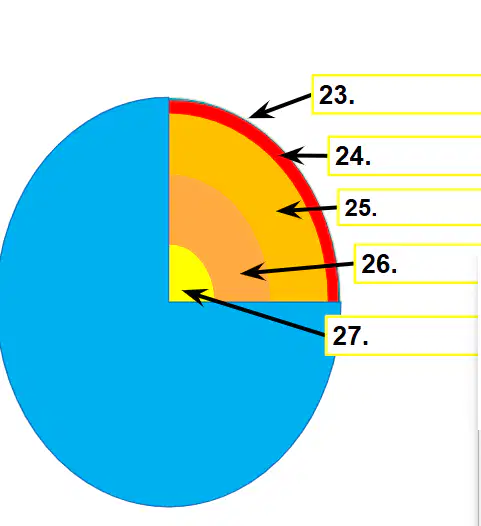
Refer to the diagram titled “Physical Properties.” Which physical layer includes the rigid outer shell of Earth and is labeled 23?
Lithosphere
Asthenosphere
Mesosphere
Inner Core

In the “Physical Properties” diagram, which layer is immediately beneath the lithosphere, behaves plastically, and is labeled 24?
Mesosphere
Asthenosphere
Outer Core
Crust
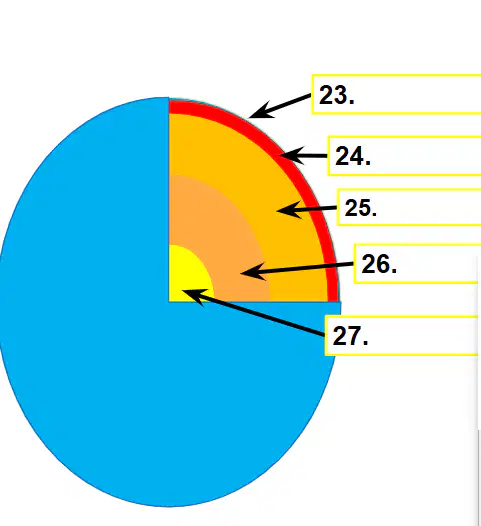
Based on the “Physical Properties” diagram, which layer is the deep, solid center labeled 27?
Outer Core
Inner Core
Asthenosphere
Mantle
Which statement best distinguishes the outer core from the mesosphere of the Mechanical Layers?
The outer core is liquid while the mesosphere is a rigid part of the mantle.
The outer core is part of the crust while the mesosphere is part of the core.
The outer core lies above the lithosphere while the mesosphere lies below the inner core.
The outer core is brittle while the mesosphere is molten rock of the crust.
Which pairing correctly matches a compositional layer with its dominant physical counterpart?
Crust — Asthenosphere
Mantle — Lithosphere
Core — Mesosphere
Core — Outer Core and Inner Core
Who proposed the theories of Continental Drift and Pangea?
Harry Hess
Alfred Wegener
Charles Darwin
Marie Tharp
Which set lists three pieces of evidence supporting the Theory of Pangea?
Ocean currents, trade winds, and monsoons
Geometric fit of continents, fossil and geologic record, and ancient climates
Volcano locations, earthquake depths, and river erosion
Magnetic reversals, sea-floor ages, and GPS plate speeds
What does the concept of geometric fit suggest about Earth’s continents?
Continents have always been in their current positions
All continents were once connected as a single landmass
Continents formed independently from volcanic islands
Only some continents were connected during ice ages
How do fossils and geologic records support geometric fit as evidence for Pangea?
They show identical fossils only on islands far from continents
They show organisms found on different continents in areas that would align if connected, and landforms line up across continents
They show fossils mostly in oceans, proving sea-floor spreading
They show that all continents share the exact same rock types everywhere
Which natural archives recorded Earth’s ancient climate in multiple ways?
Tree rings, coral reefs, glaciers, and lake sediment
Sand dunes, volcanoes, deserts, and beaches
Storm tracks, jet streams, tides, and waves
Lightning strikes, auroras, eclipses, and meteor showers
Why was Wegener’s Theory of Pangea initially not accepted?
He lacked maps of the ocean floor
He could not explain the force causing continents to move
His fossil evidence was later proven fake
He claimed Earth’s radius was shrinking
What are tectonic plates according to the review?
Liquid magma layers moving beneath the crust
Solid lithospheric rock moving on the upper portion of the asthenosphere
Large slabs of ocean water pushing continents
Rigid blocks fixed in place since Earth formed
What drives the movement of tectonic plates?
Solar radiation heating the atmosphere
Convection of molten rock in the asthenosphere
Impacts from meteorites
Changes in Earth’s magnetic field
Which statement accurately describes convection in the asthenosphere?
Molten rock sinks when heated and rises when cooled
Molten rock rises when heated by the inner core and sinks as it cools near the top of the asthenosphere
Molten rock moves only horizontally due to wind-driven currents
Molten rock stays stationary while plates slide over it
Do convection currents all move in the same direction?
Yes, they all move clockwise
Yes, they all move counterclockwise
No, they circulate in different directions
They do not move at all
Which list correctly names the three types of plate boundaries?
Subducting, uplifting, and rifting
Convergent, divergent, and transform
Normal, reverse, and strike-slip
Passive, active, and compressional
At which plate boundary do plates move toward each other?
Divergent boundary
Transform boundary
Convergent boundary
Passive boundary
What can happen at a convergent boundary that creates mountains and trenches?
Sea-floor spreading forms ridges
Subduction slides one plate under another forming trenches, or both plates push upward forming mountains
Plates move past each other without vertical motion
Hotspots punch through plates to make plateaus
How can volcanoes form at convergent boundaries?
Magma rises during subduction and may erupt
Wind carries ash that hardens into volcanoes
Radiation from the core melts the crust uniformly
Erosion exposes magma chambers at passive margins
What typically happens at divergent boundaries, and what can result?
Plates collide, causing deep trenches
Plates move away, magma rises and cools to create new land; slow pulling can form a rift
Plates slide past, producing only heat with no faults
Plates stack vertically, creating folded plateaus
What is a transform boundary and what can it cause?
A boundary where plates separate; it causes rifts
A boundary where plates collide; it causes mountain ranges
A boundary where plates move and rub against each other; it causes friction, stress, faults, and earthquakes
A boundary where plates sink into the mantle; it causes island arcs
Why is the area along the Pacific Ocean called the Ring of Fire, and how does it relate to plate boundaries?
It marks the warmest ocean currents on Earth
It is where most earthquakes and volcanoes occur, largely formed by subducting plates and numerous boundaries
It is a region with constant flooding and hurricanes
It is a zone of continuous continental rifting only
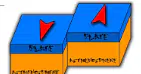
Identify the boundary type shown in the diagram: two plates sliding horizontally past each other with arrows in opposite directions.
Transform boundary
Divergent boundary
Convergent boundary
Hotspot boundary
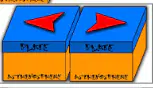
Identify the boundary type shown in the diagram: two plates moving away from each other with arrows pointing outward and magma rising between them.
Transform boundary
Divergent boundary
Convergent boundary
Subduction zone boundary
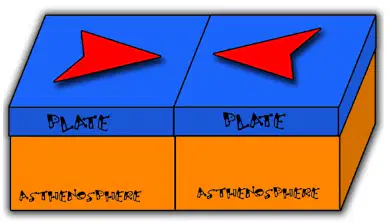
Identify the boundary type shown in the diagram: two plates moving toward each other with one descending beneath the other?
Transform boundary
Divergent boundary
Convergent boundary
Rift boundary


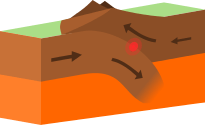
What type of plate boundary is this?
Plate
Divergent
Convergent
Transform
What is happening in the diagram?
Subduction
Reduction
Converging
Transforming


Which boundary type does this represent?
Divergent/spreading
Converging/colliding
transform/Fault
None of the above

This is a map of the Earth's _______.
plates
Ring of Fire
earthquakes
volcanoes

What happens at a transform plate boundary?
Two tectonic plates pulls away from one another.
Two tectonic plates push towards one another.
Two tectonic plates slide against each other.

What boundary creates a trench?
What is the primary force that drives the movement of the Earth's tectonic plates?
The Earth's rotation
Magnetic fields
Movement in the mantle
Gravitational pull from the sun
Which of the following is NOT a result of plate tectonics?
Earthquakes
Volcanoes
Formation of mountains
Formation of the moon
Which layer of the Earth is broken into several large tectonic plates?
Crust
Mantle
Core
Lithosphere

Which layer of Earth is plastic (silly putty)?


What is the correct order (starting from the surface) of Earth’s layers?
crust, outer core, inner core, mantle
mantle, outer core, inner core, crust
crust, mantle, outer core, inner core
outer core, inner core, crust, mantle

The most dense layer of the Earth is:
Crust
Mantle
Core


holding it together


