
 Worksheets
Energy and ATP Mod 3
Total questions: 77
Worksheet time: 39mins
Cells use adenosine triphosphate (ATP) as an energy currency. Based on the instructional text, which statement best explains how cells obtain the energy to make ATP?
Energy is absorbed directly from sunlight by every cell to form ATP
Energy is released by breaking the bonds in food molecules and is used to make ATP
Energy comes from spontaneous generation of ATP without inputs
Energy is taken only from oxygen gas during breathing to synthesize ATP
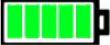
Which description correctly distinguishes ATP from ADP in terms of cellular energy status?
ATP is the drained battery, ADP is the charged battery
Both ATP and ADP are charged batteries with equal energy
ATP is the charged battery, ADP is the drained battery
ADP carries more energy than ATP because it has fewer phosphates
Select all statements that accurately describe ATP’s role in cells.
ATP supplies energy to cells where it is needed
ATP is made using energy released from food
ATP is a structural component of cell membranes
ATP molecules are like batteries for cells
Match each term to its description of energy state.
ATP
Charged battery that can supply energy
ADP
Drained battery with less available energy
Food bond energy
Source of energy released when bonds are broken
According to the diagram showing ATP and ADP cycling, what change accompanies the conversion of ATP to ADP during cellular work?
Energy is stored and the battery becomes more charged
Energy is released to power processes, reducing ATP to ADP
No energy change occurs; ATP and ADP interconvert without consequences
Energy is absorbed from the environment to convert ATP into ADP
Which statement best defines metabolism in living organisms?
The mechanical movement of muscles during locomotion
The biochemical reactions within a living organism that maintain life
The electrical signaling between neurons in the nervous system
The passive diffusion of gases across respiratory membranes
Identify the correct description of a catabolic reaction.
Formation of complex macromolecules from simple subunits, consuming energy
Equilibrium processes that neither consume nor release energy
Breakdown of larger molecules into smaller subunits with the release of energy
Transfer of electrons without any change in molecular size
Select all statements that accurately describe anabolic reactions.
They synthesize larger molecules from smaller building blocks.
They require an input of energy to proceed.
They release heat by breaking down macromolecules.
They are the only reactions occurring in metabolism.
Match each pathway type to its primary outcome.
Catabolic pathways
Release energy by breaking down molecules
Anabolic pathways
Build macromolecules from cellular building blocks using energy
Coupled reactions
Link energy release to energy-requiring synthesis
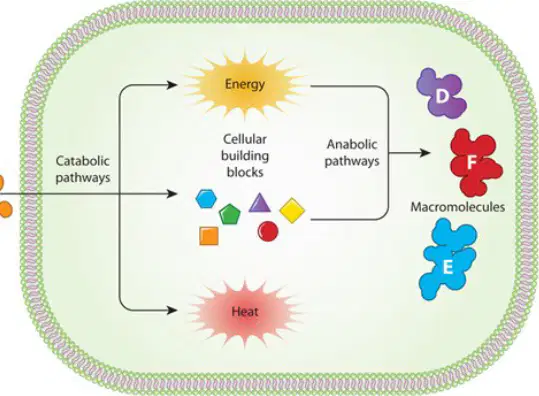
Based on the diagram of pathways within a cell, which statement explains why catabolic and anabolic reactions are described as coupled?
Energy released from catabolic pathways drives anabolic synthesis within the same cellular context.
Coupling refers to reactions occurring simultaneously without energy transfer.
Catabolic reactions only occur inside mitochondria, while anabolic reactions occur in the nucleus.
Coupling means catabolic reactions stop when anabolic reactions start.
Define metabolic rate in one sentence and choose the best option that matches this definition: "the amount of energy (calories) spent in a certain time."
Energy stored in fat over a lifetime
Energy used by the body per unit time
Number of calories in a meal
Heat produced during exercise only
Which statement best distinguishes Basal Metabolic Rate (BMR) from Resting Metabolic Rate (RMR)?
BMR includes energy for digestion, whereas RMR excludes it.
BMR is measured during fasting and reflects basal life-sustaining functions; RMR includes energy burned while resting all day, including digestion.
BMR is higher than RMR in all individuals.
BMR is only affected by physical activity level, whereas RMR is only affected by age.
Multi-select: Which factors are explicitly part of the Harris–Benedict BMR formula? Select all that apply.
Weight (in lbs)
Height (in inches)
Age
Daily physical activity level
According to the instructional text, what does a higher BMR imply for daily energy needs?
You need fewer calories per day because your body is more efficient.
You need more calories per day because your body expends more energy at rest.
Caloric needs remain unchanged; BMR does not affect them.
You should avoid eating breakfast to lower BMR.
Match each term to its description.
Basal Metabolic Rate (BMR)
Calories burned during fasting while performing basic life-sustaining functions
Resting Metabolic Rate (RMR)
Calories burned if you stayed in bed all day, including digestion
Metabolic rate
Amount of energy (calories) spent in a certain time
Which statement about individual variation in metabolic rates is supported by the material?
Metabolic rates are nearly identical across healthy adults.
Metabolic rates can vary greatly between individuals due to genetics and hormones.
Variation in metabolic rates occurs only with changes in physical activity.
Metabolic rate variation is too small to affect daily caloric needs.
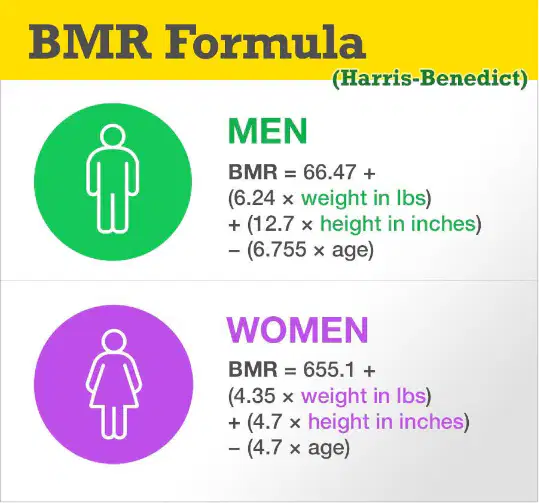
The Harris–Benedict equations differ for men and women. Which option correctly reflects this difference as described?
Men’s equation uses a larger constant and smaller coefficients for weight and height than women’s.
Women’s equation uses a larger constant and smaller coefficients for weight and height than men’s.
Both equations use the same constants and coefficients but different units.
Only the men’s equation includes age.
Which of the following is NOT included in the general BMR formula according to the material?
Sex
Age
Height
Genetics and hormones
Which statement best defines digestion as introduced in this section?
Conversion of nutrients directly into blood or lymph without breakdown
Mechanical and chemical breakdown of large food molecules into smaller subunits
Elimination of undigested waste through the anus
Selective absorption of vitamins by intestinal cells
According to the overview, where does the process of digestion primarily occur?
Respiratory system
Circulatory system
Digestive system (gastrointestinal tract)
Urinary system
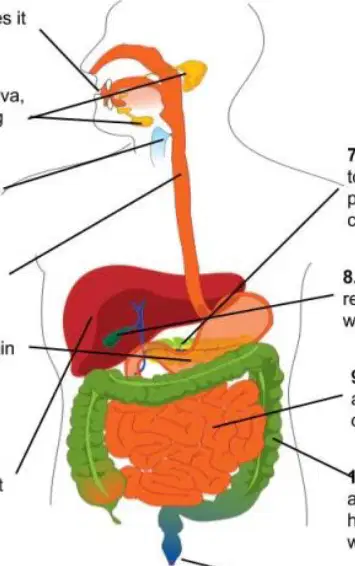
Which organs are correctly matched to the function described in the summary diagram?
Stomach
Mixes and churns food with gastric juice to create chyme
Pancreas
Releases bicarbonate and enzymes that digest macromolecules
Gallbladder
Stores bile and releases it into the small intestine when needed
Small intestine
Digests food and absorbs nutrients into blood or lymph
Which processes are part of digestion, as defined in the Functions list? Select all that apply.
Chewing to mechanically break down food
Secretion of enzymes or acid for chemical breakdown
Transport of absorbed nutrients into blood or lymph
Elimination of non-absorbed waste
Absorption in the digestive system is best described as which of the following?
Uptake of basic building blocks through cells lining the GI tract into blood or lymph
Release of bicarbonate to neutralize stomach acid
Physical churning of food with gastric juice to form chyme
Removal of undigested material from the body
Which statement accurately differentiates excretion from elimination of microbes in the digestive system?
Excretion involves microbial killing; elimination of microbes removes non-absorbed waste
Excretion is removal of non-absorbed waste; elimination of microbes protects GI tract cells with immune help
Both refer to absorption of nutrients into blood or lymph
Elimination of microbes is purely mechanical with no immune involvement
Which sequence correctly orders the fate of food molecules from ingestion to availability for cells, based on this section?
Absorption → Digestion → Excretion → Elimination of microbes
Digestion → Absorption → Excretion
Excretion → Absorption → Digestion
Elimination of microbes → Excretion → Digestion
Mechanical digestion involves physical processes that break food down without changing its chemical composition. Which process best exemplifies mechanical digestion in the stomach?
Pepsin hydrolyzing protein into peptides
Peristaltic contractions mixing and grinding chyme
Lipase cleaving triglycerides into fatty acids
Lactase splitting lactose into glucose and galactose
Peristalsis is described as rhythmic squeezing that moves food through the GI tract. Which statement most accurately characterizes peristalsis?
Voluntary waves of contraction initiated by skeletal muscle
Segmental contractions that only occur in the mouth
Involuntary, coordinated smooth muscle contractions that propel contents forward
A chemical process that digests macromolecules into monomers
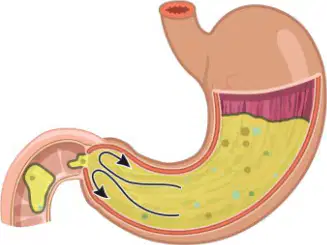
Identify the stage of mechanical processing depicted when stomach contents are driven toward the pylorus and then forced back for further mixing. Refer to the diagram.
Propulsion
Grinding
Retropulsion
Segmentation
Which combination correctly pairs a digestive enzyme with its primary substrate?
Amylase — lipids
Lipase — starch
Pepsin — proteins
Sucrase — lactose
Select all enzyme–substrate pairings that are accurate according to the material.
Amylase — starch (carbohydrate)
Lipase — lipids (fats)
Lactase — sucrose (table sugar)
Peptidase/protease — peptides (proteins)
Enzymes in chemical digestion are proteins that speed up reactions. Which feature explains their role in digestion?
They raise activation energy, slowing reaction rates
They function as biological catalysts to accelerate hydrolysis
They are carbohydrates that neutralize stomach acid
They mechanically grind food via peristaltic motion
Match each enzyme to the nutrient it primarily acts upon.
Amylase
Starch (carbohydrate)
Lipase
Lipids (fats)
Sucrase
Sucrose (table sugar)
Lactase
Lactose (milk sugar)

In the stomach, pepsin works in gastric juice to convert proteins into peptides. Which option best completes the statement: "Pepsin acts on _____ to produce _____"?
Starch; maltose
Proteins; peptides
Lipids; glycerol
Sucrose; glucose and fructose
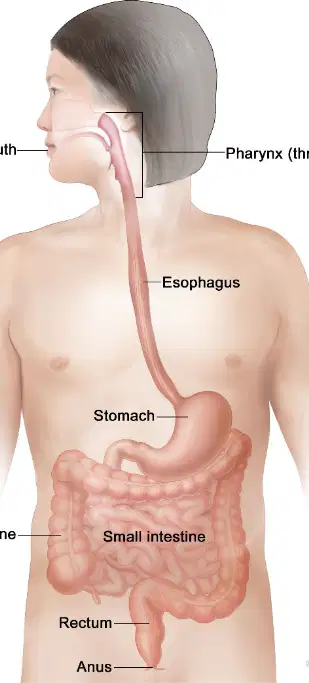
Refer to the labeled digestive tract diagram. Which sequence lists only major parts of the gastrointestinal tract in the correct oral-to-anal order?
Mouth → esophagus → stomach → small intestine → large intestine → rectum → anus
Mouth → pharynx → trachea → stomach → large intestine → rectum → anus
Mouth → esophagus → pancreas → small intestine → liver → rectum → anus
Mouth → stomach → esophagus → small intestine → large intestine → anus → rectum
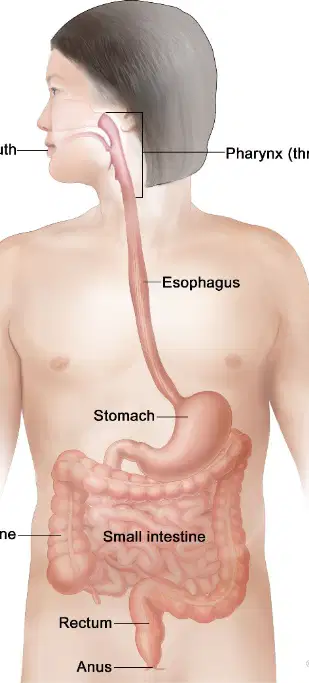
Which structure is NOT part of the gastrointestinal tract itself but is shown nearby in the diagram as a region food passes through from the mouth?
Pharynx (throat)
Stomach
Rectum
Anus
According to the text, where are fats broken down into their components for absorption?
Mouth
Stomach
Small intestine
Large intestine
Match each accessory organ with its primary contribution to digestion.
Salivary glands
Lubrication and secretion of amylase and lipase
Liver
Secretes bile; purifies blood from small intestine
Gallbladder
Stores bile
Pancreas
Secretes digestive enzymes including peptidase
Which statement best explains why accessory organs are essential for chemical breakdown of food molecules?
They move food along the GI tract by peristalsis.
They produce acid like hydrochloric acid and enzymes that act in the GI lumen.
They physically grind food to form a bolus.
They absorb all nutrients before food reaches the intestines.
Which pairing between organ and secretion/function is correct?
Stomach—releases bile to emulsify fats
Liver—stores bile for later release
Pancreas—provides digestive enzymes such as peptidase
Salivary glands—purify blood coming from the small intestine
Food moves from the mouth to the anus primarily due to which process, and how is premature backflow prevented?
Diffusion; mucus membranes
Active transport; villi
Peristalsis; sphincters
Filtration; lymphatic valves
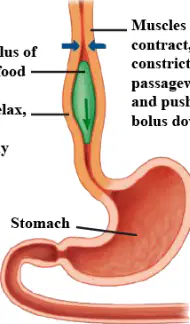
In the esophageal peristalsis diagrams, what coordinated muscle actions push the bolus toward the stomach?
Muscles relax behind the bolus and contract ahead of it
Muscles contract behind the bolus and relax ahead of it
All muscles contract simultaneously along the esophagus
All muscles relax simultaneously along the esophagus
Which definition correctly matches the digestive term with its description?
Bolus—watery mixture of partially digested food and secretions moving through intestines
Chyme—mass of food mixed with saliva moving from mouth through esophagus to stomach
Feces—mass of undigested fiber, tough tissues, bacteria, and old intestinal cells formed in the large intestine
Sphincter—wave of contractions that propel food along the GI tract
Multi-select: Which statements about chyme are accurate? Select all that apply.
It forms when a bolus mixes with gastric secretions and secretions from the liver and pancreas.
It is a watery mixture of partially digested food.
It is formed in the large intestine just before excretion.
It moves through the intestines after leaving the stomach.
Which structure directly prevents early release of stomach contents into the intestines?
Villi
Sphincters
Gallbladder
Salivary glands
Arrange the following in the typical order they appear as food progresses through digestion: bolus, chyme, feces.
Chyme → bolus → feces
Feces → bolus → chyme
Bolus → chyme → feces
Bolus → feces → chyme
According to the functions of the mouth, which process primarily contributes to mechanical digestion in the oral cavity?
Taste analysis by the tongue
Chewing with teeth
Activation of gastric enzymes
Absorption of nutrients through oral mucosa
Which pair correctly matches a salivary enzyme with its macromolecule target during limited chemical digestion in the mouth?
Salivary amylase – proteins
Salivary lipase – starch
Salivary amylase – starch
Salivary lipase – nucleic acids
Select all functions that occur in the mouth before food enters the esophagus.
Taste analysis
Swallowing initiation
Extensive nutrient absorption
Lubrication by saliva
Match each oral structure or component to its primary role in early digestion.
Teeth
Mechanical breakdown via chewing
Saliva
Lubrication and enzyme delivery
Tongue
Taste analysis and bolus formation
Pharynx
Route for swallowing toward esophagus
Which statement best explains why no absorption of food occurs in the mouth?
The oral mucosa is impermeable to all molecules, including water.
Food is not digested enough to be absorbed at this stage.
Salivary enzymes completely digest nutrients, leaving none to absorb.
Swallowing bypasses the oral cavity before digestion begins.
Which statement best describes the primary function of the esophagus during swallowing?
It chemically digests food using acidic secretions
It transports the bolus from the pharynx to the stomach via coordinated muscle contractions
It filters air entering the trachea before reaching the lungs
It stores food temporarily to regulate gastric emptying
Select all features that prevent misdirection or backflow of material during swallowing.
Epiglottis covering the tracheal opening to keep food out of the windpipe
Lower esophageal sphincter (LES) preventing acidic stomach contents from re-entering the esophagus
Circular muscle relaxation at the top of the esophagus to push the bolus upward
Longitudinal muscle contraction pulling the bolus back toward the pharynx
Match each structure or action involved in swallowing to its role.
Epiglottis
Prevents food from entering the trachea
Lower esophageal sphincter (LES)
Prevents backflow of acidic stomach contents into the esophagus
Circular muscles of the esophagus
Contract behind the bolus to propel it toward the stomach
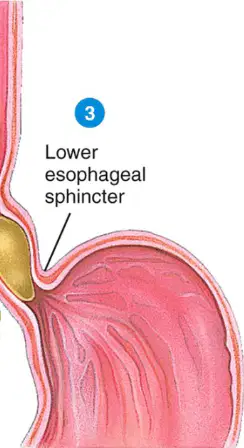
In the diagram, the lower esophageal sphincter is highlighted near the junction with the stomach. What is its physiological role?
Opening the trachea to allow air passage during swallowing
Neutralizing stomach acid before it enters the esophagus
Preventing reflux of stomach contents into the esophagus
Initiating peristalsis in the pharynx
Which statement best describes the stomach’s overall role in digestion?
Primarily performs absorption of nutrients and water
Conducts both mechanical mixing and chemical breakdown of food
Exclusively neutralizes acidic chyme from the esophagus
Stores bile and releases it to emulsify fats
Mucus secreted by the stomach serves which primary function?
Enhances protein activation by pepsin
Protects the stomach lining from hydrochloric acid
Increases bile secretion into the duodenum
Directly breaks down carbohydrates
Hydrochloric acid (HCl) in the stomach has two key roles. Select all that apply.
Breaks proteins
Activates some digestive enzymes
Neutralizes gastric pH
Facilitates vitamin B-12 absorption
Match each gastric component to its function.
Mucus
Protects stomach from acid
Pepsin
Digests proteins
Intrinsic factor
Involved in vitamin B-12 absorption
Gastrin
Stimulates mucus and HCl production
Which enzyme listed is directly involved in protein digestion within the stomach?
Amylase
Lipase
Pepsin
Trypsin
Intrinsic factor is essential for which physiological process?
Activation of pepsinogen to pepsin
Absorption of vitamin B-12
Secretion of hydrochloric acid
Emulsification of dietary lipids
Gastrin primarily stimulates which of the following in the stomach?
Bile synthesis and release
Mucus and hydrochloric acid production
Pancreatic enzyme secretion
Enterocyte glucose transporters
Which statement best describes the liver’s role in fat digestion?
It secretes enzymes that hydrolyze triglycerides directly in the stomach
It produces bile that emulsifies fat into smaller droplets for digestion
It stores bile in its ducts until fats are fully digested
It absorbs dietary fats and transports them unchanged into the bloodstream
Select all functions performed by the liver as outlined:
Detoxification of drugs, alcohol, and supplements
Regulation of blood glucose
Amino acid breakdown and synthesis
Direct secretion of insulin from hepatocytes
RBC recycling and regulation of blood composition
Match each liver-related item to its correct description.
Bile production
Helps break down fats via emulsification
Gallbladder
Stores bile until it is needed
Small intestine
Receives bile delivery for fat digestion
Fat-soluble nutrients
Stored by the liver for later use
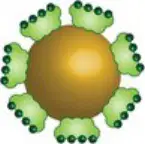
Which sequence correctly represents fat emulsification by bile salts as depicted in the diagram?
Small fat droplets → Fat globule → Emulsified fat droplets → Bile salt
Fat globule → Bile salt binds with hydrophilic side outward → Emulsified fat droplets → Small fat droplets
Fat globule → Pancreatic lipase → Chylomicron → Emulsified fat droplets
Emulsified fat droplets → Bile synthesis → Fat globule → Small fat droplets
Where is bile stored and where is it delivered for use, according to the material?
Stored in the pancreas; delivered to the large intestine
Stored in the gallbladder; delivered to the small intestine as needed
Stored in the spleen; delivered to the stomach
Stored in hepatic sinusoids; delivered to the lymphatic system
Which liver function is most directly involved in maintaining steady blood glucose levels between meals?
Cholesterol production
RBC recycling
Regulation of blood glucose
Vitamin absorption
Which statement best describes the primary function of the small intestine?
Mechanical breakdown of food via churning
Site of most chemical digestion and absorption
Storage of undigested waste prior to excretion
Production of saliva and initiation of starch digestion
Identify the feature that most directly increases the small intestine’s absorptive efficiency by expanding surface area.
Smooth inner lining
Presence of rugae in the stomach
Folded villi and microvilli
Large lumen diameter
Match each segment of the small intestine to its principal role.
Duodenum
Mixing food with pancreatic juices and bile
Jejunum
Primary site of nutrient and water absorption
Ileum
Absorbs nutrients and water not previously absorbed
Which process occurs predominantly in the duodenum according to the instructional material?
Absorption of most remaining nutrients
Mixing chyme with pancreatic enzymes and bile
Storage of bile acids
Fermentation of fiber by microbiota
Which combination accurately lists molecules absorbed in the small intestine? Select all that apply.
Glucose and amino acids
Fats and vitamins
Most minerals such as calcium, magnesium, and iron
Alcohol (80% of total) and bile acids
Approximately what proportion of total body water absorption occurs in the small intestine as stated?
10% to 20%
30% to 40%
50% to 60%
70% to 90%
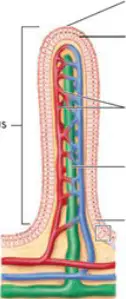
Which structural components of a villus facilitate transport of absorbed nutrients?
Striated muscle bundles and sweat glands
Blood capillary network and lacteal (lymph)
Gastric pits and mucous cells
Bronchioles and alveolar sacs
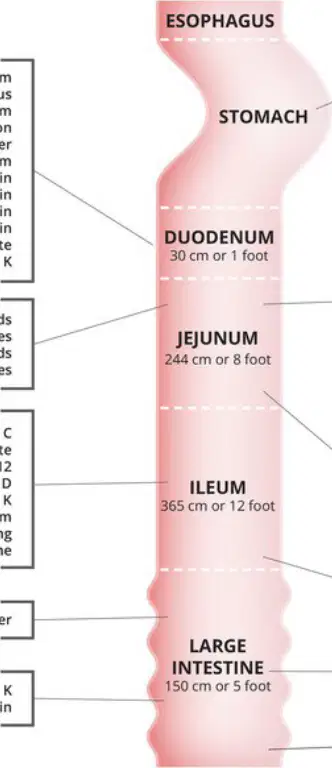
In the jejunum, which categories of molecules are highlighted as being absorbed based on the provided list? Select all that apply.
Lipids and small peptides
Monosaccharides and amino acids
Bile salts and short-chain fatty acids
Sodium and chloride
Which segment continues absorption of nutrients and water that were not previously absorbed?
Esophagus
Stomach
Jejunum
Ileum
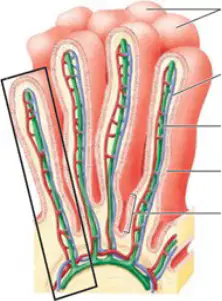
Which pair correctly matches a villus substructure with its associated fluid or tissue?
Epithelium
Single-cell layer lining the villus surface
Lacteal
Lymph vessel within the villus core
Capillary (blood)
Blood vessel network for nutrient uptake
Crypt
Invagination at the base of the villus

