
 Worksheets
Heat Transfer Practice
Total questions: 87
Worksheet time: 1hrs 4mins
There are ____________ ways heat can move from one object to another.
1
2
3
4
What is the transfer of energy from one object to another due to differences in temperature known as?
Heat
Waves
Evaporation
Erosion
What is the driving energy source for heating the Earth?
the sun
the moon
the planets
underground activity
When heat from the sun comes to the Earth it is known as _________________________________.
Conduction
Convection
Radiation
Condensation
Which one is the transfer of heat through direct contact/touching?
Conduction
Convection
Radiation
Transpiration
Which one of these is the transfer of heat through our atmosphere due to the movement of liquids and gases?
Conduction
Convection
Radiation
Weathering

This shows an example of what?
Convection
Radiation
Conduction

Which way does heat transfer from the heater to the man?
Convection
Conduction
Induction
Radiation

Which type of heat transfer is an egg cooking in a pan?
Radiation
Conduction
Convection

Sun burn is an example of....
Conduction
Convection
Radiation

Using a microwave cooks food using....
Radiation
Convection
Conduction
Which is NOT a way that heat transfers?
Conduction
Convection
Saturation
Radiation

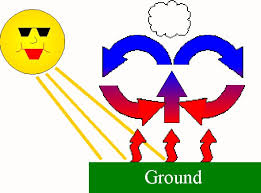
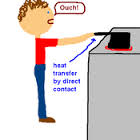

Dan heats up a sandwich in the microwave. What type of heat transfer is it from the microwave to the sandwich?
convection
conduction
radiation
microwave
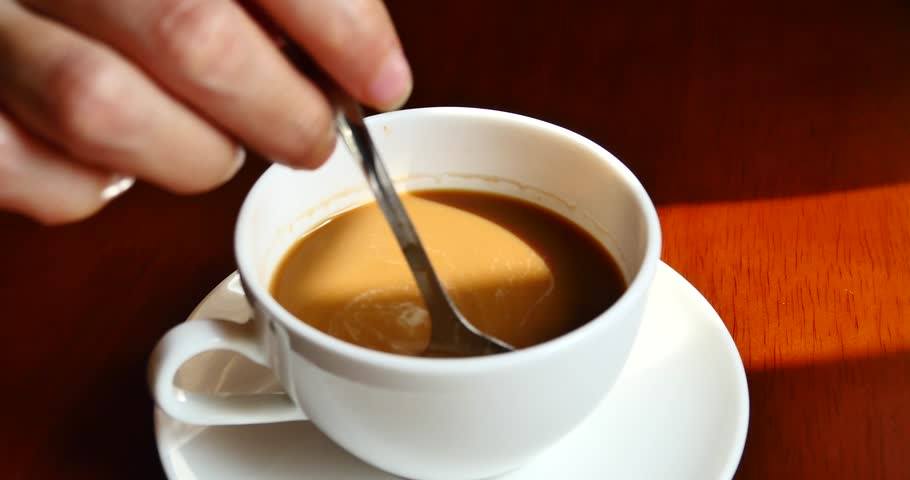
Hot coffee is stirred with a spoon, the spoon gets hot due to
Convection
Conduction
Radiation
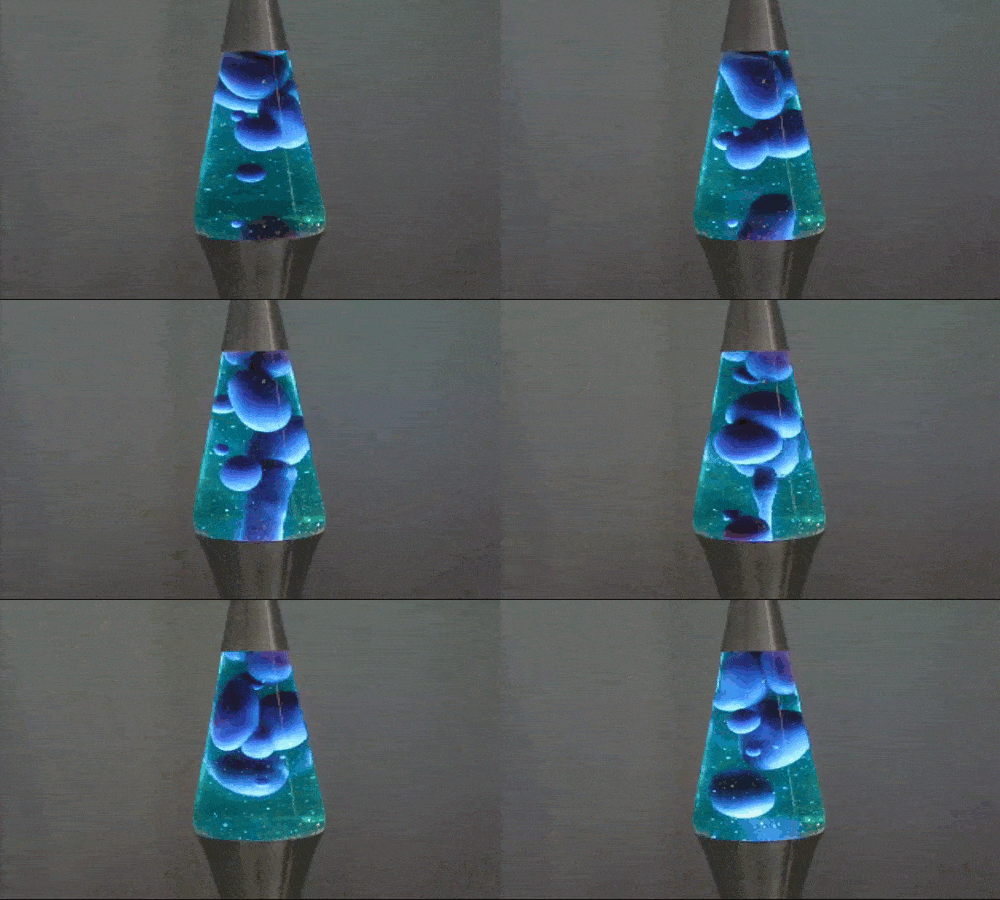
A certain type of decorative lamp contains colored liquids. These liquids form globs that break off and rise to the top of the liquid. The globs rise due to
Convection
Conduction
Radiation
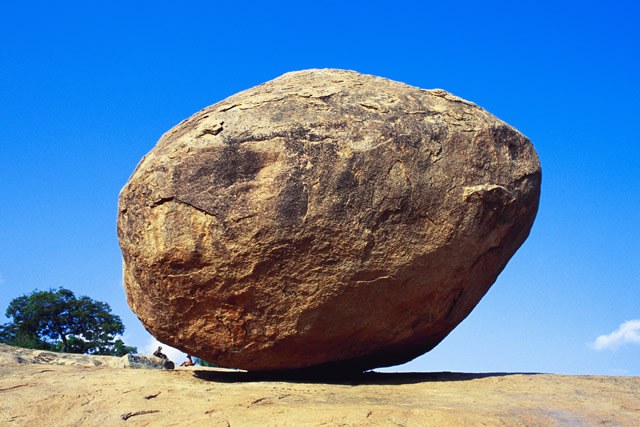
A huge boulder at the state park gets so hot during the day.
Convection
Conduction
Radiation
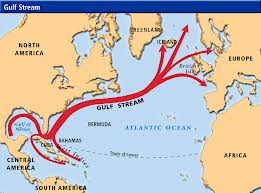

Evan's teacher asked him to draw a diagram to show how heat energy flows between the ice and the water. Which diagram should Evan draw?
A
B
C
D
The metal spoon feels hot when she stirs the pasta because:
it conducts heat from the hot pasta.
it is made of a special material.
it is too long.
it is too short.
A student wants to demonstrate the transfer of thermal energy. If she puts her warm hand on a cold metal doorknob, how will thermal energy move?
Cold will move from the doorknob to her hand.
Heat will move from her hand to the doorknob.
Heat will move from the doorknob to her hand.
Cold will move from her hand to the doorknob.
Rose makes a cup of hot tea. She places the cup of tea on the kitchen table and waits for it to cool off. When she picks up the cup a few minutes later, she notices the kitchen table is warm where the cup used to be. Which best explains the flow of energy between the cup and the table?
A. Heat transferred from the cup to the table to warm the table.
B. Cold transferred from the table to the cup to cool the tea.
C. Heat transferred from the cup to the table, and cold was exchanged between both.
D. Cold transferred from the table to the cup, and heat was exchanged between both.
Ben is boiling water to make pasta. He leaves his metal stirring spoon in the boiling water for a few minutes. What will most likely happen to the temperature of the metal spoon?
The temperature of the metal spoon will increase because cold energy from the spoon will transfer to the water.
The temperature of the metal spoon will decrease because heat energy from the spoon will transfer to the water.
The temperature of the metal spoon will increase because heat energy from the boiling water will transfer to the spoon.
The temperature of the metal spoon will decrease because cold energy from the boiling water will transfer to the spoon.
Which best describes how heat flows?
A. Heat flows from a cold object to a hot object and can cause an object's temperature to change.
B. Heat flows from a hot object to a cold object and can cause an object's temperature to change.
C. Heat flows from a cold object to a hot object but will not cause an object's temperature to change.
D. Heat flows from a hot object to a cold object but will not cause an object's temperature to change.
Roseanne heated a solution in a beaker as part of a laboratory experiment on energy transfer. After a while, she noticed the liquid solution begin to circulate within the beaker. What process involving heat transfer did Roseanne observe inside the beaker?
conduction
convection
transduction
transformation
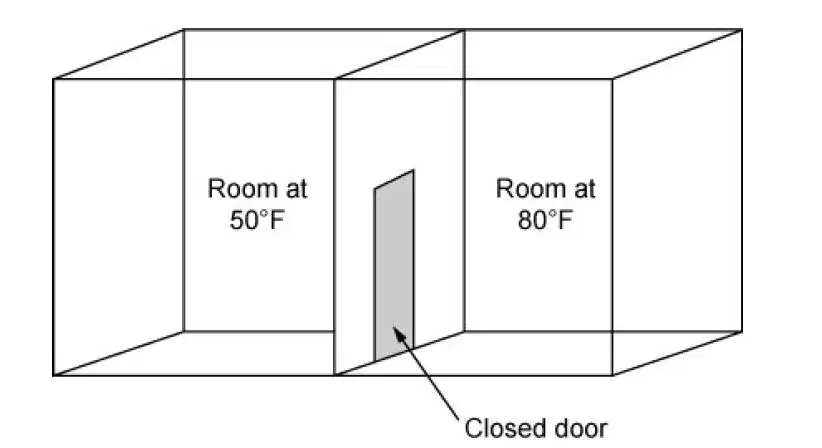
Which statement best describes what will happen as the door opens between the two rooms?
The temperature in both rooms will become equal over time.
The temperature in each room will remain unchanged.
The warmer room will cool down to 50°F.
The colder room will warm up to 80°F.
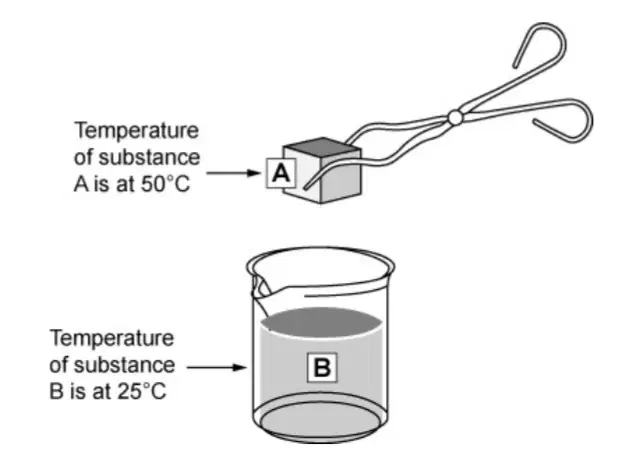
The diagram below shows two substances, A and B, which are at different temperatures. What will happen when substance A is dropped into substance B?
Substance A will get even warmer as heat flows into it from substance B.
Substance A and B will exchange heat, and they both will reach 50°C.
Substance A and B will exchange heat, and they both will reach 25°C.
Substance A and B will eventually reach the same temperature.
If a person places one end of a solid metal bar into a fire, the end that is not in the fire also gets hot. Which of the following methods of energy transfer does this describe?
conduction
convection
radiation
induction
What causes hot air to rise from the pavement on a hot summer day?
conduction
insulation
convection
radiation
Two objects are sitting on a table. Thermal energy is being transferred from one object to another. When does this transfer of thermal energy stop?
when one object is much warmer than the other
when the two objects are different temperatures
when both objects are the same temperature
when one object has completely cooled
Why do broken pieces of glacial ice decrease the temperature of the nearby ocean?
because heat transfers from the ice to the ocean through conduction
because cold transfers from the ice to the ocean through convection
because heat transfers from the ocean to the ice through conduction
because cold transfers from the ocean to the ice through convection
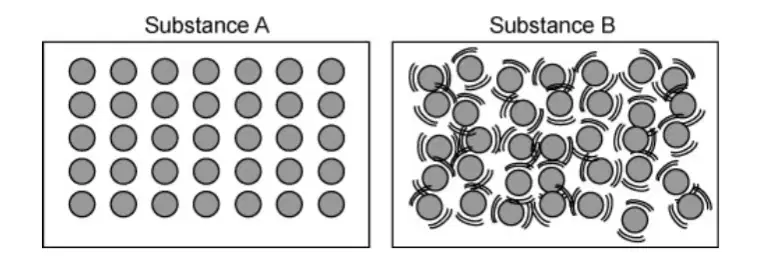
A student is investigating the transfer of thermal energy. She creates a diagram to show the particles of two substances with different amounts of thermal energy. The student must create a diagram of the two substances when they are touching each other. Which describes the diagram she should draw?
The student should draw energy transferring through conduction from A to B, because A has more thermal energy.
The student should draw energy transferring through conduction from B to A, because B has more thermal energy.
The student should draw energy transferring through convection from A to B, because A has less thermal energy.
The student should draw energy transferring through convection from B to A, because B has less thermal energy.
Which of the following is an example of thermal energy being transferred directly from one substance to another via conduction?
perspiration evaporating from a person's skin
the Sun's rays causing a person's skin to turn darker
water vapor escaping from a pot of boiling water
a mug of hot chocolate heating up a metal spoon
Which of the following types of energy transfers can take place when matter is not present?
heat
conduction
radiation
convection
Which term refers to what happens when an egg cooks in a pan on the stove?
conduction
friction
insulation
pressure
A piece of metal is heated and then submerged in cool water. Which statement below best describes what happens?
The temperature of the water will decrease, while the temperature of the metal will increase.
The temperature of the water will decrease and the temperature of the metal will also decrease.
The temperature of the water will increase, while the temperature of the metal will decrease.
The temperature of the water will increase and the temperature of the metal will also increase.
If hot soup is poured into a cold bowl, when will the soup stop transferring thermal energy to the bowl?
when the soup and the bowl have the same temperature
when the soup and the bowl have the same density
when the soup and the bowl have the same mass
when the soup and the bowl have the same volume
By which process does the heat from the Sun reach Earth?
conduction
convection
absorption
radiation
When volcanoes erupt, which process lifts the hot clouds into the sky?
Radiation that causes thermal energy to transfer into the clouds and hold them together
Conduction that causes thermal energy to pass from the smoke into the ground
Conduction that causes warmer air to spread and cooler air to condense into clouds
Convection that causes warmer air to rise and cooler air to sink into its place
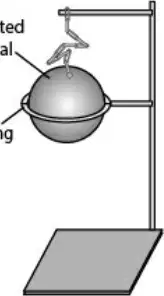
Why can't the heated metal ball pass through the ring?
The ball expands and becomes larger in size.
The ring expands and becomes larger in size.
The ball contracts and becomes smaller in size.
The ring contracts and becomes smaller in size.
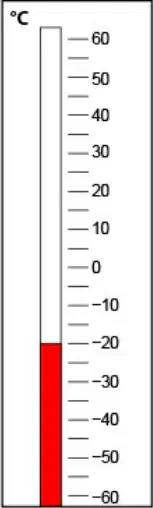
Why does the liquid in a thermometer fall when the temperature decreases?
the liquid inside the thermometer solidifies
the liquid inside the thermometer expands
the liquid inside the thermometer contracts
the liquid inside the thermometer evaporates
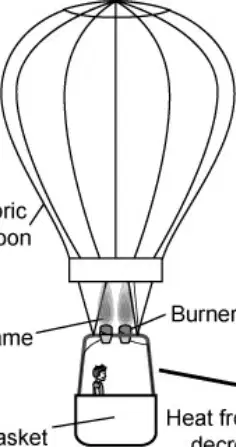
The picture shows a hot air balloon in flight.
It causes the cooler air molecules to move faster and fall via conduction.
It causes the cooler air molecules to move faster and rise via conduction.
It causes the warmer air molecules to move faster and fall via convection.
It causes the warmer air molecules to move faster and rise via convection.
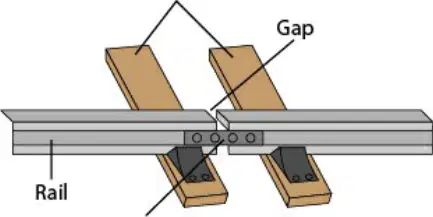
Why do railroad tracks have narrow gaps between them?
The gaps reduce dirt buildup on the tracks.
The gaps prevent trains from coming off the tracks.
The gaps prevent the tracks from breaking during temperature changes.
The gaps reduce the noise pollution caused when trains move over the tracks.
What type of energy transfer makes a hot air balloon float?
Convection
Conduction
Absorption
Radiation
What happens to mass and volume when a material expands?
Mass and volume increase.
Mass and volume decrease.
Mass and volume remain the same.
Mass remains the same and volume increases.
Which property is best for cooking materials?
low melting point
high electric charge
low thermal expansion
high reactivity with water
Which object will absorb most light?
a pink box
a black cup
a yellow hat
a white boat
Why do materials expand when heated?
Molecules move faster and farther apart.
Molecules move slower and farther apart.
Molecules move faster and closer together.
Molecules move slower and closer together.
What happens to metal railroad tracks on a hot day?
Extreme heat causes them to get shorter.
Extreme heat causes them to break in half.
Extreme heat causes them to contract and buckle.
Extreme heat causes them to expand and get slightly longer.
Why does mercury rise in a thermometer when heated?
Mercury becomes heavier when heated.
Mercury becomes lighter when heated.
Mercury contracts when heated.
Mercury expands when heated.

Why did Fabric X experience the greatest temperature increase?
because it scattered the most heat energy
because it refracted the most heat energy
because it reflected the most heat energy
because it absorbed the most heat energy
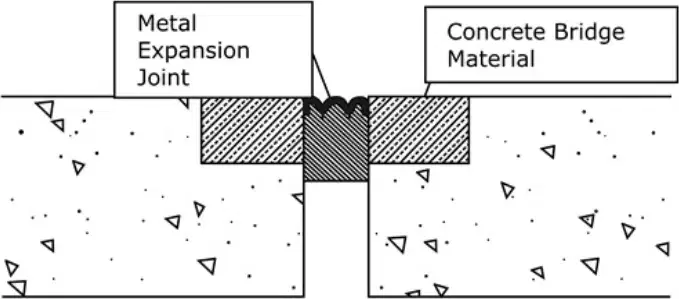
What will happen to the metal if the bridge is exposed to heat?
It will melt.
It will expand.
It will insulate.
It will contract.
A metal bar is heated to 100°C. What happens to it?
The metal bar would melt.
The metal bar would expand.
The metal bar would contract.
The metal bar would remain the same.
Jake poured water into a pot. He put the pot on a stove and turned the stove on low. After a few minutes, the water in the pot began to boil. Which statement BEST describes why the water boiled?
The stove transferred light to the pot of water.
The stove transferred electricity to the pot of water.
The stove transferred heat energy to the pot of water.
The stove transferred mechanical energy to the pot of water.
A student standing near a campfire feels warmer as the fire grows. Which process MOST likely transfers heat from the campfire to the student?
conduction
convection
radiation
transformation
After playing outside on a cold day, Jaime went inside to wash his hands. Although the water was normal temperature, he noticed that it felt warmer than usual. What would explain this phenomenon?
His body had more kinetic energy than the water.
Heat flowed from a cooler substance to a warmer substance.
The water from the faucet had a higher temperature than his skin.
The thermal energy in the room was higher than the thermal energy outside.
A student put a metal pot on the stove to boil some water. The metal transferred heat to the water through
radiation.
insulation.
convection.
conduction.
A black brick exposed to sunlight becomes warm. How is energy from the Sun transferred to the brick?
convection
conduction
radiation
reflection
The transfer of thermal energy from one object to another is known as
heat.
electricity.
magnetism.
temperature.
Which item is NOT a good conductor of electricity?
a tin can
a rubber tire
a copper coin
an aluminum wire
Which material does NOT conduct electricity?
copper
silver
wood
iron
What is an insulator?
a device that keeps too much current from flowing through wires
a switch that protects circuits from currents that are too high
a material through which current cannot move easily
a loop of wire that generates an alternating current
Energy from the Sun reaches Earth by
radiation.
conduction.
convection.
thermal expansion.

Conduction
The transfer of energy by electromagnetic waves.
A circular motion of air that causes wind and changes in weather
A type of heat transfer that occurs through the movement of fluids.
The transfer of energy from one particle of matter to another within an object or between two objects that are in direct contact.


Heat
The total kinetic and potential energy of all the particles in an object.
Energy that is transferred from a warmer object to a cooler object.
A measure of the average kinetic energy of the particles in a substance.
The heating of a substance that causes its particles to move more quickly.

Temperature
The total kinetic and potential energy of all the particles in an object.
Energy that is transferred from a warmer object to a cooler object.
A measure of the average kinetic energy of the particles in a substance.
The heating of a substance that causes its particles to move more quickly.
Which of these is a good conductor?
Wood
Paper
Silver
Air
Which statement is true?
The wooden handle on a metal pan is a good conductor of thermal energy
The metal pan is a poor conductor of thermal energy.
The metal pan causes the water to boil rapidly.
The wooden handle is a good insulator of thermal energy.
Which best describes how heat is transferred?
Heat only flows within individual substances.
Heat flows from a warmer substance to a cooler substance.
Heat flows from a cooler substance to a warmer substance.
Heat flows in many different directions between substances.
Which of the following is an example of convection?
a hot object transferring heat to a cooler one
hot air rising and cooler air falling
the rays of the Sun warming the earth
getting a sunburn
at the same speed

NOM

What device do we use to measure temperature?
Microscope
Ruler
Speedometer
Thermometer
Convection currents occur:
Only in liquids
When a dense substance is warmer than a less dense substance
In both liquids and gases
Weakly in solids
A student must choose three items to demonstrate conduction, convection, and radiation from solar energy. The student quickly chooses water and a metal bowl. Which of the following items should the student choose to complete the experiment?
Rubber ball
food coloring
heat lamp
ice cube
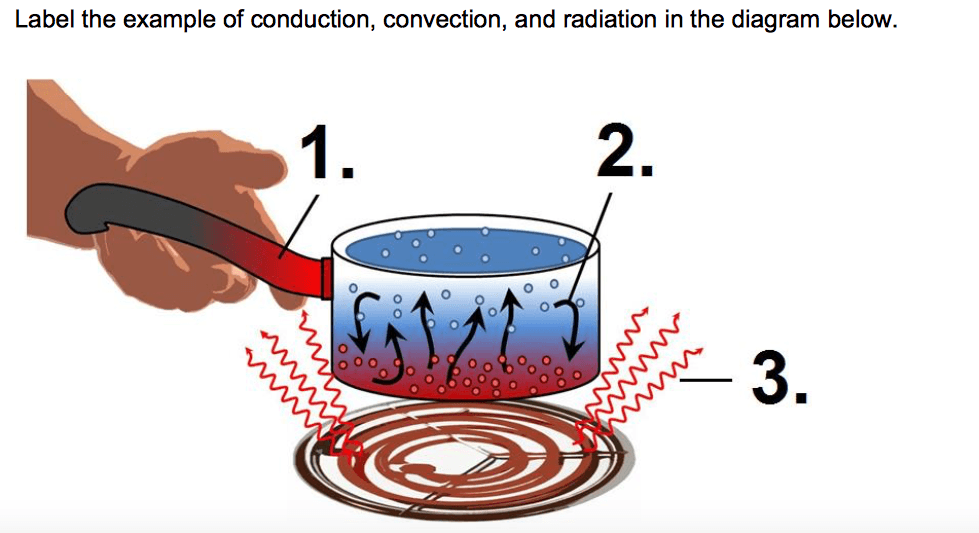
What type of thermal energy transfer is number 1 pointing to?
Convection
Conduction
Radiation
Insulation

What type of thermal energy transfer is number 3 pointing to?
Convection
Conduction
Radiation
Insulation

What type of thermal energy transfer is number 2 pointing to?
Convection
Conduction
Radiation
Insulation
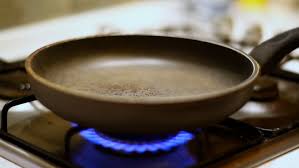
What type of heat transfer is occurring in the picture below? (the pan is touching the burner)
conduction
convection
radiation
insulation
How does heat move?
In many directions
from warm places to cooler places
from cold places to warm places
Both B and C

