
 Worksheets
Chemical Bonding Mastery Set
Total questions: 90
Worksheet time: 56mins
Why do atoms form covalent bonds?
To achieve stability and become 'happy'
To increase their mass
To lose electrons rapidly
To become radioactive
Arrange the following types of bonds in order from weakest to strongest: single, double, triple, ionic.
Single, Double, Triple, Ionic
Ionic, Triple, Double, Single
Triple, Double, Single, Ionic
Double, Single, Triple, Ionic
Which of the following is NOT a subtype of covalent bond?
Single bond
Double bond
Triple bond
Quadruple bond
In covalent bond diagrams, what does a single line between two atoms represent?
A pair of electrons shared between the atoms
Two pairs of electrons shared between the atoms
A single electron shared between the atoms
No electrons shared between the atoms
When drawing Lewis structures, how are unbonded electrons and electrons in bonds represented?
Unbonded electrons are shown as dots and electrons in bonds are shown as lines
Unbonded electrons are shown as lines and electrons in bonds are shown as dots
Both unbonded electrons and electrons in bonds are shown as dots
Both unbonded electrons and electrons in bonds are shown as lines
What is true about a covalent double bond?
Two atoms each pool 2 of their electrons and share a total of 4 electrons between themselves.
Two atoms each pool 4 of their electrons and share a total of 8 electrons between themselves.
Two atoms each pool 1 of their electrons and share a total of 2 electrons between themselves.
Two atoms do not share any electrons in a double bond.
In a covalent triple bond, how many electrons do two atoms share between themselves to reach a duet or octet?
6 electrons
3 electrons, but only one atom shares
4 electrons, with two from each atom
8 electrons, with four from each atom
Which of the following molecules contains a triple covalent bond?
N≡N
O=O
H-H
Cl-Cl
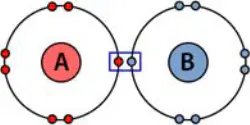
Refer to the diagram. What kind of bond is shown?
Single covalent
Ionic
Double covalent
Triple covalent
Which type of covalent bond will an atom like Hydrogen or Fluorine form if it needs 1 more valence electron?
A single bond
A triple bond with extra electrons
A double bond
No bond
An atom like Oxygen needs 2 more valence electrons. What types of bonds can it form to satisfy this need?
One double bond or two single bonds
Two triple bonds
One single bond and one triple bond
Three single bonds
Which of the following bonding arrangements is possible for an atom like nitrogen or phosphorus that needs 3 more valence electrons?
1 triple bond
1 double bond and 1 single bond
3 single bonds
All of the above
Following the Octet rule, what would the chemical formula for the covalent compound formed between fluorine and oxygen be?
OF
OF2
O2F
F2O2
Which prefix is used to indicate that there are four atoms of an element in a covalent compound?
Tetra
Penta
Hexa
Tri
What is the main difference in naming covalent compounds compared to ionic compounds?
Prefixes are used to show the number of atoms of each element in covalent compounds
The first element's name is always changed in covalent compounds
Covalent compounds do not use the -ide ending
Ionic compounds use prefixes to show the number of atoms
What is the standard name for the covalent compound H2O?
Dihydrogen monoxide
Hydrogen oxide with two hydrogens
Monohydrogen oxide
Hydrogen dioxide
Bonds formed by transferring electrons from one atom to another are
ionic
metallic
non polar covalent
covalent
Bonds formed by sharing electrons between atoms are
ionic
metallic
covalent
dipole-dipole
A compound is made of two nonmetals. It is
ionic
metallic
covalent
A compound forms between a metal and a nonmetal. It is
ionic
metallic
covalent
Ionic compounds are held together by
intermolecular forces
electrostatic forces
magnetic forces
nuclear forces
A compound that is a poor conductor and has low melting and boiling points is most likely
ionic
metallic
covalent
Generally, atoms form bonds so that _______________.
Each atom loses its electrons
Each atom has a full outer shell
Each atom has an unstable electron configuration
Each atom gains electrons

When does an atom become an ion?
When it gains or loses electrons and takes on a charge.
When it is stable because it has a full set of valence electrons.
When it forms a compound with another atom.
How many oxygen are in one unit of the compound Fe2O3 ?
(a)
How many electrons do most elements want to have in their outer shell to be stable?
(a)

What ionic charge would an atom with this electron dot diagram form?
+2
2
-2

What ionic charge would an element with this electron dot diagram take on?
(a)
What is the correct name for the compound MgI2
magnesium iodide
magnesium diiodide
monomagnesium diiodide
How many valence electrons does Al have?
3
4
5
6
How many valence electrons does Br have?
5
6
7
8
Lithium has 1 valence electron, to bond with iodine what would it do?
share an electron with iodine.
Give an electron to iodine.
It depends on the temperature: if it is hot it will give its electron to iodine but if it is cold it will take an electron from iodine.
Lithium and iodine will not react and form a bond.
How many valence electrons does Mg have?
1
2
3
4
If H bonds with O, what kind of bond will form?
covalent
ionic
metallic
none of these
If Fe bonds with F, what kind of bond will form?
covalent
ionic
metallic
none of these
If N bonds with S, what kind of bond will form?
covalent
ionic
metallic
none of these
If Cu bonds with O, what kind of bond will form?
covalent
ionic
metallic
none of these
The correct name for MgF2 is ______________.
magnesium fluoride
magnesium difluoride
manganese difluoride
magnesium (II) fluoride
The correct name for N2O is ____________.
dinitrogen monoxide
dinitrogen oxide
nickel oxide
nickel (I) oxide
BeI2
Beryllium (II) iodide
Beryllium iodine
Beryllium iodide
Beryllium (I) iodide
Strontium nitride
SrN
Sr3N2
Sr2N3
N3Sr2
Aluminum fluoride
AlF
AlF2
Al3F
AlF3
The name of monatomic negative ions (anions) all end in what suffix?
-ate
-ite
-ium
-ide
What is formula for calcium chloride?
CaCl
CaCl2
ClClO3
CaC2
What is the charge on the sulfide ion?
-1
-2
-3
+2
What is the charge on the nitride ion?
-1
-2
-3
+2
What is the correct name for the compound, P4S3?
tetrapotassium trisodium
triphosphorus tetrasulfide
phosphorus sulfur
trisulfur tetraphosphide
tetraphosphorus trisulfide
What is the correct name for the compound, BrF3?
bromine trifluoride
monoboron trifluoride
tribromine monofluoride
monobromine fluoride
trifluorine monobromide
What is the correct molecular formula for the compound, sulfur tetrafluoride?
SF
SF4
SiF4
SF5
SF3
What is the correct molecular formula for the compound, sulfur dioxide?
SeO2
SO
SO2
S2O
SO4
What is the correct molecular formula for the compound, disulfur dichloride?
S2Cl2
Si2Cl2
SCl
S2Cl4
S16Cl4
What is the correct name for the compound, PF5?
phosphorus pentafluoride
monophosphorus pentafluoride
potassium fluoride
pentafluorine monophosphide
phosphorus tetrafluoride
What is the correct molecular formula for the compound, selenium tetrafluoride?
Se4F
SF4
SeF8
SeF4
SeF
What is the correct molecular formula for the compound, disulfur decafluoride?
S2F 10
SF5
Na2F10
S8F10
S10F2
What is the correct name for the compound, NF3?
sodium trifluoride
mononitrogen trifluoride
trifluorine mononitride
nitrogen trifluoride
nitrogen fluoride
What is the correct molecular formula for the compound, dinitrogen trioxide?
NO3
Na2O3
N2O3
N4O3
N2O
What is the correct molecular formula for the compound, tetraphosphorus decasulfide?
P4S10
P2S5
PS
P10S4
K4S10
What is the correct name for the compound, IF7?
monoiodine heptafluoride
iodine heptafluoride
heptaiodine monofluoride
iodine fluoride
none of these are correct
What type of ions do metals form?
cations
anions
What types of ions do nonmetals form?
cations
anions


How many valence electrons are shown in this Bohr diagram?
2
3
5
8

How many valence electrons?
2
5
8
10

This could be the dot diagram of
Mg
Cl
C
O
How would you draw a Lewis dot diagram for Magnesium?


Which of these is correct?


The element sulfur
will lose two electrons to become stable
will gain six electrons to become stable
will lose six electrons to become stable
will gain two electrons to become stable
Electron dot diagrams are used to represent ____.
atomic mass
valence electrons
protons
the structure of the nucleus
In a chemical formula, the number of each type of atom in the compound is shown by small numbers called ____.
superscripts
chemical symbols
subscripts
oxidation numbers
The charges for metal ions are _______.
positive
covalent
negative
neutral
Which of the following elements forms a negative ion in its ionic compounds?
Mg, magnesium
Cl, chlorine
Al, aluminum
Li, lithium
The elements that make up a compound and the exact number of atoms of each element in a unit of the compound can be shown in a ____.
chemical formula
subscript
superscript
chemical symbol
The charges for nonmetal ions are _______.
neutral
positive
negative
covalent
Which of the following compounds will NOT have ionic bonds?
CH4
LiF
NaCl
MgF2
Why do the noble gases NOT form compounds readily?
They have empty outer energy levels
They have no electrons
They have seven electrons in the outer energy levels
Their outer energy levels are completely filled with electrons
a charged particle
ion
nucleus
molecule
multiple covalent bond
What is a Lewis Dot Structure?
It shows all of the particles in the atom.
Contains protons and neutrons
Only shows the element symbol and it's outer most electron shell
Contains protons and electrons

What element is this?
Na
P
N
S
Why are both Hydrogen and Helium considered exceptions to the octet rule?

