
 Worksheets
REVIEW: Introduction to Oceans
Total questions: 122
Worksheet time: 1hrs 9mins
Which statement best defines oceanography as introduced in this section?
The study of rivers and lakes on Earth’s continents
The scientific study of the ocean, including its processes, life, and interactions
The engineering of ships and undersea cables
The statistical analysis of global weather alone
Identify the branch of oceanography that examines waves, currents, tides, and air–sea interactions.
Physical oceanography
Chemical oceanography
Biological oceanography
Geological oceanography
Which focus correctly matches its oceanography branch?
Chemical oceanography—mapping underwater volcanoes and trenches
Biological oceanography—studying marine life from plankton to whales and their ecosystem interactions
Geological oceanography—measuring nutrient and carbon dioxide levels in seawater
Physical oceanography—cataloging fish biodiversity
According to the section, why is oceanography important for society and the environment?
It only improves navigation routes for cargo ships
It explains how the ocean influences weather, stores heat and carbon, provides resources, supports species, and informs challenges like climate change
It focuses solely on recreational uses of the sea such as tourism and fishing
It replaces the need to study the atmosphere
Approximately what fraction of Earth’s surface is covered by the ocean?
About 30%
About 50%
About 70%
About 90%
Which statement about the distribution of Earth’s water is accurate based on the text?
About 97% is freshwater in rivers and lakes, making it widely drinkable
About 97% is saltwater in oceans and seas, requiring costly treatment to drink
About 3% is saltwater and 97% is freshwater stored in aquifers
Half is freshwater ice and half is saltwater
Most of Earth’s freshwater is not readily accessible. Which breakdown from the passage is correct?
About 69% in glaciers, ice caps, and permanent snow; about 30% underground in aquifers; about 1% easily available in rivers, lakes, and swamps
About 30% in glaciers and ice; about 69% in rivers; about 1% in oceans
About 50% in aquifers; 25% in glaciers; 25% in lakes
About 69% in the atmosphere; 30% in oceans; 1% in rivers
A community faces water scarcity. Based on the section’s data, which strategy targets the smallest share of Earth’s freshwater and is least likely to meet broad needs without major technology?
Tapping rivers, lakes, and swamps
Melting glaciers and ice caps
Drilling deeper into aquifers
Desalinating seawater
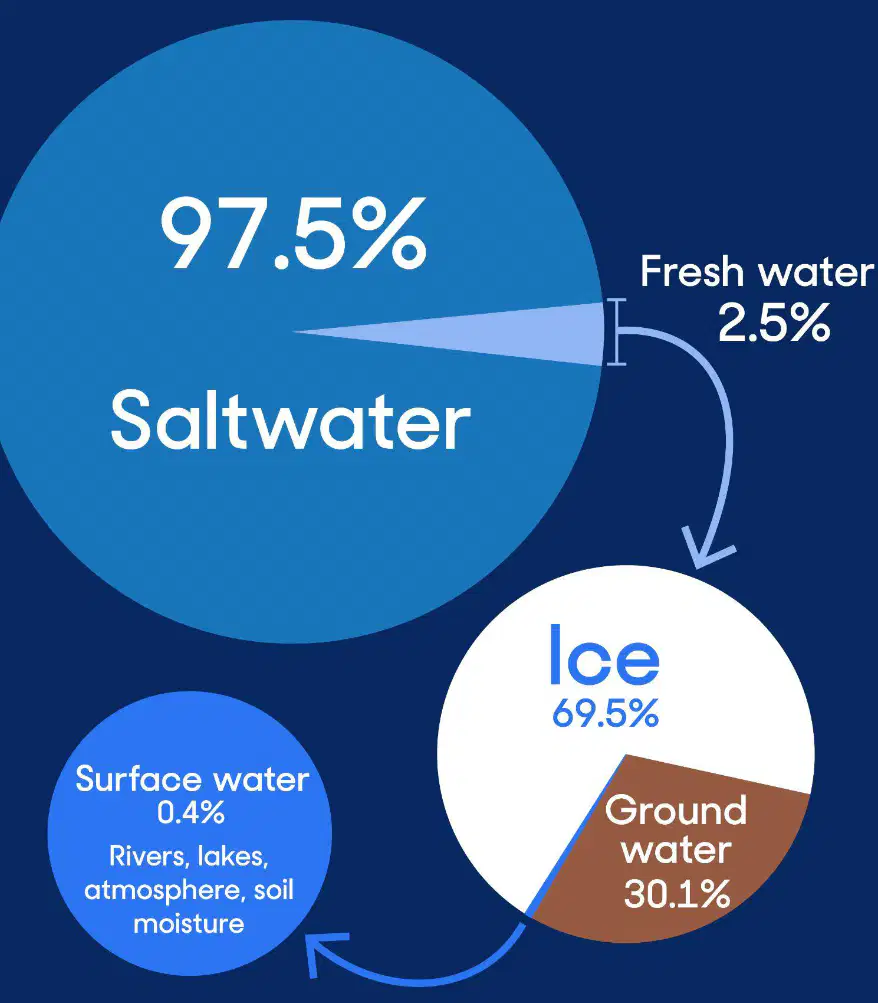
Refer to the Water Distribution on Earth diagram. What percentage of Earth’s total water is saltwater?
2.5%
30.1%
69.5%
97.5%

Using the Water Distribution on Earth diagram, which statement best describes how Earth’s freshwater is partitioned?
Most freshwater is groundwater, with a smaller portion stored as ice.
Freshwater is split evenly among ice, groundwater, and surface water.
Most freshwater is stored as ice, with groundwater as the next largest share.
Surface water accounts for the majority of freshwater, followed by ice.
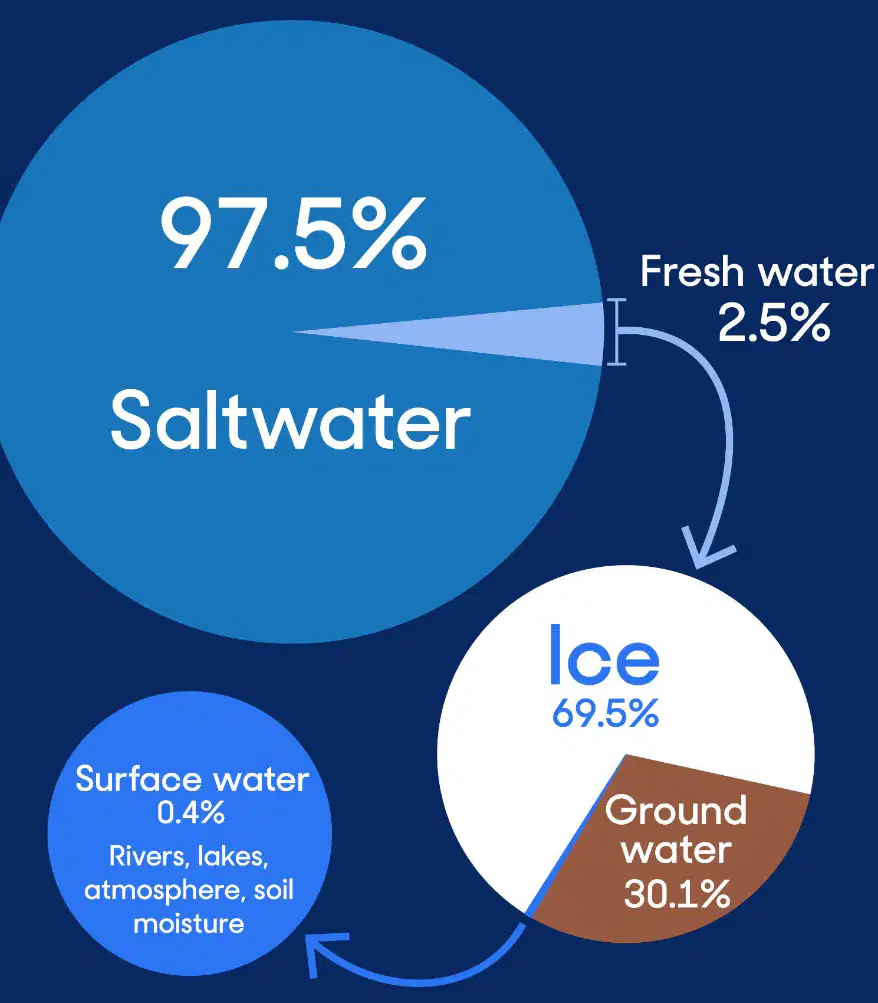
A city plans to increase its freshwater supply using the category that holds only a tiny fraction of Earth’s freshwater but is most directly accessible. Based on the diagram, which source are they most likely to target?
Surface water such as rivers, lakes, atmosphere, and soil moisture
Ice stored in ice caps and glaciers
Groundwater stored in aquifers
Desalinated saltwater from oceans
Which statement best describes the global ocean according to the text?
It consists of five separate water bodies that do not mix.
It is one connected body of salt water that is named and divided for convenience.
It is mostly freshwater with small regions of salt water near continents.
It is split into two unrelated hemispheric oceans by the equator.

Why is the Southern Hemisphere often called the water hemisphere?
Because it contains the deepest ocean trenches.
Because most of Earth's land is concentrated in the Northern Hemisphere, leaving more ocean area in the south.
Because it has the warmest sea-surface temperatures year-round.
Because tides are stronger in the Southern Hemisphere due to Earth's rotation.
Scientists and geographers divide the world ocean into how many main areas, and what are these areas called?
Four; seas
Five; oceans
Six; basins
Three; gyres
Which ocean is identified as the largest and deepest and contains the Mariana Trench?
Atlantic Ocean
Indian Ocean
Pacific Ocean
Southern Ocean
Which description correctly characterizes the Atlantic Ocean in the material?
It is the smallest and shallowest, centered on the North Pole.
It is the second-largest and famous for shipping routes connecting the Old and New Worlds.
It is the warmest ocean located entirely in the tropics.
It is icy and stormy, surrounding Antarctica and regulating climate.
Located mainly between Africa, Asia, and Australia, which ocean is known for warm waters and important trade routes?
Indian Ocean
Arctic Ocean
Pacific Ocean
Atlantic Ocean
Which ocean surrounds Antarctica and plays a major role in regulating Earth's climate by circulating cold water?
Arctic Ocean
Atlantic Ocean
Southern Ocean
Indian Ocean
According to the text, which ocean is the smallest and shallowest and is located around the North Pole, much of it covered in sea ice?
Indian Ocean
Pacific Ocean
Southern Ocean
Arctic Ocean
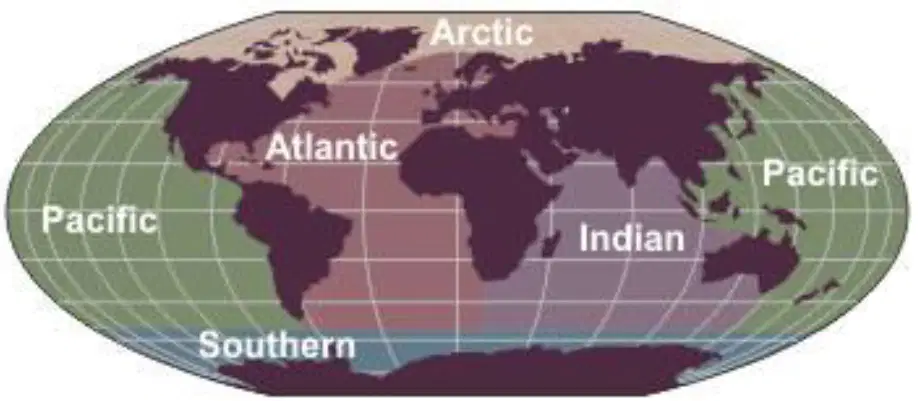
Based on the labeled world map of oceans, which pair correctly identifies two continents that the Pacific Ocean separates?
Africa and Europe
Asia/Australia and the Americas
Europe and North America
Africa and South America
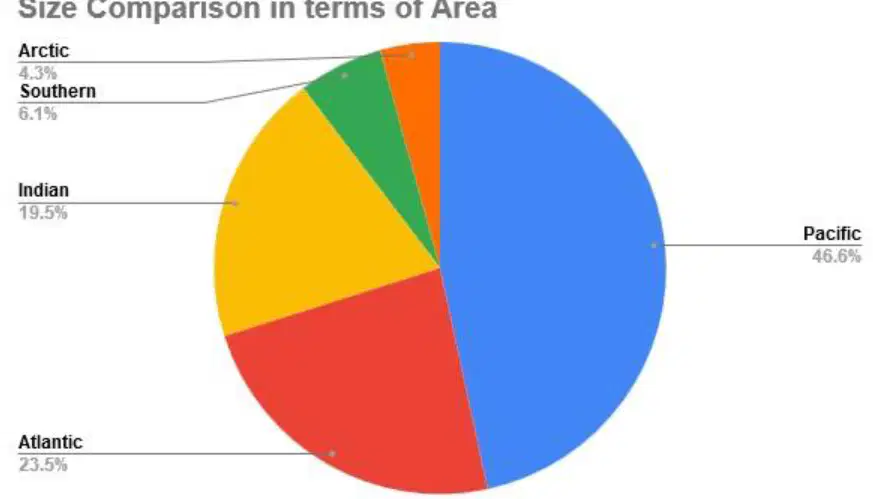
Using the pie chart of ocean areas, which sequence lists oceans from largest to smallest by area?
Pacific, Atlantic, Indian, Southern, Arctic
Atlantic, Pacific, Indian, Arctic, Southern
Pacific, Indian, Atlantic, Arctic, Southern
Indian, Atlantic, Pacific, Southern, Arctic
Which statement best describes the Challenger Deep based on the passage?
It is a mid-ocean ridge about 12,100 feet deep.
It is the deepest known point on Earth, nearly 7 miles (36,000 feet) below the ocean surface.
It is a shallow shelf where sunlight reaches the seafloor.
It is a volcanic island chain formed by plate hotspots.
In 1960, which vessel carried the first humans to the bottom of the ocean, and who were aboard?
Bathyscaphe Trieste with Jacques Piccard and Don Walsh
Deepsea Challenger with James Cameron and Don Walsh
Alvin with Jacques Cousteau and Sylvia Earle
Shinkai 6500 with James Cameron and Jacques Piccard
According to the passage, how did the engineers ensure the Trieste could withstand the extreme pressure at the Challenger Deep?
By using lightweight aluminum and large viewing windows for flexibility
By designing the vessel with thick acrylic and steel to endure immense pressure
By pressurizing the cabin to match outside pressure so no forces acted on it
By surrounding the hull with inflatable bladders to counteract pressure
Which timing sequence for the 1960 mission is accurate according to the passage?
3 hours down, 5 hours up, 10 minutes at the bottom
5 hours down, 3 hours up, roughly 20 minutes at the bottom
6 hours down, 6 hours up, 1 hour at the bottom
2 hours down, 4 hours up, 30 minutes at the bottom
Why were the 2012 dives by James Cameron scientifically significant, as stated in the passage?
They disproved earlier measurements of ocean depth using sonar.
They collected samples and high-resolution video, offering an unprecedented view of deep-ocean life and geology.
They set the record for the fastest descent using rocket-assisted propulsion.
They replaced the need for robotic exploration by proving only solo dives are reliable.
Which option best explains the role of robotic submarines in later Challenger Deep expeditions?
They primarily transport tourists to the trench for public outreach.
They map the seafloor, study deep-sea organisms, and collect rock and water samples under extreme pressure.
They are used to repair undersea internet cables at mid-depths far from trenches.
They mainly test new fishing gear for commercial applications.
Given the passage’s data, which inference about extreme ocean environments is most supported?
Life cannot exist below 12,100 feet due to total darkness.
Human-occupied vehicles are unnecessary because pressure is similar to sea level at depth.
Engineering solutions like thick pressure-resistant hulls and the use of unmanned vehicles are essential for exploring the deepest trenches.
The Challenger Deep is shallow enough for conventional submarines to operate safely.
Based on the world map, which region contains the Mariana Trench?
Western Pacific Ocean east of the Mariana Archipelago between Japan and Papua New Guinea
Central Atlantic Ocean west of Africa near the Mid-Atlantic Ridge
Southern Indian Ocean south of Madagascar near the Kerguelen Plateau
Eastern Pacific Ocean off the coast of South America near the Peru–Chile Trench
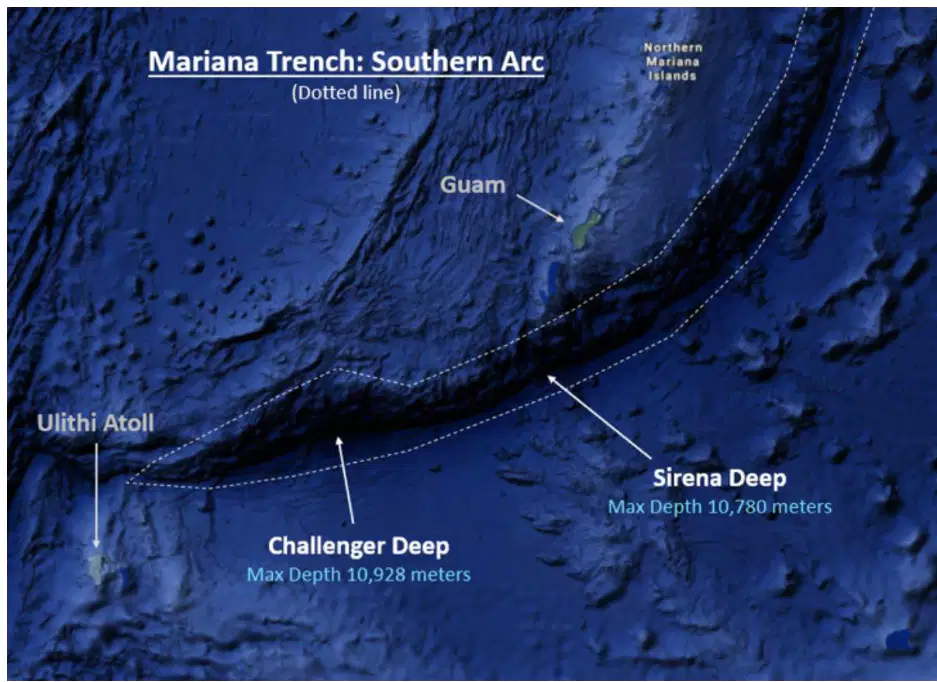
In the detailed bathymetric map of the southern arc of the Mariana Trench, which feature is identified as the deepest point?
Sirena Deep
Challenger Deep
Ulithi Atoll
Guam Basin

According to the southern arc diagram, which labeled location lies closest to the northern edge of the trench arc?
Ulithi Atoll
Challenger Deep
Guam
Sirena Deep
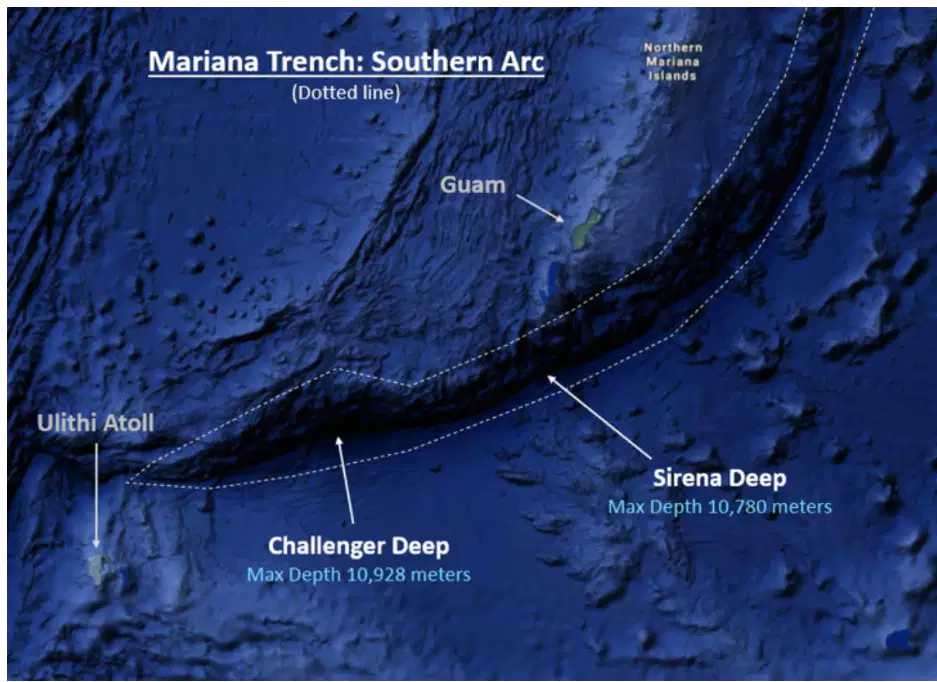
Using the depth labels on the diagram, what is the approximate depth difference between Challenger Deep and Sirena Deep?
About 148 meters (10,928 m − 10,780 m)
About 1,148 meters (10,928 m − 9,780 m)
About 10,780 meters (Sirena Deep is shallower by this amount)
They have the same maximum depth
The depth comparison graphic shows Mount Everest at 8.848 km. What conclusion does this support about ocean depth?
The deepest ocean trenches are shallower than Mount Everest is tall
The ocean’s maximum depth exceeds the height of Mount Everest
Mount Everest and the ocean’s deepest point are approximately equal in magnitude
The ocean’s depth cannot be compared to mountain heights

Identify ocean "A"
(a)
Identify ocean "B"
(a)
Identify the ocean that includes portions of ocean A, ocean C, and ocean D, below 60o South latitude
(a)
Identify ocean "C"
(a)
Identify ocean "D"
(a)
The largest ocean on Earth by area:
(a)
The smallest ocean on Earth by area:
(a)

The Northern hemisphere is also known as the (a) and the Southern hemisphere is known as the (b)
The Challenger Deep in the Mariana trench is the deepest part of the ocean. What phenomenon is this trench associated with:
Sea floor spreading
Continental rifting
Subduction
Hot spot volcanism
Reorder the following oceans from largest to smallest:
Pacific
Atlantic
Indian
Southern
Arctic
Which statement best defines ocean salinity as used in marine science?
The total mass of suspended sand particles in seawater
The measure of dissolved salts—primarily sodium chloride—in a given amount of seawater
The ratio of ocean temperature to pressure at depth
The amount of oxygen gas dissolved in seawater
What is the average salinity of ocean water, expressed using standard units?
35 parts per thousand (ppt) or about 3.5% salt by mass
3.5 parts per thousand (ppt) or about 35% salt by mass
50 parts per thousand (ppt) or about 5% salt by mass
0.35 parts per thousand (ppt) or about 0.035% salt by mass
A sample contains 1,000 grams of average seawater. Approximately how many grams of that mass are dissolved salts?
3.5 grams of salt and 996.5 grams of water
35 grams of salt and 965 grams of water
50 grams of salt and 950 grams of water
350 grams of salt and 650 grams of water
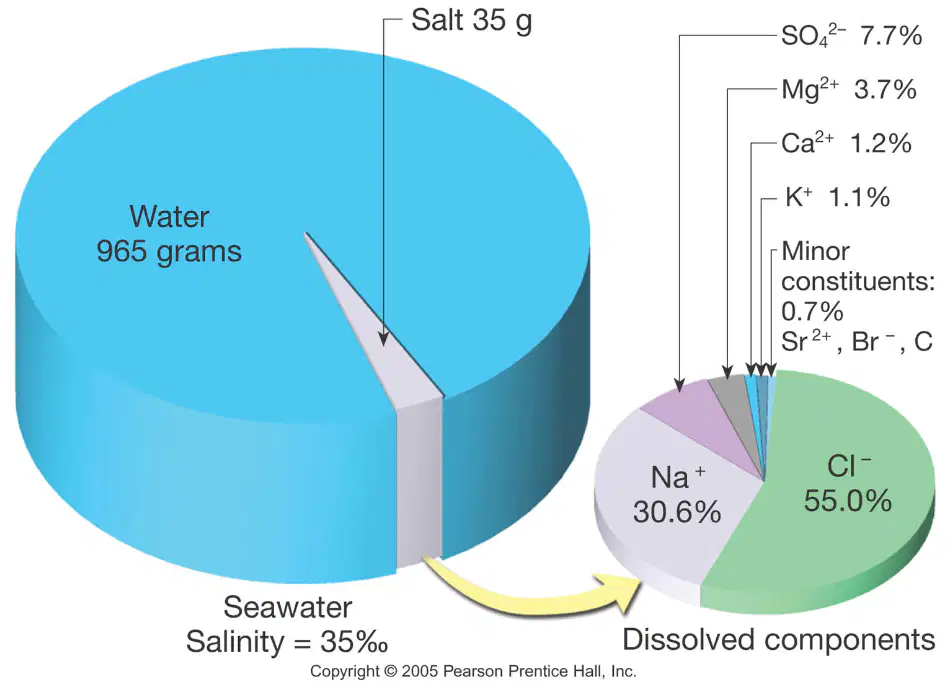
According to the composition pie chart of dissolved components, which ion makes up the largest percentage of the dissolved salts in seawater?
Sodium ion (Na+) at 30.6%
Chloride ion (Cl−) at 55.0%
Sulfate ion (SO4^2−) at 7.7%
Magnesium ion (Mg2+) at 3.7%
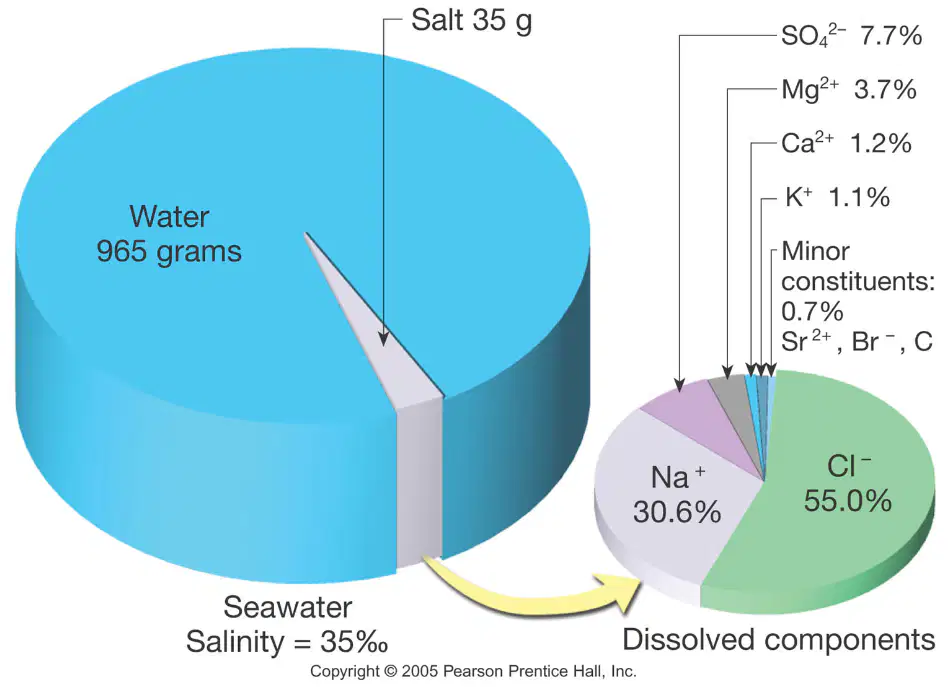
Which pair correctly matches a dissolved component with its approximate percentage in seawater salts, based on the diagram?
Potassium ion (K+) — about 7.7%
Calcium ion (Ca2+) — about 1.2%
Sulfate ion (SO4^2−) — about 30.6%
Magnesium ion (Mg2+) — about 55.0%
Which range best represents the typical salinity of open ocean water described in the passage?
12 to 17 ppt
22 to 27 ppt
32 to 37 ppt
300 to 350 ppt
DoK 1 — Which process generally increases surface ocean salinity in certain regions such as the Red Sea?
High rainfall diluting seawater
Melting sea ice adding freshwater
High evaporation removing water
River inflow carrying sediments
A coastal area experiences an unusually rainy season and extensive melting of nearby sea ice. Based on the text’s rules, what combined effect on local surface salinity is most likely?
Salinity will decrease because both processes add freshwater.
Salinity will increase because both processes concentrate salts.
Salinity will remain unchanged because salt content is fixed.
Salinity will first increase due to rainfall, then decrease due to melting.
According to the description, which pair of conditions would produce the densest seawater?
Warm and fresh
Warm and salty
Cold and fresh
Cold and salty
Differences in density help drive ocean circulation. Which reasoning best explains how these differences generate deep currents?
Dense water sinks and lighter water rises, creating vertical movements that set water masses in motion.
Wind blowing across the surface directly drags deep water along the seafloor.
Freshwater rivers inject momentum that propagates as deep currents across basins.
Tidal forces compress seawater, increasing density uniformly and pushing it poleward.
The Dead Sea has a salinity of around 300–350 ppt, nearly 10 times saltier than average ocean water at about 35 ppt. If a parcel of Dead Sea water were cooled to the same temperature as polar seawater, what would most directly account for its exceptionally high density compared with typical ocean water?
Its dissolved salt concentration is much higher, packing more mass into the same volume.
Its water molecules are larger than those in normal seawater, increasing mass.
It contains less dissolved gas, allowing tighter molecular packing.
Its temperature fluctuates more during the day, increasing average density.
Where is the Dead Sea located according to the map description?
Between Israel and Jordan near the West Bank
Along Egypt’s Mediterranean coastline
On the eastern shore of the Mediterranean Sea in Syria
South of the Gaza Strip in the open ocean
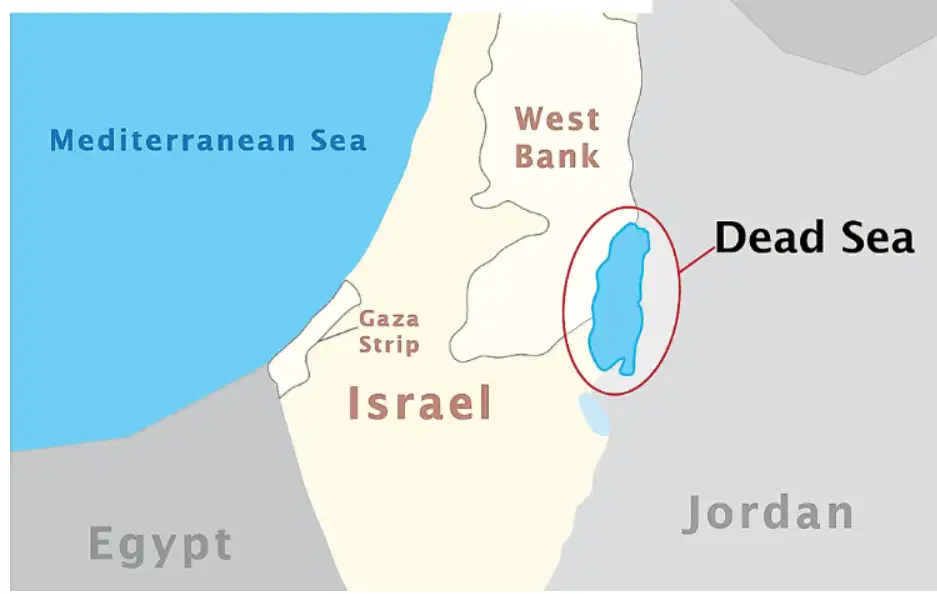
Which combination of conditions best explains why the Dead Sea became extremely salty over thousands of years?
No outlet basin plus high evaporation in a hot, dry region
Frequent river flooding that flushes salts into the open ocean
Underground freshwater springs that dilute incoming minerals
Tidal mixing with the Mediterranean Sea that concentrates salts
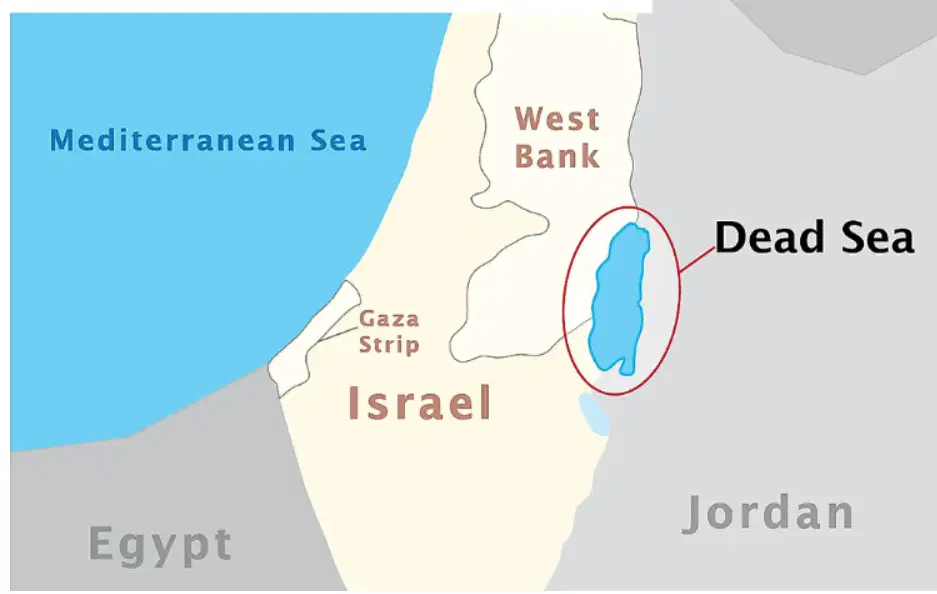
If a dam drastically reduced the Jordan River’s inflow while the climate stayed hot and dry, which outcome is most plausible for the Dead Sea over time? Use the passage’s reasoning about salinity and water balance.
Water level would drop faster and salinity could increase further as evaporation outpaces inflow
Water level would rise and salinity would decrease due to reduced mineral input
Salinity would stay constant because outlet flow would balance evaporation
The sea would become less dense because less water would evaporate in a hot climate

What physical effect of high salinity is highlighted in the photo description of the Dead Sea’s shoreline?
The high density allows people to float easily on the surface
The water freezes at a higher temperature than freshwater
The waves become taller due to increased mass
The shoreline erodes faster because salt dissolves rock quickly
Which statement best defines a brine pool as described in the passage?
A shallow coastal lagoon formed by tides
An underwater lake of extremely salty, dense water on the seafloor
A freshwater spring that seeps up through marine sediments
A volcanic crater filled with warm seawater
Why do brine pools appear as separate lakes under the sea?
They are warmer than surrounding seawater, creating convection boundaries
They are covered by a thin ice layer that reflects light
Their briny water is so dense it does not mix well with normal seawater
They are isolated by rock walls that keep seawater out

According to the formation description, what initiates the creation of a brine pool on the ocean floor?
Melting of polar ice releasing fresh water into basins
Dissolution of deep seafloor salt deposits into groundwater that seeps out
Eruption of submarine volcanoes that trap seawater
Tectonic uplift that creates enclosed marine basins
Where are brine pools most commonly found based on the text?
Arctic Ocean and the Red Sea
Gulf of Mexico and the Mediterranean Sea
Indian Ocean and the Coral Sea
South China Sea and the Bering Sea
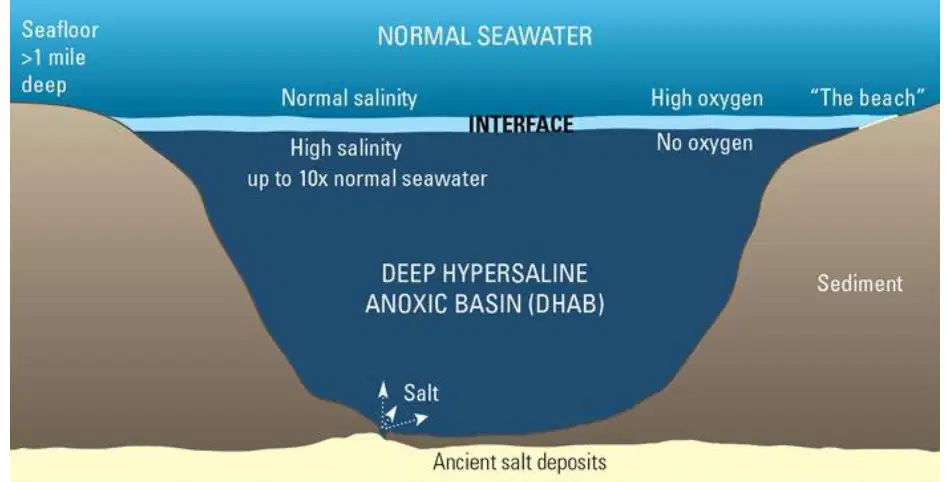
In the labeled diagram of a deep hypersaline anoxic basin (DHAB), which combination correctly describes the brine pool interior relative to normal seawater?
Low salinity and high oxygen
High salinity (up to 10× normal) and no oxygen
Moderate salinity and moderate oxygen
High temperature and high oxygen
Why do scientists nickname certain Gulf of Mexico brine pools the "Hot Tubs of Despair"?
They are warm nurseries for marine larvae
They emit bright bioluminescent light at night
They are extremely salty and toxic, containing chemicals like hydrogen sulfide and methane that quickly kill sea life
They provide a relaxing habitat where predators rarely enter
Which process primarily delivers dissolved sodium and chloride to the ocean by breaking down rocks on land and transporting the ions via rivers?
Hydrothermal vent circulation
Weathering of rocks by slightly acidic rainwater
Evaporation of seawater during warm periods
Biological uptake by marine organisms followed by decay
What role do underwater volcanic eruptions and hydrothermal vents play in the origin of ocean salinity? Choose the most accurate explanation.
They remove salts from seawater by trapping them in newly formed basalt.
They release minerals, gases, and salts directly into seawater through outgassing and vent fluids.
They dilute ocean salinity by injecting large volumes of fresh water.
They only heat seawater without changing its dissolved chemical composition.
If the hydrologic cycle caused salts to evaporate along with water at the ocean surface, how would long-term average ocean salinity most likely change, and why?
It would increase, because rivers would continue adding salts faster than they evaporate.
It would remain unchanged, because sources and sinks of salts would balance regardless of evaporation behavior.
It would decrease, because salts would be lost to the atmosphere instead of accumulating in the ocean.
It would fluctuate randomly, because volcanic activity is unpredictable.
Over millions of years, the ocean has become salty. What approximate average salinity value is reported for seawater?
3 parts per thousand
15 parts per thousand
35 parts per thousand
55 parts per thousand
Which water cycle process directly decreases ocean salinity by adding freshwater to the surface layer?
Evaporation in hot, dry regions
Precipitation of rain or snow
Freezing of seawater into sea ice
Upwelling of deep saline water
When seawater freezes to form sea ice, what happens to the salinity of the surrounding liquid water?
It decreases because salt is locked inside the ice
It stays the same because freezing does not affect salt
It increases because most salt is left behind in the liquid
It fluctuates randomly with no consistent trend
A coastal region experiences heavy river discharge for several weeks. What net effect on local ocean salinity is most consistent with the processes described?
Salinity decreases because river water dilutes seawater near the mouth
Salinity increases because sediments add salts to the ocean
Salinity is unchanged because rivers primarily carry saltwater
Salinity increases because river flow accelerates evaporation
In a subtropical gyre with strong evaporation and minimal rainfall, which mechanism best explains the observed high surface salinity?
Evaporation removes water and leaves salts behind, increasing salinity
Melting sea ice injects salt into the surface layer, increasing salinity
Precipitation adds freshwater that concentrates salt, increasing salinity
River runoff delivers dissolved salts that outweigh water addition, increasing salinity
A polar ocean sector transitions from winter to summer. Sea ice melts, and precipitation increases compared to winter. Based on the described processes, predict the combined effect on surface salinity and justify the direction of change.
Salinity increases because melting ice and rain add freshwater that leaves more salt behind
Salinity decreases because both melting ice and precipitation add freshwater that dilutes salts
Salinity remains constant because melting ice offsets precipitation effects
Salinity increases because freshwater input enhances density-driven mixing that brings saltier water up
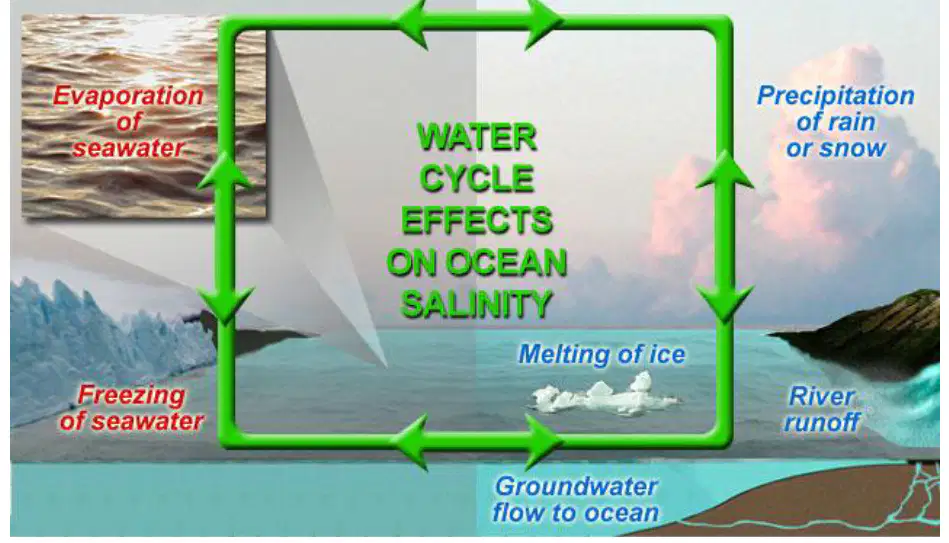
A researcher observes two adjacent basins: Basin A has intense evaporation and intermittent sea-ice formation; Basin B has frequent storms, river runoff, and seasonal ice melt. Which basin will likely have higher average surface salinity, and why?
Basin A, because evaporation and freezing remove freshwater, concentrating salts
Basin B, because storm mixing and runoff import dissolved salts from land
Basin A, because precipitation during storms adds freshwater, lowering salinity
Basin B, because melting ice excludes salts into the meltwater, increasing salinity
Identify the two (2) main dissolved components in water:
Na
Cl
Mg
Ca
K
On average, sea surface salinity is:
35 ppt
1 ppt
100 ppt
50 ppt
330 ppt
The dead sea surface salinity is:
35 ppt
1 ppt
100 ppt
50 ppt
330 ppt
Which of the following will increase ocean salinity:
Evaporation
Sea ice formation
Precipitation (Rain)
Runoff
Icebergs melting
Which of the following will decrease ocean salinity:
Evaporation
Sea ice formation
Precipitation (Rain)
Runoff
Icebergs melting
A higher salinity leads to (a) density

Which sample of water has the highest density?
A
B
C
D
They all have the same density
A temperate rainforest coastline has lots of precipitation but not as much evaporation. Estimate the salinity in this region:
30 ppt
40 ppt
45 ppt
300 ppt
precipitation
Runoff from land
Icebergs melting
sea ice melting
evaporation
formation of sea ice
Which statement best defines a carbon sink in the context of Earth’s oceans?
A system that releases more CO2 to the atmosphere than it absorbs
A reservoir that absorbs and stores large amounts of atmospheric CO2
A process that converts CO2 directly into methane in seawater
A region where CO2 cannot dissolve due to high temperatures
According to the passage, approximately what fraction of human-released CO2 since the Industrial Revolution has been absorbed by the oceans?
About one-fourth
About one-half
About three-fourths
Less than one-tenth
When atmospheric CO2 contacts the ocean surface, what immediate chemical change described in the text helps remove CO2 from the atmosphere?
Formation of methane gas bubbles
Conversion to carbonic acid after dissolving in seawater
Precipitation of pure carbon crystals
Oxidation to carbon monoxide
Which condition enhances the physical (solubility) pump, allowing more CO2 to be transported to the deep ocean?
Warm, less dense tropical water that rises quickly
Cold, dense polar water that sinks and can remain deep for centuries
Shallow coastal water warmed by tides and sunlight
Freshwater lenses that float above seawater and evaporate
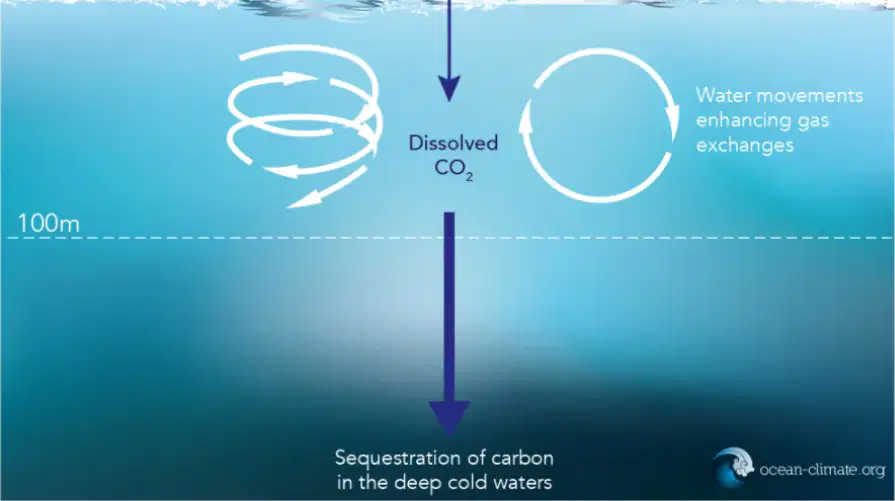
Refer to the diagram showing arrows between atmospheric CO2, dissolved CO2, and deep sequestration. Which process is primarily illustrated, and what key mechanism does it depend on?
Biological pump relying on photosynthesis by phytoplankton
Physical carbon pump relying on gas exchange and sinking of cold, dense water
Volcanic degassing relying on eruption-driven mixing
Anthropogenic injection relying on engineered pipelines
Which sequence best describes the biological pump as presented in the text?
CO2 dissolves, forms methane, and escapes to the atmosphere
Phytoplankton use CO2 for photosynthesis; organisms die and sink; carbon is stored in sediments
Corals release CO2 during calcification; gases rise and warm surface waters
Shellfish dissolve carbonate shells at the surface; carbon is released to air
In the context of long-term carbon storage described, what are bioclastic sedimentary rocks and how do they form?
Rocks formed from cooled magma enriched in CO2
Rocks produced when deep-ocean basalts absorb carbonic acid
Rocks created when hard parts of marine organisms are compacted and cemented on the ocean floor
Evaporite deposits formed by precipitation of halite and gypsum from seawater
Which statement best defines ocean acidification as described in the passage?
The process by which oceans release excess carbon dioxide into the atmosphere, raising global pH
A chemical change in seawater caused by increased absorption of atmospheric CO2 that lowers ocean pH
The dilution of seawater salts due to melting ice, increasing ocean alkalinity
A biological process where marine organisms add acids to water during respiration
When CO2 dissolves in seawater, which immediate product forms before it dissociates?
Carbonic acid (H2CO3)
Carbonate (CO32-)
Calcium carbonate (CaCO3)
Hydroxide (OH−)
What is the direct chemical reason that ocean pH decreases during acidification?
Formation of additional calcium ions that consume hydroxide
Production of hydrogen ions from carbonic acid dissociation
Oxidation of dissolved oxygen into ozone near the surface
Precipitation of carbonate minerals that remove bicarbonate
Which outcome is most directly linked to reduced availability of carbonate ions in acidified waters?
Enhanced photosynthesis in phytoplankton
Greater formation of calcium carbonate shells and skeletons
Difficulty for corals, clams, oysters, and some plankton to build shells
Increased ocean salinity throughout the water column
Consider the described chain of effects: rising atmospheric CO2 → more CO2 dissolved in seawater → formation of carbonic acid → release of hydrogen ions. Which systems-level consequence follows from this chain according to the passage?
More stable coral reef growth due to thicker skeletons
Shifts in ocean biodiversity as species’ behavior and survival change
Rapid neutralization of acidity by sea ice formation
Immediate recovery of shellfish populations due to increased bicarbonate
Which statement best explains why coral reefs can erode faster than they rebuild under increasing acidity?
Acidic water strengthens coral skeletons, promoting overgrowth that later collapses
Weakening of coral skeletons under acidic conditions makes them more prone to breakdown and erosion
Corals switch to silica-based skeletons that dissolve rapidly in alkaline water
Higher pH causes carbonate to precipitate on corals, smothering growth
Based on the passage, which scenario would most likely disrupt marine food webs?
Decline of small shell-forming organisms that sit at the base of the food chain
Temporary decrease in sea surface temperature during winter
Increase in dissolved oxygen from enhanced wave action
Growth of seagrasses that use bicarbonate during photosynthesis
According to the passage, what best describes the Great Pacific Garbage Patch?
A single solid island of trash floating on the ocean surface
A massive region with dispersed debris, largely tiny plastic pieces mixed in water
A narrow line of waste along the California coastline only
A temporary slick that appears only after storms
Which estimate for the size of the Great Pacific Garbage Patch is provided in the passage?
About 16,000 square kilometers, similar to the size of Hawaii
About 1.6 million square kilometers, roughly twice Texas or three times France
About 620 square miles, similar to a small county
About 62 million square kilometers, nearly the entire Pacific
What are microplastics as described in the passage?
Large intact bottles and nets that are easy to see and collect
Tiny pieces of plastic that are often too small to see easily
Natural sand grains produced by coral reefs
Metal fragments from ships that rust into the water
Where is the Great Pacific Garbage Patch located, and what oceanic feature maintains it?
Between Japan and Alaska, maintained by tidal bores
Between Hawaii and California, maintained by the North Pacific Gyre
South of New Zealand, maintained by El Niño currents
Near the equator off Ecuador, maintained by upwelling jets
Why do plastics in the patch persist and become microplastics over time, according to the passage?
They are quickly dissolved by salt, leaving no residue
They do not break down easily; sunlight and waves gradually fragment them into smaller pieces
They are consumed immediately by fish, removing them from the water
They sink rapidly to the seafloor and decompose within weeks
According to the section, which source contributes the largest share to the Great Pacific Garbage Patch?
Land-based litter carried by rain and wind
Waste intentionally dumped from beaches
Emissions from coastal power plants
Natural seaweed accumulations
Which item is specifically identified as a major component of marine-source debris and can entangle animals?
Ghost nets made of lost fishing gear
Glass bottles from cruise ships
Metal cans from offshore platforms
Wooden pallets from cargo ships
Which scenario best exemplifies improper waste management leading to ocean pollution?
A landfill located near a river allows trash to escape into waterways
A fishing boat loses catch during a storm
A city enacts a plastic bag fee at grocery stores
An offshore platform incinerates its waste according to regulations
Which outcome is directly described as a biological harm from plastics in the patch?
Sea turtles, fish, and seabirds mistake plastic for food and become ill or die
Coral reefs grow faster due to additional surfaces
Whales avoid the region entirely due to noise pollution
Algae blooms are eliminated by plastic shading
A coastal community expects more debris in the ocean after a category 4 hurricane. Which reasoning aligns with the text?
Storms and natural disasters can sweep large amounts of plastic and debris from land into the sea
Hurricanes dissolve plastics before they reach the ocean
Only tsunamis, not hurricanes, move trash into marine gyres
Storm-driven currents keep debris near beaches rather than offshore
Which action directly reduces the amount of new plastic entering the ocean by limiting single-use items?
Using more disposable bags for convenience
Choosing reusable bottles, bags, and containers
Burning plastics in open pits near beaches
Shipping trash to other countries for sorting
A city wants to stop trash from reaching rivers during storms. Based on the guidance, which combined approach best applies the concept of prevention?
Expanding landfills while allowing street littering to continue
Keeping storm drains clear and organizing local cleanups
Waiting for national laws before acting locally
Focusing only on offshore cleanup vessels
What is the purpose of fishing gear recovery programs in reducing the Great Pacific Garbage Patch?
To sink plastic deeper so it is less visible
To collect or recycle old nets and gear to prevent ghost nets from drifting
To increase fish catch to fund cleanup
To replace plastic nets with heavier metal nets
An environmental agency is upgrading its recycling system and constructing better-engineered landfills. Which goal from the strategies does this most directly support?
Improve waste management to prevent leakage into waterways
Reduce fishing effort to curb overfishing only
Educate boaters to avoid protected areas
Install more offshore oil platforms
A coastal community has limited funds. They can either (A) launch small local cleanups and clear storm drains monthly or (B) wait two years for a proposed large ocean barrier project. Which choice aligns better with preventing trash from entering the ocean sooner, given the strategies described?
Option A, because preventing litter through local cleanups and drain maintenance stops waste before it reaches waterways
Option B, because large ocean barriers work only after trash accumulates offshore
Both are equally preventive because both operate offshore
Neither option contributes to prevention; only laws matter
Which pairing best connects a strategy with the mechanism it uses to limit plastic pollution growth?
Education and laws—ban ocean dumping and inform the public to change behaviors
Cleanup projects—discourage reusable containers to increase recycling rates
Reduce plastic use—encourage single-use items for hygiene
Fishing gear recovery—promote discarding nets at sea to avoid dock fees
According to the FAO, what proportion of the world’s fish stocks are overfished, meaning fish are being caught faster than they can reproduce?
About 7%
About 33%
About 40%
About 60%
Which statement best describes the status of the remaining global fish stocks besides the overfished portion, based on FAO data?
Most are underfished, leaving a large buffer for recovery.
Most are fished at maximum sustainable levels, leaving little room for error.
Most are unmanaged and unmonitored, so their status is unknown.
Most are protected in no-take marine reserves.
Which species experienced a decline of over 90% in the last 50 years, illustrating the severity of overfishing on popular species?
Bluefin tuna
Atlantic cod
Pacific salmon
Mahi-mahi
What does the text identify as a major economic consequence of overfishing for the global economy?
An increase of $83 billion per year in fishing subsidies
A loss of $83 billion per year in revenue from depleted fish populations
A one-time $83 billion cost to retrofit fishing vessels
An $83 billion annual increase in seafood prices paid by consumers
Up to what fraction of fish caught worldwide are unintended species (bycatch), often including dolphins, turtles, and sharks?
Up to 10%
Up to 20%
Up to 30%
Up to 40%
If current overfishing trends continue, what risk does the FAO warn about by 2050, and who is particularly threatened?
Collapse of many major fish stocks, threatening food security for over 3 billion people who rely on fish as a primary protein source
Complete recovery of most fish stocks, threatening coastal tourism for millions
Minor declines in fish stocks, threatening luxury seafood markets only
Stabilization of fish stocks, threatening freshwater fisheries rather than marine ones
Which set of actions is listed as part of sustainable fishing practices designed to solve overfishing?
Increasing net sizes, expanding fish markets, and subsidizing fuel
Setting catch limits, protecting certain areas, banning destructive methods like bottom trawling, and promoting environmentally responsible aquaculture
Opening all waters to fishing, eliminating quotas, and focusing on high-value species
Encouraging recreational fishing only and banning commercial fishing globally
As a consumer seeking to support ocean recovery, which choice aligns with the guidance provided?
Buy only imported seafood to reduce local pressure on fish stocks
Choose sustainably sourced seafood, looking for certification labels like the Marine Stewardship Council (MSC)
Avoid seafood entirely, since all fisheries are overfished
Prefer species at the top of the food web to stabilize ecosystems

