
 Worksheets
Overview of Macroeconomics and Objectives
Total questions: 150
Worksheet time: 1hrs 15mins
Which statement best describes macroeconomics in this unit’s context?
It studies individual consumer choices in a single market.
It examines economy-wide outcomes like output, employment, and the overall price level.
It focuses only on firm-level production costs and revenues.
It analyzes how one company maximizes profit using calculus.
Which trio captures the core macroeconomic objectives introduced in this section?
High output growth, high employment with low involuntary unemployment, and stable prices
Balanced trade, zero government debt, and fixed exchange rates
Maximum corporate profits, minimal taxes, and high stock prices
Unlimited government spending, wage controls, and price freezes
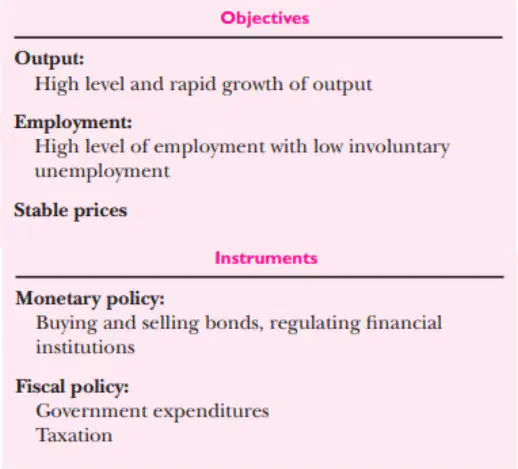
According to the overview box on objectives and instruments, which policy instrument set is used in macroeconomics?
Industrial policy and competition policy
Trade quotas and exchange controls
Monetary policy and fiscal policy
Environmental regulation and safety standards
Which is the most closely watched measure of economic output in this material?
Net National Product (NNP)
Consumer Price Index (CPI)
Gross Domestic Product (GDP)
Producer Price Index (PPI)
What does GDP measure as defined here?
The total income of all citizens regardless of location
The market value of all final goods and services produced in a country during a period of time
The number of goods produced domestically without valuing services
Only the government’s expenditure during a fiscal year
Which statement correctly contrasts nominal GDP and real GDP in this section?
Nominal GDP is calculated in constant prices; real GDP is measured in current market prices.
Nominal GDP excludes services; real GDP includes services and goods.
Nominal GDP is measured in market prices; real GDP is calculated in constant or invariant prices.
Nominal GDP includes imports; real GDP excludes imports.
Using the given formula, the percentage growth rate of real GDP in year t is computed as:
100 × (GDP_t − GDP_{t−1}) / GDP_{t−1}
(GDP_t + GDP_{t−1}) / 100
GDP_{t−1} / GDP_t × 100
100 × (GDP_t / GDP_{t−1} − 1) without any subtraction term
Based on the definition provided, potential GDP represents:
The level of output that guarantees zero inflation
The maximum sustainable level of output that the economy can produce
The average of last year’s and this year’s GDP
The output level when unemployment is zero
What does the material say tends to happen when output rises above potential output?
Price inflation tends to rise
Unemployment tends to rise
Deflation becomes more likely
The labor force automatically shrinks
According to the notes, the economy’s productive capacity—and thus potential GDP—depends on which factors?
Available inputs such as labor and capital
Economy’s technological efficiency
Only government spending levels
Short-term changes in stock prices
How is a depression characterized in this section?
A brief pause in growth lasting one quarter
A moderate downturn followed by rapid recovery
A severe and protracted downturn
A temporary increase in unemployment with stable output
Which population group is used to define the working-age population (WAP) here?
Population 10 years and over
Population 15 years and over
Population 18 to 64 years only
All citizens including children
What is the labor force according to the definitions provided?
All employed individuals only
All unemployed individuals only
That part of the working-age population that is either unemployed or employed
Only full-time workers excluding part-time workers
Which identity relating employment and unemployment rates is stated in the material?
Employment Rate × Unemployment Rate = 100%
Employment Rate + Unemployment Rate = 100%
Employment Rate − Unemployment Rate = 0%
Employment Rate + Underemployment Rate = 100%
Within this section, who constructs price indexes to track the overall price level, such as the Consumer Price Index (CPI)?
Private banks
Government statisticians (PSA)
Stock exchanges
Central business councils
Using the provided definition, price stability in this unit refers to:
A rapidly falling price level across all goods
A low and stable inflation rate, or a gently rising price level
Prices fixed by law at a constant level
Zero measured inflation regardless of circumstances
What formula is given for the rate of inflation in year t?
100 × (P_t − P_{t−1}) / P_{t−1}
(P_t / P_{t−1}) × P_{t−2}
100 × (P_{t−1} − P_t) / P_t
P_t − P_{t−1} without scaling
According to the section, what is deflation?
A situation where only wages fall but goods’ prices rise
A decline in prices or a negative rate of inflation
A decrease in GDP growth while prices are constant
A rise in unemployment with stable prices
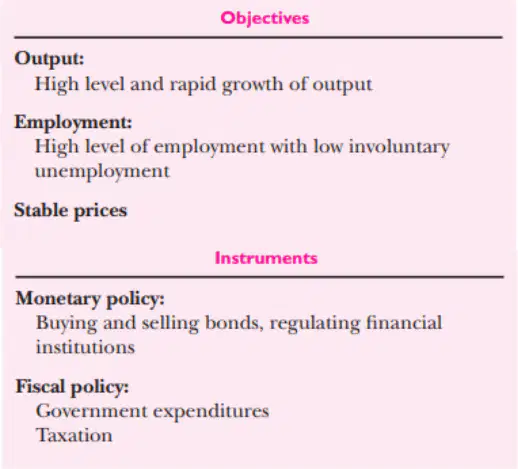
Which actions are listed under monetary policy in the visual summary of instruments?
Buying and selling bonds
Regulating financial institutions
Government expenditures on infrastructure
Taxation changes
Which statement best defines a policy instrument in macroeconomics?
A private market variable that firms cannot influence
An economic variable under government control that can affect one or more macroeconomic goals
Any change in household consumption preferences over time
A fixed parameter that never changes in response to policy
Within fiscal policy, which pair correctly lists the two distinct forms of government expenditures described?
Government purchases and government transfer payments
Government subsidies and foreign aid
Infrastructure grants and monetary injections
Public sector wages and private sector incentives
Government transfer payments are described as primarily intended to do which of the following?
Finance the purchase of tanks and roads
Increase the incomes of targeted groups such as the elderly or the unemployed
Reduce the money supply through banking regulations
Raise prices of factors of production directly
According to the material, taxation influences behavior mainly through which mechanisms?
Changing people’s disposable income and thus how much they spend and save
Altering the prices of goods and factors of production and thereby incentives
Directly setting production quotas for firms
Mandating fixed saving rates for households
Monetary policy is primarily conducted by which institution and through managing what system?
The legislature, through the national budgeting system
The central bank, through managing the nation’s money, credit, and banking system
Private banks, through deposit insurance schemes
The treasury, through tariff collection systems
Setting short-run interest rate targets in monetary policy occurs mainly through which action?
Buying and selling government securities
Altering corporate tax brackets
Issuing new currency directly to consumers
Negotiating trade treaties
Which economic variables are mentioned as being influenced by the Bangko Sentral ng Pilipinas (BSP)?
Interest rates and stock prices
Housing prices and foreign exchange rates
Unemployment benefits and pension ages
Agricultural quotas and environmental standards
International linkages include trade policies that do what?
Only restrict imports through embargoes
Consist solely of tax rebates for exporters
Consist of tariffs, quotas, and other regulations that restrict or encourage imports and exports
Eliminate all barriers to capital flows
International financial management is described as being about what central task?
Managing domestic interest rate ceilings
Helping manage the foreign exchange rate
Setting corporate governance codes
Determining the minimum wage
What does a country’s foreign exchange rate represent, according to the material?
The amount of gold backing its currency
The price of its own currency in terms of the currencies of other countries
The ratio of imports to exports in a given year
The government’s official inflation target
Aggregate demand (AD) consists of what, and how is it interpreted at each price level?
Total production by firms; it shows the output firms plan to supply at each wage level
Total spending by households, businesses, governments, and foreigners; it represents the total output that would be willingly bought at each price level
Total government expenditure only; it represents potential GDP at the natural rate
Total exports minus imports; it measures currency strength at each interest rate
Which items are listed as the components of aggregate demand?
Consumption
Investment
Government purchases
Net exports
Aggregate supply (AS) is described as depending on which set of factors?
The price level
The productive capacity of the economy
The level of costs and market conditions
The number of political parties in the legislature
At macroeconomic equilibrium, what is determined where the AS and AD curves intersect?
Only the level of government spending
Both the aggregate price level and output
Only the unemployment rate
Only the foreign exchange rate
According to the definition given, what does the aggregate demand schedule (AD curve) represent?
What firms would produce at different wage levels, holding technology constant
What everyone in the economy—consumers, businesses, foreigners, governments—would buy at different aggregate price levels, ceteris paribus
How the central bank sets interest rates across maturities
The difference between potential output and actual output at full employment
Which statement best defines the aggregate supply (AS) curve in macroeconomics?
It shows the total planned spending at each income level, ceteris paribus.
It represents the quantity of goods and services that businesses are willing to produce and sell at each price level, ceteris paribus.
It traces combinations of unemployment and inflation that policymakers target.
It measures the sum of consumption, investment, government purchases, and net exports over a year.
Macroeconomic equilibrium occurs when which condition is satisfied?
Overall price and quantity are such that buyers and sellers are satisfied with their overall purchases, sales, and prices.
The economy operates exactly at full employment or potential output.
Aggregate demand increases faster than aggregate supply at every price level.
The government budget is balanced and net exports are zero.
According to the instructional text, which components make up aggregate demand in the context of GDP? Use the standard notation.
Consumption (C)
Gross investment (I)
Government purchases of goods and services (G)
Net exports (X)
Depreciation (D)
Given the relationship GDP = C + I + G + X presented in the material, which change would directly increase measured GDP, holding other components constant?
A decrease in government purchases of goods and services
An increase in personal consumption expenditures on goods and services
A rise in depreciation charges by firms
A reduction in exports matched by an equal reduction in imports
Which statement about equilibrium output in the material is accurate?
Equilibrium output always equals full employment or potential output.
Equilibrium output can depart from full employment or potential output.
Equilibrium output is defined only by the aggregate demand curve.
Equilibrium output cannot be observed when prices change.
Which statement best defines Gross Domestic Product (GDP) in the product (expenditure) approach?
The market value of all intermediate goods produced within a nation in a year
The total money value of the flow of final goods and services produced by the nation
The quantity of goods and services produced without considering prices
The sum of profits earned by domestic firms at home and abroad
In the expenditure approach to GDP, which goods are included?
Only intermediate goods purchased by firms
Only goods produced for export
Only final goods ultimately bought and used by consumers or for investment
All goods and services regardless of use
Using the product approach example, GDP equals the sum of (price × quantity) across final goods. What is the primary implication of this formulation?
GDP increases only when prices fall
Each final product’s market value contributes to GDP without double counting inputs
Intermediate inputs are counted multiple times to reflect their importance
GDP is independent of quantities produced
According to the income (cost) approach, which components are summed to measure GDP?
Wages and salaries
Interest payments
Rents
Residual profits
In the income approach, why are profits sometimes called a residual?
Because profits are excluded from GDP and estimated later
Because profits are calculated to reconcile the equality between product and income measures
Because profits equal wages plus rents minus interest
Because profits measure only foreign earnings
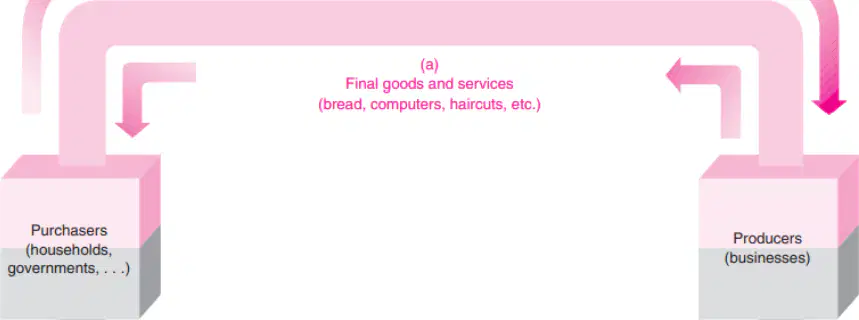
Which description matches the upper loop in the circular flow diagram of macroeconomic activity?
Flow of productive services from households to producers and factor payments back
Flow of final goods and services from producers to purchasers and consumption expenditures back
Flow of taxes from households to government and subsidies to firms
Flow of imports and exports across borders

Which description matches the lower loop in the circular flow diagram of macroeconomic activity?
Flow of final goods and services and consumption purchases
Flow of productive services such as labor and land and payments like wages, rents, and profits
Flow of government purchases and transfers
Flow of savings and investment funds
What problem does the value-added approach solve in national accounting?
Inflation bias in the price level
Double, triple, or quadruple counting of inputs across production stages
Measurement of underground economy
Exclusion of services from GDP
Which statement best defines value added for a firm?
Total sales revenue regardless of input purchases
The difference between a firm's sales and its purchases of materials and services from other firms
The sum of wages and salaries paid to workers
The market value of final goods in the economy
Which is classified as a final product in GDP accounting?
Flour sold to a bakery to make bread
A new computer purchased by a firm for use in production
Microchips sold to a computer manufacturer
Steel sold to an auto plant

Using the value-added bread example, which items are included in GDP and why?
Bread is included; flour is excluded, because GDP sums value added at each production stage
Both bread and flour are included to reflect all market activity
Only wheat is included because agriculture is the base stage
Bread and computer chips are both excluded as intermediate goods
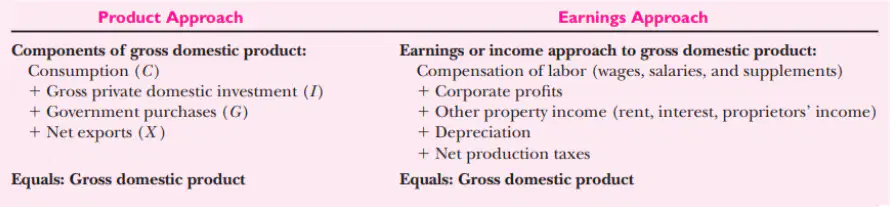
Which components comprise the product (expenditure) approach to GDP as listed in the national accounts details?
Consumption (C)
Government purchases (G)
Net exports (X)
Gross private domestic investment (I)
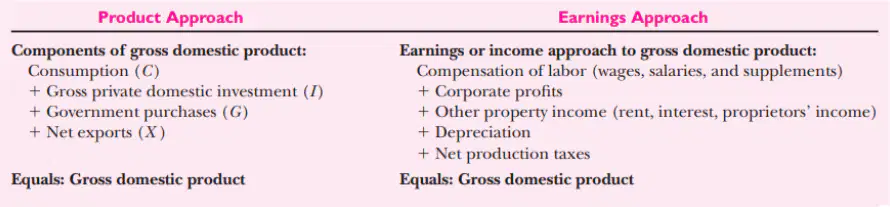
Which items are included in the earnings (income) approach to GDP according to the national accounts details?
Compensation of labor
Corporate profits
Other property income (rent, interest, proprietors' income)
Depreciation and net production taxes
What does an account for a firm or nation represent in national accounting?
A narrative history of economic events
A legal document for taxation purposes
A numerical record of all flows during a given period
A forecast of next year’s GDP
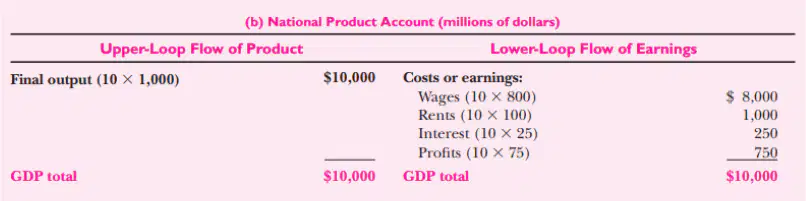
In the farm-to-national-accounts illustration, what equality is demonstrated between the upper-loop flow of product and the lower-loop flow of earnings?
Total final output value equals total costs or earnings, producing the same GDP total
Final output value exceeds earnings due to depreciation
Earnings exceed output value due to taxes
Neither approach produces the same GDP total
Which types of capital are mainly included in national accounts measures?
Intangible capital such as research and education only
Mainly tangible capital such as buildings and computers, omitting most intangible capital
Only financial capital such as bonds and stocks
Only residential housing
How are government purchases treated in GDP accounting according to the material?
They include consumption-type goods such as food for the military
They include investment-type items such as schools or roads
They exclude transfer payments because no goods or services are exchanged
They include all welfare payments as government services
Which formula correctly expresses real GDP (Q) as described?
Q = P × Q
Q = nominal GDP × GDP price index
Q = nominal GDP / GDP price index
Q = GDP price index / nominal GDP
What is the difference between nominal GDP and real GDP?
Nominal GDP measures current prices times quantities, while real GDP measures the volume or quantity produced after removing price changes or inflation
Nominal GDP is adjusted for inflation, real GDP is not
Real GDP excludes government spending, nominal GDP includes it
Real GDP measures only services, nominal GDP measures only goods
Which statement best distinguishes real GDP from nominal GDP?
Real GDP values output using current prices, while nominal GDP uses base-year prices to remove inflation.
Real GDP values output using base-year prices to remove inflation, while nominal GDP uses current prices at the time of production.
Real GDP includes underground economic activity, while nominal GDP excludes it.
Real GDP excludes government purchases, while nominal GDP includes them.
The GDP deflator primarily serves which purpose in national income accounting?
To convert nominal GDP into real GDP by adjusting for price level changes
To measure changes in employment levels across industries
To calculate net exports by deflating import prices
To separate personal income from corporate income taxes
According to the material, which is the correct distinction between real investment and financial investment?
Real investment is purchasing corporate bonds; financial investment is building factories.
Real investment is producing durable capital goods; financial investment is buying stocks or bonds.
Real investment is saving in banks; financial investment is purchasing machinery.
Real investment is government spending; financial investment is private consumption.
Which definition of depreciation aligns with its use in moving from GDP to NDP?
The total value of new capital produced in a year
The amount of capital that has been used up in a year
The portion of profits distributed as dividends
The change in inventories held by firms
Which statement correctly relates gross investment and net investment?
Net investment equals gross investment plus depreciation.
Gross investment equals net investment minus depreciation.
Net investment equals gross investment minus depreciation.
Gross investment excludes all newly produced investment goods.
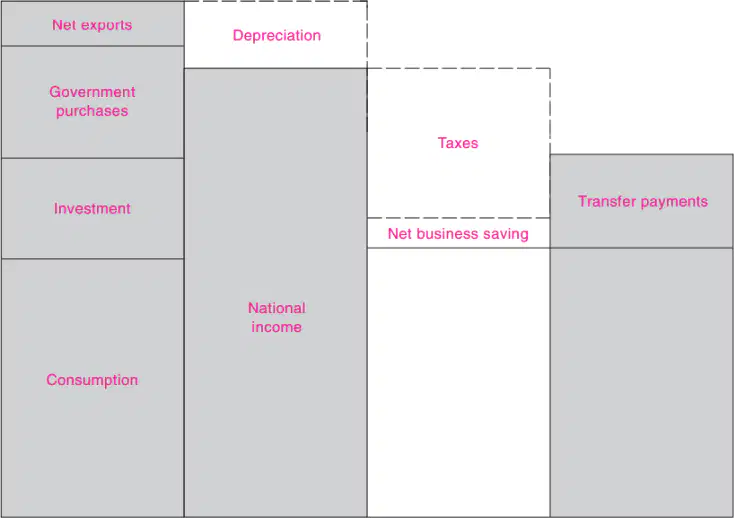
Based on the diagram pathway from GDP to DI, which component is subtracted after National Income to reach Personal Income?
Personal taxes (Tp)
Corporate taxes (Tc)
Government purchases (G)
Net exports (X)
Which sequence of equalities is supported by the explanations provided?
GDP − Depreciation = NDP; NDP − Ti = NI
GDP + Depreciation = NDP; NDP + Ti = NI
GDP − Ti = NDP; NDP − Depreciation = NI
GDP = NI − Ti; NI − Depreciation = NDP
Which items are included in National Income (NI) at factor costs according to the text?
Wages and interest
Rent and unincorporated business profits
Corporate profits composed of corporate taxes, corporate savings, and dividends
Transfer payments to households
Which identity correctly links Personal Income (PI), Disposable Income (DI), consumption (C), and personal savings (Sp)?
PI − Tp = DI = C + Sp
PI + Tp = DI = C − Sp
PI − Ti = DI = C + Sp
PI = DI + Tp = C − Sp
What does the savings-investment identity simplify to in the material when government savings are included appropriately?
S = C + I + G + X
S = I + X
S = I − X
S = C + Sp + Sc
Which tax category is listed as an indirect tax in the legend?
Corporate taxes on profits
VAT, sales tax, and excise tax
Personal income tax brackets
Property taxes on households
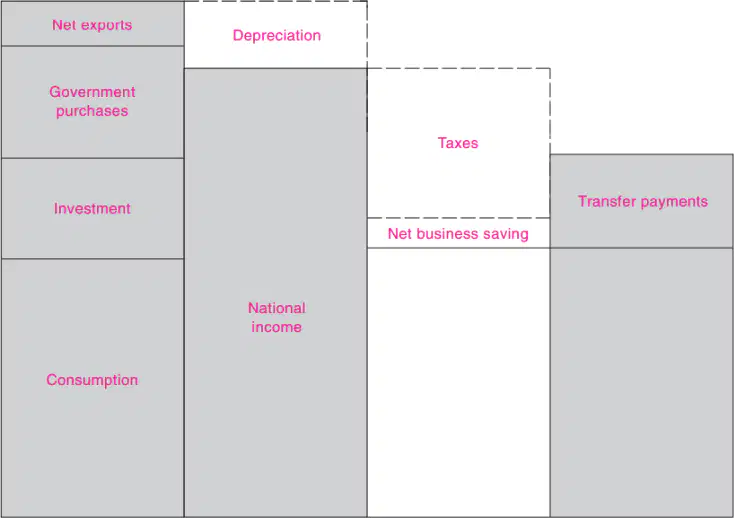
According to the flow from GDP to DI, which of the following raises Disposable Income when it increases (holding other items constant)?
Transfer payments (Tr)
Personal taxes (Tp)
Net business saving (Sc)
Corporate taxes (Tc)
Which set correctly matches a symbol to its meaning as used in the notes?
DI: National income at market prices
NDP: Disposable income after taxes
G: Government purchases of goods and services
X: Gross private domestic investment
Which of the following best describes a deficiency of GDP related to non-market activities?
GDP fully includes the value of unpaid household work through imputed wages.
GDP omits many near-market household services such as meals, laundering, and child-care provided at home.
GDP double-counts underground economic activity like bartering and smuggling.
GDP overstates value by excluding market consumption.
Which activities are part of the underground economy and therefore not reported to the government?
Gambling and prostitution
Drug dealing and smuggling
Work done by illegal immigrants
Government purchases of office supplies
What is meant by the informal economy as discussed in the material?
Illegal activities that are prosecuted by the state and therefore excluded from GDP
Not necessarily illegal activities that are not included in GDP, such as small roadside stalls
All activities conducted by registered corporations
Only bartered services reported for taxation
Which items are examples of activities beyond traditional national accounts that augmented national accounts aim to include?
Research and development and nonmarket investments in human capital
Value of unpaid production in the home and value of leisure time
Value of forests and some environmental assets
Corporate dividends paid to shareholders
Which statement about omitted environmental damage aligns with the material?
GDP subtracts the monetary value of pollution to produce NDP.
GDP omits some harmful side effects of economic activity, so measured output can overstate well-being.
GDP includes a comprehensive valuation of forests and clean air.
Environmental damage only affects real GDP, not nominal GDP.
Using the definitions provided, which formula correctly defines personal saving?
Personal saving = disposable personal income minus consumption
Personal saving = personal income minus government spending
Personal saving = consumption minus personal taxes
Personal saving = wages plus interest income
Disposable personal income is defined as which of the following?
Personal income minus personal taxes
Personal income plus personal taxes
Consumption minus savings
Wages minus indirect business taxes
According to the 2018 data listed, which combination best matches the figures at 2018 prices?
Average family income: 313 thousand pesos
Average family expenditure: 203 thousand pesos
Average savings: 75 thousand pesos
Gini coefficient: 0.4438
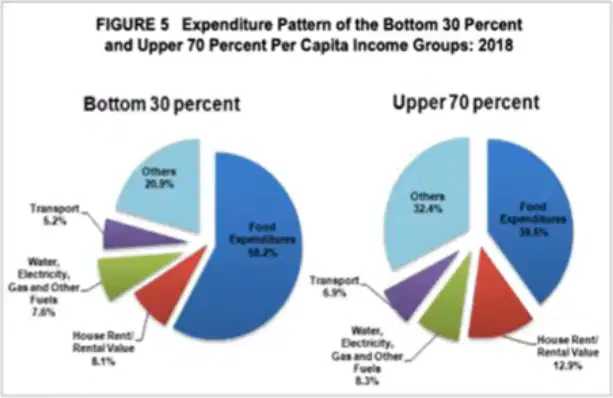
Referring to the expenditure patterns chart for 2018, which statement best captures the difference between the bottom 30 percent and the upper 70 percent income groups?
Food takes a larger share in the bottom 30 percent budget than in the upper 70 percent
Transport accounts for the same share in both groups
House rent occupies a larger share in the bottom 30 percent than in the upper 70 percent
Other expenditures are a smaller share for the upper 70 percent than for the bottom 30 percent
Which symbol matches its macroeconomic meaning in the legend provided?
C denotes Consumption
Yd denotes Disposable Income
LC denotes Life-cycle
W denotes Wealth
Which statement about the personal saving rate is accurate based on the terms provided?
It is the percent saved from disposable personal income
It is the ratio of personal taxes to personal income
It equals disposable personal income minus consumption, divided by personal income
It measures the share of government savings in GDP
What relationship does the consumption function describe?
The relationship between consumption expenditures and disposable income
The relationship between investment and interest rates
The relationship between government spending and tax revenues
The relationship between exports and exchange rates
Which scenario aligns with the concept of permanent income as described?
A promotion that raises salary leads to a large increase in consumption
A one-time bonus is mostly spent on durable goods
A temporary tax rebate causes consumption to fall sharply
An unexpected medical bill increases permanent income
According to the life-cycle hypothesis stated, why do people save?
To smooth consumption over their life-time
To maximize short-run utility only
To exactly match current income with current consumption
To eliminate the wealth effect on spending
Which macroeconomic equilibrium condition is listed as an equivalent expression of equilibrium?
AS = AD
Y = C + I + G + X
I = S
C = f(Yd, LC, W)
Consider the linear consumption function C = a + bYd. Which parameter represents the marginal propensity to consume (the slope of the consumption function)?
a
b
C
Yd
Using the 45-degree line framework, what happens at the break-even point where the consumption function intersects the 45-degree line?
Consumption is less than income and saving is positive.
Consumption equals income and saving is zero.
Consumption exceeds income and saving is positive.
Saving equals investment automatically.
In the 45-degree line diagram of consumption versus disposable income, when the consumption function lies above the 45-degree line, households are:
saving
dissaving
at break-even
at full employment
In the same diagram, when the consumption function lies below the 45-degree line, households are:
dissaving
at break-even
having positive savings
experiencing zero income
Which statement correctly interprets the parameter a in the consumption function C = a + bYd?
It is autonomous consumption, the amount consumed when income is zero.
It is the income level at break-even.
It is the fraction of income saved out of each additional peso.
It is total consumption at full employment income.
Refer to the plotted consumption function against the 45-degree line. Identify the economic meaning of the vertical distance between the 45-degree line and the consumption function at a given disposable income.
It equals saving at that income level.
It equals dissaving only at low incomes.
It equals investment expenditure.
It equals the marginal propensity to consume.
Which formula gives the saving function implied by C = a + bYd?
S = a + (1 − b)Yd
S = −a + (1 − b)Yd
S = Yd − b
S = b − aYd
From the identities Yd = S + C and C = a + bYd, which step correctly derives S?
S = Yd + C
S = Yd − C = Yd − a − bYd
S = a − Yd + b
S = a + bYd − Yd
If the marginal propensity to consume is b, what is the marginal propensity to save (MPS)?
b
1 − b
a
Yd
Which statement about MPC and MPS is correct?
MPC + MPS = b
MPC + MPS = 1
MPC = 1 − a
MPS = a + b
According to the notes, when Yd = 0, what are C and S?
C = 0 and S = 0
C = a and S = −a
C = a and S = a
C = Yd and S = 0
According to the notes, when S = 0, what is C equal to?
C = a
C = bYd
C = Yd
C = −a
Which definition best describes the marginal propensity to consume (MPC)?
The extra amount saved when income increases by one peso.
The extra amount consumed when disposable income increases by one peso.
The share of total income that is autonomous.
The change in total output resulting from investment.
Which definition best describes the marginal propensity to save (MPS)?
The fraction of an extra peso of disposable income that goes to extra saving.
The amount of saving when income is zero.
The slope of the 45-degree line.
The ratio of saving to consumption at all income levels.
In the saving function diagram, what economic relationship does the upward-sloping saving line depict?
Saving decreases as income rises.
Saving is unrelated to disposable income.
Saving increases with disposable income by (1 − b) per peso of Yd.
Saving equals consumption at all income levels.
Which pair correctly matches role of investment in macroeconomics?
It is a large and volatile component of spending affecting aggregate demand and the business cycle.
It reduces the nation’s potential output in the long run.
It leads to capital accumulation that promotes long-run growth.
It eliminates the need for saving in the economy.
Which items are listed as determinants of investment decisions for businesses?
Revenues or output produced by new investments
Interest rates and taxes
Business expectations about the economy
Autonomous consumption a
Gross private domestic investment (I) is described as which of the following?
The total of domestic and foreign investment combined.
The domestic component of national investment, one part of total social investment.
Only government investment in infrastructure.
An accounting identity equal to saving by definition only.
Investment demand can shift due to changes in macroeconomic conditions. Based on the section’s focus, which change would most likely increase investment demand at every interest rate?
Higher output raising expected revenues
Higher taxes on capital income
A fall in business expectations
An increase in interest rates
Which statement best captures the two main roles of investment in macroeconomics as presented in the instructional text?
It determines household saving and sets the money supply
It adds to aggregate demand and augments productive capacity
It fixes government spending and controls net exports
It only changes with income and is independent of interest rates
According to the note in the simple multiplier model, how is investment treated and what primarily influences it?
Investment is proportional to income and driven by taxes
Investment is autonomous and primarily a function of the interest rate
Investment is determined by government budget deficits alone
Investment is fixed by business expectations and unaffected by money supply
Which determinants are most directly cited as shifting the investment demand schedule in the material? Select all that apply.
Higher output (via expected revenues)
Higher taxes on capital income
Business euphoria (improved expectations)
Changes in household consumption propensity
Given Model #2 with parameters a = 50, b = 0.8, I0 = 40, G = 0, X = 0, and potential output Y* = 500, the equilibrium condition is Ye2 = C + I0 with C = a + bYe2. What is the resulting equilibrium income Ye2?
410
450
490
500
In Model #2, using a = 50, b = 0.8, and Ye2 = 450, compute consumption C from the consumption function C = a + bYe2.
360
400
410
450
For Model #2, national saving S is defined as S = Ye2 − C. With Ye2 = 450 and C = 410, what is S, and how does it relate to autonomous investment I0 = 40?
S = 30, which is less than I0
S = 40, which equals I0
S = 50, which exceeds I0
S = 60, which exceeds I0
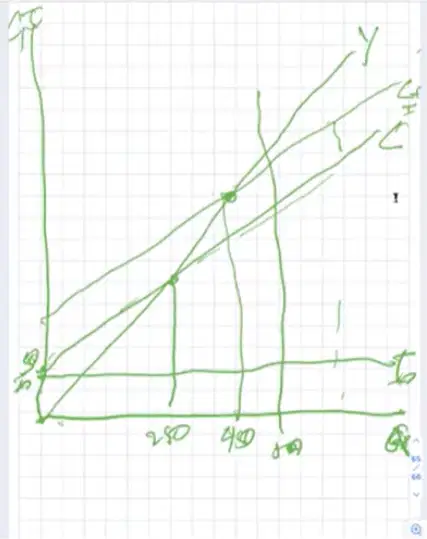
The diagram shows a shift in the C line due to investment. Based on the worked example for Model #2, which statement best interprets the shift and the new equilibrium?
The C line shifts down by 40, lowering equilibrium income to 410, which is below potential.
The C line shifts up by 40, raising equilibrium income to 450, which remains below potential output 500.
The C line remains unchanged, but investment reduces equilibrium income to 450.
The C line shifts up by 50, increasing equilibrium income to potential output 500.
Using the gap formulation Y* = Ye2 + gap × (multiplier), with Y* = 500, Ye2 = 450, and multiplier k = 5, what is the required gap in autonomous spending to reach potential output?
5
8
10
50
In the fiscal policy extension (Model #3), with a = 50, b = 0.8, I0 = 40, G0 = 10, X = 0, the model implies Ye3 = 450 + 10 × (1/(1 − 0.8)). What is Ye3 and does saving equal investment at this level?
Ye3 = 450 and S = I0
Ye3 = 500 and S ≠ I0
Ye3 = 500 and S = I0
Ye3 = 460 and S ≠ I0
The consumption function with taxes is written as C = a − bT + bY. If taxes are modeled as a proportional income tax T = tY, what is the resulting consumption function?
C = a + bY
C = a + b(1 − t)Y
C = a − bt + bY
C = a − tY + bY
Suppose taxes are a lump-sum head tax T0. Using the consumption function with taxes, which expression is correct?
C = a + b(Y − tY)
C = a − bT0 + bY
C = a − t0 + bY
C = a + b(1 − t)Y
Given parameters a = 50, b = 0.8, I0 = 40, G0 = 10, X = 0, T = 10, and a full-employment output Y* = 500. Under the head-tax model, which equilibrium condition is used to solve for Y in Model #4?
Y = C + I0 + G0 + X
Y = C − I0 + G0
Y = a − bT + bY
Y = a + bY − T0
Under the head-tax assumption, the worked derivation shows that Y equals Ye3 minus a term involving T0. What is the tax multiplier implied by that derivation?
1/(1 − b)
b/(1 − b)
−b
−b/(1 − b)
Which statement about the tax multiplier in this model is correct?
It is identical to the government expenditure multiplier 1/(1 − b).
It is one less than the government multiplier and therefore always larger in magnitude.
It equals b/(1 − b) in magnitude and is smaller than the government multiplier.
It does not depend on the marginal propensity to consume b.
The balanced budget multiplier M is computed as M = 1/(1 − b) − b/(1 − b). What is its value and interpretation here?
M = 0; equal increases in G and T leave income unchanged.
M = 1; raising G and T by the same amount raises income by that amount.
M = b; equal increases in G and T raise income by the MPC.
M = 1 − b; income rises by the portion not consumed.
Using a = 50, b = 0.8, and T0 = 10 under the head-tax model, the worked solution computes C = a − bT0 + bY when Y = 460. What is the resulting consumption level C?
C = 420
C = 410
C = 460
C = 450
With Y = 460 and C = 410 under the head-tax model, national saving is S = Y − C. What does the worked example conclude about macroeconomic equilibrium given S = 50 and government saving T − G = 40?
There is macroeconomic equilibrium because S equals government saving.
There is no macroeconomic equilibrium because S ≠ government saving.
Equilibrium holds only if b = 0.8.
Equilibrium holds only with proportional income tax.
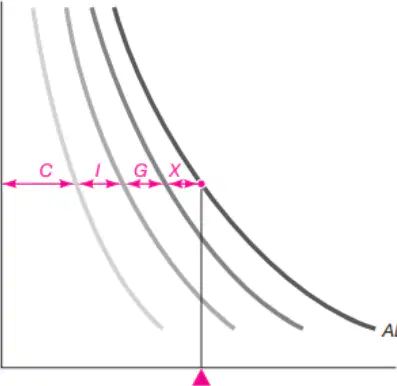
Refer to the AD diagram showing shifts due to components C, I, G, and X. Which component shift would most directly result from an increase in lump-sum taxes T0, holding other components constant?
A leftward shift in AD via lower C
A rightward shift in AD via higher G
A rightward shift in AD via higher X
No shift because taxes do not affect AD
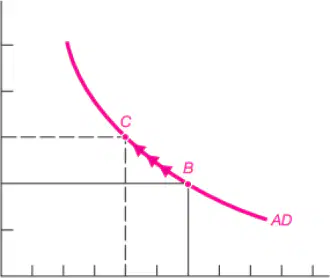
Using the diagrams of aggregate demand, identify which scenario represents a shift of the AD curve rather than a movement along it.
A fall in the price level causing real GDP to rise along the same AD curve
An increase in government spending that raises total demand at every price level
A decrease in household wealth leading to lower spending at the current price
A change in the price level due to moving from point C to point B on the same curve
According to the table of factors that increase aggregate demand, which policy action directly increases spending and shifts AD to the right?
Raising income taxes to reduce the deficit
Increasing government purchases of goods and services
Tightening monetary policy to curb credit growth
Imposing higher import tariffs to protect domestic firms
Which of the following is an exogenous variable that can increase aggregate demand by boosting net exports?
Monetary expansion that lowers interest rates
Fiscal tax incentives for investment
Output growth abroad
A reduction in domestic money wages
Select all factors that the material identifies as potentially increasing aggregate demand through wealth or cost-of-capital channels.
A rise in stock market prices that increases household wealth
Higher stock prices lowering the cost of capital and raising investment
Technological advances that open new opportunities for business investment
An increase in taxes that discourages consumption
Based on the notes provided, what is the expected effect of a tax increase on aggregate demand?
Aggregate demand increases because disposable income rises
Aggregate demand decreases because disposable income falls
Aggregate demand is unchanged because taxes and spending offset
Aggregate demand increases only if interest rates decline
The figure comparing the multiplier model with the AS–AD approach shows equilibrium at point E. In the AS–AD panel, what feature indicates the economy’s capacity limit?
The downward-sloping AD curve
The vertical line labeled Potential GDP
The 45-degree line in the TE diagram
The intercept of the AS curve on the price axis
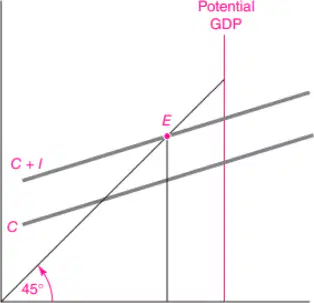
In the multiplier model panel, which schedule represents total expenditure after including investment?
C only
C + I only
C + I = TE
AS
Which monetary policy action is described as potentially lowering interest rates and loosening credit conditions, thereby raising investment and consumption of durables?
Monetary contraction
Monetary expansion
Balanced budget amendment
Exchange rate devaluation
Which items are categorized as policy variables affecting aggregate demand in the material? Select all that apply.
Monetary policy
Fiscal policy
Foreign output
Advances in technology
According to the notes, how does aggregate supply behave as the economy approaches potential output?
It remains perfectly flat at all output levels
It slowly rises until it reaches potential output
It becomes vertical immediately at low levels of GDP
It falls as technology improves
Which statement best describes the primary role of the financial system as introduced in this section?
It produces real goods and services for households.
It channels funds between savers and investors through markets and intermediaries.
It sets government tax rates and spending priorities.
It guarantees profits on all financial assets.
Financial markets in this section include which of the following categories?
Money markets
Bond and mortgage markets
Labor markets
Foreign exchange markets
Which example correctly pairs a financial intermediary with a core function described in the material?
Commercial banks — take deposits, make loans, and create money
Labor unions — negotiate wages and allocate savings
Retailers — pool customer payments and issue bonds
Central planners — set prices and clear transactions
According to the flow of funds concept, which path illustrates how household savings can finance business investment without buying securities directly?
Household deposits salary in a bank; bank lends to a small business for equipment
Household buys a pizza oven; firm issues an IPO to repay the household
Household purchases a government bond; firm buys back shares from the household
Household pays taxes; government transfers funds to the firm
Based on the diagram of the flow of funds, what role do mutual funds play?
They issue currency used for daily transactions.
They buy diversified portfolios of stocks, pooling and subdividing securities.
They regulate interest rates for all banks.
They directly set the exchange rate in foreign markets.
The note under the flow of funds diagram states a key macro relationship. What is it?
Government spending always equals tax revenue.
Measured savings is equal to investments.
Imports always equal exports.
Bank deposits always equal loans.
Which function is listed as part of the financial system’s role in transferring resources?
Transferring resources across time, sectors, and regions
Transferring ownership from firms to governments only
Transferring only physical capital between factories
Transferring voting rights among shareholders
Which items are explicitly identified as functions of the financial system in this section?
Manage risks for the economy
Pool and subdivide funds
Perform a clearinghouse function enabling rapid transfers
Set the legal definition of property rights
What example illustrates the clearinghouse function of the financial system?
A bank issues new shares to raise capital.
Writing a check for a computer, where a clearinghouse debits your bank and credits the seller’s bank.
A firm announces an IPO to attract investors.
A government imposes tariffs to protect domestic industries.
Which is the definition of a financial asset given in the material?
A tangible resource used directly in production, like machinery
A claim by one party against another party, consisting of currency-denominated assets and equities
A non-monetary store of value that cannot be traded
A contractual obligation that never changes in value
Which pairing correctly matches the financial asset with its description from the list provided?
Common stocks — peso-denominated obligations of governments
Savings accounts — deposits with banks or credit institutions
Derivatives — ownership rights to companies
Pension funds — funds that hold only short-term assets
According to the risk–return figure and discussion, which statement aligns with the historical pattern described?
Short-term government bonds tend to have the highest average return and highest risk.
Large-company and small-company stocks have higher average returns but face higher risks than bonds.
Long-term government bonds have higher risk and return than stocks.
Savings accounts historically match the return of small-company stocks.
How is rate of return defined in this section?
Total peso gain from a security measured as a percent of the price at the beginning of the period
Change in nominal GDP over a calendar year
Difference between bid and ask prices at market open
Interest rate after taxes and fees only
The text provides an example where stocks had an average annual return of 6% with a standard deviation of 16%. What does this imply about the approximate range for the real rate of return?
Between 0% and 12%
Between 6% and 16%
Between −10% and 22%
Between −22% and 10%
Which sequence reflects the evolution of money described in the section?
Modern money to commodity money to barter
Commodity money to barter to modern money
Barter to commodity money to modern (paper) money
Barter to modern money to commodity money
Which are listed as functions of money in this section?
Medium of exchange
Unit of account for measuring value
Store of value, relatively less risky than stocks or real estate
Source of government tax revenue
Which component is included in M1 (narrow money) in the Philippines?
Time deposits held at banks
Foreign currency deposits
Checking deposits that can be withdrawn on demand
Total liquidity aggregates excluded from broad money

