
 Worksheets
Macromolecules and Metabolic Pathways
Total questions: 100
Worksheet time: 52mins
Which macromolecule is used as our main source of energy?
Nucleic Acids
Lipids/fats
Proteins
Carbohydrates
Which of the following is an example of carbohydrates?
Steak
Olive oil
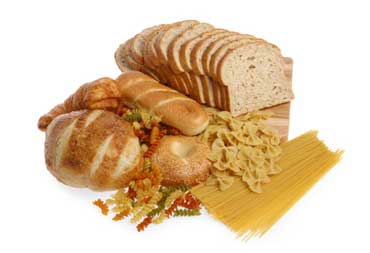
Bread
DNA
_______________ are the monomers of carbohydrates.
Monosaccharides
Polymers
Complex sugars
Fructose
Which macromolecule stores energy?
Carbohydrates
Proteins
Lipids/Fats
Nucleic Acids
The monomer of proteins is...
Polymers
Monosaccharides
Fatty Acids
Amino Acids
What is the monomer of nucleic acids?
RNA
DNA
Nucleotides
Nucleic pieces
Nucleic acids make up which of the two molecules listed below?
RNA
FDA
DNA
RDA
If this property of a protein is changed, the protein will denature and will no longer function properly
Number of carbon and hydrogen atoms
size
shape
color
What do enzymes do?
Speed up chemical reactions
Stop chemical reactions
Build tissues
Store genetic information
Enzymes are ___.
Carbohydrates
Lipids
Proteins
Nucleic Acids
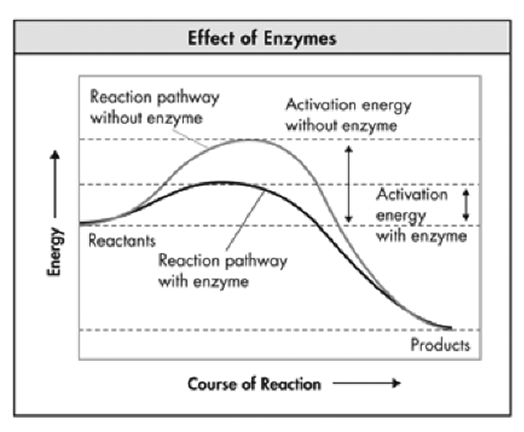
Enzymes ___ the activation energy needed for chemical reactions to occur.
Lower
Increase
Stop
Do not effect
All enzyme names end in -_____.
-ase
-ose
-ise
-ese
Which of the following is NOT an example of an enzyme?
Lactose
Lactase
Pretease
Lipase
Enzymes are ___.
always used up
not used up
only used once
not important
The active site is ___ for each different type of substrate.
Specific
General
Not specific
the same

What is number 1 labeled in this diagram?
Product
Enzyme
Substrate
Enzyme-substrate complex
Which of the following causes an enzyme to change its shape?
(choose all that apply)
Temperature
(too hot/too cold)
Light
(too bright/too dark)
pH
(too acidic/too basic)
Space
(too crowded)

In this diagram two monosaccharides bond together to form a disaccharide while losing or releasing one water molecule. What type of chemical reaction is this?
Hydrolysis
Dehydration synthesis
Degradation reaction

In this diagram a disaccharide molecule is broken apart by adding a water molecule which results in two monosaccharide molecules . What type of chemical reaction is this?
Hydrolysis
Dehydration synthesis
Synthesis Reaction

The graphs show the reaction rate for an enzyme across a range of temperatures and pH. Based on the data, this enzyme functions best at what temperature and pH?


9C The graphs show the reaction rate for an enzyme across a range of temperatures and pH.
Based on these data, this enzyme functions best at what temperature and pH?
Temperature of 27°C and a pH of 4
Temperature of 37°C and a pH of 6
Temperature of 40°C and a pH of 8
Temperature of 50°C and a pH of 10

What is structure A?
Substrate
Active site
Enzyme
Products

What is structure D?
Substrate
Active site
Enzyme
Products

What is structure C?
Substrate
Active site
Enzyme
Products
What is the primary role of enzymes in biological systems?
To provide energy for reactions
To speed up chemical reactions
To act as structural components
To store genetic information
How does temperature generally affect enzyme activity?
Enzyme activity decreases with increasing temperature
Enzyme activity is unaffected by temperature
Enzyme activity increases with increasing temperature up to a point
Enzyme activity is highest at freezing temperatures
What happens to an enzyme when it is denatured?
It becomes more active
It loses its specific shape
It binds more substrates
It becomes a different enzyme
Which of the following best describes the "lock and key" model of enzyme action?
Enzymes can bind to any substrate
Enzymes and substrates fit together precisely
Enzymes change shape to fit the substrate
Enzymes are permanently altered by the substrate
What is the term for the minimum energy required to start a chemical reaction?
Activation energy
Kinetic energy
Potential energy
Thermal energy
How does pH affect enzyme activity?
Enzymes are not affected by pH
Each enzyme has an optimal pH range
Enzymes work best at pH 7
Enzymes are denatured at any pH

Which lettered graph represents the affect of light intensity on photosynthetic rate?
A
B
C
D

Which lettered graph represents the effect of temperature on photosynthetic rate?
A
B
C
D


Which of these pairs represents the reactants of photosynthesis?
Oxygen and water
Glucose and oxygen
Water and glucose
Carbon dioxide and water
Which of these pairs represents the products of photosynthesis?
Oxygen and water
Glucose and oxygen
Water and glucose
Carbon dioxide and water
Which of these is NOT needed for photosynthesis to occur
Glucose
Sunlight
Carbon dioxide
Water
What happens when enzymes are heated to a high temperature?
The enzymes die.
The shape of the enzyme are changed and it denatures
The enzymes' amino acid sequence changes.
The enzymes remain the same
Energy is produced during cellular respiration and stored in the form of ______.
APT
ATP
TPA
PTA

Where does cellular respiration take place?
Mitochondria
Cell Membrane
Nucleus
Ribosomes
Which of the following is produced during the process of cellular respiration?
Carbon dioxide
Energy (ATP)
Water
All of the above
Which of the following is not an output of cellular respiration?
Glucose and oxygen
Carbon dioxide and water
Carbon dioxide and energy
Water and energy
Which of the following is TRUE?
Only animals undergo cellular respiration.
Only plants undergo cellular respiration.
Both plants and animals undergo cellular respiration.
Neither plants nor animals undergo cellular respiration.

Based on the diagram, which of the following materials does cellular respiration produce that plants use in photosynthesis?
Carbon dioxide and water
Carbon dioxide and energy
Glucose and oxygen
Sunlight, carbon dioxide and water
Why is cellular respiration important to animals?
It produces glucose.
It forms carbon dioxide.
It uses oxygen.
It stores energy in ATP.
Which of the following correctly explains why both plants and animals need to undergo cellular respiration?
Both plants and animal cells need chemical energy to carry out cellular processes.
Plant cells do not need chemical energy for cellular processes and animal cells do.
Plants need to store more chemical energy and animals need chemical energy for cellular processes.
Plant cells already have chemical energy stored in them and animal cells need chemical energy for cellular processes


Chemosynthesis:
converts carbon dioxide or methane and nutrients into organic matter without sunlight
Converts carbon dioxide into organic matter using sunlight
Converts water into oxygen without sunlight
Converts water into oxygen using sunlight
The main difference between photosynthesis and chemosynthesis is:
Photosynthesis gives off carbon doxide, while chemosynthesis gives off oxygen
photosynthesis happens in the dark, while chemosynthesis happens in light
photosynthesis uses chemicals (hydrogen sulfide) to make food, while chemosynthesis uses light
chemosynthesis uses chemicals (hydrogen sulfide) to make food, while photosynthesis uses sunlight
What do photosynthesis and chemosynthesis have in common? Select all that apply.
They both use carbon dioxide
They both make organic (carbon molecules) that can be used for energy
they both use sunlight
They both use water

Please indicate the compound made from the splitting of the glucose molecule.
Citric Acid
Pyruvic Acid
Lactic Acid
Water
In the absence of oxygen, which process comes after glycolysis
fermentation
krebs cycle
electron transport chain
One cause of muscle soreness is
the Krebs cycle
glycolysis
alcoholic fermentation
lactic acid fermentation
Which process is used to produce beer and wine?
glycolysis
the Krebs Cycle
lactic acid fermentation
alcoholic fermentation
Breathing heavily after running a race is your body's way of
making more citric acid
recharging the electron transport chain
repaying an oxygen debt
restarting glycolysis
Fermentation would be considered a (n) _______ process.
Aerobic
Anaerobic
Yeast go through which type of fermentation to make bread and wine?
Lactic Acid
Alcoholic
Alcoholic Fermentation is different than Lactic Acid Fermentation in that it gives off
ATP
Carbon dioxide
Oxygen
ADP
Would fermentation create any ATP molecules in its process alone without Glycolysis?
Yes
No
Lactobacillus is a type of bacteria found in yogurt. Which type of fermentation would be responsible to create the yogurt?
Lactic Acid
Alcoholic
What specific food molecule is needed for cell respiration?
amino acid
glucose
sucrose
What gas is released from cell respiration?
oxygen
carbon dioxide
What gas is needed for cell respiration?
oxygen
carbon dioxide
What process is used to make bread rise?
photosynthesis
chemosynthesis
lactic acid fermentation
alcoholic fermentation
Plants require oxygen for cell respiration.
true
false
Which of the following are produced during lactic acid fermentation?
oxygen
carbon dioxide
ATP
lactic acid
alcohol
Which of the following are produced during alcoholic fermentation?
oxygen
carbon dioxide
ATP
lactic acid
alcohol
Energy is released from ATP when
phosphate group is added
ATP is exposed to sunlight
adenine bonds to ribose
a phosphate group is removed
Milk is converted to yogurt under certain conditions when bacteria in the milk produce acid. Which of these processes would you expect to be key in the production of yogurt?
Krebs cycle
alcoholic fermentation
photosynthesis
lactic acid fermentation
Dora was feeling a burning situation in her thighs while doing the pit drill at volleyball practice. The burning sensation was a result of
glucose
lactic acid
NADP
ATP
alcohol

Glucose is an example of a
Carbohydrate
Lipid
Protein
Nucleic Acid

Which is a Carbohydrate's monomer?
Sugar
Amino acids
Monosaccharide
Nucleotide
Which monomers make up the structure of all proteins?
glucose
amino acids
carbohydrates
fatty acids
Important to the structural integrity of plant cells, this is the single most abundant polysaccharide in the world.
Starch
Glycogen
Cellulose
Chitin
What is the monomer of a nucleic acid?
nucleus
nucleotide
nucleoplasm
genes
Most enzymes are composed of .....
Lipids
Carbohydrates
Proteins
Nucleic Acids


the body’s use of molecules for energy and growth
claim
proteins
starch
metabolism
This type of reaction builds large molecules out of small molecules.
Catabolic
Anabolic
Pyruvate has ___ carbons.
6
5
4
3
ATP stores energy in these.
Bonds between phosphate groups
Disulfide linkages between thiols
Carbon-carbon structural bonds
van der Waals interactions

