
 Worksheets
The Modern Periodic Table
Total questions: 90
Worksheet time: 45mins
What is the symbol for Sodium?
Na
So
S
Nd
What is the atomic number of Oxygen?
8
6
12
16
Which element has the symbol Fe?
Iron
Gold
Silver
Copper
What is the atomic weight of Carbon?
12.011
14.007
15.999
1.008
Which group do the noble gases belong to in the periodic table?
Group 18
Group 1
Group 2
Group 17
The arrangement of elements in the modern periodic table is:
in order of increasing atomic number
in order of increasing atomic mass
in alphabetical order
in order of discovery
The atomic mass of an element is determined by which of the following methods, and how are atomic mass units defined?
By averaging the masses of all naturally occurring isotopes, with atomic mass units defined as one-twelfth the mass of a carbon-12 atom.
By counting the number of protons in the nucleus, with atomic mass units defined as the mass of a hydrogen atom.
By measuring the volume of the atom, with atomic mass units defined as the mass of an oxygen atom.
By adding the number of electrons and neutrons, with atomic mass units defined as the mass of a nitrogen atom.
General properties of metals, nonmetals, and metalloids include:
Metals are good conductors, nonmetals are poor conductors, metalloids have properties of both.
Metals are brittle, nonmetals are shiny, metalloids are always gases.
Metals are always gases, nonmetals are always solids, metalloids are always liquids.
Metals have low melting points, nonmetals are ductile, metalloids are magnetic.
Properties of elements change in which way across a periodic table?
They become more metallic from left to right.
Atomic number decreases from left to right.
Reactivity always increases from left to right.
Electronegativity generally increases from left to right.
Which group does the element 'Ne' (Neon) belong to in the spiral periodic table?
Alkali Metals
Noble Gases
Transition Metals
Lanthanides & Actinides
Fill in the blank: The element with the symbol 'Fe' is classified as a ________ in the spiral periodic table.
Transition Metal
Noble Gas
Halogen
Alkali Metal
Match the following elements to their correct group in the spiral periodic table:
Alkali Metals
Alkali Metals
Noble Gases
Noble Gases
Lanthanides & Actinides
Lanthanides & Actinides
Transition Metals
Transition Metals
Which of the following elements is found in the Lanthanides & Actinides group in the spiral periodic table?
Sm
Na
Kr
Zn
Fill in the blank: The element 'K' is an example of an ________ in the spiral periodic table.
Alkali Metal
Noble Gas
Halogen
Transition Metal
What is the definition of 'Period' in the context of the periodic table?
A period is a horizontal row in the periodic table.
A period is a vertical column in the periodic table.
A period is a group of elements with similar properties.
A period is a block of metals in the periodic table.
What is the definition of 'Group' in the context of the periodic table?
A group is a vertical column in the periodic table.
A group is a horizontal row in the periodic table.
A group is a block of elements with similar atomic masses.
A group is a set of elements with the same number of protons.
What is the 'Periodic Law'?
The periodic law states that the properties of elements are a periodic function of their atomic numbers.
The periodic law states that all elements have the same atomic mass.
The periodic law states that elements are arranged alphabetically.
The periodic law states that the properties of elements are a random function of their atomic numbers.
What does 'Atomic Mass Unit (AMU)' mean?
An atomic mass unit (AMU) is a unit of mass used to express atomic and molecular weights, equal to one twelfth the mass of a carbon-12 atom.
An atomic mass unit (AMU) is a unit of length used to measure the size of atoms.
An atomic mass unit (AMU) is a unit of energy used in chemical reactions.
An atomic mass unit (AMU) is a unit of temperature used in thermodynamics.
What are 'Metals'?
Metals are elements that are typically shiny, malleable, ductile, and good conductors of heat and electricity.
Metals are elements that are always liquid at room temperature and poor conductors of electricity.
Metals are elements that are dull, brittle, and insulators of heat and electricity.
Metals are elements that are only found in gaseous state and do not conduct heat.
What are 'Transition Metals'?
Transition metals are elements found in groups 3-12 of the periodic table, characterized by their ability to form variable oxidation states and colored compounds.
Transition metals are nonmetals found in group 18, known for being inert gases.
Transition metals are elements that are always radioactive and found only in the actinide series.
Transition metals are elements that do not conduct electricity and are found in group 1.
What are 'Nonmetals'?
Nonmetals are elements that are generally not shiny, not malleable, and poor conductors of heat and electricity.
Nonmetals are elements that are always shiny and good conductors of electricity.
Nonmetals are elements that are always malleable and ductile.
Nonmetals are elements that are only found in liquid state.
What are 'Metalloids'?
Metalloids are elements that have properties intermediate between metals and nonmetals.
Metalloids are elements that are only found in liquid state.
Metalloids are elements that are always radioactive.
Metalloids are elements that conduct electricity better than metals.
The Periodic Law: Who developed the periodic table before the discovery of protons?
Mendeleev
Rutherford
Bohr
Dalton
Did Mendeleev know that all atoms of an element have the same number of protons?
True
False
Did Mendeleev know that atoms of two different elements could not have the same number of protons?
True
False
What fundamental particle had not been discovered when Mendeleev developed his periodic table?
Proton
Electron
Neutron
Positron
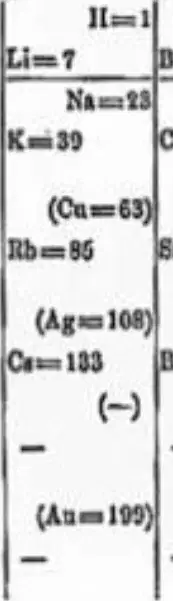
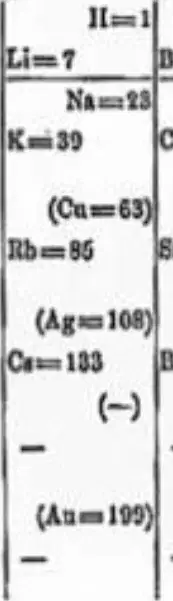
What is the atomic weight of Lithium (Li) according to the table?
7
3
12
9
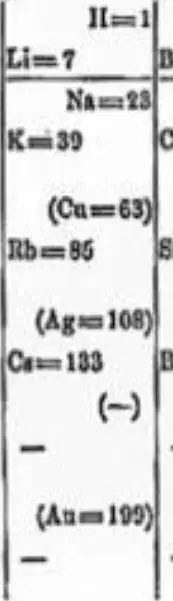
Which element has the symbol 'Na' and what is its atomic weight according to the table?
Sodium (Na), 23
Nitrogen (N), 14
Neon (Ne), 20
Nickel (Ni), 58
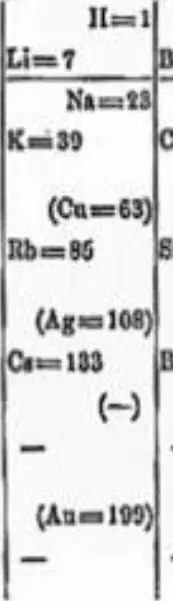
What is the symbol for Potassium and its atomic weight according to the table?
K, 39
P, 31
Na, 23
Ca, 40
Which group does Magnesium (Mg) belong to in the table?
Group II
Group I
Group III
Group IV
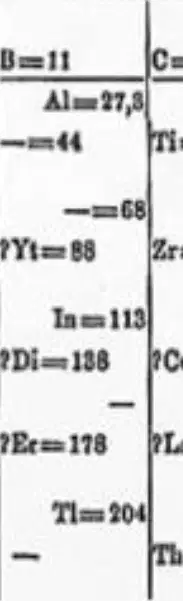
What is the atomic weight of Boron (B) according to the table?
11
5
14
20
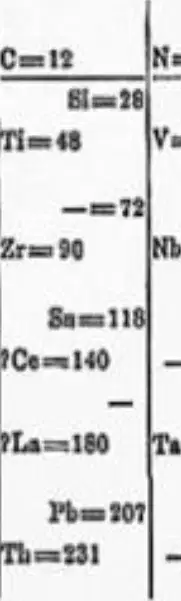
Which element is listed with the atomic weight 12 in the table?
Carbon (C)
Oxygen (O)
Nitrogen (N)
Magnesium (Mg)
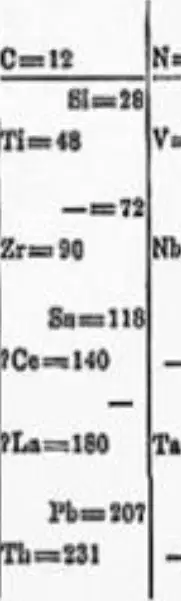
What is the symbol for Nitrogen and its atomic weight according to the table?
N, 14
Ni, 28
Na, 23
Ne, 20
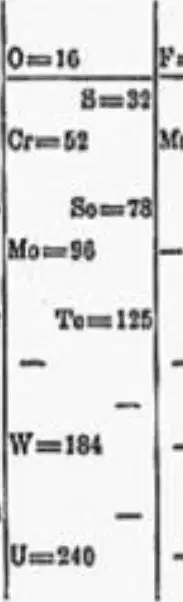
Which element has the atomic weight 16 according to the table?
Oxygen (O)
Nitrogen (N)
Carbon (C)
Helium (He)
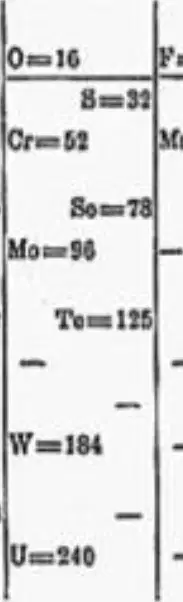
What is the atomic weight of Chlorine (Cl) according to the table?
35.5
12.0
24.3
40.1
Which group does Calcium (Ca) belong to in the table?
Group II
Group I
Group III
Group IV
In the modern periodic table, elements are arranged by increasing atomic number (number of protons). What does the atomic number represent?
Number of neutrons
Number of electrons
Number of protons
Number of isotopes
According to the legend in the periodic table, which color represents Alkali Metals?
Yellow
Green
Blue
Orange
Fill in the blank: The element with atomic number 1 is _____
Hydrogen
Oxygen
Carbon
Nitrogen
Match the following elements to their correct categories as per the legend in the periodic table:
Alkali Metals
Inert Elements
Alkali Earth Metals
Alkali Metals
Inert Elements
Alkali Earth Metals
Non-Metals
Inert Elements
Which of the following elements is a liquid at room temperature according to the periodic table legend?
Mercury (Hg)
Hydrogen (H)
Oxygen (O)
Sodium (Na)
Fill in the blank: The symbol for the element with atomic number 8 is _____
O
N
C
S
Each row in the table of elements is called a ________.
period
group
block
family
How many elements does Period 1 have?
2
1
8
18
How many elements do Periods 2 and 3 have?
8
10
6
12
How many elements do Periods 4 and 5 have?
18
16
20
14
How many elements does Period 6 have?
32
18
28
36
Why does the number of elements per period vary?
Because the number of available orbitals increases from energy level to energy level.
Because the atomic mass increases in each period.
Because the number of neutrons changes randomly.
Because the elements are arranged alphabetically.
Each column on the periodic table is called a _______.
group
period
element
block
What do the elements within a group on the periodic table have in common?
Different properties
Similar properties
No properties
Random properties
According to the passage, what determines an element's chemical properties?
A) Its atomic number
B) Its electron configuration
C) Its mass number
D) Its melting point
Members of a group in the periodic table have ______ chemical properties.
similar
different
random
opposite
What is the pattern of repeating properties in the periodic table called?
Periodic law
Atomic theory
Chemical bonding
Electron affinity
Fill in the blank: Atomic mass is a value that depends on the distributions of an element’s _______ in nature and the masses of those _______.
isotopes; isotopes
atoms; electrons
protons; neutrons
ions; atoms
Scientists assigned how many atomic mass units to the carbon-12 atom?
12 atomic mass units
6 atomic mass units
1 atomic mass unit
24 atomic mass units
How many protons and neutrons does a carbon-12 atom have?
6 protons and 6 neutrons
12 protons and 0 neutrons
6 protons and 12 neutrons
12 protons and 6 neutrons
An atomic mass unit (amu) is defined as:
The mass of a hydrogen atom
One twelfth the mass of a carbon-12 atom
The mass of a proton
The mass of an electron
In nature, most elements exist as a mixture of two or more _______.
isotopes
molecules
ions
compounds
Based on the diagram, how many protons are present in the chlorine isotope shown?
17
18
16
20
Based on the diagram, how many neutrons are present in the chlorine isotope shown?
18
17
19
20
According to the passage, elements are classified as which of the following based on their states at room temperature?
Metals, Nonmetals, Metalloids
Solids, Liquids, or Gases
Acids, Bases, or Salts
Organic, Inorganic, or Synthetic
According to the passage, the symbols for solids are _____
black
red
blue
green
According to the passage, the symbols for liquids are which color?
Black
Purple
Red
Blue
According to the passage, the symbols for gases are _____
red
blue
green
yellow
According to the passage, how are elements divided?
By their color
By their atomic mass
By whether they occur naturally or not
By their melting point
All but two elements with atomic numbers 1 through 92 occur on Earth.
True
False
Elements with atomic numbers of ___ and higher do not occur naturally.
93
86
79
100
What color are the symbols for elements that do not occur naturally?
White
Red
Green
Blue
Elements are classified as _______, nonmetals, and metalloids. (Fill in the blank)
metals
gases
liquids
solids
In the periodic table, where are metals located?
On the left
On the right
In between
At the top
In the periodic table, nonmetals are located on the _______.
right
left
top
bottom
Where are metalloids located in the periodic table?
On the left
On the right
In between
At the bottom
What are metals?
Metals are elements that are good conductors of electric current and heat.
Metals are elements that are poor conductors of electricity and heat.
Metals are elements that are always gases at room temperature.
Metals are elements that do not react with other substances.
Which metal is not a solid at room temperature?
Mercury
Iron
Copper
Gold
Most metals are malleable.
True
False
Many metals are ductile; that is, they can be drawn into thin wires.
True
False
Which of the following is NOT a property of metals?
Good conductor of heat
Poor conductor of electricity
Malleable
Ductile
Name any one metal shown in the image.
Scandium
Oxygen
Sulfur
Carbon
Which of the following metals is shown in the image?
Scandium
Sodium
Potassium
Calcium
Fill in the blank: Gold remains shiny because it does not ______ with the oxygen.
react
combine
mix
blend
Which metal quickly dulls when exposed to oxygen in air?
Gold
Magnesium
Silver
Copper
Read the passage: Some metals are extremely reactive and some do not react easily. One way to demonstrate this difference is to compare the behavior of gold and the behavior of magnesium when these metals are exposed to the oxygen in air. Gold remains shiny because it does not react with the oxygen. Magnesium reacts with the oxygen and quickly dulls.
True
False
What are transition metals?
Elements that form a bridge between the elements on the left and right sides of the table.
Elements that are always gases at room temperature.
Elements that do not conduct electricity.
Elements that are found only in Group 1 of the periodic table.
Transition elements, such as copper and silver, were among the first elements discovered. Which of the following are examples of transition elements?
A) Copper and Silver
B) Oxygen and Nitrogen
C) Sodium and Potassium
D) Helium and Neon
Transition elements, such as copper and silver, were among the first elements discovered.
True
False
What are nonmetals?
Elements that are good conductors of heat and electric current
Elements that are poor conductors of heat and electric current
Elements that are always solid at room temperature
Elements that are always liquid at room temperature
All the gases in the periodic table are _________
nonmetals
metals
metalloids
noble gases
Nonmetals that are solids at room temperature tend to be brittle.
True
False
Because nonmetals have low boiling points, many nonmetals are ______ at room temperature.
solids
liquids
gases
metals
If nonmetals that are solids at room temperature are hit with a hammer, what happens to them?
They shatter or crumble.
They bend easily.
They melt instantly.
They conduct electricity.

