
 Worksheets
Cancer Quiz
Total questions: 80
Worksheet time: 27mins
Which of the following best describes cancer?
A group of diseases characterized by uncontrolled and abnormal cell proliferation, loss of regulation over growth, differentiation, and death, and the potential to invade other tissues (metastasis)
A single disease caused by bacteria
A viral infection that only affects the skin
A genetic disorder that only affects children
What is meant by metastasis in the context of cancer?
The potential of cancer cells to invade other tissues
The process of normal cell division
The death of healthy cells
The differentiation of stem cells
Which of the following is NOT a characteristic of cancer?
Controlled cell growth and differentiation
Uncontrolled and abnormal cell proliferation
Loss of regulation over cell death
Potential to invade other tissues
Loss of regulation over growth, differentiation, and death is significant in the development of cancer because:
It allows cells to multiply uncontrollably and avoid normal processes that would limit their growth, leading to tumor formation and potential spread to other tissues.
It helps the immune system fight infections more effectively.
It causes cells to become more specialized and function better.
It prevents cells from dividing, stopping tissue growth.
Which of the following is a key feature of cancer cells that allows them to evade programmed cell death?
Angiogenesis
Metastasis
Avoid Apoptosis
Sustained Proliferation
What is the process called by which cancer cells promote blood vessel formation to support rapid growth?
Metastasis
Apoptosis
Angiogenesis
Proliferation
Cancer cells are able to grow and divide out of control primarily due to which of the following?
Increased blood supply
Genetic mutations such as oncogenes and tumor suppressor gene loss
Enhanced immune response
Reduced oxygen supply
Which feature of cancer cells enables them to spread to distant organs through blood or lymph?
Angiogenesis
Metastasis
Apoptosis
Proliferation
Sustained proliferation in cancer cells contributes to tumor growth by allowing cells to divide uncontrollably due to genetic mutations. Which of the following best explains this process?
Sustained proliferation allows cancer cells to divide uncontrollably due to genetic mutations, such as activation of oncogenes and loss of tumor suppressor genes, leading to tumor growth.
Sustained proliferation causes cancer cells to die quickly, preventing tumor growth.
Sustained proliferation increases blood vessel formation, which directly causes tumor growth.
Sustained proliferation makes cancer cells less likely to spread to other organs.
A researcher observes that a group of cells is able to survive much longer than normal cells and does not undergo programmed cell death. Which key feature of cancer cells is most likely being observed, and what is its significance in cancer development?
Angiogenesis; it helps the cells form new blood vessels.
Metastasis; it allows the cells to spread to other organs.
Avoid Apoptosis; it enables the cells to evade programmed cell death and live longer, contributing to cancer development.
Sustained Proliferation; it causes the cells to divide rapidly.
Which type of cancer originates from epithelial cells such as those found in the breast, lung, or colon?
Carcinoma
Sarcoma
Leukemia
Melanoma
What is the origin tissue for sarcoma?
Connective tissue (bone, muscle)
Epithelial cells (e.g., breast, lung, colon)
Blood-forming tissue (bone marrow)
Immune system cells
Leukemia is a type of cancer that originates from which tissue?
Blood-forming tissue (bone marrow)
Pigment-producing skin cells (melanocytes)
Connective tissue (bone, muscle)
Epithelial cells (e.g., breast, lung, colon)
Which type of cancer is associated with pigment-producing skin cells?
Melanoma
Lymphoma
Carcinoma
Leukemia
Compare and contrast the origin tissues of sarcoma and carcinoma. How do their tissues of origin influence the types of organs or body parts affected by these cancers?
Sarcoma originates from connective tissue (bone, muscle), affecting structural parts of the body, while carcinoma originates from epithelial cells, affecting organs like the breast, lung, and colon.
Both originate from epithelial cells, so they affect similar organs.
Carcinoma originates from blood-forming tissue, while sarcoma originates from immune system cells.
Sarcoma and carcinoma both originate from pigment-producing skin cells.
Which type of drugs are used in chemotherapy to target cancer cells?
Cytotoxic drugs
Antibiotic drugs
Antiviral drugs
Analgesic drugs
Which of the following is an example of curative therapy in chemotherapy?
Testicular cancer (cisplatin-based)
Breast cancer management
Symptom relief in advanced disease
Pain management in arthritis
How does the goal of palliative care in chemotherapy differ from curative therapy?
Palliative care focuses on symptom relief in advanced disease, while curative therapy aims to eliminate the cancer.
Palliative care aims to cure the disease, while curative therapy only relieves symptoms.
Palliative care is used only for children, while curative therapy is for adults.
Palliative care uses antibiotics, while curative therapy uses cytotoxic drugs.
Which type of cells does chemotherapy primarily target?
Rapidly dividing cells
Only healthy cells
Only nerve cells
Only muscle cells
Chemotherapy interferes with which of the following cellular processes?
Cell division, DNA replication, and metabolic processes
Protein synthesis, cell migration, and hormone production
Photosynthesis, respiration, and fermentation
Cell signaling, apoptosis, and differentiation
Which of the following treatments can chemotherapy be combined with?
Surgery, radiotherapy, targeted therapy, and immunotherapy
Physical therapy, acupuncture, and massage
Antibiotics, antivirals, and antifungals
Diet, exercise, and meditation
Which side effects are commonly associated with chemotherapy drugs due to their low selectivity?
Alopecia and mucositis
Hypertension and diabetes
Insomnia and anxiety
Obesity and arthritis
Explain why most chemotherapy drugs cause side effects such as alopecia and mucositis.
Because they have low selectivity and affect both cancer and normal cells
Because they are only effective against normal cells
Because they are administered in low doses
Because they are targeted only at cancer cells
Which drug type acts on a specific phase of the cell cycle, such as the S or M phase?
Cell Cycle Specific (CCS)
Cell Cycle Non-Specific (CCNS)
Alkylators
Anthracyclines
Which of the following is an example of a cell cycle non-specific (CCNS) drug?
Alkylators
Antimetabolites
Vinca alkaloids
S-phase inhibitors
Cell cycle specific (CCS) drugs are most effective during which phases of the cell cycle?
Specific phases such as S or M
Any phase including resting cells
G0 phase only
G1 phase only
If a drug acts on any phase of the cell cycle, including resting cells, which category does it belong to?
Cell Cycle Non-Specific (CCNS)
Cell Cycle Specific (CCS)
Antimetabolites
Vinca alkaloids
A patient is prescribed a drug that targets the M-phase of the cell cycle. Which class does this drug most likely belong to?
Cell Cycle Specific (CCS)
Cell Cycle Non-Specific (CCNS)
Alkylators
Anthracyclines
Cell cycle non-specific (CCNS) drugs can be effective against both actively dividing and resting cells because:
They act on any phase of the cell cycle, including resting cells
They only target the S-phase
They are only effective during mitosis
They inhibit only DNA synthesis
According to the Log-Kill Hypothesis, what does a chemotherapeutic drug kill in cancer treatment?
A constant proportion of cancer cells
A fixed number of cancer cells
All cancer cells at once
Only healthy cells
Why are multiple cycles of chemotherapy needed to cure cancer according to the Log-Kill Hypothesis?
Because each cycle only kills a constant proportion of cells, not all of them
Because cancer cells become immune after one cycle
Because the drug only works in the first cycle
Because the body needs time to recover between cycles
The Log-Kill Hypothesis justifies the use of repeated chemotherapy cycles in cancer treatment because:
Each cycle reduces the number of cancer cells by a constant proportion, not a fixed number, so multiple cycles are needed to eliminate all cancer cells.
Chemotherapy is only effective in the first cycle.
Cancer cells grow faster after each cycle.
The drug becomes more potent with each cycle.
Which type of tumors respond better to chemotherapy?
Tumors with high growth fraction (e.g., leukemias)
Tumors with low growth fraction (e.g., prostate cancer)
Tumors with no growth fraction
Tumors with moderate growth fraction
Tumors with high growth fraction are more responsive to chemotherapy compared to slow-growing tumors because:
Chemotherapy targets rapidly dividing cells, making it more effective against tumors with high growth fraction.
Chemotherapy only works on tumors with low growth fraction.
Slow-growing tumors have more blood supply, making chemotherapy more effective.
Chemotherapy is less effective against all types of tumors.

Which piece of equipment visible in the image is essential for delivering precise doses of medication intravenously?
Infusion pump
Stethoscope
X-ray machine
Blood pressure cuff
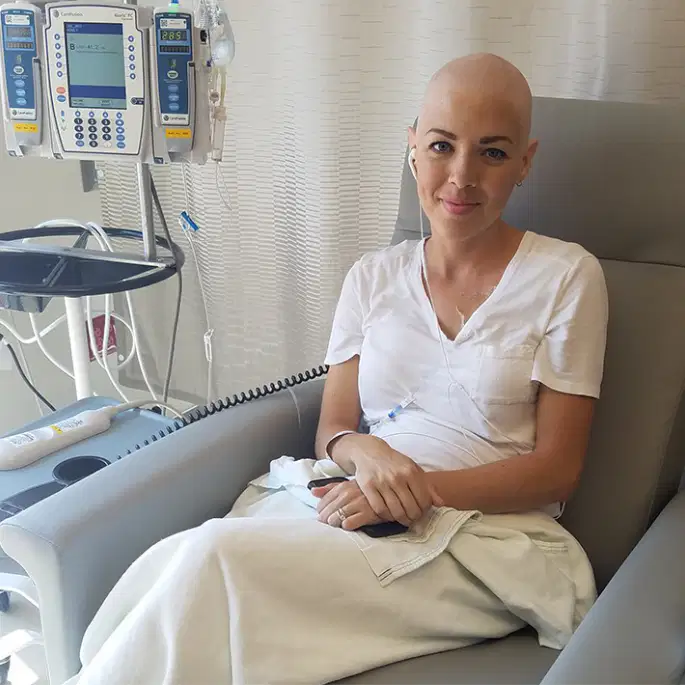
Based on the image, what is a likely reason for the patient’s hair loss?
Side effect of chemotherapy
Result of physical injury
Genetic inheritance
Poor nutrition
Which type of drug resistance in cancer chemotherapy is characterized by tumors that are inherently resistant to chemotherapy?
Primary (Intrinsic)
Acquired
Secondary
Adaptive
What is an example of primary (intrinsic) drug resistance in cancer chemotherapy?
Melanoma is often chemo-resistant
P-glycoprotein (P-gp) efflux pump increase in doxorubicin-treated cancers
Leukemia relapse after initial remission
Tumor shrinkage after chemotherapy
Which mechanism is associated with acquired drug resistance in cancer chemotherapy?
Tumor evolves resistance after initial response
Tumors inherently resistant to chemotherapy
Chemotherapy-induced apoptosis
Tumor cell differentiation
P-glycoprotein (P-gp) efflux pump increase is an example of which type of drug resistance in cancer chemotherapy?
Acquired
Primary (Intrinsic)
Adaptive
Secondary
Acquired drug resistance in cancer chemotherapy develops when a tumor evolves resistance after an initial response to treatment. Which of the following is a specific example of this process?
An increase in P-glycoprotein (P-gp) efflux pump in doxorubicin-treated cancers.
Primary resistance occurs when tumors are inherently resistant to chemotherapy, such as melanoma.
Acquired resistance is due to genetic mutations present before treatment.
Primary resistance develops after repeated exposure to chemotherapy.
Which of the following normal fast-dividing cells is affected by chemotherapy, leading to myelosuppression?
Bone marrow cells
GI mucosal cells
Hair follicle cells
Liver cells
What is the term for the side effect caused by chemotherapy on GI mucosal cells?
Mucositis
Alopecia
Myelosuppression
Nephrotoxicity
Which side effect is most likely to occur due to chemotherapy affecting hair follicle cells?
Alopecia
Myelosuppression
Mucositis
Leukopenia
Why does the maximum tolerable dose (MTD) limit the effectiveness of chemotherapy?
Because higher doses cause unacceptable toxicity to normal cells
Because cancer cells become resistant at higher doses
Because chemotherapy is only effective at low doses
Because MTD increases the risk of infection
Chemotherapy can cause side effects in tissues other than cancer cells because:
It targets all fast-dividing cells, including normal ones, leading to toxicities that limit the maximum tolerable dose.
It only targets cancer cells, so side effects are rare and do not limit dosing.
It strengthens normal cells, allowing for higher doses to be used safely.
It is ineffective at all doses due to rapid drug clearance.
Which of the following best describes tumor heterogeneity?
Tumors are made up of identical cells with the same genetic mutations.
Tumors are not uniform and contain different cell populations with varied genetic mutations within the same cancer.
Tumors only contain healthy cells.
Tumors are always easy to treat with a single drug.
Why does tumor heterogeneity make it difficult to treat cancer with a single drug?
Because all tumor cells respond the same way to treatment.
Because single drugs are too expensive.
Because different cell populations within the same tumor may respond differently to the drug.
Because tumors are always resistant to all drugs.
A researcher is developing a new cancer drug. Based on the concept of tumor heterogeneity, what should the researcher consider to improve the effectiveness of the treatment?
Use a single drug that targets only one type of cell mutation.
Develop a combination of drugs that target multiple cell populations with different genetic mutations.
Ignore genetic mutations in tumor cells.
Focus only on shrinking the tumor size, regardless of cell diversity.
Which of the following is considered a host factor that can influence drug response?
Age and organ function
Type of medication
Route of drug administration
Time of day medication is taken
Which of the following is an example of a comorbidity that may affect host factors?
Diabetes
Sunburn
Broken bone
Common cold
How can genetic differences in drug metabolism impact patient treatment outcomes? (Select the best answer)
They can lead to variations in drug toxicity and effectiveness.
They always make drugs more effective.
They have no impact on drug response.
They only affect the color of the medication.
A patient with a TPMT mutation is prescribed mercaptopurine. What is a potential concern for this patient?
Increased risk of drug toxicity
Decreased risk of infection
Improved drug absorption
No effect on drug response
What does it mean when a drug has a narrow therapeutic index?
The drug is only effective at very low doses.
The drug can be safely given in any amount.
A dose high enough to kill cancer cells can also damage vital organs.
The drug has no side effects.
Which drug is associated with cardiotoxicity?
Cisplatin
Doxorubicin
Penicillin
Ibuprofen
Cisplatin is known to cause toxicity in which organ?
Heart
Liver
Kidneys
Lungs
Drugs with a narrow therapeutic index present a challenge in cancer treatment because:
They are always ineffective against cancer cells.
They can damage vital organs at doses required to kill cancer cells.
They are too expensive to produce.
They only work for a short period of time.
According to the Fraction Kill Hypothesis, what is killed with each dose of chemotherapy?
A constant fraction of tumor cells
A constant number of tumor cells
All tumor cells
Only mutated tumor cells
Why is repeated dosing more effective than a single high dose in chemotherapy, according to the Fraction Kill Hypothesis?
Because effectiveness depends on repeated doses
Because a single high dose kills all tumor cells
Because repeated doses increase drug resistance
Because repeated doses reduce side effects
What does the Linear Dose-Response Relationship suggest about chemotherapy dosing in many cancers?
Higher doses result in greater tumor cell kill
Lower doses are more effective
Dose has no effect on tumor cell kill
Only single doses are effective
What concept justifies dose intensification in chemotherapy?
Growth fraction concepts
Drug resistance
Spontaneous mutation
Single-drug therapy
According to the Goldie-Coldman Hypothesis, what leads to drug resistance in cancer cells?
Spontaneous mutations
Repeated dosing
High drug doses
Fraction kill
How does early and multiple-drug therapy affect the chances of resistance emerging in cancer treatment?
Reduces the chances of resistance emerging
Increases the chances of resistance emerging
Has no effect on resistance
Only affects tumor size
Combining chemotherapy agents is justified by the Goldie-Coldman Hypothesis because:
Because single-drug therapy is always more effective
Because chemotherapy agents are less toxic when combined
Because multiple-drug therapy reduces the likelihood of drug resistance due to spontaneous mutations
Because combining agents increases tumor growth
The concept of dose intensification in chemotherapy is related to the linear dose-response relationship because:
Dose intensification is justified because higher doses result in greater tumor cell kill within safe limits
Dose intensification only applies to single-drug therapy
Dose intensification decreases effectiveness
Dose intensification is not related to dose-response
According to the Goldie-Coldman Hypothesis, which strategy is recommended to reduce resistance in cancer cells developing resistance to a single chemotherapy drug?
Initiate early and multiple-drug therapy
Increase the dose of the single drug
Reduce the frequency of dosing
Switch to radiation therapy only
(DoK Level 3) To maximize tumor cell kill and minimize resistance in a chemotherapy regimen, which principles from the provided hypotheses should be integrated into the treatment plan?
Fraction Kill Hypothesis, Linear Dose-Response Relationship, and Goldie-Coldman Hypothesis
Only Fraction Kill Hypothesis
Only Linear Dose-Response Relationship
None of the above
Which of the following is NOT a basis for the classification of chemotherapeutic (anticancer) agents?
A. Chemical Structure
B. Mechanism of Action
C. Cell cycle specificity
D. Dosage Form
Chemotherapeutic agents can be categorized based on which of the following criteria? (Select the most complete answer.)
A. Only their chemical structure
B. Their chemical structure, mechanism of action, and cell cycle specificity
C. Only their mechanism of action
D. Only their cell cycle specificity
A researcher is developing a new anticancer drug. To properly classify this drug, which aspects should they consider?
A. The drug's color and taste
B. The drug's chemical structure, mechanism of action, and cell cycle specificity
C. The drug's price and manufacturer
D. The drug's packaging and marketing strategy
Which of the following is the primary mechanism of action for alkylating agents?
Addition of alkyl groups to DNA bases
Inhibition of protein synthesis
Activation of immune cells
Blocking hormone receptors
Which of the following is NOT a consequence of alkylating agents acting on DNA?
DNA cross-linking
Misparing of bases
Increased protein synthesis
Strand breakage
Which of the following drugs is classified as an alkylating agent?
Cyclophosphamide
Doxorubicin
Methotrexate
Paclitaxel
For which of the following clinical conditions are alkylating agents commonly used?
Breast cancer, lymphomas, ovarian cancer
Diabetes, hypertension, asthma
Osteoporosis, arthritis, gout
Tuberculosis, malaria, influenza
The addition of alkyl groups to DNA by alkylating agents can ultimately lead to cell death by which of the following mechanisms?
It increases the rate of cell division, causing exhaustion of resources.
It causes DNA cross-linking, mispairing of bases, and strand breakage, which inhibit replication and lead to cell death.
It blocks nutrient uptake, starving the cell.
It enhances the immune response, leading to destruction of cancer cells.
Which of the following drugs is classified as a Nitrogen mustard?
Bendamustine
Carmustine
Carboplatin
Busulfan
Which class does the drug cisplatin belong to?
Platinum analogs
Triazenes
Alkyl sulfonate
Nitrosoureas
Identify the drug that is an example of an Alkyl sulfonate.
Busulfan
Thiotepa
Temozolamide
Lomustine
Which of the following is NOT a Platinum analog?
Lomustine
Carboplatin
Cisplatin
Oxaliplatin
If a patient is prescribed temozolamide, to which class of drugs does it belong?
Triazenes
Nitrosoureas
Ethyleneimine
Alkyl sulfonate

