
Font size
 Worksheets
Geoscience Unit 1: Review Questions
Total questions: 60
Worksheet time: 31mins
The rock on top of Mt. Everest is a shallow marine limestone deposited 200 million years ago. What does this tell us about the geologic history of the Himalayas?
200 million years ago the Himalayas did not exist.
The ocean level 200 million years was much higher than today.
There was a high-altitude lake in the Himalayas.
How is the velocity of sound (and seismic waves) affected by the density of the material it is passing through? (air, water, rock)
The higher the density, the faster the wave moves.
The higher the density the slower the wave moves.
The velocity of the wave is independent of density. It is only a function of the type of wave.
Which of the following statements about the Earth's magnetic field is true?
The Earth's magnetic field is fixed and cannot change direction
The Earth's magnetic field has reversed in the past, but never will again.
The Earth's magnetic field has reversed in the past, and will in the future.
In which layer/sphere of Earth do most earthquakes occur (i.e. the hypocenter/focus)?
Crust
Lithosphere
Asthenosphere
Mantle
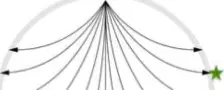
Consider the image of the earthquake and seismic station shown below. If an earthquake happens at the red dot on top, and you record it at the green star (on the right), answer the following (choose all that apply from the list of options below the image)
What can you measure?
Distance: from the EQ to the SS
Density: of the rock the EQ passed through
Composition: of the rock the EQ passed through
Velocity: of the wave within the Earth
Time: that the wave takes to travel from the EQ to the SS
Consider the image of the earthquake and seismic station shown below. If an earthquake happens at the red dot on top, and you record it at the green star (on the right), answer the following (choose all that apply from the list of options below the image)
What can you calculate?
Distance: from the EQ to the SS
Density: of the rock the EQ passed through
Composition: of the rock the EQ passed through
Velocity: of the wave within the Earth
Time: that the wave takes to travel from the EQ to the SS
Consider the image of the earthquake and seismic station shown below. If an earthquake happens at the red dot on top, and you record it at the green star (on the right), answer the following (choose all that apply from the list of options below the image)
What can you infer?
Distance: from the EQ to the SS
Density: of the rock the EQ passed through
Composition: of the rock the EQ passed through
Velocity: of the wave within the Earth
Time: that the wave takes to travel from the EQ to the SS
Karl Popper's principle of falsification says:
all scientific ideas will eventually be proven wrong
to be a valid hypothesis, there must be test that, if it fails, will prove the idea wrong
scientific ideas cannot be proven right, they can only be proven wrong
science is a false ideal

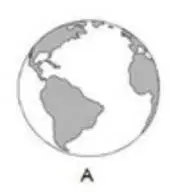
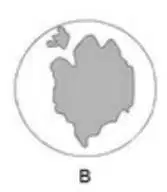
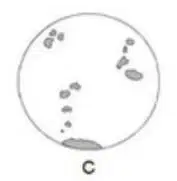
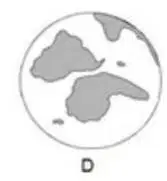
The first figure on the left is a view of one-half of the Earth's surface as seen from space today. Which of the other figures do you think most closely represents this half of the Earth's surface when humans first appeared on Earth?
Which of these is (are) NOT part of the Scientific Method of Inquiry?
Listen to interviews of celebrities for their opinions on things
Rocks are collected in the field
Ask a respected scientist for his opinion
Ask your teacher what the correct explanation is
A newspaper report of a discovery
The rock on top of Mt. Everest is a shallow marine limestone deposited 200 million years ago. What does this tell us about the geologic history of the Himalayas?
200 million years ago the Himalayas did not exist.
The ocean level 200 million years was much higher than today.
There was a high altitude lake in the Himalayas.
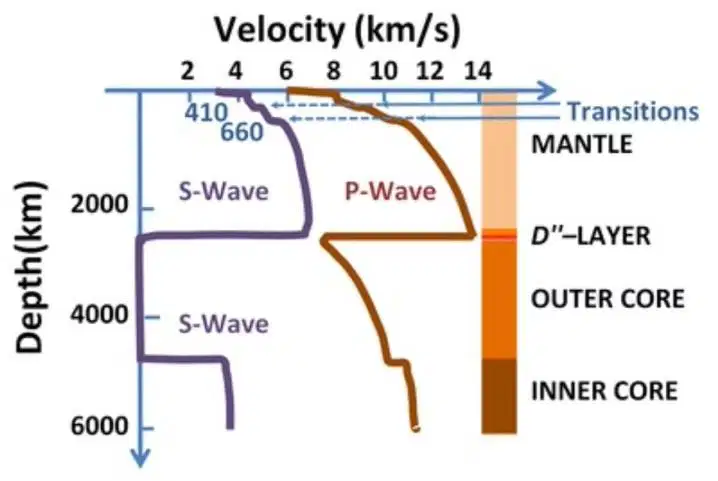
What causes the seismic velocities to increase with depth within a particular layer?
Change in composition.
Decrease in density.
Increase in density.
Increase in temperature.
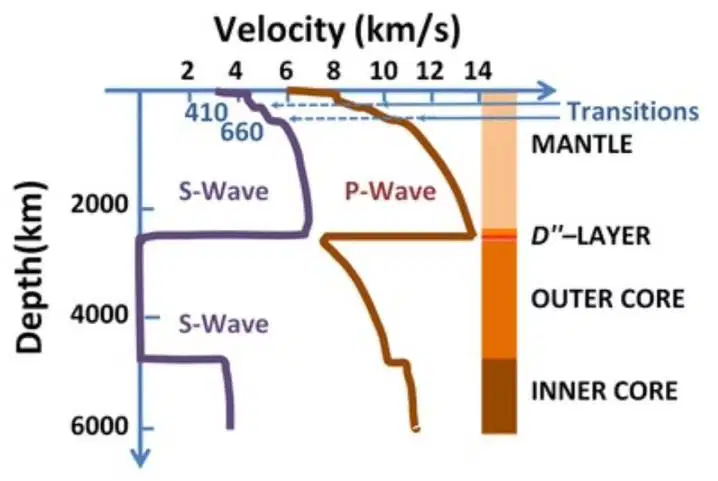
What causes the seismic velocities to increase or decrease abruptly at the transitions between or within layers?
Change in composition.
Decrease in density.
Increase in density.
Increase in temperature.
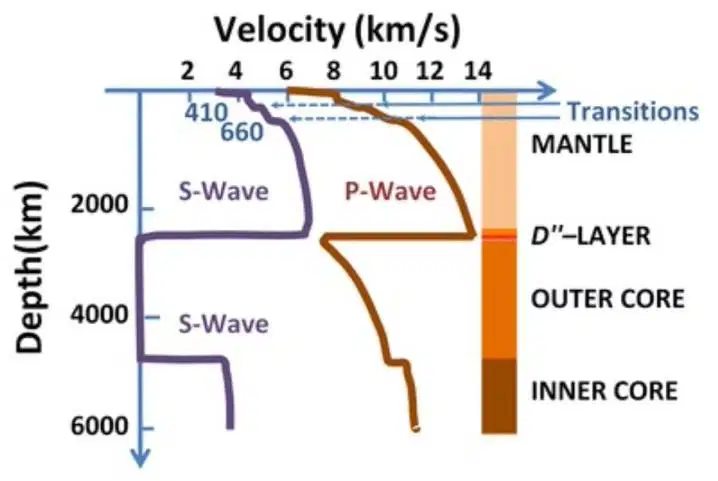
Something quite abrupt happens at the outer core. What can you conclude about s-waves and the outer core?
s-waves are too weak to penetrate deeper than 2300 km.
s-waves cannot pass through the outer core because it is liquid.
s-waves cannot pass through the outer core because it is too dense.
s-waves move so fast through the outer core that they cannot be measured.
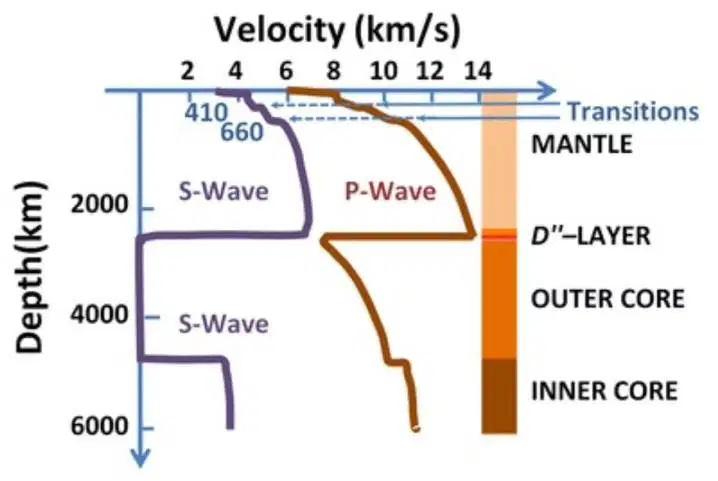
If we stipulate that the composition of the mantle does not change from 660 km to >2000 km depth, what can you infer about the density of the rock?
The density is constant in the mantle.
The density increases with depth.
The density decreases with depth.
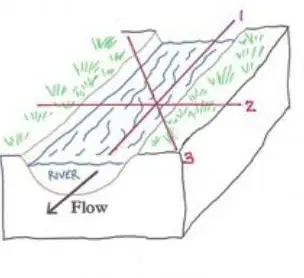
Look at the cross sketch of the river below and the cross sections. Match the cross section with the direction it illustrates.
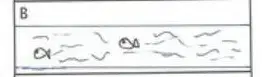
1
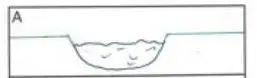
2
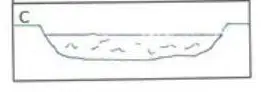
3
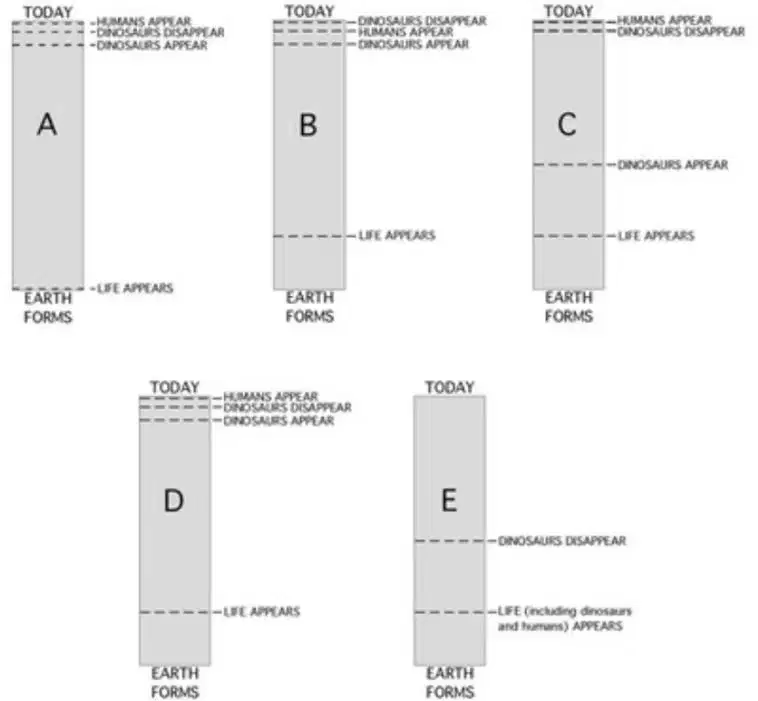
Which of these figures most closely represents changes in life on Earth over time?
A
B
C
D
E
How is the velocity of sound (and seismic waves) affected by the density of the material it is passing through? (air, water, rock)
The higher the density, the faster the wave moves.
The higher the density the slower the wave moves.
The velocity of the wave is independent of density. It is only a function of the type of wave.
"The physical, chemical, and biological laws that operate today have also operated in the geologic past," is a statement of the doctrine of ___________________________.
Uniformitarianism
Unity
Universal Truth
Paleontology
Catastrophism
Which of these things will align themselves with the Earth's magnetic field?
Darker minerals crystallizing out of a magma.
Quartz sand settling onto the bottom of a lake.
Iron-rich sediments settling onto the ocean floor.
Minerals being squeezed by tectonic pressures deep in the Earth.
Butterflies migrating.
Which step of this version of the scientific method is most challenging for many questions in geoscience?
Describe a problem and formulate a question to answer.
Formulate a hypothesis: A statement that predicts what you think will happen.
Develop an experiment.
Observe and analyze the results.
State your conclusion. Did you accept or reject the hypothesis? What have you learned based on the information collected?
Texas was once under the ocean. How do we know that?
The information is in history books.
Texas is low elevation, and we know sea-level was higher in the past.
The fossils of extinct animals in Texas rocks are like marine animals today.
The rocks that make up much of Texas are very similar to the sediments on ocean floors today.
There are fossils of ocean-dwelling creatures in Texas rocks.
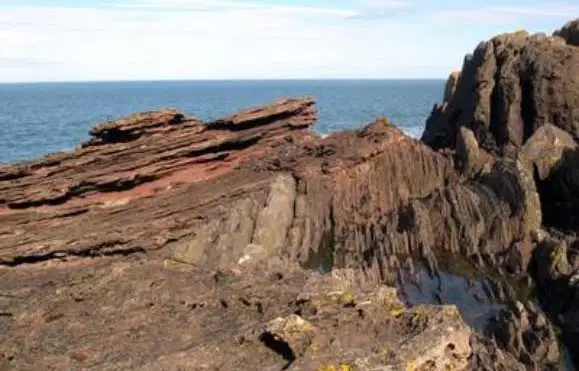
On this picture of Siccar Point (Scotland), where are the youngest rocks you see.
The horizontal layers at the top of the cliff
The tilted layers at the bottom of the cliff
The rocks in the water
The rocks on the right side of the image
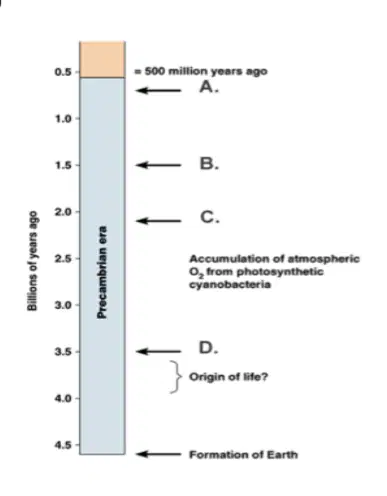
The letters on the timeline at the right point to major milestones in life’s history. Which letter points to the approximate date of the first eukaryotes?
A
B
C
D
Which of the following does not occur when increasing the metamorphic grade of a rock?
The rock will melt.
Grain size of the rock increases.
Environmental temperature and pressure increases.
Foliation in the rock becomes more defined.
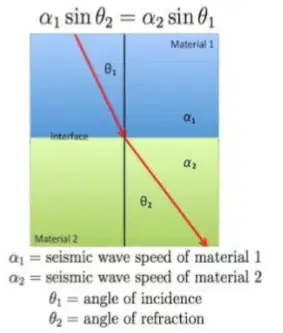
Study the equations and diagram shown to the right. Which material, 1 or 2, is denser?
Material 1
Material 2
Which of these things will align themselves with the Earth's magnetic field?
Quartz sand settling onto the bottom of a lake
Darker minerals crystallizing out of a magma
Iron-rich sediments settling onto the ocean floor
Some minerals in rocks close to a campfire
Butterflies migrating
How do geologists determine the silicon (Si) composition of rocks?
crystal shape
color
crystal size
level of foliation
Which of the following is untrue regarding rock formation?
Most rocks form at the surface of the Earth.
Most rocks form underground and are exposed when the overlying rocks are removed.
Most rocks form underground and are pushed to the surface by magma.
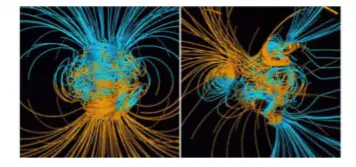
The image on the left is a supercomputer model of a magnetic field. The image on the right shows:
The magnetic field disappearing.
The transition of the magnetic field - a polar reversal.
Fun artwork that you can do with super computers.
The influence of a giant magnetic meteor on Earth's magnetic field.
What geologic period is defined by the sudden appearance of a great variety of fossils, such as clams and snails?
Silurian
Jurassic
Devonian
Cambrian
What is a feedback loop?
The ability to translate observations into inscription
Low-frequency, high impact events
Perceptions that are shaped by conceptions
Outputs of a system that are routed back as inputs as part of a chain of cause-and-effect
Which of the following is not true about mass extinctions?
Mass extinction is normal and happens every million years.
Mass extinction is when 50% of species go extinct in a short period of time.
Mass extinctions create an opportunity for evolution.
5 mass extinctions have occurred in Earth’s history.
True or false: 1) The difference between crust and mantle is based on chemical composition. 2) The difference between the lithosphere and asthenosphere is based on convection.
a) 1) is true; 2) is true
b) 1) is true; 2) is false
c) 1) is false; 2) is true
d) 1) is false; 2) is false
What can a fossil assemblage tell you about a rock?
The geologic period the rock is formed in.
The environment the rock is formed in.
The characteristic age of the rock.
All of the above.
Which of the statements below related to why mantle convection occurs is correct?
The Earth is cooling over time.
Hotter mantle material is less dense than cooler mantle material.
Temperature is hotter in the core than at the crust.
The mantle can flow because it is liquid, like water.
What defines the boundaries in the geologic time scale, such as eons and periods?
climate
tectonic changes
fossil record
rock types
What are the most common fossils found during the Precambrian time?
land plants
stromatolites
dinosaurs
trilobites
Igneous rocks are classified by what two characteristics:
color and texture
composition and crystal size
Crystal size and texture
composition and texture
Volcanic igneous rocks are named based on their silica content from ___________ to the ___________.
highest ; lowest amount silica content
lowest ; highest amount silica content
lowest ; middle amount silica content
lowest to the middle ; highest amount of silica
Match the rock type to the correct characteristics
a) Volcanic Igneous Rock - slow cooling rate and large crystals
b) Volcanic Igneous Rock - felsic composition
c) Volcanic Igneous Rock - Fast cooling rate and foliated crystals
d) Volcanic Igneous Rock - fast cooling rate and small crystals
What kinds of life were present during the Paleozoic time?
Reptiles
Land Plants
Fish
Water Plants
Land Vertebrates
What kinds of life were present during the Mesozoic time?
Land Vertebrates
Birds
Land Plants
Mammals
Fish
What kinds of life were present during the Cenozoic time?
Fish
Humans
Land Vertebrates
Birds
Mammals
Granite is a common igneous rock that has which of the following characteristics?
Is an extrusive rock
Has large crystals
is mafic in composition
has high silica content
has foliation
Metamorphic rocks are transformed by the effects of
Fluids
Pressure
compaction and cementation
Temperature
Crystallization
The most distinctive characteristic of metamorphic rock is foliation, which is:
the cooling time to form crystals
the pressure placed on grains to compact together allowing fluids to bind the grains together
the alignment of mineral into the same plane
the minerals creating fold patterns in rocks due to pressure
Which of the following cause seismic waves to reflect and refract within the Earth?
Density
Temperature
Composition
interference from the magnetic field
Compressional waves
A seismograph measures how much the ground is shaking and mainly used for earthquakes.
True
False
P-waves and S-waves are the waves from an earthquake that cause the most damage to buildings.
True
False
Refraction of the waves through gradual increase in density will eventually lead to a curve path
True
False
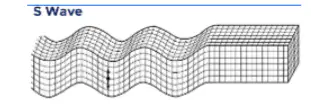
The motion of a particle in the following S-wave picture is:
same direction as the direction of the wave.
perpendicular to the direction of the wave.
side to side motion as the wave directions.
in built up bunches
The abrupt changes in both the P-wave and S-wave velocities are caused by the transition between the layers of the Earth.
True
False
Secondary (S) Waves can pass through:
crust and core
solids only
liquids only
solids, liquids, and gases.
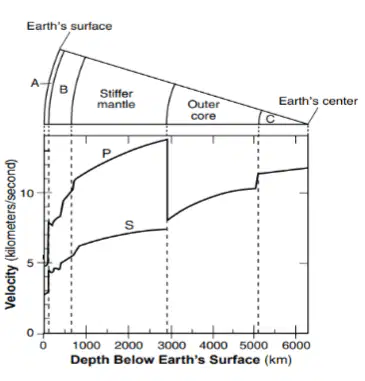
Which Layers of the Earth's Interior are represented by letters A and B?
A is the Crust and B is the rigid Mantle
A is the asthenosphere and B is the crust.
A is the lithosphere and B is the Asthenosphere
A is the rigid mantle and B is the lithosphere
Which type of seismic wave can travel through both solid and liquid layers of the Earth?
Surface waves
S-waves
P-waves
Rayleigh waves
What evidence supports the idea that the Himalayas were once under the ocean?
Presence of marine fossils in Himalayan rocks
Desert sand deposits
High altitude lakes in the region
Frequent volcanic eruptions
What is the main reason for the abrupt change in seismic wave velocity at the boundary between Earth's mantle and core?
Change in temperature
Increase in surface area
Change in material composition
Decrease in pressure
Which type of seismic wave cannot travel through liquids?
P-waves
S-waves
Surface waves
All seismic waves can travel through liquids
Which of the following best describes the Cambrian period?
The era when mammals dominated
A period marked by a rapid increase in the diversity of life forms
The period when dinosaurs first appeared
A time of mass extinction

