
Font size
 Worksheets
Quarter 1 Review Challenge
Total questions: 98
Worksheet time: 49mins
When you step out into the cold, your body shivers in order to keep its temperature at 98.6F.
All living things maintain homeostasis
All living things contain cells
All living things get and use energy
All living things grow and develop
Green plants produce their own food through the process of photosynthesis.
All living things contain cells
All living things get and use energy
All living things grow and develop
All living things maintain homeostasis
A mother bird and father bird have babies.
All living things reproduce
All living things grow and develop
All living things maintain homeostasis
All living things get and use energy
A pill bug (roly poly) eats a carrot.
All living things get and use energy
All living things maintain homeostasis
All living things grow and develop
All living things contain cells
A camel has eyelashes that work to keep the dust and sand out of its eyes.
All living things grow and develop
All living things have cells
All living things adapt to their environment / the species evolves over time
All living things get and use energy
A caterpillar hibernates in a cocoon and emerges as a butterfly.
All living things get and use energy
All living things grow and develop
All living things adapt to their environment / the species evolves over time
All living things respond to their environment
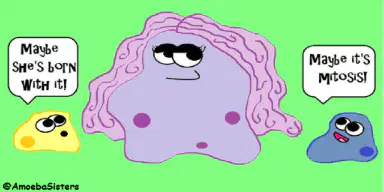
An amoeba is a unicellular organism. Which characteristic of life is this?
All living things respond to their environment
All living things contain cells
All living things grow and develop
All living things get and use energy
A tulip opens in the morning at sunrise and closes in the evening at sunset.
All living things have cells
All living things grow and develop
All living things get and use energy
All living things respond to their environment
Over three years, Tim's height has increased from 5'4" to 5'11".
All living things grow and develop
All living things get and use energy
All living things contain cells
All living things maintain homeostasis
An adult hydra is producing its offspring through budding.
All living things get and use energy
All living things grow and develop
All living things contain cells
All living things reproduce
The roots of a plant grow towards a source of ground water.
All living things reproduce
All living things grow and develop
All living things get and use energy
All living things respond to their environment
Over many hundreds of years, a population of rabbits living in the woods adapts to its surrounding with brown fur.
All living things get and use energy
All living things have cells
All living things adapt to their environment / the species evolves over time
All living things grow and develop
What is the most basic unit of life?
cell
organ system
tissue
organ
Anything that has all of the characteristics of life is called an:
organism
cell
atom
molecule
If an organism is out of homeostasis for too long
it starts to sweat
it gets removed from the herd
it stops eating
it could die
How could you prove an organism has DNA?
not all organisms have DNA
look at it under a microscope to see inside of the cell
use a telescope to see inside of the cell
How could you prove an organism grows or reproduces?
poke at it
feed it
observe it over time
look at it under a microscope
What is the function of DNA?
it is a type of unicellular bacteria
it provides the instructions for how to create proteins which helps all living things function
not all organisms have DNA
we eat it every day to get energy
Maintaining internal stable conditions is the definition of...
having DNA
growing and developing
evolving and adapting
homeostasis
A scientist is trying to decide whether an organism is unicellular or multicellular. Which information would help the scientist most to make her decision?
size of the cells of the organism
what the organism eats
how many cells are in the organism
how fast the organism grows
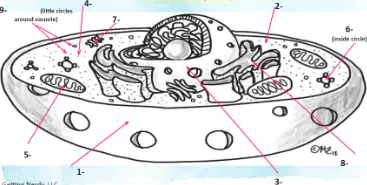
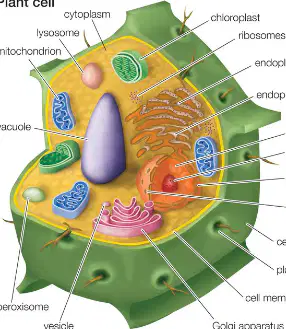
What organelle is number 6? This organelle stores food, water, and wastes for a cell.
Vacuole
Lysosome
Nucleus
Ribosome

Number two is the organelle that protects and gives the plant cell shape.
Chloroplast
Cell wall
Golgi body
Cytoplasm
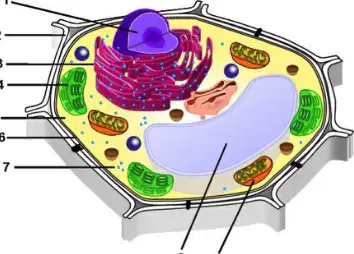
What is organelle 7? This organelle sorts and packages proteins and other substances.
Cytoplasm
Golgi Body
Organelle
Vacuole
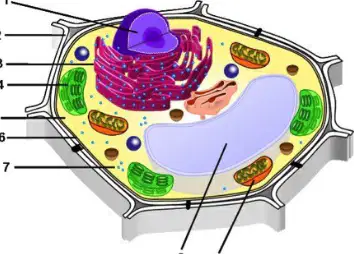
Number 4 is where food is made through photosynthesis in plant cells.
Chloroplast
Ribosome
Nucleus
Golgi Body
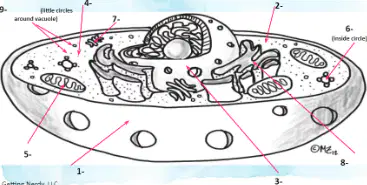
What is number 3? This organelle is the control center of all activities in the cell.
Nucleus
Organelle
Ribosome
Cytoplasm
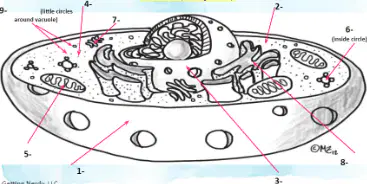
The organelle shown in number 8 transports proteins around in the cell and makes lipids.
Mitochondria
Cytoplasm
Cell Membrane
Endoplasmic Reticulum (ER)
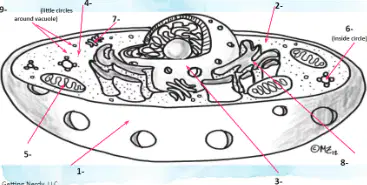
What is number 2? This organelle is a jelly-like substance which flows inside the cell.
Organelle
Cell Membrane
Mitochondria
Cytoplasm

The organelle in number 5 releases energy in the cell.
Lysosome
Golgi Body
Mitochondria
Cell Wall
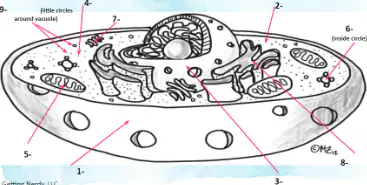
The organelle for #1 is a selectively permeable layer that controls what enters and leaves the cell.
Cell Wall
Mitochondria
Cytoplasm
Cell Membrane
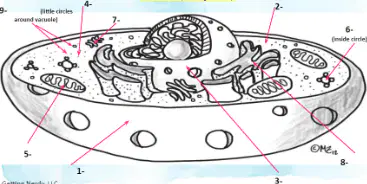
These organelles make protein for the cell.
Chloroplast
Cytoplasm
Nucleus
Ribosome
There are 2 parts that Plant Cells have that are NOT in animal cells. What are they?
Cell Wall
Chloroplast
Cytoplasm
Mitochondria
Where is the DNA of a eukaryotic cell found?
Vacuole
Cell Wall
Ribosomes
Inside the Nucleus
Select which is true about Eukaryotes
They have a Nucleus and Membrane bound organelles
They DO NOT have a Nucleus or Membrane bound organelles
Animal cells are
Eukaryotic
Prokaryotic
Plant cells are
Eukaryotic
Prokaryotic
Bacteria cells are
Eukaryotic
Prokaryotic
What do plant cells have that animal cells do not?
Lysosomes
Cell Membrane
Cell Wall
Chloroplast
Large Vacuole
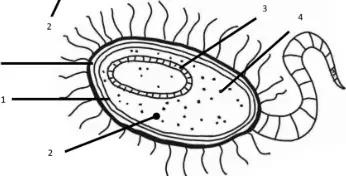
Identify #11 in the diagram of the prokaryotic cell.
Cell wall
Ribosomes
Cytoplasm
Cell membrane
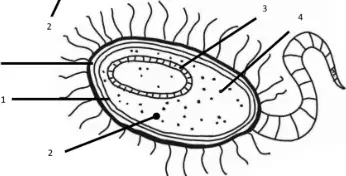
Identify #1 in the diagram of the prokaryotic cell.
Ribosomes
Cell membrane
Cytoplasm
Cell wall
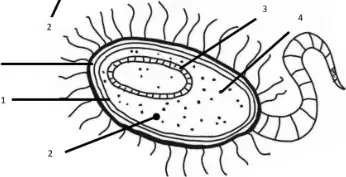
Refer to the diagram of the prokaryotic cell. Identify #2 (pointing to the white background):
Cytoplasm
Ribosomes
Cell wall
Cell membrane
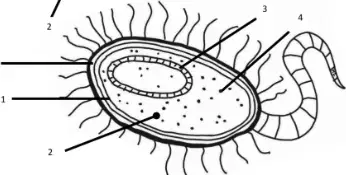
Refer to the diagram of the prokaryotic cell. Identify #4 (pointing to the black dots):
Cytoplasm
Ribosomes
Cell membrane
Cell wall
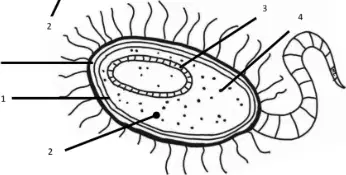
Refer to the diagram of the prokaryotic cell. Identify #3:
Cytoplasm
Mitochondria
Ribosomes
DNA
In a prokaryotic cell, the DNA is found in the nucleus
True
False
Which of the following is an example of a prokaryotic cell?
Plant Cell
Animal Cell
Bacteria Cell
None of these
Which of the following best describes a prokaryotic cell?
Large and complex
Small and simple
The cell membrane's function is to:
create proteins
make DNA
allow things in/out of the cell
do photosynthesis
Select the answers that are examples of PROKARYOTIC cells
onion cell
listeria bacteria
mushroom cell
streptococcus bacteria
human blood cell
Select the 2 answers that best describe a prokaryotic cell
DNA is contained in a nucleus
contains many membrane-bound organelles such as mitochondria, ER, & more
small size & simple
DNA is NOT contained in a nucleus
large size & complex
In a prokaryotic cell, the DNA is...
contained inside of a nucleus
floating freely inside the cell
The Cell Wall's function is to
provide support & structure for the cell
create proteins
let things in/out of the cell
make energy for the cell
The function of the ribosomes is to...
let things in/out of the cell
do photosynthesis
create proteins
provide structure/support for the cell
DNA's function is to...
provide structure/support for the cell
let things in/out of the cell
create proteins
provide instructions for the cell to survive, grow, & reproduce
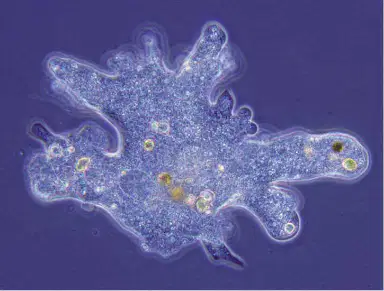
According to cell theory, where did this cell come from?
another pre-existing amoeba cell.
the nonliving environment.
energy from sun that allowed the protist to reproduce.
a multicellular organism.
Refer to the diagram of the plant cell. Which of the following is NOT a part of the Cell Theory?
a) All cells come from pre-existing cells
b) All living things are composed of cells
c) All living things are made mostly of water
d) Cells are the basic unit of structure and function of all living things
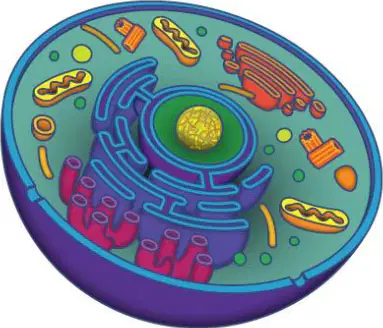
Refer to the diagram. All living things are made up of...
organ systems
cell tissues
cells
organ
Rocks are not living because
they aren't needed for humans
they never move
they are not made of cells
they don't break down
What is the basic structural and functional unit of all living things?
human
atom
cell
molecule
An organism made of one cell is called
multicellular organism
unicellular organism
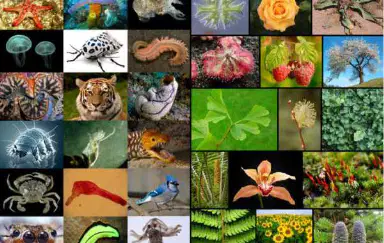
What is one way in which all living things on Earth are alike?
All living things have hair.
All living things can move.
All living things are made of cells and come from other cells.
The cells of all living things have chloroplast.
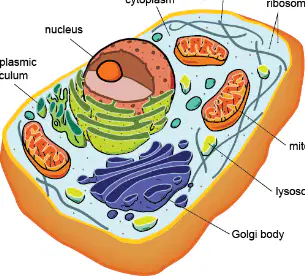
Which of the following statements is not part of the cell theory?
All living things are composed of cells.
Cells are made of smaller cells
Cells are the basic unit of structure and function in all living things.
All cells are produced from other cells.
Which of the following scientists concluded that all animals are made of cells?
Rudolf Virchow
Matthias Schleiden
Robert Hooke
Theodor Schwann
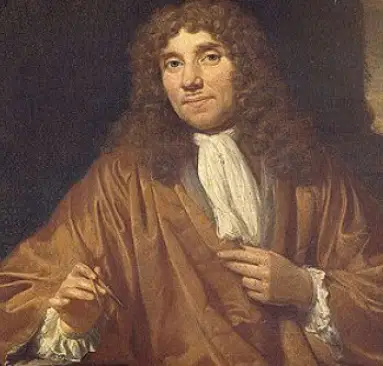
Which of the following scientists was the first to observe bacteria under a microscope?
Robert Hooke
Matthias Schleiden
Anton van Leeuwenhoek
Theodor Schwann
Which is NOT part of the Cell Theory
New cells are produced from existing cells
All living things are composed of cells
Cells are the basic unit of structure & function in living things
Eukaryotic cells have a nucleus

How are unicellular organisms different from multicellular organisms?
There are no differences.
They are made of many cells.
They are made of only one cell.
They are only classified as prokaryotes.
Why couldn't humans see cells before the 1600's?
Because microscopes hadn't been invented yet
Cells were too big to be around humans.
they didn't exist until 1600
Because there were no jails
Which scientists contributed to cell theory?
Virchow, Hook, Schwann
Virchow, Schleiden, Schwann
Hook and Leeuwenhoek
Leeuwenhoek, Schleiden and Virchow
Who looked at cork and named the cell?
Robert Hooke
Francesco Redi
Van Leeuwenhoek
Robert Brown
All plants are made of cells. This was discovered by....
Rudolf Virchow
Robert Hooke
Matthias Schleiden
Aristotle
Who was the "scientist" who observed pond water and teeth scrapings in his microscope?
Schleidian
Leeuwenhoek
Virchow
Hooke
For generations, people believed in "spontaneous generation." Spontaneous generation is the idea that . . . .
cells are the basic unit of structure and function
living things could "generate" from non-living matter.
... all cells come from other cells.
..... all living things are made of cells
What is the first stage of the cell cycle?
Telophase
Metaphase
Mitosis
Interphase
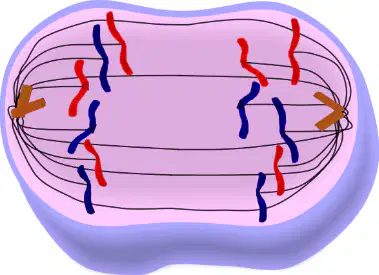
Which phase mitosis is pictured above?
Metaphase
Prophase
Anaphase
Telophase
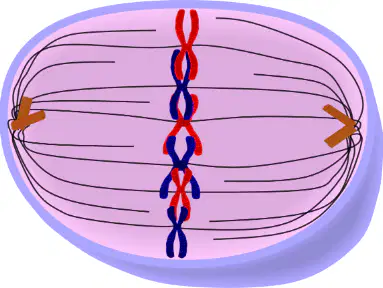
Which phase of mitosis is pictured above?
Cytokinesis
Anaphase
Interphase
Metaphase
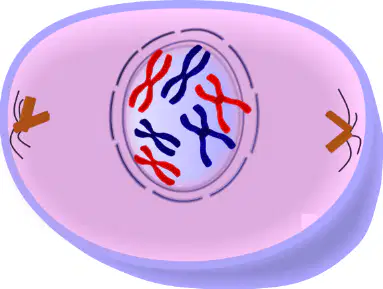
Which phase of mitosis is pictured above?
Prophase
Cytokinesis
Anaphase
Interphase
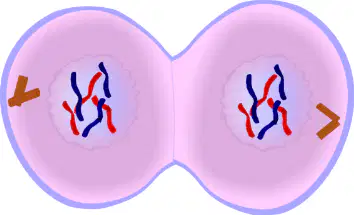
Which phase of mitosis is pictured above?
Telophase
Cytokinesis
Anaphase
Prophase
Refer to the diagram labeled 'Phases of the Cell Cycle'. Which is Metaphase?
E
C
A
F
In mitosis, the two resulting cells are:
different from the starting cell and different from each other.
different from the starting cell and identical to each other.
identical to the starting cell and different from each other.
identical to the starting cell and identical to each other.
How many chromosomes do humans have?
21
92
46
23
A chromosome is a single, long DNA molecule
False
True
Fruit fly body cells have 8 chromosomes. After mitosis, you would expect a resulting fruit fly daughter cell to have -
8 chromosomes.
4 chromosomes.
46 chromosomes.
16 chromosomes.
Where does a cell contain its genetic material?
nucleolus
nucleus
golgi
cytoskeleton
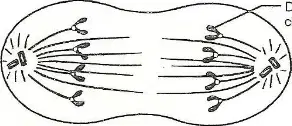
Which phase comes NEXT?
anaphase
metaphase
prophase
telophase

Structure A refers to the _____
chromosome
chromatid
centromere
an X pair
Before cells can divide, what must be copied? HINT: This is what happens in Interphase!
DNA
Cell Wall
mitochondria
cytoplasm
Which of these lists presents the stages of the cell cycle in the correct order?
interphase, mitosis, cytokinesis
cytokinesis, mitosis, interphase
mitosis, interphase, cytokinesis
interphase, cytokinesis, mitosis
Which of these phases of mitosis take place first?
prophase
metaphase
telophase
anaphase
Matt uses a microscope to look at slides of plant cells. He sees a cell with two nuclei that have visible chromosomes. In which stage of cell division is this cell?
anaphase
telophase
interphase
prophase
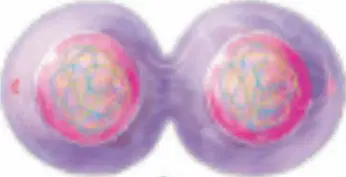
Identify the stage of the cell cycle.
prophase
anaphase
cytokinesis
interphase
Mitosis is an example of...
Asexual Reproduction
Sexual Reproduction
In which type of cell does a CELL PLATE form during cytokinesis? HINT: This allows the cell wall to form!
Bacteria
Animal
Red Blood Cell
Plant

Which process and type of resulting cells are represented?
meiosis, body cells
mitosis, body cells
mitosis, gametes
meiosis, gametes
A male shark has 40 chromosomes in each of its sex cells. How many would be present in its body cells?
160
80
40
20
Compared to the number of chromosomes contained in a body cell, how many chromosomes would normally be contained in a gamete?
One-fourth as many
Half as many
Twice as many
The same number
Chromosomes exchange genetic material during
replication
crossing over
synthesis
translation
A human being has a somatic cell that has 46 chromosomes. What is the haploid number found in a gamete?
23
46
69
92
Fruit fly body cells have 8 chromosomes. After mitosis, you would expect a resulting fruit fly daughter cell to have -
4 chromosomes.
46 chromosomes.
16 chromosomes.
8 chromosomes.
The cells produced via meiosis are called:
skin cells
body cells
somatic cells
sex cells
Why do we need meiosis?
To triple the number of chromosomes going into sex cells
To cut in half the number of chromosomes going into sex cells
To double the number of chromosomes going into sex cells
To not change the number of chromosomes going into sex cells

