
 Worksheets
Hunter's Study Quizizz
Total questions: 97
Worksheet time: 38mins
Name
Class
Date
1.

A constellation is a group of visible ____ that form a pattern when viewed from Earth.
a)
planets
b)
stars
c)
patterns
d)
creatures
2.
The sky is divided into ____ constellations.
a)
11
b)
22
c)
44
d)
88
3.
Visible stars that form a pattern in the sky are called...
a)
galaxies
b)
constellations
c)
meteors
d)
dot to dot
4.
What is the largest constellation?
a)
Canis Major
b)
Big Dipper
c)
Draco
d)
Hydra
5.
What constellation has the Little Dipper as part of its pattern?
a)
Ursa Minor
b)
Ursa Major
c)
Polaris
d)
Andromeda
6.
Polaris always points
a)
East
b)
West
c)
North
d)
South
7.
What is the smallest constellation?
a)
The Little Dipper
b)
The Crux
c)
Orion
d)
Sagittarius
8.

The constellation patterns may take the shape of an ___, ___, ____, ___, or object such as a crown or compass.
a)
planets, stars, animals, people
b)
stars, animals, people, man
c)
man, animals, stars, planets
d)
animal, mythological creature, man, woman,
9.

Ursa Major is also called “Larger Bear” and is one of the largest constellations.
a)
True
b)
False
10.
Ursa Major (Larger Bear) has this asterism in its pattern
a)
the Little Dipper
b)
the Big Dipper
c)
Orion
d)
The Crux
11.
The constellation Orion is named because it resembles
a)
part man, part horse
b)
a great bear
c)
a great hunter
d)
a plow
12.
The term Zodiac refers to ...
a)
the light from Saturn's rings
b)
the head of the Celestial Empire
c)
a method for making astrological predictions
d)
a group of constellations lying near the ecliptic
13.
A notable usefulness of constellations
a)
as a cute picture in your windows
b)
as a calendar to assist in when to plant and harvest crops
c)
to assist bakers when proofing bread
d)
as evidence of life in the universe
14.
A light year is...
a)
The speed light travels
b)
How long it takes light to get to you from the sun
c)
The distance light can travel in a year
d)
How many years it takes light to be emitted
15.
What planet is closest to the sun?
a)
Saturn
b)
Mercury
c)
Mars
d)
Neptune
16.
The color of a star is determined most by its
a)
temperature
b)
distance from Earth
c)
size
d)
mass
17.
Stars are categorized by their variety in size. Which category does the sun belong?
a)
Supergiant stars
b)
Giant stars
c)
dwarf stars
d)
main sequence stars
18.
All of the inner planets
a)
are gas giants
b)
are large with many moons
c)
have an atmosphere and liquid water
d)
are rocky and dense
19.
Which planet is considered a sister planet to Earth because of its size?
a)
neptune
b)
mercury
c)
uranus
d)
venus
20.

According to this Hertzsprung-Russell Diagram which stars are brightest?
a)
Purple
b)
Red
c)
Blue
d)
Yellow
21.
Black Holes are thought to be remnants of ______________ explosion.
a)
Death Star
b)
The Big Bang Theory
c)
Supernova
d)
Planetary Nebula
22.

Hertzsprung-Russell Diagram shows the correct order of decreasing surface temp for stars is?
a)
Red, Yellow, White, Blue
b)
Red, Yellow, Red, Yellow
c)
Blue, White, Yellow, Red
d)
Blue, Red, White, Yellow
23.
The shape of our Milky Way galaxy can be classified as ____________.
a)
Spiral
b)
Elliptical
c)
Irregular
d)
French
24.
Huge clouds of dust and gas are called
a)
Star
b)
Nebulae
c)
Neutron Star
d)
Comets
25.

Which stars have the highest surface temperature?
a)
Yellow
b)
Red
c)
Blue
d)
Orange
26.
Luminosity measures a star's _____________________.
a)
Color
b)
Temperature
c)
Brightness
27.
Space and all the matter and energy in it.
a)
Space
b)
Solar System
c)
Universe
d)
Sun
28.
The sun, all the planets and other bodies that travel around it.
a)
Universe
b)
Galaxy
c)
Star
d)
Solar System
29.
A large celestial body that is composed of gas and that emits light.
a)
star
b)
black hole
c)
element
d)
big bang
30.

What color is the hottest color of star?
a)
Blue
b)
red
c)
purple
d)
Black
31.
Our galaxy is called the
a)
Earth Nebula
b)
The Hubble Galaxy
c)
The Milky Way
d)
The Snickers
32.

Put the stars in order from hottest to coolest.
a)
Blue, Red, White, Yellow, Orange,
b)
Red, White, Yellow, Orange, Blue
c)
Blue, White, Yellow, Red, Orange
d)
Blue, White, Yellow, Orange, Red
33.
The process that all stars perform is called?
a)
nuclear fission
b)
nuclear fusion
c)
mass expulsion
d)
star tectonic motion
34.
After the Nebula stage is the
a)
Protostar stage
b)
Pickle Star Stage
c)
Prototransformer stage
d)
Blackhole stage
35.
The Main Sequence
a)
is the longest stage of a star's life cycle
b)
is the shortest stage of a star's life cycle
c)
is not a part of the star's life cycle
d)
is only part of the sun's life cycle
36.

The life cycle of a star begins with which stage?
a)
Nebula
b)
Protostar
c)
Blackhole
d)
Main Sequence
37.
Which is NOT a type of galaxy?
a)
spiral
b)
irregular
c)
spherical
d)
elliptical
38.
What is the MOST IMPORTANT factor that determines a star's life cycle path?
a)
density
b)
mass
c)
temperature
d)
color
39.

What is a Nebula?
a)
star cemetery
b)
star explosion
c)
star hospital
d)
star birthplace
40.

What is the first stage in the life cycle of a star?
a)
protostar
b)
white dwarf
c)
neutron star
d)
main sequence
41.
Which is the next phase for our sun?
a)
supergiant
b)
neutron star
c)
giant
d)
white dwarf
42.

The moon is a natural ______ of Earth.
a)
comet
b)
axis
c)
satellite
d)
space probe
43.

Earth's ________ on its axis causes day and night.
a)
rotation
b)
revolution
c)
phase
d)
comet
44.

The __________ has planets, moons, comets, and asteroids.
a)
solar system
b)
earth
c)
rotation
d)
United States
45.
Which outer planets have rings?
a)
Just Saturn
b)
Saturn and Jupiter
c)
Jupiter, Neptune, and Saturn
d)
all 4 of them
46.
Which is the largest object in our solar system?
a)
Sun
b)
Jupiter
c)
Earth
d)
Pluto
47.
Which planet is closest to the sun?
a)
Uranus
b)
Mercury
c)
Neptune
d)
Earth
48.
Which planet is third from the sun?
a)
Mars
b)
Pluto
c)
Venus
d)
Earth
49.
Which planet is fifth from the sun?
a)
Saturn
b)
Jupiter
c)
Mars
d)
Earth
50.
Which planet is seventh from the sun?
a)
Saturn
b)
Earth
c)
Venus
d)
Uranus
51.
Which planet is farthest from the sun?
a)
Neptune
b)
Pluto
c)
Earth
d)
Uranus
52.
Which planet is known as the Red Planet?
a)
Jupiter
b)
Mars
c)
Earth
d)
Neptune
53.
What are Saturn's rings made of?
a)
light
b)
slime
c)
crystals
d)
ice and rocks
54.
How many days does it take the Earth to revolve around the Sun?
a)
30 days
b)
365 days
c)
100 days
d)
40 days
55.
A ball of ice and dust with a tail of gas and dust pointing away from the sun.
a)
Asteroid
b)
Comet
c)
Moon
d)
Meteor
56.
Which planet is the hottest?
a)
Mercury
b)
Uranus
c)
Venus
d)
Saturn
57.
Which planet is the windiest?
a)
Uranus
b)
Saturn
c)
Venus
d)
Neptune
58.
Which planet is the coldest?
a)
Neptune
b)
Saturn
c)
Uranus
d)
Earth
59.

Day and night are caused by the ______________ of earth on its axis
a)
revolution
b)
orbit
c)
rotation
d)
tilt of the axis
60.

The earth orbits around the _________
a)
sun
b)
moon
c)
other planets
d)
solar system
61.

Why is it warmer in the summer?
a)
Closer to the sun
b)
More direct light from Earth's tilt
c)
Stronger light from the sun
d)
Earth spins slower
62.

What are the reasons for the season?
a)
Earth's tilt & rotation
b)
Earth's tilt & revolution
c)
Earth's rotation & revolution
d)
Earth's tilt & resolution
63.
What is the "name" for the longest and shortest days of the year?
a)
equinoxes
b)
solstices
c)
months
d)
seasons
64.
Rotation causes ___________.
a)
Day and Night
b)
Seasons
c)
The Earth to be tilted
65.
In general, tides occur...
a)
each hour
b)
2 times a day
c)
each month
d)
twice a month
66.
As the moon's shape appears to get smaller, we say that the moon is _.
a)
swelling
b)
waxing
c)
waning
d)
disappearing
67.
Which moon phase is when you can't see the moon at all?
a)
Waning crescent
b)
Full moon
c)
Waxing gibbous
d)
New moon
68.
Which of the following words describe the phases of the moon?
a)
none, quarter, half, three quarters, full
b)
new, crescent, quarter, gibbous, full
c)
dark, light, half, quarter, blue
d)
first quarter, second quarter, third quarter, fourth quarter
69.

Name this phase of the moon. (NO MOON SEEN)
a)
New moon
b)
waxing crescent
c)
waning crescent
d)
full moon
70.
Define Waxing
a)
Moon is increasing and light part appears to be growing
b)
Completely illuminated
c)
dark side is facing earth
d)
Moon is decreasing and light part appears to be shrinking
71.
Which type of plate boundary would cause mountains to form
a)
Transform
b)
Convergent
c)
Divergent
d)
Reform
72.
What are the two types of crust
a)
continental and oceanic
b)
ocean and upper
c)
lower and upper
d)
pizza and subway
73.
Which layer has convection currents?
a)
Inner Core
b)
Outer Core
c)
Mantle
d)
Crust
74.
Earthquakes and volcanoes are most likely found in which locations?
a)
At plate boundaries
b)
in oceans
c)
in the middle of continents
d)
in the middle of plates
75.
When one plate sides underneath another, it _________ and the magma _________.
a)
hardens, sinks
b)
melts, sinks
c)
hardens, rises
d)
melts, rises
76.
Which of the following is NOT a tectonic boundary?
a)
Convergent
b)
Divergent
c)
Detergent
d)
Transform
77.
The area where two tectonic plates meet.
a)
mantle
b)
focus
c)
plate boundary
d)
convection
78.
Most volcanoes and earthquakes occur...
a)
along the coast
b)
along tectonic plate boundaries
c)
in the Arctic
d)
in the ocean
79.
This landform can occur at a divergent plate boundary.
a)
ocean trench
b)
mid-ocean ridge
c)
tall mountains
d)
transform fault
80.

What is the name of the plate boundary that slides past each other?
a)
Divergent
b)
Convergent
c)
Transform
d)
Mr. C the Slide Man
81.
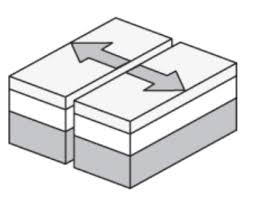
Name the boundary
a)
convergent boundary
b)
divergent boundary
c)
transform boundary
d)
sergent boundary
82.

Name the boundary
a)
convergent boundary
b)
divergent boundary
c)
transform boundary
d)
seregent boundary
83.
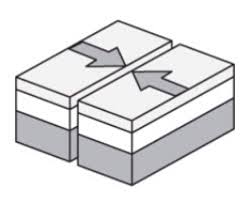
Name the boundary
a)
convergent boundary
b)
divergent boundary
c)
transform boundary
d)
seregent boundary
84.
The idea that continents slowly move over the earth's surface is
a)
Continental drift
b)
Sea floor spreading
c)
Fossils
d)
Mid-Ocean Ridges
85.
___________ hypothesis was that all the continents were once joined together in a single landmass
a)
Niels Bohr
b)
Alfred Wegener
c)
Gregor Mendel
86.
The once super continent was called
a)
super continent
b)
Pangea
c)
world mass
87.
Plates that move apart are called
a)
divergent
b)
convergent
c)
transform
88.
Plates that collide together are called
a)
divergent
b)
convergent
c)
transform
89.
Plates that slip past each other are called
a)
divergent
b)
convergent
c)
transform
90.
The theory of Plate Tectonics states:
a)
The Earth is made of porcelain plates that make up its crust.
b)
Earth's surface is made of rigid slabs or plates that move with respect to each other.
c)
The Earth's crust is two types of plates.
91.
The word "tectonic" describes the ________.
a)
forces that shape Earth's surface and the rock structures that form as a result
b)
type of oily plates found in the Earth's inner core
c)
the type of energy needed in the Earth to push it in orbit
d)
the surfaces that glide around in and out of the valleys and mountains of the Earth
92.
When plates slide past each other, ______________ can result.
a)
lava
b)
rivers
c)
mountains
d)
earthquakes
93.
Compare to Earth's interior layers, Earth's outermost layers are ___ and ___.
a)
soft; moist
b)
soft; cold
c)
cold; rigid
d)
moist; rigid
94.
Earth's tectonic plates are large pieces of the ___________.
a)
Mesosphere
b)
Barysphere
c)
Lithosphere
d)
Earthsphere
95.
The asthenosphere is located _______.
a)
below the Lithosphere
b)
above the Barysphere
c)
in the Earthsphere
d)
between the Barysphere and the Mesosphere
96.
The transfer of energy through liquid or gas.
a)
convection
b)
electricity
c)
con-transportation
d)
conduction
97.
A crack in the Lithosphere is called a ________.
a)
slip
b)
chip
c)
fault
d)
slab pull
100 %

