
 Worksheets
Learning Objectives for Parenteral Medications
Total questions: 97
Worksheet time: 49mins
Safe administration practices for parenteral medications include:
Using sterile technique during preparation and administration
Using expired medications if no alternatives are available
Mixing medications without checking compatibility
Ignoring patient allergies when administering medications
Compare and contrast the volumes of medications that can be measured in a tuberculin syringe and those of larger-volume syringes.
Tuberculin syringes measure small volumes (up to 1 mL), while larger-volume syringes measure greater volumes.
Tuberculin syringes measure larger volumes than larger-volume syringes.
Both tuberculin and larger-volume syringes measure the same volume of medications.
Larger-volume syringes are only used for measuring very small doses.
Selecting the correct needle gauge and length depends on which of the following factors?
The patient's age, injection site, and type of medication
The color of the needle
The brand of the syringe
The time of day
Which of the following best summarizes the advantages and disadvantages of using prefilled syringes?
They offer convenience and reduce contamination risk, but can be more expensive and less flexible for dosing.
They are always cheaper and allow for unlimited dosing flexibility.
They increase contamination risk and are less convenient than traditional syringes.
They have no disadvantages and are suitable for all medications.
Differentiate among ampules, vials, and Mix-O-Vials.
Ampules are sealed glass containers for single use, vials are small bottles with rubber stoppers for multiple or single use, and Mix-O-Vials are vials with two compartments to mix drugs before use.
Ampules are plastic containers for multiple use, vials are glass containers for single use, and Mix-O-Vials are pre-filled syringes.
Ampules are vials with two compartments, vials are sealed glass containers, and Mix-O-Vials are small bottles with rubber stoppers.
Ampules are pre-filled syringes, vials are sealed glass containers for single use, and Mix-O-Vials are plastic containers for mixing drugs.
Describe the technique used to prepare two different drugs in one syringe (e.g., insulin).
The technique involves drawing air into the syringe for both vials, injecting air into each vial, then drawing up the required dose of each drug without contaminating the vials.
The technique involves mixing both drugs in a separate container before drawing them into the syringe.
The technique involves drawing both drugs into the syringe without injecting air into the vials.
The technique involves drawing one drug, discarding the needle, and then drawing the second drug with a new needle.
What does parenteral administration mean?
Drug administration by the GI tract
Drug administration by any route other than the GI tract
Drug administration by oral route only
Drug administration by topical route
Which of the following is NOT a characteristic of parenteral administration?
Onset is faster but shorter duration
Doses often small
More costly, inconvenient, pain/infection risk
Onset is slower but longer duration
Fill in the blank: One of the parenteral routes is ___________.
Subcutaneous
Oral
Rectal
Sublingual
One of the parenteral routes is ___________.
Intramuscular (IM)
Oral
Sublingual
Rectal
Fill in the blank: One of the parenteral routes is ___________.
Intravenous (IV)
Oral
Sublingual
Rectal
Which of the following is NOT a part of a syringe used in parenteral administration?
A) Barrel
B) Plunger
C) Tip
D) Needle
Fill in the blank: The three main parts of a syringe are ________, Plunger, and Tip.
Barrel
Needle
Handle
Tube
Fill in the blank: The part of the syringe that is used to push the medication out is called the ________.
Plunger
Barrel
Needle
Hub
Fill in the blank: The end of the syringe where the needle attaches is called the ________.
Tip
Barrel
Plunger
Hub
Which of the following types of syringe tips can be used in parenteral administration?
Luer-Lok
Luer-Slip
Both A and B
None of the above
Refer to the diagram of the syringe. What is the name of the part labeled at the front end of the syringe?
Tip
Barrel
Plunger
Flange
Which syringe (A or B) has a larger capacity for holding liquid?
Syringe A
Syringe B
Syringes are calibrated in which unit?
Liters
Milliliters
Grams
Ounces
Which syringe should be used if the total volume to be administered is less than 1 mL?
5 mL syringe
3 mL syringe
1 mL syringe
10 mL syringe
Name two specific medications that may require the use of a 1 mL syringe.
Insulin, Heparin
Amoxicillin, Paracetamol
Ibuprofen, Aspirin
Metformin, Lisinopril
Tuberculin syringes (1-mL syringe) are used to measure small volumes of medication accurately. What is the maximum volume they are used to measure?
Less than 1 mL
1 mL
2 mL
5 mL
Insulin syringes have a special scale for measuring insulin. What do they usually hold?
0.5 mL
1 mL
2 mL
5 mL
Insulin syringes measure in units rather than _____
mL
mg
cm
oz
There is room for medication errors when using insulin syringes due to their measurement scale.
True
False
In the United States, insulin is manufactured in what concentration?
U-50
U-100
U-200
U-500
A U-100 syringe holds how many units of insulin per milliliter?
100 units
10 units
50 units
500 units
Low-dose insulin syringes are used for patients receiving _____ units or less of U-100 insulin.
50
20
30
100
What is shown in the image?
Thermometers
Syringes
Pens
Measuring cylinders
Fill in the blank: The objects shown in the image are used for administering _________
injections
tablets
syrups
ointments
What is a prefilled syringe?
A syringe that is reusable and contains no medication
A disposable syringe that contains a premeasured amount of medication
A syringe that must be filled before use
A syringe used only for vaccines
Which of the following is an advantage of prefilled syringes?
A) Time saved in preparation
B) Additional expense
C) Volume of second medication limited
D) Different holders for different cartridges
Which of the following is an advantage of prefilled syringes?
Less chances of contamination
Additional expense
Different holders for different cartridges
Volume of second medication limited
Fill in the blank: One disadvantage of prefilled syringes is _________?
Additional expense
Reduced sterility
Increased dosage accuracy
Longer preparation time
Fill in the blank: Prefilled syringes may require ________ for different cartridges.
different holders
extra needles
special lubricants
additional plungers
What is the brand name mentioned for prefilled syringes?
Carpuject
FlexPen
SoloStar
EpiPen
Which device is shown in the top left image?
EpiPen (Epinephrine Auto-Injector)
Humalog KwikPen
Carpuject
Which device is shown in the bottom left image?
EpiPen (Epinephrine Auto-Injector)
Humalog KwikPen
Carpuject
Which device is shown in the right image labeled 'Carpuject'?
EpiPen (Epinephrine Auto-Injector)
Humalog KwikPen
Carpuject
Name the three parts of a needle.
Hub, Shaft, Beveled tip
Handle, Blade, Point
Cap, Tube, Tip
Base, Stem, Edge
What does needle gauge refer to?
The diameter of the hole inside the needle
The length of the needle
The material of the needle
The sharpness of the needle
The larger the gauge number, the smaller the diameter of the needle.
True
False
Needles used and site selected for injections vary from pediatric to adult. Which type uses smaller needles?
Pediatric
Adult
What is the name of the part labeled at the very top?
Beveled tip
Shaft
Hub
Plunger
What is the name of the long, thin part in the middle?
Shaft
Handle
Tip
Base
Refer to the diagram of the needle. What is the name of the wide part at the bottom?
Hub
Shaft
Bevel
Tip
Needle Selection: BOTH gauge and length depend on _______.
route
patient age
needle material
injection speed
Needle Selection: Gauge is determined by which of the following?
Length of needle
Viscosity of medication
Volume of medication
Route of administration
Needle Selection: Volume of medications varies for each _______.
route
patient
dose
needle
Needle Selection: Volumes in the syringe are read at the point where the rubber flange is parallel to the _______ on the barrel.
calibration scale
needle hub
plunger tip
barrel end
What is the recommended volume for an intradermal injection? (Fill in the blank)
0.01-0.1 mL
0.5-1 mL
1-2 mL
2-5 mL
What gauge needle is used for an intradermal injection?
25-27
18-20
21-23
30-32
What is the recommended needle length for an intradermal injection?
1/4 to 5/8 in
1 to 1.5 in
5/8 to 1 in
2 to 2.5 in
What angle should be used for an intradermal injection?
5-15 degrees
45 degrees
90 degrees
30 degrees
Where should an intradermal injection be administered?
Hairless site (inner surface of mid forearm)
Outer surface of upper arm
Abdomen near the navel
Upper outer quadrant of buttock
What is the recommended volume for a subcutaneous injection?
0.5-2 mL
5-10 mL
2-5 mL
10-20 mL
What gauge needle is used for a subcutaneous injection?
25-31
18-22
10-15
32-36
What is the recommended needle length for a subcutaneous injection?
Individualized, 3/8-5/8 in (ATI)
1-1.5 in
5/8-1 in
2 in
What angle should be used for a subcutaneous injection?
45-90 degrees
10-20 degrees
120-150 degrees
180 degrees
Where should a subcutaneous injection be administered?
Adequate fat padding (abdomen, upper arm/hips, thighs)
Directly into a vein
Into the muscle tissue
Under the fingernail
What is the recommended volume range for intramuscular injections?
0.1-0.5 mL
0.5-3 mL
3-5 mL
5-10 mL
What is the recommended gauge range for intramuscular injections?
10-15
16-18
18-25
25-30
What is the recommended gauge for pediatric intramuscular injections?
10-15
18-20
21-23
25-27
What is the recommended needle length for intramuscular injections in adults?
1/4 to 1/2 in
5/8 to 1.5 in
2 to 3 in
3 to 4 in
For obese patients, what is the recommended needle length for intramuscular injections?
1/2 to 1 in
1 to 2 in
2.5 to 3 in
3 to 4 in
At what angle should intramuscular injections be administered?
90 degrees
45 degrees
30 degrees
15 degrees
Which of the following sites is NOT recommended for intramuscular injections due to close proximity to the sciatic nerve?
Ventrogluteal
Deltoid
Vastus lateralis
Dorso gluteal
Name two recommended sites for intramuscular injections.
Ventrogluteal, deltoid, and vastus lateralis (pediatric)
Subcutaneous tissue and dorsogluteal
Cephalic vein and median cubital vein
Radial artery and femoral artery
What is the length range for a 15G needle?
1 1/2"–2"
1/2"–1"
2"–2 1/2"
3"–3 1/2"
What is the length range for an 18G needle?
1 1/2"–2"
1/2"–1"
2"–2 1/2"
3"–4"
What is the length range for a 20G needle?
1"–1 1/2"
1/2"–3/4"
2"–2 1/2"
3/4"–1"
What is the length range for a 22G needle?
1"–1 1/2"
1/2"–3/4"
2"–2 1/2"
3"–3 1/2"
What is the length range for a 23G needle?
1"–1 1/2"
1/2"–3/4"
2"–2 1/2"
3/4"–1"
What is the length of a 25G needle?
5/8"
1"
1/2"
1 1/2"
What is the length range for a 26G needle?
1/2"–3/8"
1"–1 1/2"
5/8"–1"
3/4"–1 1/4"
What is the length range for a 28G needle?
1/2"–3/8"
5/8"–1"
1"–1 1/2"
3/8"–5/8"
Which of the following is NOT contained in needleless systems suitable for injection?
Stainless-steel needle
Needle sleeve
Retractable syringe
Safety shield
Name one safety device used to prevent needlestick injuries.
Needle sleeve
Cotton swab
Alcohol pad
Bandage
Needleless systems contain stainless-steel needles suitable for injection.
True
False
List any two safety devices mentioned in the safety systems.
Needle sleeve, Retractable syringes, Safety shield
Glass syringe, Metal needle, Cotton swab
Plastic tube, Alcohol pad, Bandage
Rubber stopper, Test tube, Pipette
What is the purpose of providing an alternative to needles for routine procedures?
To reduce the risk of needlesticks with contaminated sharps.
To increase the cost of medical procedures.
To make procedures more complicated.
To reduce patient comfort during procedures.
Syringes and needles must be sterile.
True
False
Which part of the syringe is labeled as 'Safe lock indicator'?
The green section near the plunger is labeled as 'Safe lock indicator'.
The needle cap is labeled as 'Safe lock indicator'.
The barrel is labeled as 'Safe lock indicator'.
The tip of the syringe is labeled as 'Safe lock indicator'.
Which of the following is the correct name for the part labeled 'Sleeve' in the syringe diagram?
Needle
Plunger
Sleeve
Barrel
In image 'A', what is the correct procedure for inserting a syringe into a vial?
Insert the syringe needle through the vial's rubber stopper vertically.
Insert the syringe needle at an angle through the vial's rubber stopper.
Insert the syringe needle through the side of the vial.
Insert the syringe needle without touching the rubber stopper.
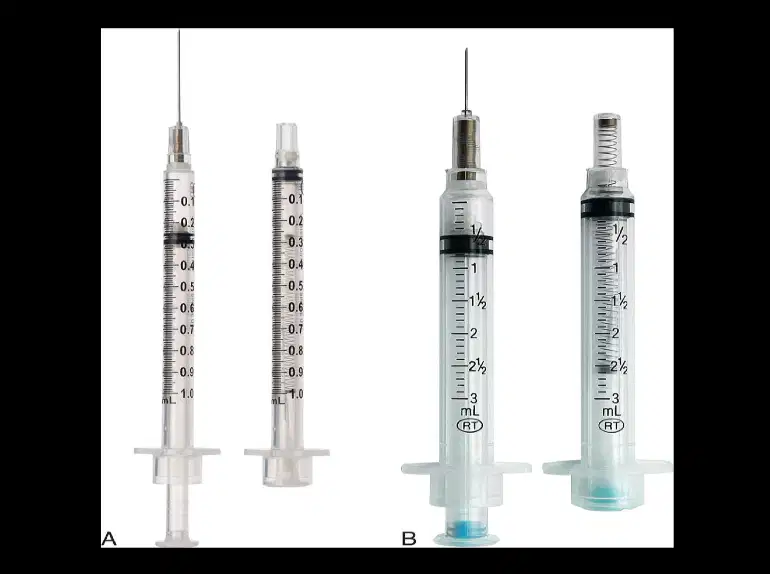
Which set (A or B) contains syringes with a larger volume capacity?
Set A
Set B
Look at the image showing two syringes with orange safety caps. What is the purpose of the orange cap on the needle?
The orange cap is a safety mechanism to prevent accidental needle sticks after use.
The orange cap is used to measure the dosage of the medication.
The orange cap is for decorative purposes only.
The orange cap is used to identify the type of medication in the syringe.
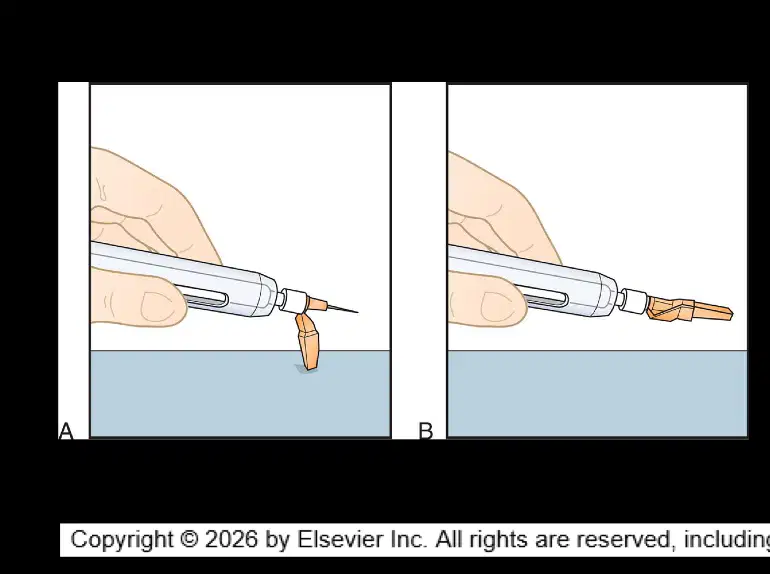
Refer to the bottom left image labeled A and B. Which image (A or B) demonstrates the correct way to activate the needle safety mechanism after use?
Image A
Image B
What should be done with used syringes and needles according to safety systems?
They should be disposed of in a sharps container and comply with OSHA standards.
They should be thrown in regular trash bins.
They should be washed and reused.
They should be left on countertops for cleaning staff to handle.
Why are vaccinations important in safety systems?
Vaccinations are important to prevent the spread of infectious diseases.
Vaccinations are important to increase the risk of disease.
Vaccinations are important to reduce food allergies.
Vaccinations are important to improve air quality.
What is the purpose of a sharps container in healthcare settings?
A sharps container is used to safely dispose of needles and syringes.
A sharps container is used to store medications for patients.
A sharps container is used to clean surgical instruments.
A sharps container is used to hold patient records.
Patients who use needles at home can get a Sharps Disposal by Mail System for home use.
True
False
As nurses, what are the three primary safety concerns?
Patient, themselves, and other healthcare workers.
Patient, visitors, and equipment.
Patient, medication, and environment.
Patient, family members, and hospital administration.
Which type of parenteral dose form is a glass container usually containing a single dose?
Ampules
Vials
Mix-O-Vials
Syringes
Ampules are scored at the neck for proper opening.
True
False
What type of needle should be used with ampules?
Filter needle
Insulin needle
Spinal needle
Winged infusion needle
Vials are glass containers that contain one or more doses and have a ______ diaphragm and a plastic lid.
rubber
metal
glass
paper

