Wayground logo

Free Printable Worksheets

Font size

S
M
L
XL
Worksheets

Waves Test

Total questions: 102

Worksheet time: 4hrs 10mins

Name
Class
Date
1.

A pendulum in an old clock tower has a period of 6.30 seconds. Assuming it behaves like a simple pendulum, estimate the height of the clock tower.

(a)  

2.

An anchor vibrates with a frequency of 85 Hz when it hits the hull of a ship. If the speed of sound in sea water is 1520 m/s, how many wavelengths of sound will fit between the boat and the ocean bottom 395 m below?( whole numbers only)

(a)  

3.

A spring in a toy launcher requires a force of 10 N to compress it 0.05 m. A 100 g ball is placed in the launcher and the spring is compressed by 0.15 m. (a) What is the spring constant? (b) How much potential energy is stored? (c) How fast does the ball shoot out?

(a)  

4.

A police car's siren has a frequency of 720 Hz and is traveling at 20 m/s. We are traveling at 25 m/s away from the police. What frequency do we hear?

(a)  

5.

How deep is the ocean floor if it takes 5.8 seconds for the sonar signal to return?

(a)  

6.

A 350g mass is attached to a spring and executes simple harmonic motion with a period of 0.5 s If the total energy of the system is 2.0 J, find the (a) force constant of the spring (b) the amplitude of the motion

(a)  

7.
In simple harmonic motion, what makes the restoring force unique?
a)
It is constant
b)
It is directly proportional to displacement
c)
It is inversely proportional to velocity
d)
It remains unchanged
8.
Which of the following statements best describes resonance?
a)
sound changes speed in going from one medium to another
b)
sound makes multiple reflections
c)
the amplitude of a wave is amplified
d)
an object is forced to vibrate at its natural frequency
e)
all of the above
9.
Noise-canceling earphones are an example of which phenomenon?
a)
constructive interference
b)
destructive interference
c)
beats
d)
resonance
10.
A 680-Hz sound wave travels at 340 m/s in air. What is its wavelength?
a)
0.5 m
b)
5 m
c)
50 m
d)
500 m
e)
none of the above
11.
If two waves with an amplitude of 2.5 m each arrive at the same place at the same time exactly in step with each other, what is the resulting wave's amplitude?
a)
0.6 m
b)
1.3 m
c)
2.5 m
d)
5.0 m
e)
10.0 m
12.
In which type of wave do particles move perpendicular to the wave's motion?
a)
Longitudinal waves
b)
Transverse waves
c)
Surface waves
d)
Mechanical waves
13.
Which of the following is an example of a longitudinal wave?
a)
Light waves
b)
Sound waves
c)
Ripples in a pond
d)
Radio waves
14.
What does the amplitude of a wave represent?
a)
The distance between two crests
b)
The height of the wave from the rest position
c)
The speed of the wave
d)
The frequency of the wave
15.
If 12 waves pass an observer every minute, what is the frequency in Hz?
a)
0.2 Hz
b)
1 Hz
c)
2 Hz
d)
12 Hz
16.
Which wave property represents the distance between two consecutive wave crests?
a)
Amplitude
b)
Period
c)
Wavelength
d)
Frequency
17.
Energy transfer in waves occurs through:
a)
Matter movement
b)
Direct particle transfer
c)
Oscillation of medium particles
d)
Quantum tunneling
18.
When a wave moves around a barrier or though an opening it is known as what?
a)
Refraction
b)
Diffraction
c)
Reflection
d)
Resonance
19.
Find the frequency of an electromagnetic wave with a wavelength 2.75 × 10⁻⁸ m. Remember c = f*λ and c = 3.00 x 10⁸ m/s.
a)
1.10 Hz
b)
1.09 × 10 16 Hz
c)
9.17 × 10 15 Hz
d)
9.17 × 10 16 Hz
20.
___ is when light travels through a material and bends.
a)
Reflection
b)
Diffraction
c)
Refraction
d)
Difusion
21.
What type of EM wave has the highest energy?
a)
Gamma
b)
Xrays
c)
Infrared
d)
Radio
22.
The type of image a convex mirror always creates is a(n) ________ image(select all that apply)
a)
real
b)
fake
c)
parallel
d)
virtual
23.
A lens or mirror has a magnification factor of 4x. What is the height of an image created by the mirror of an object that 1.5 cm?
a)
3 cm
b)
6 cm
c)
12 cm
d)
18 cm
24.
Which converges light beams?
a)
Concave lens
b)
Convex lens
c)
Concave mirror
d)
Convex mirror
25.
The size of the image formed increases as the distance between the object and the lens is _____
a)
Increase
b)
Decrease
c)
Same
26.
The distance from the vertex of the mirror to the center of curvature is also known as the
a)
focal length.
b)
radius of curvature.
c)
object distance.
d)
image
27.
The image formed by this diverging mirror is
a)
upright, smaller, real
b)
inverted, larger, virtual
c)
upright, smaller, virtual
d)
inverted, smaller, real
28.
Compared to a sound of 10 decibels, a sound of 50 decibels has what intensity?
a)
40 times the intensity
b)
400 times the intensity
c)
10,000 times the intensity
29.
A 680-Hz sound wave travels at 340 m/s in air. What is its wavelength?
a)
0.5 m
b)
5 m
c)
50 m
d)
500 m
e)
none of the above
30.
What happens to the frequency of sound waves as the source moves towards an observer?
a)
It decreases.
b)
It increases.
c)
It remains constant.
d)
It becomes zero.
31.
What is the effect of temperature on the speed of sound in air?
a)
Speed decreases with temperature.
b)
Speed increases with temperature.
c)
Speed remains constant regardless of temperature.
d)
Temperature has no effect on sound speed.
32.
If two waves with the same frequency and amplitude interfere destructively, what is the result?
a)
A wave with a larger amplitude.
b)
A wave with a smaller amplitude.
c)
No wave at all.
d)
A wave with a different frequency.
33.
What does the negative sign in Hooke's Law represent?
a)
A calculation error
b)
Negative energy
c)
A restoring force opposite to displacement
d)
Measurement uncertainty
34.
In the equation F = -kx, what does 'k' represent?
a)
Kinetic energy
b)
Spring constant
c)
Kinematic velocity
d)
Displacement coefficient
35.
What is the relationship between period (T) and frequency (f)?
a)
T = f
b)
f = 1/T
c)
T = 2πf
d)
f = T²
36.
What parameter describes the maximum displacement from equilibrium in Simple Harmonic motion?
a)
Velocity
b)
Frequency
c)
Amplitude
d)
Period
37.
What unit measures frequency of oscillation?
a)
Watts
b)
Joules
c)
Hertz
d)
Newtons
38.
What is the primary function of a wave?
a)
To carry energy
b)
To carry matter
c)
To create sound
d)
To transmit light
39.
In which type of wave do particles move perpendicular to the wave's motion?
a)
Longitudinal waves
b)
Transverse waves
c)
Surface waves
d)
Mechanical waves
40.
If the amplitude of a wave increases, what happens to its energy?
a)
It decreases
b)
It remains the same
c)
It increases
d)
It fluctuates
41.
How does wavelength relate to frequency?
a)
Longer wavelength means higher frequency
b)
Shorter wavelength means lower frequency
c)
Longer wavelength means lower frequency
d)
Wavelength and frequency are unrelated
42.
What is the wave speed equation?
a)
Speed = Amplitude × Frequency
b)
Speed = Frequency + Wavelength
c)
Speed = Frequency × Wavelength
d)
Speed = Wavelength / Frequency
43.
If a wave has a frequency of 50 Hz and a wavelength of 2 m, what is its speed?
a)
25 m/s
b)
50 m/s
c)
100 m/s
d)
150 m/s
44.
Which of the following is an example of a longitudinal wave?
a)
Light waves
b)
Sound waves
c)
Ripples in a pond
d)
Radio waves
45.
What happens to the energy of a wave if its wavelength decreases?
a)
Energy increases
b)
Energy decreases
c)
Energy remains constant
d)
Energy fluctuates
46.
Which of the following best describes the fundamental definition of a wave?
a)
A disturbance that moves through space without transferring matter
b)
A physical object that oscillates in place
c)
A vibration that only occurs in solid materials
d)
A mechanical movement that requires constant energy input
47.
In a transverse wave, the particles of the medium move:
a)
Parallel to the wave's direction of propagation
b)
Perpendicular to the wave's direction of propagation
c)
Randomly in all directions
d)
Spirally around the wave's axis
48.
In a longitudinal wave, particle movement is:
a)
Perpendicular to wave propagation
b)
Parallel to wave propagation
c)
Circular around wave axis
d)
Diagonal to wave direction
49.
If a wave has a frequency of 262 Hz and a wavelength of 1.30 m, its speed would be:
a)
340 m/s
b)
200 m/s
c)
400 m/s
d)
500 m/s
50.
What type of wave does sound represent?
a)
Transverse wave
b)
Longitudinal wave
c)
Electromagnetic wave
d)
Quantum wave
51.
Energy transfer in waves occurs through:
a)
Matter movement
b)
Direct particle transfer
c)
Oscillation of medium particles
d)
Quantum tunneling
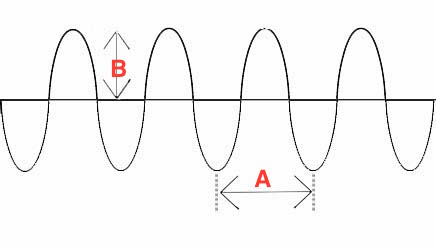
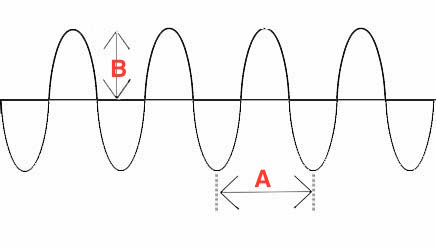
52.
What property of the wave is represented by the letter "B"?
a)
amplitude
b)
crest
c)
trough
d)
wavelength
53.

What property of this wave is represented by the letter "A"

a)

amplitude

b)

crest

c)

trough

d)

wavelength

54.
What property of this wave is represented by the letter "A"
a)
amplitude
b)
crest
c)
trough
d)
wavelength
55.

Period of a wave refers to...

a)

how long it takes for the event to repeat.

b)

how strong a wave is.

c)

how long a wave is.

d)

how much energy a wave has.

56.

The two waves have different...

a)

amplitudes

b)

speeds

c)

wavelengths

d)

frequencies

57.

What is the amplitude of this wave?

a)

4

b)

8

c)

2

d)

6.3

58.
This image is representing what wave interaction?
a)
Refraction
b)
Diffraction
c)
Reflection
d)
Interference
59.

What would you call this?

a)

Reflection

b)

Diffraction

c)

Refraction

d)

Friction

60.

A wave can travel through space and ______ transferring energy from one place to another.

a)

Matter

b)

Air

c)

Time

d)

Ears

61.
What is frequency?
a)
waves
b)
distance between equilibrium to crest
c)
hand motion
d)
The number of wave cycles completed in one second
62.
This illustration shows three different waves traveling through the same medium. 
a)
The waves travel at different speeds.
b)
The waves have different wavelengths.
c)
The waves carry different amounts of energy.
d)
The waves are a different distance from the source.
63.
Sound waves are _______________
a)
Transverse waves
b)
Longitudinal waves
c)
Circular waves
d)
Seismic waves
64.

What is A supposed to be?

a)

wavelength

b)

crest

c)

trough

d)

amplitude

65.

Which type of mirror always produces a virtual, upright, and reduced image?

a)

Convex mirror

b)

Parabolic mirror

c)

Plane mirror

d)

Concave mirror

66.

What happens to the wavelength of a wave if its frequency increases, assuming the speed remains constant?

a)

Wavelength stays the same

b)

Wavelength becomes zero

c)

Wavelength decreases

d)

Wavelength increases

67.

Which electromagnetic wave has the lowest energy?

a)

Microwave

b)

X-ray

c)

Ultraviolet

d)

Radio

68.

This reflection is

a)

specular.

b)

diffuse.

69.

The distance from the vertex of the mirror to the center of curvature is also known as the

a)

focal length.

b)

radius of curvature.

c)

object distance.

d)

image distance.

70.

This image is

a)

real.

b)

virtual.

71.

The image formed by this diverging mirror is

a)

upright, smaller, real

b)

inverted, larger, virtual

c)

upright, smaller, virtual

d)

inverted, smaller, real

72.

The object distance is positive and the image distance is

a)

positive.

b)

negative.

c)

upright.

d)

inverted.

73.

According to the law of reflection the angle of incidence is ____________ the angle of reflection.

a)

less than

b)

greater than

c)

equal to

74.
Which one is a convex lens?
a)
A
b)
B
75.
What type of image is formed in a plane mirror?
a)
Real
b)
Virtual
c)
Enlarged
d)
Small
76.
The do will be a _________________ value.
a)
positive
b)
negative
77.
The di for a real image will be a _________________ value
a)
positive
b)
negative
78.
A converging lens produces an image twice the size of the original. If the object is placed 0.40 m from the lens, and the image produced is 0.80 m from the lens. What is the focal length of the lens? 
a)
0.351 m
b)
0.267 m
c)
0.416 m
d)
0.112 m
79.

A tree 20 m high is located 40 m from the converging lens of focal length 0.08 m.Calculate the distance from the lens to the image.

a)

0.08 m

b)

0.01 m

c)

0.10 m

d)

0.20 m

80.
In the thin lens equation, do represents 
a)
Distance of the object from the lens
b)
Distance of the image from the lens
81.
The focal length of the lens in your eye is about 0.015 m. If the object is 1 m from your eye, where is the image produced? 
a)
0.0315 m
b)
0.0243 m
c)
0.0152 m
d)
0.0601 m
82.
An object is placed 10 cm from a convex mirror. Its image is formed 5 cm behind the mirror.The focal length of the given convex mirror is
a)
-5 cm
b)
5 cm
c)
10 cm
d)
-10cm
83.
A real image having a size of 10 cm is formed by a concave mirror. The size of the object is 5 cm.The magnification of the object is
a)
-5
b)
5
c)
2
d)
-2
84.

A concave mirror or lens has a focal length of 5 cm. The image created by the mirror is 7.3 cm away from the mirror. What is the distance from the mirror of the object?

a)

21.2 cm

b)

11.3 cm

c)

4.75 cm

d)

15.9 cm

85.

A lens or mirror has a magnification factor of 4x. What is the height of an image created by the mirror of an object that 1.5 cm?

a)

6 cm

b)

2.67 cm

c)

60 cm

d)

12 cm

86.

An incident ray strikes a plane mirror at an angle 35°35\degree to the normal. What is the angle of the reflected ray?

a)

55°55\degree

b)

70°70\degree

c)

35°35\degree

d)

90°90\degree

87.

While driving to Chick-Fil-A, you see a car in your passenger side mirror. The image of the car appears to be 5 m beyond the mirror, and the focal point of the mirror is 16 m behind the mirror. What is the actual distance the car is from the mirror?

a)

10.1 m

b)

7.3 m

c)

2.8 m

d)

152.7 m

88.

Derive the formula for the observed frequency when the source of sound is moving towards a stationary observer. Assume the speed of sound in the medium is vv , the speed of the source is vsv_s , and the frequency of the source is f0f_0 .

a)

f′=f0(vv+vs)f' = f_0 \left(\frac{v}{v + v_s}\right)

b)

f′=f0(v+vsv)f' = f_0 \left(\frac{v + v_s}{v}\right)

c)

f′=f0(v−vsv)f' = f_0 \left(\frac{v - v_s}{v}\right)

d)

f′=f0(vv−vs)f' = f_0 \left(\frac{v}{v - v_s}\right)

89.

Calculate the observed frequency when a train moving at 30 m/s approaches a stationary observer. The frequency of the train's whistle is 500 Hz, and the speed of sound is 340 m/s.

a)

545 Hz

b)

515 Hz

c)

530 Hz

d)

500 Hz

90.

What happens to the observed frequency if the observer moves towards a stationary sound source at a speed of 20 m/s, given the speed of sound is 340 m/s and the source frequency is 400 Hz?

a)

The observed frequency decreases.

b)

The observed frequency remains the same.

c)

The observed frequency increases.

d)

The observed frequency becomes zero.

91.

If the medium changes from air to water, how does this affect the Doppler effect for sound waves?

a)

The Doppler effect is more pronounced in water.

b)

The Doppler effect is less pronounced in water.

c)

The Doppler effect is the same in both air and water.

d)

The Doppler effect does not occur in water.

92.

A car is moving away from a stationary observer at 25 m/s. If the car's horn emits a frequency of 600 Hz and the speed of sound is 340 m/s, what is the observed frequency?

a)

560 Hz

b)

580 Hz

c)

590 Hz

d)

600 Hz

93.

Derive the expression for the observed frequency when both the source and observer are moving towards each other. Assume the speed of sound is vv , the speed of the source is vsv_s , the speed of the observer is vov_o , and the source frequency is f0f_0 .

a)

f′=f0(v+vov−vs)f' = f_0 \left(\frac{v + v_o}{v - v_s}\right)

b)

f′=f0(v−vov+vs)f' = f_0 \left(\frac{v - v_o}{v + v_s}\right)

c)

f′=f0(v+vsv−vo)f' = f_0 \left(\frac{v + v_s}{v - v_o}\right)

d)

f′=f0(v−vsv+vo)f' = f_0 \left(\frac{v - v_s}{v + v_o}\right)

94.

How does the density of a medium affect the speed of sound and consequently the Doppler effect?

a)

Higher density increases the speed of sound and enhances the Doppler effect.

b)

Higher density decreases the speed of sound and diminishes the Doppler effect.

c)

Density does not affect the speed of sound or the Doppler effect.

d)

Higher density increases the speed of sound but does not affect the Doppler effect.

95.

A source emits sound at a frequency of 1000 Hz. If the observer is moving away from the source at 20 m/s and the speed of sound is 340 m/s, what is the observed frequency?

a)

940 Hz

b)

960 Hz

c)

980 Hz

d)

1000 Hz

96.

Calculate the observed frequency when a source moving at 40 m/s emits a sound of frequency 800 Hz towards a stationary observer. The speed of sound is 340 m/s.

a)

880 Hz

b)

820 Hz

c)

840 Hz

d)

800 Hz

97.

The total time for sound waves to return to a ship was 8 seconds after being released. What is the depth in meters?


Distance (Depth) = Velocity x (Total time/2)

Velocity of sound in water = 1500 m/s

a)

12,000m

b)

6000m

c)

375m

d)

187.5m

98.

The total time for sound waves to return to a ship was 4.5 seconds after being released. What is the depth in meters?


Distance (Depth) = Velocity x (Total time/2)

Velocity of sound in water = 1500 m/s

a)

6750m

b)

333.33m

c)

667m

d)

3375m

99.

If the depth of the ocean floor is 9000 meters, how long, in total time, does it take sound waves to return to the SONAR detector?


Distance (Depth) = Velocity x (Total time/2)

Velocity of sound in water = 1500 m/s

a)

13,500,000sec

b)

12sec

c)

0.17sec

d)

3sec

100.

The time for sound waves to return to a ship from just the bottom of the ocean was 1.25 seconds. What is the depth in meters?


Distance (Depth) = Velocity x (Total time/2)

Velocity of sound in water = 1500 m/s

a)

937.5m

b)

1875m

c)

10050m

d)

1200m

101.

If the depth of the ocean floor is 7500 meters, how long does it take sound waves to reach the bottom of the ocean?


Distance (Depth) = Velocity x (Total time/2)

Velocity of sound in water = 1500 m/s

a)

10sec

b)

5sec

c)

11,250,000sec

d)

0.2sec

102.

The speed of sound varies when the medium it passes through changes. For example, the speed of sound through air is 343 m/s. A boat mapping the seafloor near Greenland determines after a 12-second ping, the depth is 8100 meters. What is the speed of sound in this cold, icy water?


Distance (Depth) = Velocity x (Total time/2)

a)

1875m/s

b)

48,600m/s

c)

675m/s

d)

1350m/s