
 Worksheets
Clayton’s Basic Pharmacology for Nurses: Chapter 9 Review
Total questions: 94
Worksheet time: 47mins

Which chapter of Clayton’s Basic Pharmacology for Nurses, 20th edition, focuses on Parenteral Administration?
Chapter 9
Chapter 5
Chapter 12
Chapter 3
What is the main topic discussed in Chapter 9 of Clayton’s Basic Pharmacology for Nurses, 20th edition?
Parenteral Administration
Oral Medication
Drug Interactions
Patient Assessment
Which route involves administering medication into the skin just below the epidermis?
Intradermal route
Intravenous route
Oral route
Rectal route

What equipment is typically needed to administer medication via the subcutaneous route?
Syringe and needle
Stethoscope
Blood pressure cuff
Thermometer

Which muscle sites should be identified before administering medication intramuscularly?
Vastus lateralis, rectus femoris, ventrogluteal, and deltoid
Biceps, triceps, and pectoralis major
Gastrocnemius, soleus, and tibialis anterior
Latissimus dorsi, trapezius, and rhomboids

When planning intramuscular medication administration, which site is most suitable for infants?
Vastus lateralis
Deltoid
Ventrogluteal
Rectus femoris
Describe the difference between the technique used for subcutaneous and intramuscular medication administration.
Subcutaneous injections are given into the fatty tissue under the skin, while intramuscular injections are given into the muscle.
Subcutaneous injections are given into the muscle, while intramuscular injections are given into the fatty tissue.
Both are given into the bloodstream directly.
Both are administered orally.
Which layer of the skin is targeted in the intradermal route of medication administration?
Dermal layer just below the epidermis
Epidermis
Subcutaneous tissue
Muscle layer
What is the typical angle used for an intradermal injection?
15 degrees
45 degrees
90 degrees
30 degrees
Which of the following is NOT a common use of the intradermal route?
Allergy sensitivity tests
Desensitization injections
Local anesthetics
Antibiotic therapy
Which site is most commonly preferred for intradermal injections?
Upper chest
Inner aspect of forearms
Scapular area of the back
Abdomen
A small bleb typically appears after which type of injection?
Intradermal injection
Intramuscular injection
Subcutaneous injection
Intravenous injection
Which method is NOT used for allergy testing in the intradermal route?
Intradermal injection method
Skin prick test (SPT) method
Blood test method
Both A and B
Explain why a smaller volume of medication is used in the intradermal route compared to other injection routes.
To prevent deep tissue damage and ensure localized effect
Because the skin cannot absorb any medication
To increase the risk of infection
To make the injection more painful

Which layer of the skin is targeted during an intradermal injection?
Epidermis
Dermis
Subcutaneous
Muscle

At what angle is the needle typically inserted for an intradermal injection?
45 degrees
90 degrees
15 degrees
30 degrees

Which of the following is NOT a layer of the skin shown in the diagram for the intradermal route?
Epidermis
Dermis
Subcutaneous
Cartilage

Explain why the intradermal route requires the needle to be inserted at a shallow angle, such as 15 degrees, rather than a steeper angle.
To avoid reaching the muscle layer
To ensure medication is delivered into the dermis
To prevent formation of a bleb
To increase absorption rate in the subcutaneous layer
Which type of tissue is targeted when administering a subcutaneous injection?
Loose connective tissue between the dermis and muscle layer
Muscle tissue only
Epidermal layer
Bone tissue
What is the usual amount of medication administered via the subcutaneous route?
Usually 1 mL or less
5 mL or more
10 mL
3 mL
At what angle should a subcutaneous injection be administered for thinner patients?
45 degrees
90 degrees
30 degrees
60 degrees
Why is it important to rotate injection sites when administering subcutaneous injections?
To prevent tissue damage and ensure proper absorption
To increase the rate of absorption
To reduce medication dosage
To avoid using syringes
Which of the following medications is commonly administered via the subcutaneous route?
Heparin
Amoxicillin
Paracetamol
Ibuprofen
Compare the rate of absorption for subcutaneous injections to intramuscular (IM) or intravenous (IV) injections. What is a key difference?
Subcutaneous absorption is slower and drug action takes longer
Subcutaneous absorption is faster than IV
Subcutaneous absorption is immediate
Subcutaneous absorption is unpredictable
A nurse is preparing to administer insulin to an obese patient via the subcutaneous route. What angle should the nurse use for the injection?
90 degrees
45 degrees
30 degrees
60 degrees
Which of the following is NOT a preferred site for subcutaneous injections?
Abdomen
Upper arms
Anterior thighs
Forehead
What should you avoid doing after administering a subcutaneous injection?
Rubbing the injection site
Rotating injection sites
Using a sterile syringe
Monitoring the patient

Which layer of the skin is targeted when administering medication via the subcutaneous route?
Epidermis
Dermis
Subcutaneous
Muscle

At what angle is the needle typically inserted for a subcutaneous injection?
90 degrees
30 degrees
45 degrees
15 degrees

Arrange the following layers of the skin in order from outermost to innermost: Dermis, Muscle, Epidermis, Subcutaneous.
Epidermis, Dermis, Subcutaneous, Muscle
Dermis, Epidermis, Subcutaneous, Muscle
Epidermis, Subcutaneous, Dermis, Muscle
Muscle, Subcutaneous, Dermis, Epidermis

Explain why a subcutaneous injection is administered at a 45-degree angle rather than a 90-degree angle.
To avoid reaching the muscle layer and ensure medication is delivered into the subcutaneous tissue
To make the injection less painful
To increase the speed of medication absorption
To prevent damage to the epidermis
Which of the following is the correct term for the injection sites shown in the image?
Intramuscular Sites
Subcutaneous Sites
Intravenous Sites
Intra-articular Sites
Which areas of the body are commonly used for subcutaneous injections according to the diagram?
Upper arms, abdomen, and thighs
Forehead, neck, and feet
Chest, back, and ankles
Palms, soles, and ears
Why is it important to rotate subcutaneous injection sites, as indicated by the numbered locations in the diagram?
To increase pain at the injection site
To prevent tissue damage and ensure proper absorption
To reduce the effectiveness of medication
To make injections more difficult
Which layer of tissue is targeted during an intramuscular injection?
Muscle layer
Skin layer
Fat layer
Bone layer
What is the recommended angle for administering an intramuscular injection?
45 degrees
60 degrees
90 degrees
30 degrees
Why is absorption through the intramuscular route considered more rapid than subcutaneous injections?
Because muscles have a richer blood supply
Because the skin is thinner
Because the drug is injected directly into the bloodstream
Because the injection is less painful
What complication can occur if a vein is punctured during an intramuscular injection?
Infection
Hematoma
Allergic reaction
Swelling
A nurse is preparing to give an intramuscular injection. Which of the following practices helps minimize complications?
Using muscles that have previous injection sites
Using muscles free from injections and wounds
Injecting into the same site repeatedly
Ignoring the recommended angle
If a patient experiences pain after an intramuscular injection, which of the following is the most likely cause?
The drug volume was too low
The nerve was touched during injection
The injection was given at the wrong angle
The muscle was not used
Which of the following is a factor to consider when administering medication via the intramuscular route?
Age
Blood pressure
Heart rate
Skin color
What is the maximum volume of medication that should be administered via the intramuscular route for pediatric patients?
1 mL
2 mL
3 mL
5 mL
Which needle gauge range is appropriate for intramuscular injections?
18-25
10-15
26-30
5-10
A nurse is preparing to administer an intramuscular injection to an adult patient. Which site is NOT commonly used for this procedure?
Gluteal area
Deltoid
Vastus lateralis
Forearm
If a medication requires a volume of 2.5 mL to be administered intramuscularly to an adult, is this within the recommended range?
Yes, it is within the recommended range.
No, it exceeds the recommended range.
Yes, but only for pediatric patients.
No, only 1 mL is allowed for adults.

Which layer of the skin does an intramuscular injection target?
Epidermis
Dermis
Subcutaneous
Muscle

At what angle is the needle inserted for an intramuscular injection?
45 degrees
60 degrees
90 degrees
30 degrees

Arrange the following layers of the skin in order from outermost to innermost: Dermis, Muscle, Epidermis, Subcutaneous.
Epidermis, Dermis, Subcutaneous, Muscle
Dermis, Epidermis, Subcutaneous, Muscle
Epidermis, Subcutaneous, Dermis, Muscle
Subcutaneous, Dermis, Epidermis, Muscle
Which muscle is commonly used as an intramuscular injection site, especially in infants?
Vastus Lateralis Muscle
Biceps Brachii Muscle
Trapezius Muscle
Gluteus Maximus Muscle
Where is the Vastus Lateralis muscle located?
Anterior lateral thigh
Posterior upper arm
Lower back
Medial forearm
Why is the Vastus Lateralis muscle preferred for intramuscular injections in infants?
It has the largest muscle mass for their age group
It is closest to major nerves
It is the smallest muscle in the body
It is located in the upper arm
Which of the following is a benefit of using the Vastus Lateralis muscle for intramuscular injections?
Good drug absorption
Slow drug absorption
High risk of hitting nerves
Limited medication volume
Explain why the Vastus Lateralis muscle is considered a safe site for intramuscular injections in terms of its anatomical location.
It is away from nerves and blood vessels
It is close to the spinal cord
It is surrounded by bone
It is near the heart
A nurse needs to administer a large volume of medication intramuscularly to an infant. Which site should they choose and why?
Vastus Lateralis muscle, because it has the largest muscle mass for infants and allows for larger volumes of medication
Deltoid muscle, because it is easy to access
Gluteus Maximus muscle, because it is far from the thigh
Trapezius muscle, because it is in the upper back

Which muscle is commonly used as an intramuscular injection site in the thigh?
Vastus lateralis
Biceps femoris
Rectus femoris
Sartorius

Which nerve must be avoided when administering an intramuscular injection in the thigh?
Sciatic nerve
Femoral nerve
Tibial nerve
Obturator nerve

What is the anatomical landmark located at the top of the femur, important for identifying intramuscular injection sites?
Greater trochanter
Patella
Acetabulum
Iliac crest

Explain why it is important to identify the femoral artery and vein when selecting an intramuscular injection site in the thigh.
To avoid accidental injection into blood vessels and prevent complications
To ensure the medication is absorbed faster
To increase the pain of injection
To make the injection site more visible
Which muscle is located medial to the vastus lateralis and does not cross the midline of the anterior thigh?
Rectus femoris muscle
Gluteus maximus muscle
Biceps femoris muscle
Sartorius muscle

What is a disadvantage of using the rectus femoris muscle as an intramuscular injection site?
Closer to the sciatic nerve and major blood vessels
Difficult to access in supine position
High risk of infection
Limited blood supply
Which intramuscular site is easily accessible if the patient is in prone, supine, or side-lying position?
Ventrogluteal area
Deltoid muscle
Rectus femoris muscle
Dorsogluteal area
When identifying the ventrogluteal landmark for intramuscular injection, which finger should be placed on the anterior superior iliac spine?
Index finger
Thumb
Middle finger
Ring finger
Explain the steps for locating the ventrogluteal area for intramuscular injection and discuss why this site is considered easily accessible.
Place your palm on the side of the hip with your thumb pointing toward the groin, place your index finger on the anterior superior iliac spine, and extend your middle finger along the iliac crest; this site is easily accessible because the patient can be in prone, supine, or side-lying position.
Place your palm on the thigh, point your thumb toward the knee, and extend your fingers along the femur; this site is easily accessible because it is close to the midline.
Place your palm on the shoulder, point your thumb toward the neck, and extend your fingers along the clavicle; this site is easily accessible because the patient can be seated.
Place your palm on the back, point your thumb toward the spine, and extend your fingers along the scapula; this site is easily accessible because the patient can be standing.
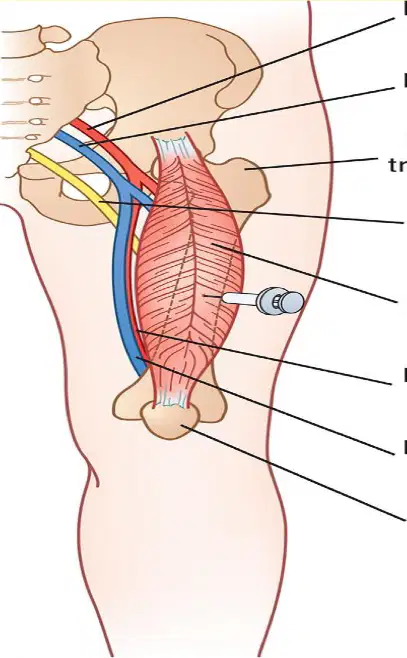
Which muscle is commonly targeted for intramuscular injections in the thigh?
Rectus femoris muscle
Biceps femoris muscle
Sartorius muscle
Vastus lateralis muscle
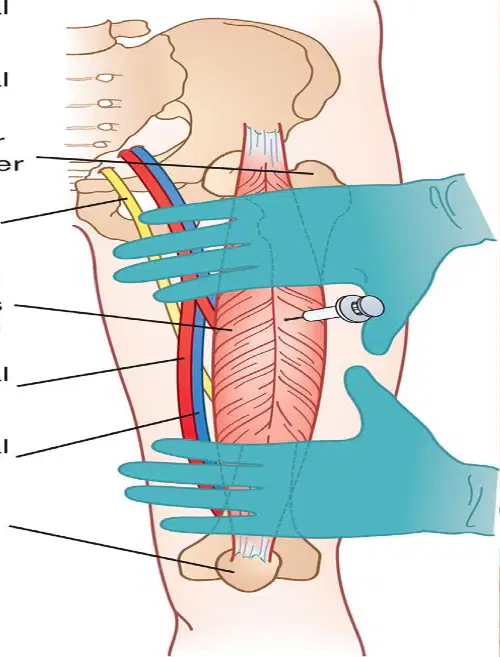
Which nerve must be avoided when administering an intramuscular injection in the thigh?
Sciatic nerve
Femoral nerve
Tibial nerve
Obturator nerve
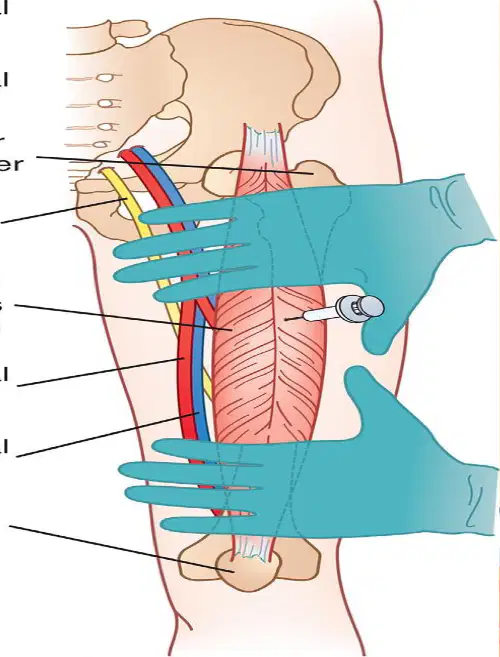
What anatomical landmark is used to help locate the site for an intramuscular injection in the thigh?
Greater trochanter
Iliac crest
Acromion process
Olecranon process
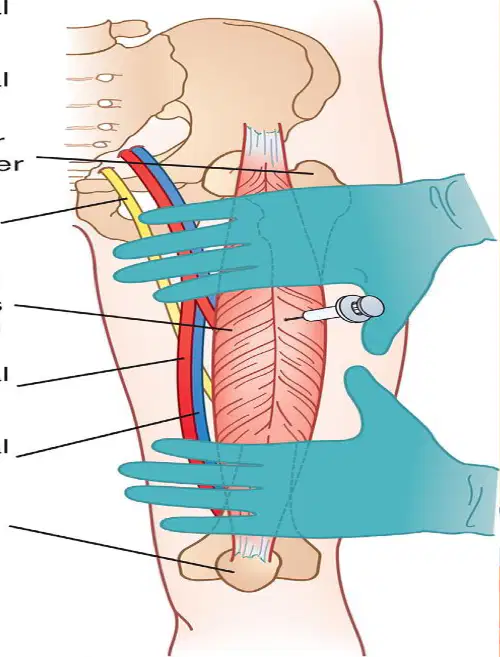
Why is it important to identify the femoral artery and vein before giving an intramuscular injection in the thigh?
To avoid accidental injection into a blood vessel
To increase the speed of drug absorption
To reduce pain during injection
To ensure the drug reaches the bone
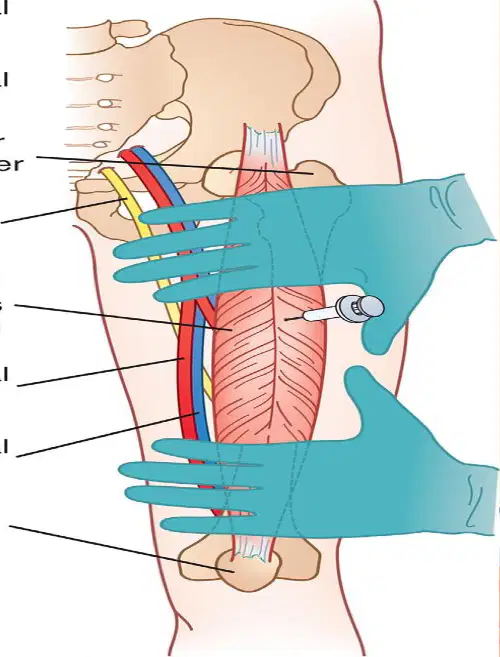
A nurse is preparing to give an intramuscular injection in the thigh. Which structure should they avoid to prevent nerve injury?
Sciatic nerve
Femoral artery
Patella
Greater trochanter

Which muscle is commonly targeted for intramuscular injections in the gluteal region?
Gluteus medius
Biceps femoris
Rectus femoris
Sartorius

Which anatomical landmark is used to help locate the site for an intramuscular injection in the gluteal region?
Iliac crest
Patella
Tibial tuberosity
Acromion process

At what angle should the needle be inserted for an intramuscular injection according to the diagram?
45° to 90°
10° to 30°
100° to 120°
0° to 15°

Explain why the gluteus medius is preferred over other muscles for intramuscular injections in the gluteal region.
It avoids major nerves and blood vessels, reducing the risk of injury.
It is the largest muscle in the body.
It is closer to the skin surface.
It is less painful than other muscles.
Which muscle is most often used for intramuscular injections due to its easy access?
Deltoid muscle
Gluteus maximus
Biceps brachii
Trapezius muscle
For infants, when is the deltoid muscle recommended as an intramuscular injection site?
For large volumes and irritating drugs
For small volumes, non-irritating and quickly absorbed drugs
For any type of medication
Only for vaccines
What is the maximum volume of medication recommended for intramuscular injection in the deltoid muscle of adults?
5 mL or less
2 mL or less
1 mL or less
10 mL or less
Which of the following is a correct procedure for locating the deltoid muscle landmark for intramuscular injection?
Palpate the top of the shoulder and measure down 2-3 fingerbreadths
Palpate the elbow and measure up 5 fingerbreadths
Palpate the wrist and measure up 1 fingerbreadth
Palpate the knee and measure down 2 fingerbreadths
Explain why the deltoid muscle is preferred for intramuscular injections in clinical practice. (DoK Level 2)
It is the largest muscle in the body
It is most often used due to easy access
It is the least vascularized muscle
It is located near the heart
A nurse needs to administer a non-irritating medication to an adult patient via intramuscular injection. What considerations should the nurse keep in mind regarding the site and volume? (DoK Level 2)
Use the deltoid muscle and limit the volume to 1 mL or less
Use the gluteus maximus and limit the volume to 5 mL or less
Use the biceps brachii and limit the volume to 2 mL or less
Use the trapezius muscle and limit the volume to 10 mL or less
A pediatrician is considering an intramuscular injection for an infant. What factors should be evaluated before choosing the deltoid muscle as the injection site? (DoK Level 3)
The infant's age and ability to tolerate large volumes
The medication's volume, irritation potential, and absorption rate
The color of the medication
The infant's weight and height
A healthcare provider is teaching a student how to locate the deltoid muscle for an intramuscular injection. What steps should the student follow, and why is this landmark important? (DoK Level 3)
Palpate the top of the shoulder, measure down 2-3 fingerbreadths; this ensures accurate placement and avoids injury
Palpate the elbow, measure up 5 fingerbreadths; this ensures the injection is deep enough
Palpate the wrist, measure up 1 fingerbreadth; this avoids hitting a bone
Palpate the knee, measure down 2 fingerbreadths; this ensures the medication is absorbed quickly

Which muscle is commonly targeted for intramuscular injections in the upper arm?
Deltoid muscle
Biceps brachii
Triceps brachii
Pectoralis major

Which bone is located directly below the deltoid muscle in the diagram?
Humerus
Clavicle
Scapula
Radius

What is the function of the acromion process in relation to intramuscular injection sites?
It serves as a landmark for locating the deltoid muscle
It is the site of injection
It protects the radial nerve
It is a blood vessel

Why is it important to avoid the radial nerve when administering an intramuscular injection in the upper arm?
To prevent nerve damage and possible loss of arm function
To increase absorption of medication
To avoid hitting a bone
To reduce pain at the injection site
Which of the following medications is commonly administered using the Z-Track method?
Iron
Acetaminophen
Amoxicillin
Insulin
What is the primary purpose of the Z-Track method when administering medication?
To keep the medication from leaking out
To reduce pain during injection
To increase the speed of absorption
To prevent allergic reactions
Which muscle sites MUST be used for the Z-Track method?
Ventrogluteal or vastus lateralis
Deltoid or biceps brachii
Trapezius or pectoralis major
Gluteus maximus or rectus femoris
Why is 0.5mL of air added to the syringe in the Z-Track method?
To ensure the drug will clear the syringe
To reduce pain during injection
To dilute the medication
To prevent infection
Which step is performed immediately before injecting the medication in the Z-Track method?
Pull the patient’s skin about 1 inch to one side
Remove the needle
Wait 10 seconds
Add medication to the syringe
After injecting the medication using the Z-Track method, what should be done before removing the needle?
Wait 10 seconds
Massage the injection site
Apply a bandage
Pull the skin back to its normal position
Explain why the Z-Track method is preferred for medications that can irritate or stain the skin. Use evidence from the technique to support your answer.
It keeps the medication from leaking out and helps seal it in the muscle, preventing irritation or staining of the skin.
It allows for faster absorption, reducing the risk of irritation.
It uses a smaller needle, minimizing skin damage.
It requires less medication, lowering the chance of staining.
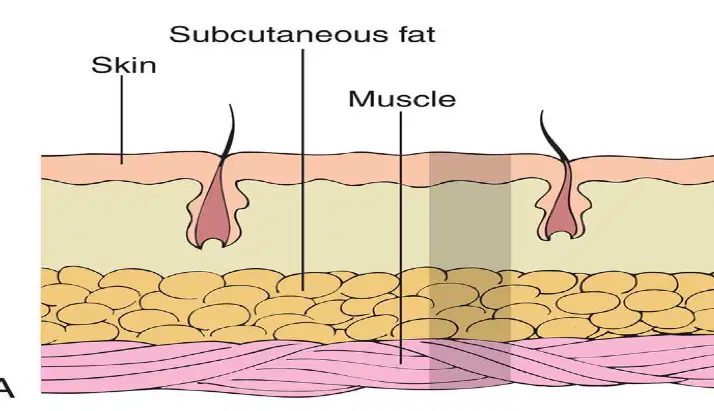
Which layer of tissue is located directly beneath the skin as shown in the diagram?
Muscle
Subcutaneous fat
Bone
Cartilage
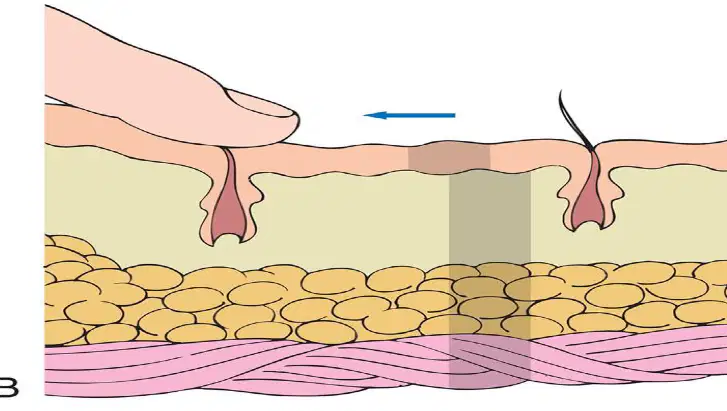
What is the primary purpose of pinching the skin before administering an injection, as illustrated in the diagram?
To reduce pain
To avoid injecting into muscle
To increase blood flow
To sterilize the area

Based on the sequence shown in the diagram, what would be the consequence of not pinching the skin before the injection?
The medication may be injected into the muscle instead of the subcutaneous fat
The injection will be more effective
The skin will heal faster
The needle will be less likely to penetrate the skin

