
 Worksheets
Module 6 recap
Total questions: 84
Worksheet time: 3hrs 48mins
What is the primary enzyme involved in gene expression in prokaryotes?
RNA polymerase
Ligase
DNA helicase
ATP synthase
Explain the process of transcription in prokaryotes.
Ribosomes bind to the DNA and synthesize a complementary RNA strand
RNA polymerase binds to the promoter region of the DNA and synthesizes a complementary RNA strand.
DNA polymerase binds to the promoter region of the DNA and synthesizes a complementary RNA strand
RNA polymerase binds to the terminator region of the DNA and stops transcription
What is the role of the promoter region in gene expression in prokaryotes?
Regulating protein synthesis
Replicating DNA
Packaging the DNA into chromosomes
Initiating transcription of a gene
Describe the structure and function of the lac operon in prokaryotic gene expression.
The lac operon is only active in the presence of lactose in eukaryotic cells.
The lac operon is a set of genes that encode proteins involved in the metabolism of lactose in prokaryotic cells.
The lac operon is a set of genes that encode proteins involved in the metabolism of proteins in prokaryotic cells.
The lac operon is involved in the metabolism of glucose in eukaryotic cells.
How does the lac repressor protein regulate gene expression in prokaryotes?
By promoting the binding of RNA polymerase to the promoter region
By binding to the operator region and preventing RNA polymerase from transcribing the genes
By degrading the mRNA after transcription
By enhancing the activity of RNA polymerase
What is the significance of the operator region in prokaryotic gene expression?
It is the site where the ribosome binds to initiate translation
It is the location where DNA replication occurs
It is the site where the repressor protein binds to control the transcription of the gene.
It is the region where the promoter protein binds to start transcription
Explain the process of translation in prokaryotes.
Carbohydrate synthesis in the cytoplasm using mRNA, rRNA, and ribosomes.
Protein synthesis in the cytoplasm using mRNA, tRNA, and ribosomes.
Lipid synthesis in the cytoplasm using mRNA, tRNA, and ribosomes.
Protein synthesis in the nucleus using DNA, tRNA, and ribosomes.
What are the key differences between gene expression in prokaryotes and eukaryotes?
Prokaryotes have transcription in the nucleus and translation in the cytoplasm, while eukaryotes have transcription and translation occur simultaneously in the cytoplasm.
Prokaryotes have multiple linear chromosomes, while eukaryotes have a single circular chromosome.
Prokaryotes have a single circular chromosome, while eukaryotes have multiple linear chromosomes. Prokaryotes have no introns in their genes, while eukaryotes have introns that need to be spliced out. Prokaryotes have transcription and translation occur simultaneously in the cytoplasm, while eukaryotes have transcription in the nucleus and translation in the cytoplasm.
Prokaryotes have introns in their genes, while eukaryotes have no introns.
Discuss the role of ribosomes in prokaryotic gene expression.
Cell division
Energy production
DNA replication
Protein synthesis
How do mutations affect gene expression in prokaryotes?
Increasing the stability of mRNA
Decreasing the stability of mRNA
Changing the rate of transcription
Altering the sequence of DNA
The homeobox genes code for an area on a protein called.....
Hox domian
Homeiotic domain
Homeodomain
How many long is the sequence of DNA in in a homeobox ?
160 bp
180 bp
60 bp
What does the nucleus break down into during controlled cell death?
Blobs
Blebs
Vesicles
Amino acids
What is the correct term to describe controlled cell death?
Apoptosis
Anaphylaxis
Cytokinesis
How does the addition of methyl groups to histone proteins affect DNA coiling?
Reduces positive charge so DNA loosens
Reduces negative charge so DNA coils more tightly
makes histones more hydrophobic so DNA coils more tightly
What word describes the fusing of DNA introns together?
Polymerisation
mRNA adhesion
Splicing

Red flower color is dominant to white flower color in rose plants. What is the expected results of a cross between two heterozygous rose plants?
100% red
75% red, 25% white
50% red, 50% white
25% red, 75% white
Timothy has attached earlobes like his maternal grandfather. His mother and father have free earlobes, which are dominant. Which statement best explains how Timothy inherited attached earlobes.
He received a recessive allele from each parent
He received a dominant allele from each parent
He received a recessive allele from his mother and a dominant allele from his father
He received a dominant allele from his mother and a recessive allele from his father

Two plants are crossed, and the traits of height and color are assessed in the offspring. The following cross was conducted: TTPP x ttpp
T = dominant allele for height, tall plant
t = recessive allele for height, short plant
P = dominant allele for color, purple
p = recessive allele for color, white
Which of the following choices correctly describes the offspring?
Three quarters of the plants are tall and purple
Three quarters of the plants are short and white
All are short and white
All are tall and purple

Albino individuals lack all pigmentation so that their hair and skin are white. This family tree shows that albinism -
is carried only by females in this family
is a recessive genetic trait
is a sex-linked gene
requires both parents to be albinos
A genetic pedigree showing that only males are affected by a certain disorder in evidence of what type of inheritance?
Dominant
Sex-linked
Recessive
Passive

In 1910, Thomas Morgan discovered traits linked to sex chromosomes in the fruit fly. The Punnett square above shows the cross between red-eyed females and white-eyed males. Fruit flies usually have red eyes. If a female and male offspring from the cross shown above are allowed to mate, what would the offspring probably look like?
2 red-eyed females; 2 white-eyed males
2 red-eyed females; 1 red-eyed male, 1 white-eyed male
1 red-eyed female and 1 white-eyed female; 2 red-eyed males
2 white-eyed females; 1 white-eyed male and 1 red-eyed male
If 98 out of 200 individuals in a population express the recessive phenotype, what percent of the population would you predict to be heterozygous?
70%
30%
42%
49%

Darwin's Finches became separate species due to
Geographic isolation
Temporal Isolation
Behavioral Isolation
Postzygotic Isolation

The term for the formation of new and distinct species over the course of evolution is...
speciation
biological species concept
reproductive barrier
natural selection


What is the purpose of Polymerase Chain Reaction (PCR) in the process of sequencing DNA?
To separate DNA fragments by size
To synthesize copies of template DNA
To change the structure of template DNA
To terminate the elongation of a DNA strand
During PCR, what happens during the Denaturation step?
DNA strands are separated according to size using gel electrophoresis.
Primers form base pairs with the single-stranded template DNA.
DNA polymerase adds new nucleotides to the primer to elongate the new strand.
Hydrogen bonds between bases are broken using high heat to separate DNA strands.

During which PCR step do primers form complementary base pairs with single-stranded template DNA?
Denaturation
Annealing
Extension
Synthesis

DNA has a ___________ charge and will migrate through a gel towards the ___________ electrode.
positive, negative
positive, positive
negative, positive
negative, negative

Larger DNA fragments move through a gel _____________ smaller DNA fragments.
faster than
at the same rate as
slower than

What do dideoxynucleotides do when added to a growing DNA strand during Cycle Sequencing?
They stop the elongation of that strand.
That double the length of that strand.
They shorten the length of the strand.
They denature the strand.

Write the correct sequence that matches this chromatogram.
(a)
Why has next-generation sequencing (NGS) accelerated scientific development?
1 Entire genomes can now be sequenced
2 NGS is much faster and less costly than older methods of DNA sequencing
3 Portable technologies allow sequencing to be done outside of traditional labs
1, 2 and 3
Only 1 and 2
Only 2 and 3
Only 1
In addition to forensic investigations, what are the other uses of DNA profiling?
1 Comparing evolutionary relationships between organisms
2 Identifying genetic relationships e.g. paternity testing
3 Curing genetic diseases
1, 2 and 3
Only 1 and 2
Only 2 and 3
Only 1
What is the function of primers in polymerase chain reaction (PCR)?
To synthesise DNA
To break the hydrogen bonds between DNA strands
To bind to a complementary sequence of DNA and initiate replication
To work with the buffer solution to maintain an optimum pH
What is the source of the DNA polymerase used in polymerase chain reaction (PCR)?
Thermophilic bacteria
Complementary DNA
Human blood serum
Genetically engineered bacterium
If one molecule of DNA goes through 5 PCR cycles in the thermocycler, how many copies of that molecule of DNA will be produced?
16
6
32
64
Some scientists were investigating the frequency of an allele responsible for insecticide resistance in a population of flies.
They obtained DNA samples from a representative group in the population and then carried out PCR to amplify the DNA.
Scientists used the same restriction endonuclease on each sample before undertaking PCR, explain why.
To separate the DNA template strands
To isolate the required gene sequence
To produce smaller DNA fragments
To allow RNA polymerase to bind to the promotor region
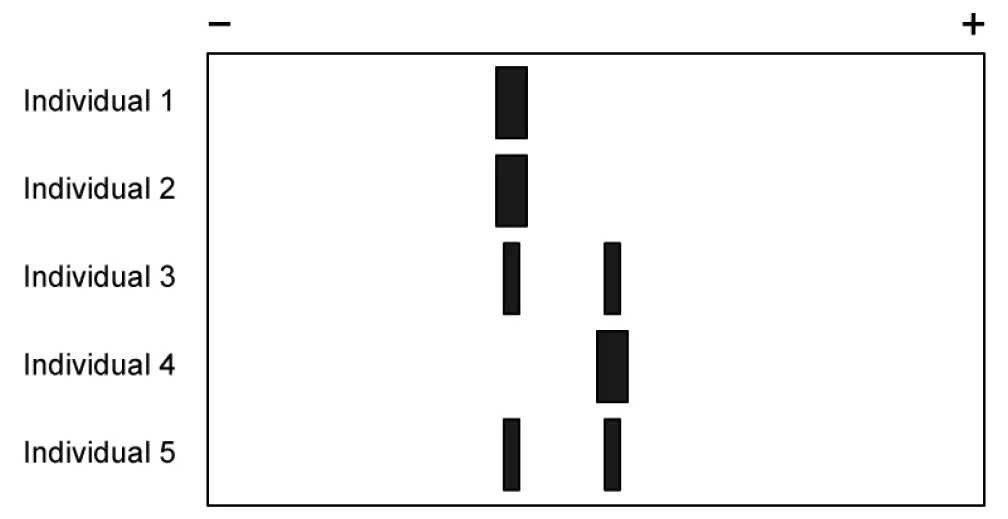
DNA samples were taken from five individuals and analysed using gel electrophoresis to produce a DNA profile. The DNA profile shows the results for a single gene.
What conclusions can be made from the profile shown in the image?
There are equal frequencies of two alleles
There are two alleles and the frequency of one allele is about 75%
There are 3 different alleles for the gene B.
There are three homozygous individuals in the population
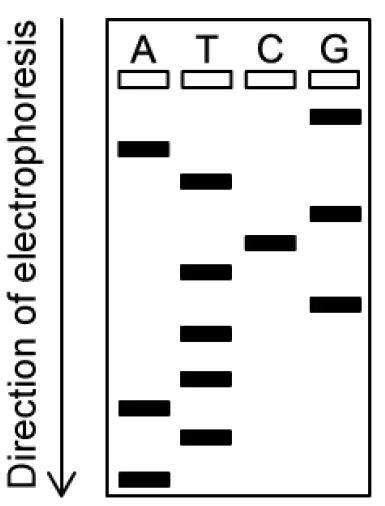
The image below shows the results of DNA sequencing. Which method of sequencing was used to collect these results?
Nanopore technology
Pyrosequencing
High-throughput sequencing
Sanger sequencing
Gene sequencing has a number of uses.
Which of the following is not a use of gene sequencing?
Building phylogenetic trees
The polymerase chain reaction
Identification of antigens to be used in vaccine production
Identifying restriction enzymes for use in genetic engineering
Which of the following is the correct definition of 'synthetic biology'?
Taking a section of DNA from one organism and inserting it into the genome of an organism from a different species.
Redesigning the genome of existing organisms by creating brand new sections of DNA.
Using biological molecules in industry, such as enzymes used in washing powders.
Altering a person's DNA in order to treat or cure diseases.
What is the best explanation for the use of Taq polymerase in PCR?
Using a bacterial enzyme avoids the ethical considerations of having to extract human DNA polymerase
Taq polymerase has a high number of disulphide bridges, making it thermostable
Taq polymerase has a higher affinity for the substrate than other DNA polymerases
Taq polymerase has a higher rate of activity at body temperature than human DNA polymerase
Which statements correctly explain why variable number tandem repeats (VNTRs) are useful for genetic fingerprinting?
1 VNTRs occur in non-coding regions of DNA so are not exposed to selection
2 There are restriction endonuclease sites in the middle of VNTRs
3 The number of VNTRs are inherited by offspring from their parents
4 Fluorescent probes with a similar sequence to a VNTR region can be attached to make them visible under UV light
2 only
1 and 3 only
2 and 4 only
1 and 4 only
Which statements correctly describes germ line gene therapy
Involved altering protein expression in cells.
Involves altering the genome of gametes.
Uses liposomes to deliver the genes required
Treatment might need to be repeated

Which of the following microbes is used in making cheese
Lactobacillus
Lactococcus
Probiotics
Penicillium
Which of the following statements about biotechnology is incorrect?
Biotechnology can be used in producing pharmaceuticals.
Bioremediation involved use of microbes in the controlling pollution.
Biotechnology is the use of whole living organisms in industrial processes.
The term biotechnology was first coined in 1919.

What is the fungi Fusarium venenatum used to produce?
Insulin production
SCP production
Bioremediation
Beer production
Which of these is a disadvantage of using microbes in industrial processes.
Microbes are able to work at ambient temperatures and pressures.
Microbes can be genetically modified easily.
Microbial biomass can have a high proportion of nucleic acids.
There are less ethical considerations when using microbes rather than animals.

Which microbe is usually used to create wine?
Penicillium
Sachharomyces Venenatum
Lactobacillus
Saccharomyces Cerevisiae
Which of the following describes a primary metabolite?
Primary metabolites are produced when the microbe is becoming stressed.
Primary metabolites are commonly collected at the end of the staionary phase or in the decline phase of population growth.
Primary metabolites are produced during normal activities of the microbe cell.
Primary metabolites are collected using batch culture
In which phase of microbial growth does reproduction rate exceed the death rate.
Lag phase
Log phase
Stationary phase
Decline phase

Which part of the fermenter is responsible for ensuring that nutrients and bacteria are continually mixed thoroughly?
A
B
I
D

Which part of the fermenter can also be called the sparger
B
D
E
H
Which method of immobilising enzymes involves the enzyme forming ionic bonds with the support material
Adsorption
Entrapment
Covalent bonding
Membrane separation
Which support material is used in covalently bonding of enzymes?
Sodium Alginate
Cellulose
Clay
Titanium

What type of spreading technique is being shown here?
Seeding
Spreading
Streaking
Swabbing
Agar is normally sterilised in which of the following ways?
Heating in a saucepan to at least 121°C for 15 minutes.
Heating in an autoclave to at least 121°C for 15 minutes.
Heating in the oven to 100°C for 25 minutes.
Heating in an autoclave to at least 100°C for 25 minutes.

Which enzyme is used to make fruit juices smooth?
Lactase
Maltase
Pepsinase
Pectinase
What microbe is genetically modified to produce insulin?
Clostridium spp.
Saccharomyces Cerevisiae
E.Coli
Fusarium Venenatum
Which of the following describes the role of nitrogen-fixing bacteria in the nitrogen cycle? Nitrogen-fixing bacteria convert....
nitrates intro nitrogen gas
ammonia into proteins
nitrogen gas into nitrogen compounds
proteins into nitrates
Organisms require nitrogen to make which of the following?
glucose and starch
lipids and nucleic acids
proteins and nucleic acids
carbohydrates and proteins
Which group of bacteria convert ammonium ions to Nitrite ions?
Azotobacter
Nitrosomonas
Nitrobacter
Which group of bacteria convert nitrite ions to nitrate ions?
Azotobacter
Nitrosomonas
Nitrobacter
Which group of plants contain symbiotic nitrogen fixing bacteria?
Saprobionts
Nitrogen fixing
Leguminous
Which is the correct formula for ammonium ions?
NH3
NH4+
NH3-
NH4
Which of the following species can be found in the root nodules of leguminous plants and is involved in nitrogen-fixation?
Rhizobium
Nitrosomonas
Azotobacter
Salmonella
Which of the following species is NOT a nitrifying bacterial species?
Rhizobium
Nitrosomonas
Nitrobacter
Which is the correct sequence of chemical changes that occurs during nitrification?
NH4+ 🡪 NO2- 🡪 NO3-
NO3- 🡪 NO2- 🡪 NH4+
NH4+ 🡪 NO3- 🡪 NO2-
Which of these is NOT an example of interspecific competition?
Oysters and barnacles competing for settling space on the rocky shore
Goats and sheep in the same paddock competing for grass
Ferns and kawakawa competing for shaded locations in a forest
Stags competing for mates
Which of these are conditions required for two species to compete? (select all that are correct):
Live in the same habitat
Use the same resources
Active at the same time of day
Have different niches
What happens to two competing species that have exactly the same niche?
Both of them will move into their realised niches to avoid competition
One of them will move into its realised niche to avoid competing and the other better competitor will take up its fundamental niche
One of them will go extinct in the local area and the other one will take over the niche
Which of these is a method plants use in contest competition (also called antibiosis)?
Succession
Zonation
Stratification
Allelopathy

According to the graph, what is causing the deer population to decrease
They got sick
The wolf population is decreasing
The wolf population increased
They ran out of food

Predator population lags behind prey population because......
Increase in predators leads to decrease in prey
Increase in predators leads to increase in prey
Increase in predators leads to decrease in producers
Increase in producers leads to increase in prey

The largest number of individuals that an environment can support long term is...
carrying capacity
emigration
immigration
population density

Something that regulates the size of a population is called...
a limiting measure
a limiting factor
carrying capacity
biodiversity

