
 Worksheets
Unit 3 Review - Human Land Use
Total questions: 73
Worksheet time: 36hrs 1mins
Acid rain has a pH LESS than
5
7
8
3
Normal rain water has a pH of about
3.5
5.5
7.5
6.5
What are the two types of acids that are in acid rain?
Iron
sulfuric
nitric
sulfur
Acid rain can damage
Drinking water sources
Aquatic (water) life
Architecture / buildings
All options are correct
Acid rain most directly decreases plant productivity by:
Increasing nitrogen fixation in root nodules
Leaching essential cations such as Ca²⁺, Mg²⁺ and Al+3 from soil.
Enhancing microbial decomposition of organic matter
Raising soil pH above optimal levels
This is primarily due to changes in which lake condition?
Put the steps of acid rain formation in the correct order.
Fossil fuels are burned.
Burning of fossil fuels releases nitrogen oxides and sulfur dioxide.
Oxides combine with water vapor in the atmosphere.
Sulfuric acid and nitric acid are formed.
Acidic rain falls to the ground.

According to this image, the pH of the precipitation in 1994 where we live was...
Less than 4.3
4.5-4.6
4.7-4.8
4.9-5.0
What are the two air pollutants that most often produce acid rain?
Nitrogen Oxides and Sulfur Oxides
Carbon Dioxide and Ozone
Particulate Matter and VOCs
Carbon Monoxide and Smog
What human activity is the primary source of acid rain?
motor vehicles
deforestation
coal powerplants
waste incinerators
Why is normal rain water slightly acidic?
It mixes with NO2 and SO2 in the atmosphere and acidifies.
It mixes with oxygen in the atmosphere and acidifies
It mixes with carbon dioxide in the atmosphere to form carbonic acid.
The original source that the rain water evaporated from was acidic.
Acid rain is the result of water combining in the atmosphere with sulfur oxides to form sulfuric acid. Which of the following might occur in a region that has acid rain?
Lakes have a lower pH than normal
Plants Die
Rocks weather/erode (break down)
All of the Above

What type of weathering is it when acid rain breaks down and changes the rock.
chemical weathering
physical or mechanical weathering
erosion
A(n) ______ is a substance with a pH less than 7.
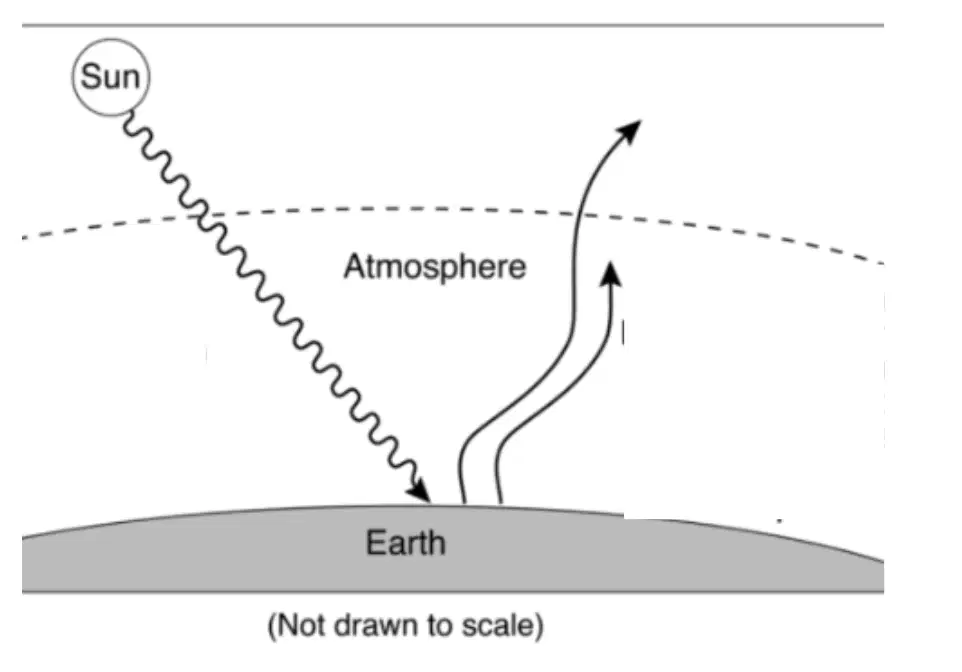
Which radiation source, wavelength, and type is correctly matched?
Sun, long-wave, visible
Earth, short-wave, visible
Sun, short-wave, infrared
Earth, long-wave, infrared
Which of the following processes would cause carbon to move into the atmosphere?
Decomposition
Photosynthesis
Respiration
Combustion
Ocean Acidification
Which of the following are present in the Earth's atmosphere, but are NOT greenhouse gasses?
O2
H20
N2
CH4
N2O
Carbon diffuses from the atmosphere into the ocean and from the ocean into the atmosphere...
Uplifty
Extraction
Exchange
Combustion
Weathering
The process by which humans remove fossil fuels from the geosphere.
Burial
Extraction
Uplift
Calcification
Erosion
Which of the following processes can remove carbon from the atmosphere?
Respiration
Decomposition
Photosynthesis
Exchange (diffusion)
What type of radiation do greenhouse gases absorb and re-radiate randomly in any direction?
Ultraviolet
Visible
Infrared
Microwave

When a system's carbon output (amount of carbon leaving to the atmosphere) is greater than the carbon input (amount of carbon entering from the atmosphere).
Carbon Cycle
Carbon Sink
Carbon Flow
Carbon Source

When a system's carbon output (amount of carbon leaving to the atmosphere) is less than the carbon input (amount of carbon entering the atmosphere).
Carbon Cycle
Carbon Sink
Carbon Flow
Carbon Source

The process by which atmospheric carbon is stored in different reservoirs so that it does not lead to warming.
Carbon Emissions
Carbon Input
Carbon Sequestration

Process by which dead organisms, waste and other forms of organic matter are broken down by microorganisms and fungi. Carbon dioxide is formed during this process and released into the atmosphere.
Photosynthesis
Decomposition
Respiration
Combustion (Burning)
~1% of Earth's atmosphere
(many other gasses would be part of the correct answers below, but would be very small fractions of 1%)
N2O
Nitrous Oxide
H2O
Water Vapor
O2
Oxygen Gas
N2
Nitrogen Gas
CH4
Methane Gas
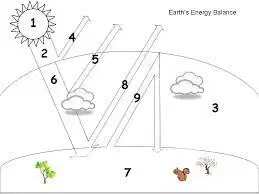
What does number 2 in the diagram represent?
Precipitation falls through Earth's atmosphere
Shortwave electromagnetic radiation travels through space to earth's atmosphere
Heat is radiated away from Earth's surface
Shortwave UV and visible light is absorbed at Earth's surface
What does number 4 in the diagram represent?
Some electromagnetic radiation is reflected off Earth's atmosphere
Shortwave electromagnetic radiation travels through space to earth
Heat is radiated away from Earth's surface
Some electromagnetic radiation is reflected off clounds
What does number 5 in the diagram represent?
Some electromagnetic radiation is reflected off Earth's atmosphere
Shortwave electromagnetic radiation travels through space to earth
Heat is radiated away from Earth's surface
Some electromagnetic radiation is reflected off clounds
What does number 6 in the diagram represent?
Some electromagnetic radiation is reflected off Earth's atmosphere
Shortwave electromagnetic radiation travels through space to earth
Heat is radiated away from Earth's surface
About 50% of incoming shortwave solar radiation makes it to Earth's surface
What does number 8 in the diagram represent?
About 30% of the shortwave electromagnetic radiation that reaches Earth's surface is reflected off Earth's surface
Shortwave electromagnetic radiation travels through space to earth
Infrared radiation (heat) is radiated away from Earth's surface
About 50% of incoming shortwave solar radiation makes it to Earth's surface
What does number 8 in the diagram represent?
About 30% of the shortwave electromagnetic radiation that reaches Earth's surface is reflected off Earth's surface and goes back out to space
Shortwave electromagnetic radiation travels through space to earth
Infrared radiation (heat) is radiated away from Earth's surface
About 50% of incoming shortwave solar radiation makes it to Earth's surface
What does number 9 in the diagram represent?
(Hint: 2 answers!!!)
About 30% of the shortwave electromagnetic radiation that reaches Earth's surface is reflected off Earth's surface and goes back out to space
About 60% of the shortwave electromagnetic radiation that reaches Earth's surface is absorbed and reradiated as longwave infrared radiation (heat)
Oxygen absorbs some energy and re-radiate part of it back to the Earth
About 50% of incoming shortwave solar radiation makes it to Earth's surface
Greenhouse gasses in the atmosphere absorb and reradiate heat from Earth's surface, trapping it in the atmosphere
6O2 + C6H12O6 -> 6CO2 + 6H2O + ATP
6O2 + C6H12O6 + ATP -> 6CO2 + 6H2O
6CO2 + 6H2O -> 6O2 + C6H12O6 + ATP
6CO2 + 6H2O + ATP -> 6O2 + C6H12O6
C6H12O6 + 6O2 --> 6CO2 + 6H2O
6H2O + 6CO2 + 6O2 --> C6H12O6 + 6CO2

What is another name for the J-shaped curve
Exponential
Logistic

What is another name for this S-shaped graph?
Exponential
Logistic

The Red dotted line reperesents what?
Carrying Capacity
Average of population
Which of the following is a density-independent factor?
Competition
Predation
Disease
Natural Disaster
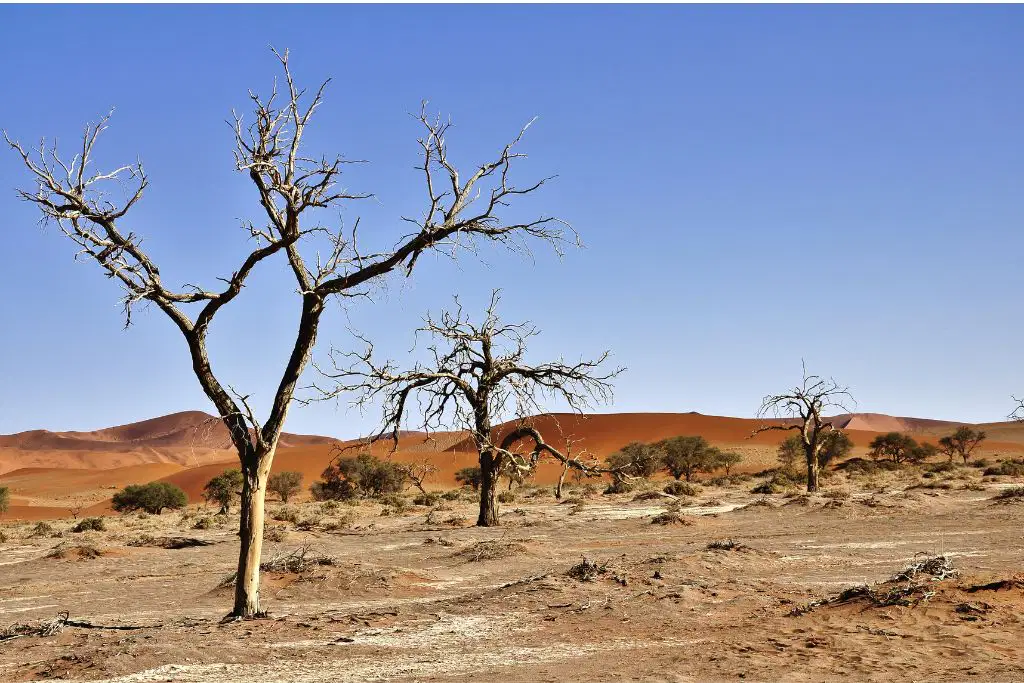
What is desertification (the process of land becoming desert), and how is it connected to poor soil management?
Desertification is the process of fertile land becoming desert, often due to poor soil management
Desertification is the process of deserts turning into forests
Desertification is caused by too much rain
Desertification is unrelated to soil management
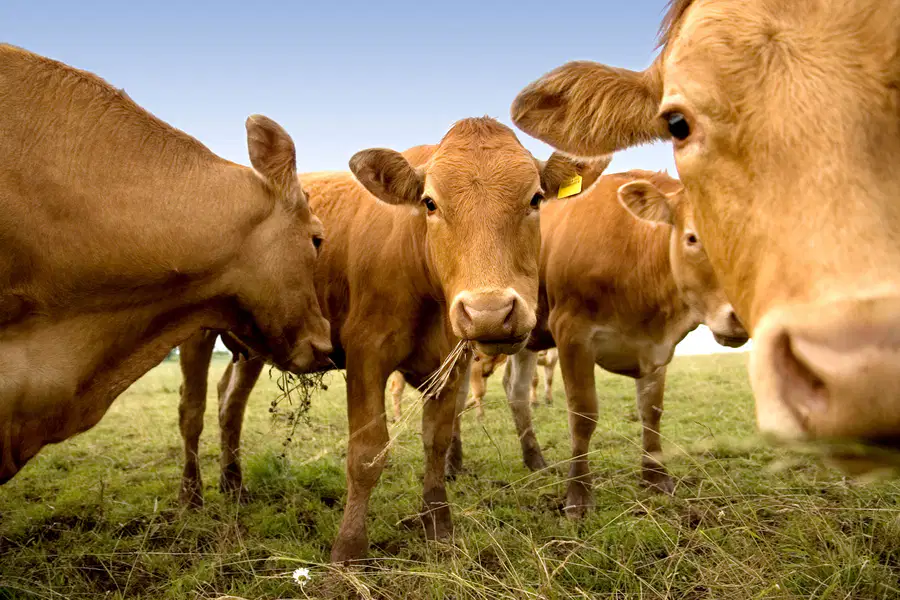
How can changing grazing (letting animals eat grass) practices improve soil health and support regenerative agriculture?
By rotating animals and allowing grass to recover, soil health improves
By keeping animals in one place, soil health improves
By removing all animals from the land, soil health improves
By increasing the number of animals, soil health improves

How can farmers and ranchers (people who raise animals) make a difference in the fight against climate change?
By using regenerative practices (farming methods that improve soil) to reduce carbon emissions
By using more chemical fertilizers
By cutting down more trees
By ignoring soil health

What role do government policies (rules and laws made by the government) play in promoting regenerative agriculture?
They can support sustainable farming through incentives and regulations
They have no impact on agriculture
They only support conventional farming
They discourage sustainable practices

After watching Kiss the Ground, which of the following actions can help protect (take care of) the environment?
Continuing conventional (usual) farming without any changes.
Supporting policies (rules) and food choices that promote (help) soil regeneration (renewal).
Increasing the use of pesticides (chemicals to kill pests) to enhance crop production.
Focusing only on planting non-native (not originally from here) plants to improve biodiversity (variety of living things).

Which of the following human activities can cause an increase in soil erosion?
Mining of metals.
Clearing of land for construction.
Plowing land for farming.
All of these options.

Which of the following is NOT a type of more sustainable farming practices?
Crop Rotation
Contour Plowing
Slash and Burn Farming
Cover Crops
A rapidly growing city in the Pacific Northwest replaces 300 acres of mixed conifer forest with commercial buildings and large parking lots. After several years, hydrologists observe a 25% increase in the average daily streamflow of a nearby creek.
Which mechanism best explains this increase?
arking lots absorb rainfall, reducing infiltration and increasing groundwater absorption
Impermeable surfaces prevent infiltration, causing more rainfall to enter streams as rapid runoff
Commercial development increases evapotranspiration due to heat absorption
Forest removal causes the water table to rise, feeding streams directly
A suburban town in Colorado replaces grasslands with low-density housing and wide asphalt roads. One year later, water quality tests show higher levels of nutrients and heavy metals in local streams.
What process most likely caused this change?
Increased infiltration filtering pollutants before reaching streams
Increased runoff transporting contaminants from roads and lawns into waterways
Decreased fertilizer use due to reduced agricultural land
Higher groundwater recharge diluting contaminants in the watershed
A desert city converts natural scrubland into a large housing development. Scientists note that surface temperatures increased by 3°C and stormwater runoff increased significantly.
Which statement best connects these two observations?
Higher temperatures expand soil pore spaces, improving infiltration
Urban heat increases cloud formation and rainfall, raising runoff
Impermeable surfaces both heat up and prevent water infiltration, increasing runoff volumes
Scrubland plants cool soils, reducing evaporation before development
A Midwestern town expands industrial zones and paves nearby open fields. Soon, the local stream shows erosion, reduced biodiversity, and muddier water.
Which sequence best explains this degradation?
Paved surfaces → increased infiltration → stabilized streambanks → lower biodiversity
Fewer plants → more transpiration → increased soil moisture → more erosion
Paved surfaces → increased runoff velocity → stream bank erosion → habitat loss/potential fragmentation
Industrial development → cooler surface temperatures → slower runoff → sediment buildup
Regenerative farms using cover crops and compost amendments consistently show higher soil carbon levels than conventionally tilled farms.
Which mechanisms explain why these practices increase soil carbon?
Cover crops add root biomass and carbon-rich root exudates to the soil
Compost increases the amount of organic matter entering the soil
Frequent tilling breaks soil aggregates and protects carbon from decomposition
Cover crops increase erosion losses of carbon-rich topsoil
Organic matter is rapidly oxidized when covered by mulch
A farmer eliminates plowing and switches to no-till drilling. After several years, soil carbon measurements increase.
Which processes contribute to this increase?
Reduced disturbance allows soil aggregates to form and protect carbon
Microbial decomposition of organic matter slows because carbon is physically shielded
No-till methods increase carbon release by exposing deeper soil layers
Less carbon is lost to the atmosphere as CO₂ because oxidation decreases
A diversified regenerative pasture contains grasses, legumes, and deep-rooted perennials. Soil carbon increases significantly.
Which mechanisms explain this pattern?
A variety of root depths deposits carbon at multiple soil layers
Diverse plants produce more total biomass and root exudates
Monocultures store carbon more efficiently than diverse plant communities
More plant species support a wider range of soil microbes that stabilize carbon
Diverse systems reduce photosynthesis rates and carbon input
A ranch adopts rotational grazing and notices long-term increases in soil carbon.
Which processes are responsible?
Livestock manure returns carbon-rich organic matter to the soil
Rotational grazing promotes regrowth, increasing plant photosynthesis and root biomass
Continuous grazing maximizes leaf removal and boosts soil carbon
Trampling helps incorporate organic matter into the soil surface
Well-timed rest periods allow larger root systems to form and deposit carbon
A region adopting regenerative agriculture shows both higher soil carbon and better water-holding capacity.
Which mechanisms link these outcomes?
Higher organic matter binds soil particles into aggregates that store carbon
Aggregates trap carbon inside tiny pores where microbes cannot easily break it down
Increased organic matter acts like a sponge, improving water retention and stabilizing carbon
Reduced organic matter speeds water infiltration and carbon leaching
Regenerative soils reduce erosion, preventing carbon-rich topsoil from washing away
A region replaces 2 million km² of grazing land with crop land for human food. Which impact on global caloric production is most consistent with provided land-use efficiency data?
Caloric production will likely decrease because crops require more land per calorie.
Caloric production will likely increase because crops are far more land-efficient than livestock.
Caloric production will remain unchanged because livestock and crops have similar efficiencies.
Caloric production will decrease due to reduced methane emissions.
A country loses 1 million hectares of tropical forest annually. Which consequence most directly reflects the “double impact” of deforestation on atmospheric carbon?
Increased methane emissions from forest animals and more nitrogen oxide pulled from the atmosphere
Loss of carbon sequestration AND release of stored carbon from biomass
Reduced albedo and increased UV absorption
Increased soil nitrogen fixation and nitrification
A city converts 20 km² of wetlands to commercial buildings. Years later, CO₂ emissions continue rising from the soil. What mechanism explains this long-term release?
Ongoing photosynthesis
Anaerobic respiration by bacteria
Aerobic decomposition of formerly waterlogged organic matter
Reduced nitrogen fixation
Which scenario best illustrates urban sprawl as a positive feedback loop?
Increased housing density reduces need for roads.
New suburbs lead to road construction, which encourages even more suburban expansion.
Improved public transit reduces automobile dependence.
Zoning laws prevent development beyond a city boundary.
Tailings from a gold mine are placed near a river. Heavy metals begin appearing in downstream water. Which process is responsible?
Vertical leaching via infiltration
Thermal expansion
Eutrophication
Nitrification
A region experiences an increase in nitrous oxide emissions after adopting new agricultural practices. Which change most likely caused this rise?
Reduced fertilizer application
Increased use of legumes that fix nitrogen naturally
Over-application of synthetic nitrogen fertilizers
Conversion of grazing land to cropland
Cattle ranching expands into a tropical forest. Which combination correctly identifies greenhouse gases released and their sources?
CO₂ from intact vegetation; CH₄ from dry soils
CH₄ from tree decay; N₂O from photosynthesis
CO₂ from biomass loss; CH₄ from enteric fermentation; N₂O from disturbed soils
N₂O from livestock breath; CO₂ from manure pits
A new law requires mining companies to return overburden and regrade land after mining. Which U.S. legislation does this resemble?
Clean Water Act
CERCLA (“Superfund”)
SMCRA (1977)
CITES
A developing nation experiences rapid urban migration. Which related trend is most consistent with global demographic patterns?
Rural population increasing while urban population decreases
Urban population increasing as people move for economic opportunity
Forest gain increasing in tropical regions
Urban density decreasing as cities build upward

