
 Worksheets
Amplifier Quiz
Total questions: 29
Worksheet time: 30mins
Which type of amplifier typically provides higher gain for the same Emitter / Source current in general?
BJT amplifier
MOSFET amplifier
Both give the same gain
None of the above
In a common-source MOSFET amplifier, the input impedance is very high mainly because:
The drain voltage swings widely
The gate is insulated and draws almost no current
The source resistor is large
The MOSFET operates in saturation
Why does adding an unbypassed emitter resistor RE reduce the voltage gain of a CE amplifier?
It increases β
It introduces negative feedback
It reduces RC
It shifts the Q-point up
A MOSFET common drain (source follower) stage is usually used because:
It gives voltage gain > 100
It gives current gain and low output impedance
It gives students nightmares
It converts AC into biryani
What’s the most expensive part of a Bluetooth speaker?
The MOSFET amplifier IC
3.5mm Jack
The speaker + battery
The student's attention span
MOSFET CS amplifier has high gain because:
(gm X Rd) is large
g_m stands for 'Great MOSFET'
Source follower gives it blessings
Why is Common Drain called a “Buffer”?
Its output follows input (gain≈1, low Rout)
It can store values and can act as a memory for digital logic 0 and 1
Because textbooks said so
Because it drains all confusion
The input impedance of a common gate amplifier is very low (~1/gm) , 50 to 500 Ohms) This is useful because:
Antennas like low impedance so power transfers properly
Low impedance can be used as a current source
Its not useful , only common source configuration makes sense
It prevents Wi-Fi from leaking into your brain
When you increase a bias resistor value in base bias CE amplifier by +20%, the gain should:
Voltage Gain should Decrease
Voltage Gain should Increase
Biasing resistors comes under DC analysis, no effect on gain
LT spice will crash
Why does actual gain sometimes differ from RC/re formula?
Transistor re model assumes small input signal, which may not be the case and output is clipping or operating in reduced gm zones.
Real RC resistor is not ideal, heats up once circuit is turned on, changing the output
Small-signal model assumptions breaks every now and than.
Increasing RE from 470 Ω to 1 kΩ usually produces:
Lower gain but more linear, smoother output.
Improved thermal stability.
Less distortion in speech/music signals.
A calmer, more spiritually grounded transistor.
Why is Common Drain called a “Buffer”?
Its output is inverted
Its output follows input (voltage gain≈1, low Rout)
Because textbooks said so
Because it drains all confusion
Why does the output distort when input amplitude rises too much?
Transistor reaches cutoff or saturation limits.
Q-point isn’t centered properly.
The amplifier can't supply the required swing.
The circuit thinks you're trying to play DJ.
Which source resistance gives maximum signal into amplifier input?
50 Ω
600 Ω
5 kΩ
Which stage drives a speaker or long wire?
Common Drain (CD) – low output impedance
Common Source – high output impedance
Common Gate – not meant for driving loads
Hit the wire until signal becomes strong
Which amplifier matches the antenna's 50 Ω?
Common Gate (CG) – low Rin ≈ 1/gm
Common Drain (CD) – high Rin
Common Source (CS) – high Rin
Match by good friendship
If the gate oxide capacitance (Cₒₓ) of a MOSFET increases, what happens to the voltage gain of a common-source amplifier?
Gain increases
Gain decreases
Gain remains unchanged
Depends on bias current
If the threshold voltage (Vₜ) of a MOSFET increases while keeping V_GS constant, what happens to transconductance (gₘ)?
gₘ increases
gₘ decreases
gₘ remains same
Can't determine
If channel length (L) decreases (technology scaling), with W/L ratio kept constant by adjusting W, what happens?
gₘ increases
gₘ decreases
gₘ same, but MOSFET high frequency response improves
Both a and c
If electron mobility (μₙ) increases due to better semiconductor material:
gₘ increases, speed increases
gₘ decreases, speed decreases
Only speed increases
No effect on amplifier
If Early voltage V_A increases:
Output resistance r_o increases, gain increases
r_o decreases, gain decreases
No effect on gain
gₘ increases
If R_D increases in CS amplifier:
No effect
Gain always increases
Gain decreases
DC bias point changes, but gain increases if properly biased
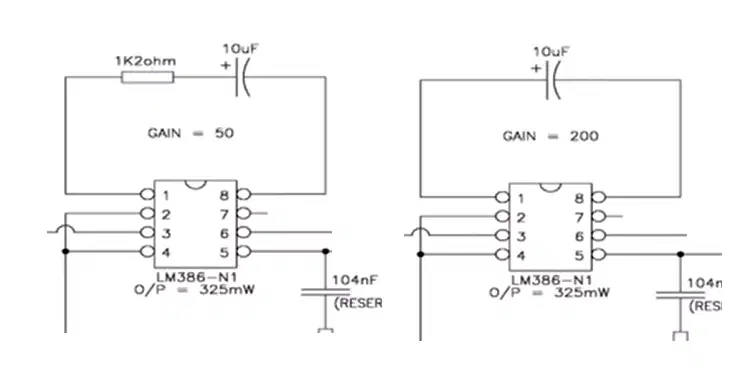
LM 386 is an audio amplifier IC . Its default gain is 20. When you add a capacitor between pins 1 and 8 , the gain increases to 200 as shown in the figure. Whats the most plausible explanation
Capacitor increases the bandwidth
It shifts the DC biasing point such that gain boosts
It bypasses the internal emitter-degeneration resistor
It changes the output load line
Unbypassed R_S in CS amplifier:
Reduces gain, increases linearity, increases input impedance
Increases gain, decreases bandwidth
No effect on gain
Makes it oscillate
Is it possible to build a Bluetooth speaker in ₹209?
Yes, if we use LM386 + ₹70 Bluetooth module + ₹30 speaker + ₹20 battery + ₹20 box
No, Amazon won’t allow it
Yes, if you steal the battery
Yes, but your expectations must be very low
A boy has a small TV antenna that gives a very weak signal.
He wants to connect it to his circuit without the antenna signal dropping.
Which amplifier should he connect first so that the tiny signal doesn’t get loaded?
Common Source (CS) – medium input impedance
Common Drain (CD) – high input impedance, does not load the antenna
Common Gate (CG) – low input impedance
Just hold the antenna higher in the air
The boy now says:
“Okay, the antenna signal is not dropping now… but I want the signal to become bigger!”
Which MOSFET stage gives the highest power gain?
Common Source (CS)
Common Drain (CD)
Common Gate (CG)
Add more antennas
He now wants to send the signal through a long wire to another circuit which takes-in more current.
He says: “My CS amplifier output becomes weak when I connect a long wire.”
Which stage should he use at the output?
Common Source – high output impedance
Common Gate – not meant for driving loads
Common Drain (CD) – low output impedance
None
If your LM386 speaker is too low in volume, what is the FIRST thing you should do?
Bring speaker close to the ear
Add 10 µF across pin 1 & 8
Replace MOSFET with BJT
Throw speaker out of window

