
Font size
 Worksheets
Energy Changes
Total questions: 77
Worksheet time: 2hrs 44mins
How does heat move?
From warmer object to cooler object
From cooler object to warmer object
When particles move, they have --- energy.
Potential
Kinetic
No energy
---- is a measure of the average kinetic energy of particles in an object.
Heat
Temperature
--- is the transfer of thermal energy from a warmer object to a cooler object.
Heat
Temperature
What is collision theory?
Molecules must collide in the correct orientation with enough energy to bond.
Molecules need enough energy to collide and react.
Atoms constantly collide and react.
The minimum energy needed for atoms to react
What is the rate of reaction?
How much energy is needed for a reaction to occur.
The energy required to break a bond.
The time it takes for a reaction to occur.
Collision Theory
Increasing the temperature of your solution will.......
Not affect the rate of reaction.
Speed up the rate of reaction
Slow down the rate of reaction
Decreasing the concentration of a substance will usually........
Slow down the reaction
Speed up the reaction
Have no affect on the reaction
Which has more surface area?
Large chunks of chalk
Cube of sugar
Powdered sugar
Small chunks of sugar
If you shrink the container size that your gas substance is in what will happen?
The reaction rate will stay the same
The reaction rate will speed up
The reaction rate will slow down
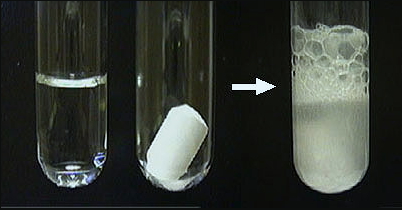
How could we make this reaction happen more quickly?
Decrease the concentration of the acid
crush the chalk to increase the surface area
Put the test tube in an ice bath
A temperature increase causes the particles ......
to slow down
move faster
collide higher
in the right order
How does a catalyst work in speeding up a reaction?
By lowering the activation energy or reaction
by giving them more energy
by making them more available
Which of the following increase the reaction rate?
less surface area
lower temperature
increased concentration
Rank the state os matter from FASTEST to SLOWEST particle speed.
solid, liquid, gas
liquid, solid, gas
gas, liquid, solid
gas, solid, liquid
The higher the temperature a substance has the
more energy it has
less energy it has
What does a catalyst do to speed up a reaction?
It reduces the surface area of the reactants
It increases the surface area of the reactants.
It reduces the required energy for a chemical reaction to occur
It increases the required energy for a chemical reaction to occur
A reactants surface area is increased. What happens?
more collisions occur
the same number of collisions occur
greater collision energy
less collision energy
the same collision energy
A substance that is formed as the result of a chemical reaction.
products
reactants
catalyst
collision
Phase change going from a Gas to a Liquid...
Sublimation
Deposition
Ionization
Condensation
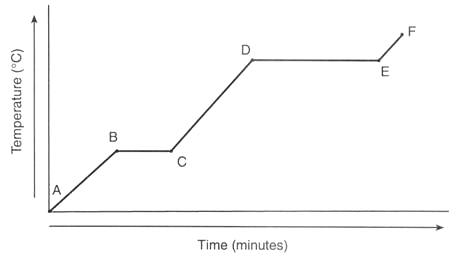
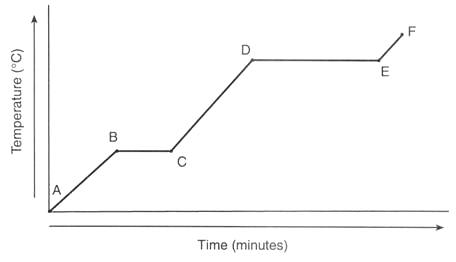
What state/phase is the object likely from points A to B?
Solid
Liquid
Gas
Plasma
What is happening to the particles in the substance between points D and E?
Melting
Freezing
Vaporizing
Sublimating

Where on the graph are phase changes taking place?
1
2
3
4
5
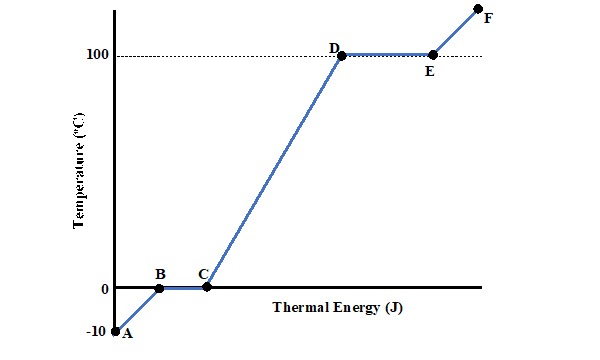
Between which two points is the gas heating up?
A ----> B
B <---- C
C ----> D
D ----> E
E ----> F


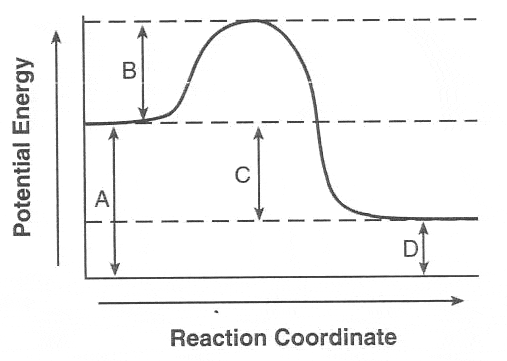
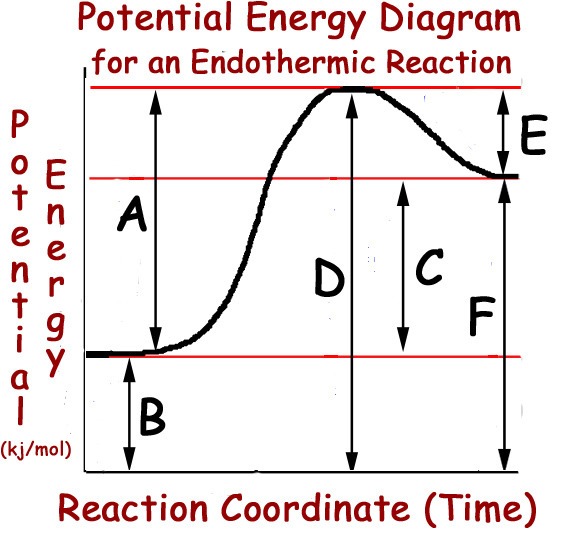
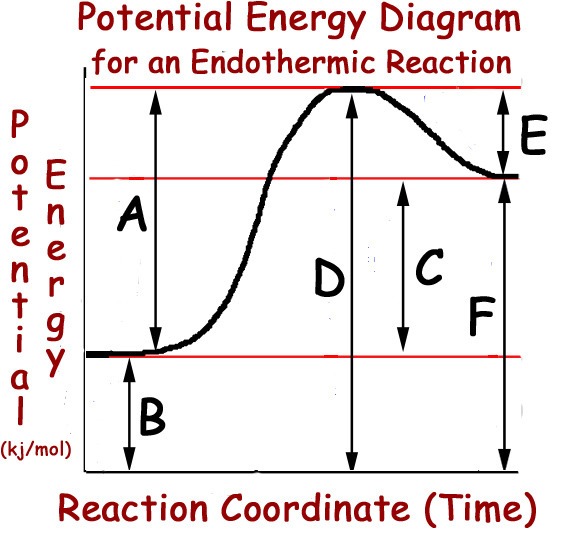
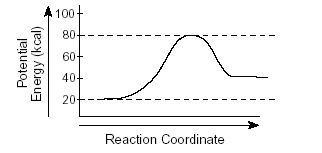
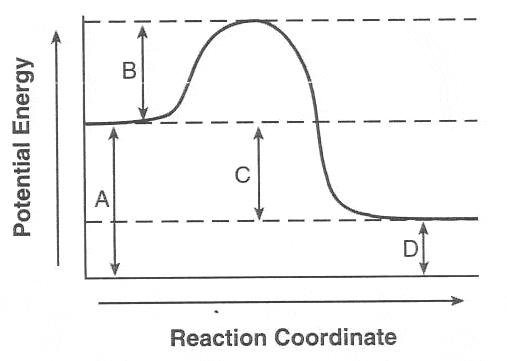
What is the ΔH of this reaction?
40 kJ
20 kJ
80 kJ
-60 kJ
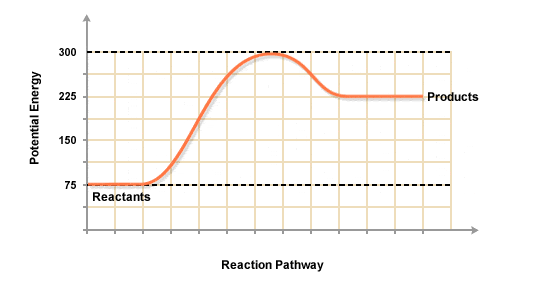
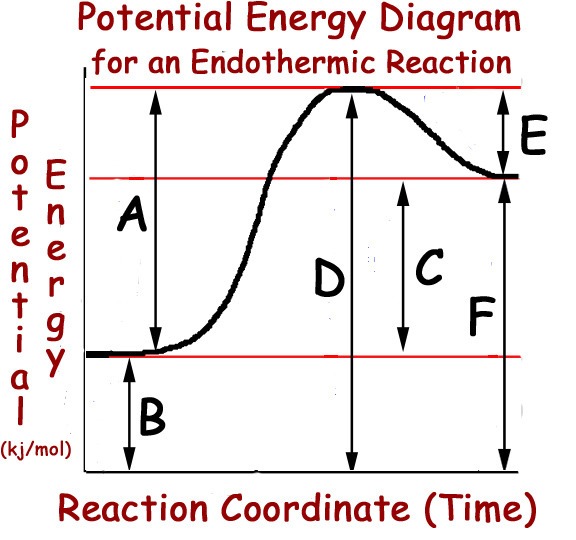
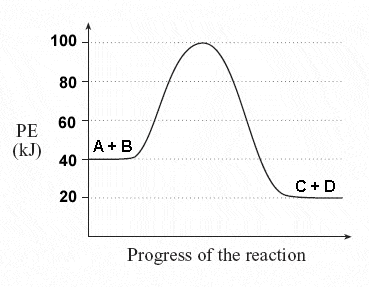
What is the change of the heat of the reaction (ΔH)?
-40 kJ
-20 kJ
100 kJ
60 kJ


What is the change of the heat of the reaction (ΔH)?
100 kJ
-175 kJ
-50 kJ
75 kJ
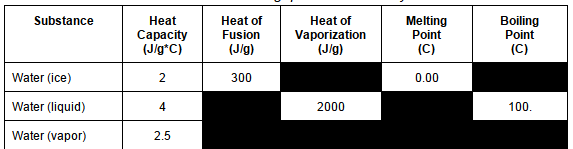
Calculate ΔT when a substance goes from 10*C to 75*C
-65*C
75*C
10*C
65*C
Calculate A 50g sample is heated with 500 joules of energy and has a 10*C temperature change. Calculate it’s specific heat.
1 j/g*C
250000 j/g*C
500 j/g*C
10 j/g*C
4180 j of heat energy are added to change the temperature of water by 10*C. How many grams of water are being heated? cwater=4.18 j/g*C
4.18 j/g*C
10000g
174724g
100g
What heat energy is required to raise the temperature of a 1g sample of mercury (cHg=.16 j/g*C) by 100*C?
16j
.0016j
16000j
625 j

What type of reaction is this?
Endothermic
Exothermic
Allergic

What type of reaction is this?
Endothermic
Exothermic
Allergic
What is meant by HEAT OF REACTION?
Energy change in a chemical reaction
Energy absorbed in a chemical reaction
Energy released in a chemical reaction
Energy required in a chemical reaction
What is the sign of ΔH for endothermic reaction?
positive
negative

Based on the diagram, Heat energy is ___________ to the surrounding.
releases
absorbs

Based on the diagram, which of the following is true?
The reaction is endothermic
Thermometer reading increases
The heat energy is absorbed from surrounding
The reaction between calcium nitrate solution and sodium carbonate solution is endothermic. Which of the following represents this reaction?


The reaction between calcium nitrate solution and sodium carbonate solution is endothermic. Which of the following represents this reaction?

Based on the diagram, total energy content of the products is _________ than total energy of the reactants.
less
more
During a chemical reaction, chemical bonds of the reactants are __________ and new bonds in the products are ___________.
formed, broken
broken, formed
formed, formed
broken, broken

This reaction is an ______________ reaction.
endothermic
exothermic

What is the value of x?
+270 kJ
+200 kJ
–130 kJ
+130 kJ

What is the type the reaction and the activation energy?
Exothermic, 30 kJ
Exothermic, 70 kJ
Endothermic, 30 kJ
Endothermic, 70 kJ
Calculate the heat of formation for the following reaction under standard conditions:
C(diamond) + O2 (g) --> CO2 (g)
-391.62
-395.38
395.38
394.88
What is the change in enthalpy for the following formation reaction?
NaOH(s) + HCl(g) ---> NaCl(s) + H2O(g)
519 kJ
-133.8 kJ
133.8 kJ
-519 kJ
Calculate the heat of reaction of HBr → H+ + Br-. ΔHf Br- = -121 kJ, ΔHf H+ = 0 kJ, ΔHf HBr = -36 kJ.
+157 kJ
+85 kJ
-157 kJ
-85 kJ

