wayground logo

Free Printable Worksheets

Font size

S
M
L
XL
Worksheets

DAY 4 REVIEW - Replication, Protein Synthesis, Mutations, Virus

Total questions: 87

Worksheet time: 3hrs 30mins

Name
Class
Date
1.
DNA is copied during a process called ______________ which results in an identical copy of itself.
a)
Photosynthesis
b)
Transcription
c)
Replication
d)
Translation
2.
Genes contain instructions for assembling _______________.
a)
Nucleosomes
b)
Proteins
c)
Purines
d)
Pyrimidines
3.
Unlike DNA, RNA contains...
a)
a phosphate group
b)
thymine
c)
guanine
d)
uracil
4.
What is produced during transcription?
a)
Protein
b)
tRNA
c)
mRNA
d)
DNA
5.
What happens during the process of translation?
a)
The cell uses information from messenger RNA to produce proteins.
b)
Messenger RNA is made from DNA.
c)
Copies of DNA molecules are made.
d)
Transfer RNA is made from messenger RNA.
6.
DNA has a ______ strand; RNA has a ______ strand.
a)
double/double
b)
double/triple
c)
double/single
d)
single/single
7.
In RNA, the nitrogen base____ replaces ____ that was present in DNA. 
a)
A, U (adenine, uracil)
b)
C, G (cytosine, guanine)
c)
U, T (uracil, thymine)
d)
U, A (uracil, adenine)
8.
What is the transcribed mRNA strand for CATTAA
a)
GUAAUU
b)
GTAATT
c)
AUGGUU
d)
CATTAA
9.
Which type of bond, denoted by the arrows, allows DNA to be readily replicated?
a)
ionic bond
b)
peptide bond
c)
covalent bond
d)
hydrogen bond
10.
Which best describes the shape of a DNA molecule? 
a)
single helix 
b)
double helix
c)
single strand
d)
t-shaped strand
11.
What statement best describes the role of DNA in protein synthesis? 
a)
DNA carries the amino acid to the ribosomes. 
b)
DNA forms the structural parts of the ribosomes.
c)
DNA joins the chains of amino acids to form a protein. 
d)
DNA contains the information for building individual proteins. 
12.
In DNA, Adenine bonds with ______________.
a)
Guanine
b)
Thymine
c)
Cytosine
d)
Adenine
13.
Guanine bonds with ______________.
a)
Adenine
b)
Guanine
c)
Cytosine
d)
Thymine
14.
Which 2 molecules forms the sides (backbone) of the DNA ladder?
a)
deoxyribose and adenine
b)
deoxyribose and a hydrogen bond
c)
sugar and the nucleus
d)
deoxyribose (sugar) and phosphate
15.
What does DNA stand for?
a)
Deoxyribonucleic acid
b)
Denitrogenous acid
c)
Deribonucleic acid
d)
Diribonucleic acid
16.
From which molecules are mRNA molecules transcribed?
a)
tRNA
b)
rRNA
c)
DNA
d)
proteins
17.
The genetic code is always read
a)
3 bases at a time in the same direction.
b)
4 bases at a time in the same direction.
c)
3 bases at a time and the direction varies.
d)
4 bases at a time and the direction varies.
18.

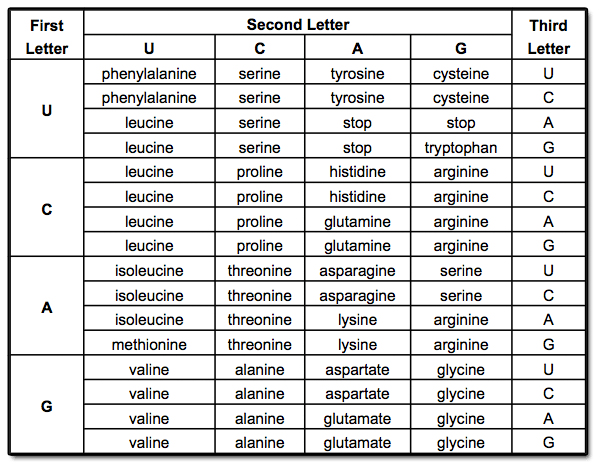
What is the amino acid sequence for the following mRNA strand:


UGG-ACU-CGA-GUG

(a)  

19.

What is the amino acid sequence for the following mRNA strand:


AUU-AAG-UGC-GGG

(a)  

20.

What is the amino acid sequence for the following mRNA strand:


CCA-GAG-UUU-UAG

(a)  

21.

What is the amino acid sequence for the following mRNA strand:


GUA-CAU-UUG-AGA

(a)  

22.

What is the amino acid sequence for the following mRNA strand:


AUG-CAG-UAC-AGC

(a)  

23.

Organize these options into the right categories

Categorize the following

mushrooms

person

plant

bacteria

rock

water

insect

bird

Has DNA
Has No DNA
24.

What monomers make up DNA?

a)

b)

c)

d)

25.

Match the complementary nitrogen bases in DNA.

a)

Adenine

1.

Thymine

b)

Cytosine

2.

Guanine

c)

Guanine

3.

Cytosine

d)

Thymine

4.

Adenine

26.

Reorder the following steps of DNA Replication from start to finish.

a)

The original strand of DNA is in a double helix.

b)

An enzyme breaks the hydrogen bonds between the two nucleic acid strands.

c)

The two nucleic acid strands separate from each other.

d)

New nucleotides are put in place by DNA Polymerase according to the base-pairing rules.

e)

Two strands of identical DNA are made.

1)
2)
3)
4)
5)
27.

What is the purpose of protein synthesis?

a)

to make a copy of DNA

b)

to transcribe DNA into messenger RNA

c)

to produce a protein from the info stored in DNA

d)

to translate mRNA into a protein

28.

Match the following

a)

Made in the nucleus from DNA; makes a transcript of the gene being used

1.

mRNA

b)

Found inside and is part of the ribosome; helps to build the protein

2.

rRNA

c)

carries amino acids to the ribosome

3.

tRNA

29.

What is the purpose of transcription in protein synthesis?

a)

To replicate DNA

b)

To carry amino acids to the ribosome

c)

To copy a segment of DNA into RNA

d)

To obtain the information on how to produce a ribosome

30.

Reorder the following steps of Transcription in Protein Synthesis.

a)

The segment of DNA that needs to be expressed unwinds in the nucleus

b)

An enzyme will attach RNA nucleotides to the exposed bases

c)

The whole gene is transcribed or copied

d)

Messenger RNA will be released and the DNA seals back up

e)

Messenger RNA leaves the nucleus and heads to the ribosome

1)
2)
3)
4)
5)
31.

Label the following diagram of protein synthesis.

32.

The purpose of translation in protein synthesis is

a)

To make amino acids that your body is unable to make.

b)

To use the information in mRNA to assemble a protein

c)

to use tRNA to make a copy of the DNA molecule

d)

to use DNA to help make tRNA

33.

Reorder the following steps of translation in protein synthesis from start to finish.

a)

The messenger RNA bonds with a ribosome

b)

The start codon is matched with a transfer RNA's anticodon

c)

The polypeptide continues to grow by adding more amino acids

d)

The stop codon is reached

e)

The polypeptide or protein is released from the ribosome.

1)
2)
3)
4)
5)
34.

Organize these options into the right categories

Categorize the following

occurs in the nucleus

Occurs in the cytoplasm

ribosome

tRNA

polypeptide

DNA

mRNA

rRNA

Transcription (2 answers)
Used in Both (one qanswer)
Translation (4 answers)
35.
The sequence of DNA below is part of a gene. How many amino acids are coded for by this segment? 
a)
4
b)
8
c)
12
d)
20
36.
Which of the following carries amino acids to the site of protein synthesis? 
a)
mRNA
b)
rRNA
c)
tRNA
d)
nRNA
37.

What is the order for Protein Synthesis?

a)

Transcription -> Translation -> Protein

b)

Translation - > Transcription -> Protein

c)

Protein -> Transcription -> Translation

d)

Translation -> Protein -> Transcription

38.
What is the location in the cell for translation?
a)
nucleus
b)
mitochondria
c)
ribosome
d)
chloroplast
39.

Which sequence could be found in RNA?

a)

ACCTGT

b)

CGCATT

c)

AUGCUU

40.
What amino acid is represented by the codon UUA?
a)
Phenylalanine
b)
Tyrosine
c)
Leucine
d)
Stop codon
41.
The codon CCU codes for what amino acid?
a)
Isoleucine
b)
Stop
c)
Methionine
d)
Proline
42.

The picture below shows the steps of DNA replication beginning with step one and ending with step three.


​Because you are reusing the old, or parent, DNA strand DNA replication is said to be

a)

Semi- Conservative

b)

Semi-discontinuous

c)

Continuous

d)

Fully-Conserveative

43.

The picture below shows an enzyme unwinding and unzipping DNA.

​What is the name of this enzyme?

a)

DNA Helicase

b)

DNA Ligase

c)

DNA polyermase

d)

RNA Polymerase

44.

Okazaki fragments appear on which strand of DNA during DNA replication?

a)

lagging

b)

leading

45.

DNA replication runs from ______' to _____' and is said to be ______________________

a)

5, 3, antiparallel

b)

3, 5, antiparallel

c)

5, 3, parallel

d)

3, 5, parallel

46.
If a strand reads:
3' A A A T T T C 5'
The matching strand would read...
a)
5' T T T A A A G 3'
b)
3' T T T A A A G 5'
c)
5' A A A T T T C 3'
d)
3' U U U A A A G 5'
47.

Reasons that viruses are considered to be nonliving is because

a)

They are not cellular

b)

They cannot reproduce on their own

c)

They do not process energy

d)

all of the above

48.
What do viruses need to reproduce?
a)
they need genetic material
b)
They need a host cell
c)
They need  bacteria
d)
They need insulin
49.

Viruses are...

a)

prokaryotic

b)

eukaryotic

c)

non-living

d)

living

50.

What does a vaccine do?

a)

Gives you immunity from a disease

b)

Gives you a disease

c)

Cures you from a disease

d)

Gives you autism

51.

Which can be treated with antibiotics?

a)

Virus

b)

Bacteria

c)

Mutations

d)

Genetic diseases

52.
Which of the following occurs after a virus attaches to a host cell
a)
The host cell dies
b)
The virus dies
c)
The virus inserts its genetic information into the host cell
d)
the virus eats the cell
53.
Which of the following is one important difference between a virus and a bacterial cell?
a)
a virus is much larger in size than a bacterial cell
b)
a virus always causes more severe disease than a bacterial cell
c)
a virus can never reproduce on its own, but a bacterial cell can
d)
a virus does not contain genetic material, but a bacterial cell does
54.
What is the first step of the virus reproduction cycle?
a)
The viruses genetic material (DNA) starts to take over the functions of the cell
b)
The host cell bursts open, releasing the new viruses
c)
The virus injects its genetic material into the cell
d)
A virus attaches to the surface of a host cell
55.
Antibiotics kill viruses
a)
True
b)
False
56.

What TWO things do all viruses have?

a)

DNA

b)

genetic material

c)

capsid (protein coat)

d)

membrane / envelope

57.

Which of these is NOT a viral disease?

a)

HIV

b)

Influenza

c)

Tetanus

d)

Polio

e)

Chickenpox

58.

Where do new viruses often come from?

a)

Animals

b)

Space

c)

Evil scientists' labs

d)

Vaccines

59.

What virus has been eradicated from nature?

a)

Smallpox

b)

Chicken pox

c)

Polio

d)

HIV

60.

Why is there no cure for AIDS?

a)

AIDS inserts its DNA into our DNA

b)

AIDS destroys your brain

c)

AIDS kills to fast to be cured

d)

AIDS is caused by HIV

61.

This enzyme converts RNA into DNA; HIV uses it to infect our white blood cells

a)

transcriptase

b)

replicase

c)

reverse transcriptase

d)

RNA polymerase

62.
What does a virus have on the inside?
a)
DNA, but never RNA
b)
RNA but never DNA
c)
DNA or RNA
d)
neither DNA or RNA
63.
Viruses are highly specific to the host cells that they can infect.
a)
True
b)
False
64.
What is one way that a lysogenic infection differs from a lytic infection?
a)
A lysogenic virus does not act on bacteria as a lytic virus does.
b)
A lysogenic virus can remain in the host DNA for a longer period without becoming active.
c)
A lysogenic virus contains RNA instead of DNA.
d)
A lysogenic virus directs the production of new viruses right away.
65.
What is a way to become immune to a disease without first having the disease?
a)
antibiotics
b)
Anti-retroviral drugs
c)
Vaccinations
d)
Exposure Therapies
66.

Which is not one of the types of vaccines discussed in class?

a)

Use live, weakened viruses

b)

Use viral proteins

c)

Use virus RNA

d)

all are types of vaccines

67.

What mutation has occurred here?

T-G-A-C-C-A

T-G-A-G-C-A

a)

Substitution

b)

Deletion

c)

Insertion

d)

Frameshift

68.

Which of the following would result in a frameshift mutation?

a)

Insertions only

b)

Substitution only

c)

Deletion only

d)

Insertions and Deletions

69.

DNA molecule segment is : TTACGCAAG

The mutated DNA segment is TTCGCAAG. This is an example of ___ mutation.

a)

Substitution

b)

Deletion

c)

Insertion

d)

Inversion

70.

A mutation is defined as:

a)

A change in the cell's structure

b)

Anything that changes in an embryo

c)

Any change in the physical features of a human

d)

A change in the DNA sequence

71.

ATTTGAGCC- Original

ATTGAGCC - Mutated

The example above is an example of a

a)

Insertion- Frameshift

b)

Deletion- Substitution

c)

Deletion -Frameshift

d)

All of the above

72.

What mutation has occurred here?

T-G-A-C-C-A

T-G-A-G-C-A

a)

Substitution

b)

Deletion

c)

Insertion

d)

Frameshift

73.

Identify the DELETION mutation form the following:

ATG CCA AAT

a)

ATG TCA AAT

b)

ATG CCT AAA T

c)

ATC CA AT

d)

ATG CCA AAT

74.
Are all mutations bad?
a)
Yes
b)
No
75.
In a molecule of double-stranded DNA, the amount of Adenine present is always equal to the amount of
a)
cytosine
b)
guanine
c)
thymine
d)
uracil
76.
Which organelle is DNA usually found in?
a)
cell membrane
b)
vacuole
c)
chloroplast
d)
nucleus
77.
What are the building blocks of proteins called?
a)
DNA
b)
RNA
c)
Ribosomes
d)
Amino Acids
78.
Why are insertion and deletion (frameshift) mutations so harmful?
a)
They change all of the codons from the mutation on down the line, which changes the amino acid sequence
b)
They insert things that an organism doesn't need.
c)
They often delete things that organisms need.
d)
Insertion and deletions are not any more harmful than substitution mutations.
79.
Guanine bonds with ______________.
a)
Adenine
b)
Guanine
c)
Cytosine
d)
Thymine
80.
Which RNA bases would pair with TACGAA in transcription
a)
AUGCUU
b)
ATGCTT
c)
GCATCC
d)
GCAUCC
81.

A substitution mutation occurs when

a)

a base pair is missing from the DNA strand

b)

a base pair is added to the DNA strand

c)

a base pair is replaced with a different base pair

82.

An insertion/additon mutation occurs when

a)

a base pair is missing from the DNA strand

b)

a base pair is added to the DNA strand

c)

a base pair is replaced with a different base pair

83.

A deletion mutation occurs when

a)

a base pair is missing from the DNA strand

b)

a base pair is added to the DNA strand

c)

a base pair is replaced with a different base pair

84.
What type of gene mutation has occurred here? 
T-G-A-C-C-A
T-G-A-C-C-A-A
a)
Base Substitution
b)
Base Deletion
c)
Base Insertion
d)
Frameshift 
85.
DNA molecule segment is : TTACGCAAG
The mutated DNA segment is TTACGCAAC. This is an example of ___ mutation.
a)
Base Substitution
b)
Base Insertion
c)
Base Inversion
d)
Translocation
86.

Use the DNA code provided and fill in the complementary DNA strand. (Answer in ALL CAPS and NO spaces between letters)

(a)  

87.

Which mutation will cause translation to stop?

a)

Mutations 1 and 3 only

b)

Mutation 1 only

c)

Mutation 2 only

d)

Muations 1, 2, 3