
 Worksheets
Fingerprint Collection / Serology
Total questions: 80
Worksheet time: 44mins
Which surface type is best described as hard and non-absorbent for latent print development?
Wood, leather, and fabric
Paper, cardboard, and cloth
Glass, mirrors, and tiles
Soil, sand, and gravel
What treatment is commonly used to develop fingerprints on non-absorbent surfaces?
Dusting with powders
Soaking in solvents
Fuming with iodine
Staining with dyes
Which method is usually preferred for porous surfaces like paper or cloth?
Application of gray powder
Application of black powder
Exposure to chemical vapors
Rinsing with distilled water
Black fingerprint powder is primarily composed of which material and is best used on which surface color?
Iron oxide, metallic surfaces
Soot, dark colored surfaces
Graphite, reflective surfaces
Charcoal, light colored surfaces
Gray fingerprint powder, made of aluminum dust, performs best on which surfaces?
Darker backgrounds
Lighter backgrounds
Porous papers
Wet materials
A technician must choose a method for a latent print on a bathroom mirror. Which choice is most appropriate?
Heat-treat the mirror
Use ninhydrin reagent
Soak with chemical etchant
Apply black or gray powder
You need to visualize a latent print on notebook paper without smearing the fibers. Which approach is most suitable?
Brush with black powder
Wipe with acetone swab
Brush with gray powder
Treat with chemical vapors
Which method makes latent prints visible by heating iodine crystals to create iodine vapor that bonds with body oils?
Cyanoacrylate fuming polymerizing residues
Iodine fuming with vapor bonding to oils
Physical developer reducing silver nitrate
Ninhydrin reacting with amino acids
What is a key limitation of iodine-fumed fingerprints unless they are fixed?
They overdevelop on porous plastics
They smear under infrared light
They turn blue and mask ridges
They are not permanent and will fade
Ninhydrin primarily reacts with which fingerprint residue to form colored prints?
Amino acids in sweat residues
Sugars in environmental dust
Lipids from body oils
Salts deposited from skin
What color are fingerprints typically after treatment with ninhydrin?
Black to gray ridge deposits
Purple to blue ridge impressions
Brown to yellow ridge outlines
Green to teal ridge contours
Under typical conditions, how quickly do many ninhydrin-developed prints begin to appear after application?
In ten to fifteen minutes
Within one to two hours
After three to five days
Around eight to twelve hours
Which step can speed up the development of ninhydrin fingerprints?
Rinsing with dilute starch spray
Cooling the substrate with ice
Adding extra iodine crystals nearby
Applying gentle heat to the surface
Physical developer solutions are primarily based on which compound?
Silver nitrate aqueous chemistry
Iodine sublimation vapors
Copper sulfate complexes
Aluminum oxide suspensions
On which type of evidence is physical developer especially useful?
Hot nonporous plastic packaging
Clean dry glass microscope slides
Freshly painted metallic surfaces
Items that have been wet at some point
In a workflow on porous paper, when is physical developer commonly applied?
Before any ninhydrin application
After ninhydrin fails to reveal prints
Only after cyanoacrylate fuming
Simultaneously with iodine fumes
Why should physical developer generally be used after ninhydrin in a sequence?
It requires purple prints to guide placement
It only reacts with prior blue-colored ridges
It permanently fixes iodine-stained prints first
It can wash away remaining proteins in residues
Which surface type is best suited for superglue fuming when developing latent fingerprints?
Granular surfaces like soil and sand
Porous papers such as notebooks and books
Non-porous materials like tape and metals
Absorbent fabrics like cotton and wool
In a standard superglue fuming procedure, how is the evidence typically treated to allow prints to develop?
Exposed to open sunlight outdoors
Sealed with fumes for several hours
Air dried under a ceiling fan
Rinsed briefly with warm water
RUVIS is primarily used to visualize fingerprints by employing which part of the electromagnetic spectrum?
Ultraviolet wavelengths for latent prints
Infrared radiation for thermal maps
Visible red light for contrast boosting
Microwave bands for deep penetration
A lab must process fingerprints on a metal knife without adding powders or chemicals. Which method should be chosen first, and why?
Ninhydrin, because it reacts with paper cellulose
Dusting, because powders bond to porous fibers
RUVIS, because it reveals prints using ultraviolet
Iodine fuming, because it stains absorbent cloth
A technician wants ridge detail quickly but only has access to a sealed chamber and cyanoacrylate. Which step will most directly influence development success?
Maintaining enclosure of fumes for set hours
Cooling the chamber with ice packs
Shining green lasers through the chamber
Wiping the surface before fuming gently
Which statement best defines blood in the human body?
A fluid mixture of cells, enzymes, proteins, salts
A solution of only water and dissolved gases
A suspension of only red and white cells
A colloid made solely of inorganic minerals
What is the fluid portion of blood called, and about what fraction of total blood does it represent?
Cytosol, about thirty percent
Lymph, about sixty-five percent
Serum, about forty-five percent
Plasma, about fifty-five percent
Which set correctly lists formed elements found within the blood?
Enzymes, hormones, antibodies
Erythrocytes, leukocytes, platelets
Neurons, myocytes, osteocytes
Plasma, serum, electrolytes
Erythrocytes are also known as which type of cell?
Red blood cells
Stem precursor cells
White blood cells
Platelet fragments
What are antigens in the context of blood typing?
Chemical structures on red cell surfaces
Proteins dissolved in blood plasma
Genetic codes inside cell nuclei
Hormones released by immune tissues
The presence of antigen A and antigen B on red blood cells indicates which blood type?
Type O blood
Type B blood
Type A blood
Type AB blood
Which blood type results when neither antigen A nor antigen B is present on red blood cells?
Type AB blood
Type O blood
Type A blood
Type B blood
Which statement about antibodies in blood is correct?
They cause agglutination with incompatible blood
They are identical to the cell surface antigens
They only bind to oxygen like hemoglobin
They form on platelets during clot contraction
A person with antigen A on their red blood cells will typically have which antibodies in their plasma?
Anti-B antibodies
Anti-A antibodies
Both Anti-A and Anti-B
Neither Anti-A nor Anti-B
Which pairing of antigens and antibodies is most consistent with safe transfusion compatibility reasoning?
Type AB has no antibodies, accepts A, B, AB, O
Type A has Anti-A antibodies, accepts only type A
Type B lacks antigens, accepts A and B freely
Type O has A antigens, donates only to type O
Which statement best describes the purpose of a color test in forensic blood analysis?
Confirms human origin with antibodies
Screens if a stain is blood at a scene
Measures blood type using agglutination
Quantifies hemoglobin concentration in vitro
What key observation indicates a positive Kastle-Meyer test when phenolphthalein and hydrogen peroxide are applied to a swabbed stain?
Swab turns pink after a few seconds
Swab emits blue glow in darkness
Swab releases heat instantly
Swab forms visible precipitate ring
Field investigators commonly use Hemastix for what primary reason?
Locating blood via chemiluminescence
Species determination with antisera
Definitive DNA profiling at the lab
Rapid presumptive screening in the field

Luminol and Bluestar share which important property for crime scene work?
Dissolve dried blood for typing
React with blood to produce light
Only detect undiluted fresh blood
Destroy DNA during bright glow
A floor is mopped repeatedly, yet investigators still want to locate traces of blood without harming DNA recovery. Which reagent choice is most appropriate?
Luminol or Bluestar application
Kastle-Meyer phenolphthalein
Benzidine color development
Precipitin antisera tubes
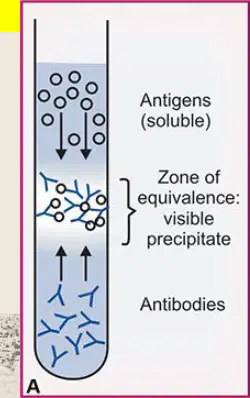
What question does the precipitin test directly answer during forensic analysis?
What ABO blood type is present
How long since the blood was shed
Where on the body the blood came from
Is the blood human or animal in origin
In a precipitin assay, antiserum from an animal neutralizes human blood antigens and forms a visible precipitate band. What is the correct interpretation?
False positive caused by chemiluminescence
Negative result showing no antigen present
Inconclusive due to peroxide interference
Positive reaction indicating animal antibodies binding
Which statement best defines forensic serology in crime investigations?
Measuring angles of impact on hard surfaces
Identifying fingerprints using chemical reagents
Examination and testing of blood from crime scenes
Testing liquids from any laboratory incident
Bloodstain pattern analysis can help determine which aspect of a violent event?
Exact time since the crime occurred
Chemical composition of wall paint
Direction the blood originated from
Brand of weapon used in assault
An examiner observes elongated blood drops with narrow tails on a floor. What inference is most justified?
Blood fell vertically with no lateral motion
Blood originated upward from a ceiling vent
Blood drops traveled in a specific direction of motion
Blood was diluted heavily with cleaning fluids
Which task typically comes after identifying unknown blood samples during an investigation?
Reconstructing the sequence of crime events
Estimating ambient humidity at the scene
Calculating terminal velocity of raindrops
Cataloging regional blood donation records
A series of cast-off arcs on a wall suggests multiple swings occurred. Which quantity can analysts estimate from such patterns?
The minimum number of blows delivered
The exact mass of the striking object
The blood type without testing kits
The victim’s precise pulse rate
You are asked to locate where the assailant likely stood when striking. Which evidence feature should be analyzed first?
Rate of coagulation under room temperature
Convergence point of projected bloodstains
Spread of DNA loci on gel electrophoresis
Color saturation of each individual drop
Which statement best defines passive blood drops in crime scene analysis?
Drops formed solely by gravity without added force
Drops created by high-velocity impacts like gunshots
Drops generated by cast-off from swinging weapons
Drops produced by arterial spurting under pressure
What feature forms at the edges of a passive blood drop when energy pushes blood outward on impact?
Satellite pools forming far away
Spines projecting outward from the rim
Cavitation voids inside the drop
Crystalline ridges after drying
How does increasing the height of fall most directly affect a passive blood drop?
Creates more spines and increases drop size
Removes spines and decreases drop size
Prevents spreading and keeps diameter constant
Produces circular drops with fewer edges
A trail of elongated drops with small tails is found on a floor. What does this most likely indicate?
The source was moving and direction is shown
The source was stationary for a long time
The impact angle was exactly ninety degrees
The drops were projected by high pressure
Investigators compare two passive drops: one from 30 cm and one from 150 cm. Which outcome is most reasonable?
The 30 cm drop exhibits the greatest number of spines
The 150 cm drop is perfectly circular with no spines
The 150 cm drop has more spines and larger size
Both drops have identical size and edge features

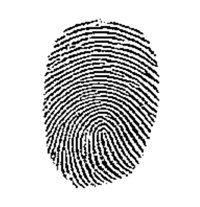
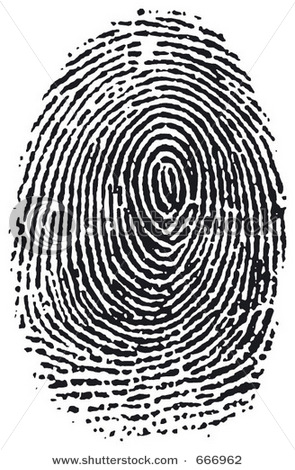
Identify the fingerprint pattern shown.
loop
arch
whorl



The liquid portion of blood is known as plasma.
True
False
Cast off bloodstains occur when blood patterns are produced from the use of a blood instrument.
True
False
The type of blood which contains B antigens is Type A.
False
True
The main difference between impact spatter due to blunt force and impact spatter due to gunshot is the
size of the bloodstains
angle of impact
evidence of foreign material
bubbles in the bloodstain

Which letter in the diagram is the spine?
C
A
B
The common point on a two dimensional surface, over which the directionality of several blood drops can be retraced is called
area or point of convergence
source site
impact site
origin
Mr. Rideb went to college at ______________
Texas A&M University - College Park
Texas A&M University - Commerce
Texas A&M University - Corpus Christi
Texas A&M University - College Station
Hair is what type of evidence?
Class
Individual
unknown
all of the above
DNA is never present on hair
False
True
Is it possible to determine what body part hair evidence came from?
yes
no
Can we tell if a hair was forcibly removed?
Yes
no
Is it possible to determine the species of hair evidence without DNA?
Yes
no
What are the tree stages of hair growth in order from start to end?
Anagen, telogen, and catagen
anagen, catagen, and telogen
telogen, catagen, and anagen
catagen, telogen, and anagen

Which number in the diagram represents the cuticle?
A
D
B
F

Which number in the diagram represents the medulla?
C
A
B
D

Which number in the diagram represents the cortex?
B
A
C
D

What medullary pattern is represented in the diagram?
Fragmented
interupted
continuous
not visible
What are the three cuticle patterns?
Coronal, spinous, imbricate
flowery, circular, triangular
square, round, diamond
What types of DNA can be found on the hair?
Mitochondrial
nuclear
Both mitochondrial and nuclear
none

