
 Worksheets
FINAL BIO REVIEW QUIZ
Total questions: 140
Worksheet time: 2hrs 20mins
A student observes a cloud growing in size and moving across the sky. The student claims the cloud is living because it grows and moves. Which statement best explains why the cloud is non-living?
It does not require energy to move.
It does not maintain homeostasis or reproduce.
It is not made of atoms.
It is larger than a microscopic cell.
A student writes four statements:
1. All cells come from preexisting cells.
2. Mutations can randomly occur in DNA.
3. Cells are the basic units of structure in living things.
4. Mitochondria and chloroplasts duplicate on their own.
Which TWO statements can the student use to describe the cell theory?

The main reason that viruses are considered to be nonliving is that they are not made of ______.
protein
viruses
bacteria
cells
Which of the following characteristics of living organisms explain why humans sweat when they get hot?
Enzymes are (a) that (b) chemical reactions by (c) the activation energy required to start the reaction.
Label the parts of a phospholipid.
Hydrophobic
Hydrophilic
Which macromolecule makes up sugar?
carbohydrates
lipids
proteins
nucleic acids
A student is analyzing the chemical structure of a macromolecule. The structure contains Carbon, Hydrogen, and Oxygen in a 1:2:1 ratio. This molecule is likely a (a) which provides (b) for the cell. If the molecule contained Carbon, Hydrogen, and very little Oxygen in long chains, it would be a (c) .
Collagen is found in skin, hemoglobin carries oxygen in the blood, and lipase digests fats. Although these three molecules have very different functions, what characteristic do they all have in common?
They are all composed of amino acid monomers.
They all contain genetic information in the nucleus.
They provide the primary source of short-term energy.
They are all made of fatty acid chains and glycerol.
Label the enzyme, substrate, and active site.
Substrate
Enzyme
Active Site
Match the molecule to its Category
carbohydrate
Nucleic Acid
Protein
Lipid

Label the enzyme diagram
products
active site
substrate
enzyme
Enzymes are catalysts that speed up chemical reactions. Why is a specific enzyme, like lactase, unable to break down a different sugar, like sucrose?
The enzyme is used up after one reaction and cannot be used again.
The active site of the enzyme changes shape to fit any substrate.
The shape of the enzyme's active site is specific and only fits the shape of lactose.
Enzymes only work at very high temperatures which destroys sucrose.
Match the structures

Phospholipid

Polypeptide Chain

Carbohydrate

DNA

monosaccharide

amino acid

nucleotide

fatty acid
Carbohydrates
Proteins
Nucleic Acids
Lipids
Match the following

Golgi body

mitochondria

centrioles

chloroplast

rough ER
Viruses are often considered non-living because they cannot reproduce on their own. Which cellular structure must a virus hijack from a host cell to produce viral proteins?
Mitochondria
Chloroplasts
Ribosomes
Lysosomes
Which kind of cell contains a nucleus and membrane-bound organelles?
Match the following

virus of bacteria

animal cell

plant cell

bacteria cell

virus
Sequence the path of a protein that is being synthesized to be secreted (sent out) of the cell?
Ribosome
Endoplasmic Reticulum
Golgi Apparatus
Cell Membrane

Which statement describes the movement of oxygen in this diagram?
Oxygen gas requires a transport protein to move through the cell membrane with the concentration gradient
Oxygen gas moves through the cell membrane with the concentration gradient by simple diffusion
Oxygen gas requires energy to move through the cell membrane against the concentration gradient by using active transport
Oxygen gas moves across the cell membrane by the process of osmosis

White blood cells that are able consume bacteria in order to fight or prevent bacterial infection. These cells have many lysosomes that contain enzymes to destroy the engulfed bacterium cell.
Which process are these cells specifically designed to carry out?
Osmosis
Endocytosis
facilitated diffusion
Exocytosis
Which of the following statements about active and passive transport is correct?
Active transport requires cellular energy, but passive transport does not
Passive transport requires cellular energy, but active transport does not
Both passive transport and active transport require cellular energy
Neither passive transport nor active transport requires cellular energy
Match the following:

no change in cell size

cell shrinks

cell swells
Compare the osmosis solutions.

hypertonic

hypotonic

isotonic
Compare the osmosis solutions.
more water enters cell
hypotonic
more water leaves cell
hypertonic
water enters and leaves equally
isotonic
Compare the kinds of passive transport.

osmosis

facilitated diffusion

simple diffusion
A cell reaches a checkpoint and detects DNA damage. The protein p53 is responsible for stopping the cell cycle to allow for repairs or trigger apoptosis if the damage is too severe. If p53 is mutated and cannot function, what is the most likely result?
The cell cycle would pause until p53 is repaired.
The cell would stop dividing and remain in a dormant state.
The cell will divide uncontrollably, leading to the potential formation of cancer.
The cell would activate apoptosis, regardless of the p53 mutation.

A diagram of a parent hydra and its budding offspring is shown.
How would you compare the cells from the parent to the cells of the offspring?
The cells of the offspring will have half the original number of chromosomes as the parent
The cells of the offspring will be genetically identical to the cells of the parent
The cells of the offspring will contain double the genetic information as the cells of the parent
The cells of the offspring will be genetically similar to the cells of the parent with only slight variations
Place mitosis cells in order: (start with interphase)


A parent cell that has eight chromosomes.
After the parent cell undergoes mitosis, how many chromosomes will each daughter cell contain?
2
4
8
16

Cell differentiation is the process of how cells (a) (turn on genes) they need
and (b) (turn off) ones they don’t need
in order to form (c) cells to do a specific job.
During mitosis, one diploid (2n) cell divides into (a) diploid (2n) cells that are genetically (b) .
During meiosis, one diploid (2n) cell divides into (c) haploid (n) cells that are genetically (d) .

A student investigates muscle fatigue by measuring the concentration of lactic acid in the blood of an athlete during a 10-minute exercise session. The data is shown in the graph below.
Based on the trends in the graph, which statement best explains the cellular process occurring between minute 2 and minute 5?
he muscle cells had sufficient oxygen and produced large amounts of ATP through the Krebs cycle.
The muscle cells ran out of glucose and began breaking down lipids for energy.
The muscle cells experienced an oxygen deficit and switched to anaerobic respiration to produce ATP.
The muscle cells stopped producing ATP entirely, causing the lactic acid to accumulate as a waste product.
Label the reactants and products of photosynthesis in the diagram.
glucose
oxygen
carbon dioxide
water
light energy
Label the ATP-ADP Cycle
ATP
phosphate
Cell Work Energy
Food Energy
ADP
Click the high-energy bond in the ATP diagram.
Label the Aerobic Respiration Diagram
2 ATP (Kr.)
2 ATP (Gly.)
34 ATP
ETC
KREBS
GLYCOLYSIS
glucose
Complete the sentences to describe the cause of a trisomy condition. Claim: The condition is the result of a mutation during (a) . Evidence: There is an (b) in the number of chromosomes in the affected person.
Which statement correctly compares the function of the new cells produced by mitosis and meiosis?
Cells from mitosis are used for reproduction; cells from meiosis are used for repair.
Cells from mitosis are used for growth and repair; cells from meiosis are used for reproduction.
Cells from mitosis result in genetic diversity; cells from meiosis result in identical offspring.
Cells from mitosis have half the DNA; cells from meiosis have the full set of DNA.

Study the human karyotype. On which numbered pair of chromosomes would the gene for red-green color blindness (a sex-linked recessive trait) be located?
Pair 1
Pair 7
Pair 21
Pair 23

What best describes the diagram?
Nondisjunction results in a genetic mutation
Disjunction separated sister chromatids at the centromere
Mitosis results in identical daughter cells
Crossing over results in greater genetic variation

What type of mutation is responsible for the disorder represented by the karyotype in the diagram?
A portion of one chromosome has been transferred to a homologous chromosome
A deletion has resulted in part of a chromosome being left off
A translocation has resulted in a portion of one chromosome being added to another chromosome
Nondisjunction has resulted in an extra copy of one chromosome
If the BODY CELLS of an animal contain 14 chromosomes, then the GAMETES of that animal cell would contain how many chromosomes?
2
7
14
28
Which statement best describes the purpose of MEIOSIS in creating gametes?
To reduce the chromosome number and allow for genetically identical offspring
To maintain the chromosome number and allow for genetically identical offspring
To increase the chromosome number and allow for genetically unique offspring
To reduce the chromosome number and allow for genetically unique offspring
The zygote divides by (a) , creating (b) cells with (c) number of chromosomes.
Fertilization is the process in which a (a) sperm and egg cells unite,
forming a (b) zygote.
Label the processes.
Mitosis
Meiosis
Fill in the missing phenotypes
affected male
normal female
normal male
carrier female


What is the genotypic ratio:
BB : Bb : bb
0:2:2
1:2:1
2:0:2
2:2:0
Straight hair (SS) is incompletely dominant to curly hair (S'S"), and wavy hair (SS') is heterozygous.
Mr. and Mrs. Anderson both have wavy hair (SS').
What percentage of their children will also have wavy hair (SS')?
25%
50%
75%
100%
Duchenne Muscular Dystrophy (DMD) is a sex-linked recessive disorder that results in progressive muscle degeneration. A healthy father and a mother who is a carrier for the disorder have a son. What is the percent chance that the son will be affected by Muscular Dystrophy?
0%
25%
50%
100%
Dominant traits (a) so (b) have carriers.
Recessive traits (c) so (d) have carriers.
Sex-linked recessive traits are only found on a sex chromosome - usually the (e) .

A segment of DNA has the sequence TAC - GGG - AGA. Which of the following mutations to this sequence would be considered a silent mutation? (Hint: Transcribe each option to mRNA and check the amino acid).
TAC - GGC - AGA
TAC - GGG - ATC
TAG - GGG - AGA
TAC - GTG - AGA
A student is analyzing two different mutations to a DNA sequence. Original DNA: ATC - GGG - CCC Mutation A: ATC - GAG - CCC is a (a) mutation that affects (b) .
Mutation B: ATC - GGC - CC is a (c) mutation that affects (d) .

A mutation occurs in a DNA strand, changing the mRNA sequence from GAA to GUA. Using the mRNA codon chart, how will this mutation affect the resulting protein?
The resulting protein will remain unchanged (Silent Mutation).
The amino acid Leucine (Leu) will be replaced by Valine (Val).
The amino acid Glutamic Acid (Glu) will be replaced by Valine (Val).
The protein synthesis will stop early (Nonsense Mutation).
Scientists have successfully cloned a rare breed of cow to prevent it from going extinct. Which statement describes the most significant biological risk associated with maintaining a population solely through cloning?
The cloned cows will be larger and more aggressive than the original population.
The population will lack genetic diversity, making it susceptible to disease.
The cloned cows will not be able to produce milk for their offspring.
The population will evolve too rapidly to adapt to the current environment.
A strand of mRNA has the sequence AUG-CCA-UAG. Using the codon chart, what implies the end of the protein chain?
The codon AUG codes for Methionine, which is a start codon.
The codon CCA codes for Proline, which stops the process.
The codon UAG is a stop codon, signaling the ribosome to release the protein.
The ribosome runs out of tRNA.

DNA sequence: TAT-AGT-CTT
Mutation: TAT-AGG-CTT
This mutation is caused by a(n) (a) of a nucleotide. .
This is a (b) mutation.
DNA sequence: TAT-ATG-CTT
Mutation: TAT-ATC-CTT
This mutation is caused by a(n) (a) of a nucleotide. .
This is a (b) mutation.
DNA sequence: TAT-ATG-TCT
Mutation: TAT-ATT-CT
This mutation is caused by a(n) (a) of a nucleotide. .
This is a (b) mutation.
Which characteristic of the DNA structure most directly determines the specific traits of an organism?
The strength of the sugar-phosphate backbone
The sequence of the nitrogenous bases
The number of hydrogen bonds between strands
The double-helix shape of the molecule
During the process of (a) , the DNA code is converted into mRNA in the (b) . Then, during (c) , the mRNA is read by a ribosome to assemble amino acids.
What are TWO CONCERNS of creating transgenic/GMO organisms?
What are THREE BENEFITS of creating transgenic/GMO organisms?
Label Protein Synthesis
Transcription
Translation
Label Protein Synthesis
DNA
mRNA
tRNA
rRNA
In the NUCLEUS, (T) (a) occurs when (b) is produced, copying the DNA code.
The mRNA then leaves the nucleus for the cytoplasm.
In the cytoplasm, (T) (c) occurs when RIBOSOMES ( (d) ) READS the mRNA sequence one codon at a time.
(e) brings the correct amino acid to the RIBOSOME.
The RIBOSOME joins the amino acids together with a PEPTIDE BOND.
Label the diagram.
[transcription and translation go on right side]
polypeptide
Transcription
Translation
DNA
mRNA
(a) carries the DNA code from the nucleus to a ribosome.
(b) carries an amino acid to the ribosome.
The ribosome is made up of (c) and joins amino acids together with a (d) bond.
Label the central dogma diagram.
Transcription
Translation
Replication
Label the Diagram.
chromosome
DNA
Gene
A chromosome is made of one long strand of (a) .
A (b) is a small section of DNA that codes for one protein.
DNA is made of (c) .
The order of nucleotides in DNA has the instructions to make one (d) .
Proteins are made up of (e) .
A (a) is made from of an order of amino acids.
Instructions to make one protein is contained in a (b) .
Genes are found on (c) , which are made up of (d) .
DNA contains the (a) to make proteins.
One long strand of DNA makes up a (b) .
The information to make one protein is contained in one (c) .
In DNA, Adenine only bonds with (a) .
In RNA, Adenine only bonds with (b) .
In both DNA and RNA, Guanine only bonds with (c) .
Place the evolution of chemicals and cells in order.
Inorganic Chemicals
Organic Chemicals
Simple Cells
Complex Cells
The first true cells did not have a nucleus ( (a) ),
was made of only one cell ( (b) ),
did not use oxygen ( (c) ),
and consumed chemicals from its environment ( (d) )
Place the evolution of prokaryote metabolism in order.
Anaerobic Bacteria
Photosynthetic Bacteria
Aerobic Bacteria
(a) consume substances from their environment and release carbon dioxide.
(b) use carbon dioxide to make food and release oxygen.
(c) use oxygen to make ATP energy.
A whale flipper, bird wing, and a monkey arm each have similar structure (numbers and arrangements of bones).
These are called a. (a) structures and are the result of b. (b) evolution
and indicate that whales, birds, and monkeys c. (c) a recent common ancestor.
Body parts that have no use in the a. (a) species but did have use in a. (b) species
are known as c. (c) structures.
(a) provide evidence of evolutionary changes by
showing how the structures of species have (b) over time.

Whale ancestors had legs and lived partially on land. Over millions of years, whales changed over time and adapted to fully aquatic environments. The diagram shows a simplified summary of these changes.
Compared to early whale ancestors,
the body structure of modern whales has (a) ,
and the number of visible limbs has (b)
in adaptation for aquatic movement.
Scientists compared the DNA sequences of four different species.
Which statement best explains how DNA sequence homology supports the idea that the species share a common ancestor?
Species with more similar DNA sequences likely evolved in the same environment.
Species with more similar DNA sequences likely inherited them from a common ancestor.
Species with different DNA sequences cannot be related.
Species that have similar physical features always have identical DNA.

The illustration below shows the results of gel electrophoresis of 4 different deer species.
Which two species of deer are more closely related?
1 and 3
1 and 4
2 and 3
2 and 4
Label the cladogram.
legs
opposable thumbs
development of lungs
presence of fur

The diagram below shows an incomplete cladogram for four organisms. Use the traits to determine the correct order of branching.
Which TWO statements BEST describe the relationships shown in the cladogram?
The trait that separates amphibians from reptiles is the presence of feathers
The trait that separates birds from mammals is the presence of fur and milk production
The trait that separates amphibians from reptiles is the ability to lay eggs on land
The trait that separates mammals from reptiles is the ability to lay eggs
The trait that separates reptiles from birds is the development of lungs

Process by which individuals that are better suited to their environment survive and reproduce most successfully?
Match the following
The "struggle for existence" where organisms must fight for limited resources like food, mates, and territory.
competition
The natural differences in traits (like fur color or beak shape) that exist among individuals within a population.
variation
The core idea of "survival of the fittest," where individuals with the best-suited adaptations for their environment are able to survive, reproduce, and pass on their genes.
unequal reproductive success
The strategy of producing far more offspring than can possibly survive, such as a sea turtle laying 100 eggs.
over production
The overall process by which organisms best adapted to their environment survive and reproduce, causing helpful traits to become more common in a population over time.
natural selection
[Genetic drift = small gene pool = less variation]
After a volcanic eruption created a new island, a population of birds from the mainland colonized it.
This is an example of the (a) effect .
The new population on the island has a (b) gene pool and is (c) likely to survive.
[Genetic drift = small gene pool = less variation]
A severe drought leads to a dramatic population crash for a herd of gazelles with only a few survivors.
Because of the (a) , the new population of gazelles will have a (b) gene pool and will be (c) likely to survive.
If larger mice are favored, which graph represents the change in their (large mice) population over time?

small-med-large
small-med-large

small-med-large
small-med-large

small-med-large
small-med-large

small-med-large
small-med-large
If larger mice are favored and smaller mice are selected against, which graph represents the change in the total mice population over time?
small-med-large

small-med-large
small-med-large

small-med-large
small-med-large

small-med-large
small-med-large
Anoles are a type of lizard that exist as almost 400 different species. An estimated 50 million years ago, populations of Anoles lizards spread to the Caribbean Islands. Many different species of Anoles evolved over time as they adapted to different niches on the islands.
The emergence of different species of anoles is an example of which of the following?
selective breeding
bottleneck effect due to near extinction
divergent evolution
hybridization
The northern spotted owl is a medium-sized, dark brown owl, while the Mexican spotted owl is brown with irregular white and brown spots. The female Mexican spotted owls prefer mating with male Mexican spotted owls though they can mate with the northern spotted owls. A scientist finds that the two species of spotted owls were once the same species.
What kind of isolation has caused this speciation?
geographic isolation
temporal isolation
mechanical isolation
behavioral isolation
A wild horse is driven from its herd.
The horse joins a new herd of wild horses. The wild horse (a) the genetic variation of the new herd.
The wild horse joining the new herd is called (b) through gene flow.
A group of ponies lives in the Chincoteague National Wildlife Reserve in Virginia. The development of longer legs over time would be selected if -
it increased the survival rate of the long-legged ponies
it decreased the rate of reproduction of the long-legged ponies
it prohibited the long-legged ponies from using available food sources
it made the long-legged ponies run more slowly
A commercial farmer sprays his crops with an insecticide to kill whiteflies. Most of the whiteflies are killed, but a few survive.
Which of the following is likely to occur the following year if the farmer uses the same insecticide again?
The insecticide will kill the remaining whiteflies.
The remaining whiteflies will migrate to another field that is not treated with the insecticide.
The insecticide will become more toxic not only to whiteflies but also to other species of insects.
The insecticide will be less effective in killing the surviving whiteflies and their offspring.
Scientists hypothesize that early in Earth's history, inorganic gases in the atmosphere could have reacted with one another to form amino acids and other simple organic compounds. Is this hypothesis supported by evidence?
Yes, the Miller-Urey experiment and similar experiments show that these reactions might have occurred
No, scientists have tried, but failed, to re-create the chemical reactions that would have had to occur.
Yes, scientists have observed similar chemical reactions occurring in the atmospheres of Mars, Venus, and other planets.
No, scientists have not observed these reactions occurring in the atmosphere of Earth or another planet.
What evidence shows that land plants evolved from cyanobacteria?
both carryout cellular respiration
both carry out both asexual and sexual reproduction
both carry out photosynthesis
both are made of cells
In the water cycle, water moves between the atmosphere and the surface of Earth. Which process represents a direct interaction between a biotic factor (living) and an abiotic factor (nonliving)?
Precipitation falling from clouds to the ground.
Water evaporating from the surface of a lake.
Transpiration releasing water vapor from plant leaves.
Water infiltrating the soil to form groundwater.
Match the organism to their trophic level:
producer
1
primary consumer
2
secondary consumer
3
tertiary consumer
4
Match the following terms:
Animals eating plants
herbivory
Animals hunting and eating other animals
predation
Both organisms benefit
mutualism
One organism benefits, other is unaffected
commensalism
One organism benefits, other is harmed
parasitism
Which pair lists one biotic and one abiotic process that add CO₂ to the atmosphere?
Cellular respiration (biotic) and combustion (abiotic)
Photosynthesis (biotic) and volcanic activity (abiotic)
Decomposition (biotic) and ocean absorption (abiotic)
Transpiration (biotic) and evaporation (abiotic)

The graph above shows the growth of a population of bacteria over time. Which statement best explains why the population growth levels off after day 25?
The rate of immigration began to exceed the rate of emigration.
The population reached the carrying capacity of its environment due to limited resources.
The population shifted from logistic growth to exponential growth.
A density-independent factor, such as a temperature drop, destroyed the population.
A severe wildfire burns a large section of Mississippi's De Soto National Forest. The fire burns the trees and plants, but the soil remains intact. Which statement best describes the ecological succession that will follow?
Primary succession will occur, starting with lichens colonizing the bare ground.
Secondary succession will occur, starting with grasses and weeds that can grow in the existing soil.
Primary succession will occur, as all the original organisms were removed by the fire.
Secondary succession will occur, starting with the immediate regrowth of the climax community of oak trees.
In a Mississippi ecosystem, which of the following best describes the climax community that will eventually form after a long period of stability?
A grassland filled with wildflowers and weeds
A dense forest dominated by hardwood trees like oak and maple
A fast-growing pine forest with a thick underbrush of shrubs
A wetland area populated by cattails and sedges
In ecological succession, what role do decomposers play?
They are the first organisms to colonize a barren environment.
They break down dead organic matter, returning nutrients to the soil.
They compete with pioneer species for resources.
They prevent the establishment of new species.
Pland pond succession in order - start with POND
Pond
Grasses
Shrubs
Small Trees
Forest
Place Secondary Succession in Order
Soil
Grasses
Shrubs
Fast-growing Trees
Hardwood Forest
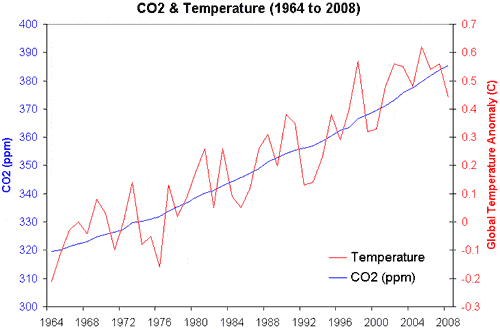
The graph below shows CO2 emissions and temperatures from 1909 to 1949. What conclusion is best supported by the graph?

Analyze the diagram.
What is the role of weathering of rocks in the phosphorus cycle?
It allows phosphorus to cycle between the atmosphere and organisms
It transforms phosphorus into nitrogen for plant uptake
It releases phosphate into the soil where it becomes available to plants
It stores phosphate in the form of fossil fuels for long-term energy use

Analyze the diagram.
Antibiotics in soil can kill bacteria involved in key nitrogen cycle processes.
Which outcome is most likely if nitrogen-fixing bacteria are reduced?
Decreased nitrogen fixation, reducing the amount of usable nitrogen in the soil
Increased nitrogen gas returning to the atmosphere through denitrification
More nitrogen compounds in the soil due to reduced reliance on nitrogen-fixing bacteria
Higher nitrogen fixation, causing excess nitrogen to be released into the atmosphere


What is the most likely effect of removing a top predator, like a bobcat, from a Mississippi forest ecosystem?
Prey populations will decrease, and plant life will thrive.
Prey populations will increase, leading to overgrazing and less plant life.
Other predators will stop hunting to avoid competition.
The ecosystem will remain stable and unaffected.

A lake in Mississippi is stocked with a new species of fish.
Over the first few years, the fish population grows rapidly.
After a while, the growth slows and the population levels off.
What most likely explains this shift from exponential to logistic growth?
The fish ran out of genetic variation.
Predators stopped hunting the fish.
Resources like oxygen and food became limited as the population grew.
The fish evolved to stop growing after a certain number of years.
Label the growth curve.
carrying capacity
fast growth
slow growth
Label the transfer of energy correctly on the energy pyramid.
5 J
50 J
500 J
5,000 J
50,000 J
Click the food chain that has the correct arrows.

Cattle egrets ride on the backs of grazing animals to catch insects exposed while they graze, cows not bothered. This relationship is called (a) .
Hummingbirds feed on nectar from flowers and pollinate them in the process. This relationship is called (b) .
Vine grows on tree to get light, tree doesn't care - (a)
False widow spiders look like deadly black widow spiders - (b)
Chameleon coloration blends in to hide from the flies it catches to eat - (c)
Predation

A nonvenomous king snake's scale coloration resembles a venomous coral snake - (a)
A squirrel's fur resembles the tree it lives in - (b)
Order of ecological organization from least to most complex:
(a) > (b) > (c) > (d) > Biome > Biosphere
Deer, trees, birds, and foxes all living in the same forest. - (a)
A group of deer living in the same forest. - (b)
Deer, trees, birds, foxes, sunlight, soil, water, and temperature in the same forest. - (c)
One deer walking through the forest. - (d)

