
 Worksheets
Biology Midterm 2025
Total questions: 62
Worksheet time: 32mins
The fossil record shows how organisms change over time through millions of years.
What characteristic of life is being represented with the sentence above?
All living things are made up of cells.
All living things have a life cycle; they grow and develop.
All living things evolve as a group to better adapt to changing environments.
All living things reproduce, on their own, creating more individuals.
What is the correct term for when an organism obtains and uses materials and energy?
Stimulus
Homeostasis
Metabolism
Evolution
Match the following macromolecules with their correct monomers.
Nucleotides
Nucleic Acids
Monosaccharides
Carbohydrates
Amino acids
Proteins
Glycerol and fatty acid tails
Lipids
Match the following macromolecules with their correct monomers.
Used for gene expression and to direct the cell’s activities
Nucleic Acids
Used for fast energy
Carbohydrates
Used to build muscle and transport materials in/out of the cell
Proteins
Used for long-term energy and to build cell membranes
Lipids

Which of the above cell specimens is a prokaryotic cell?
Cell 1
Cell 2
Cell 3
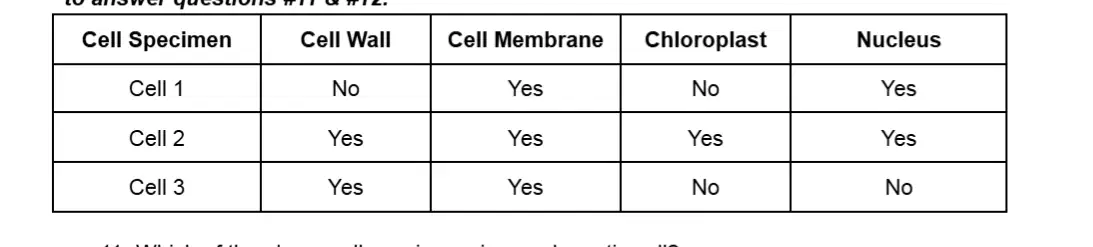
Which of the above cell specimens is a plant cell?
Cell 1
Cell 2
Cell 3
Which of the following organelles are found in every living cell?
Cell membrane and ribosomes
Chloroplasts and mitochondria
Nucleus and cell membrane
Centrioles and Golgi apparatus
Skeletal muscle cells require more energy (ATP) to function compared to other cells in the body. Which of the following organelles would you expect to find in high concentration within muscle cells?
Golgi apparatus
Chloroplasts
Mitochondria
Ribosomes
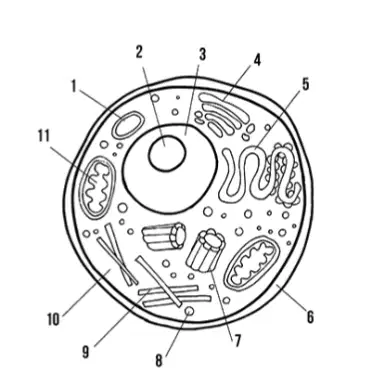
What number in the cell to the right represents the structure that is semi-permeable and allows material to move in and out of the cell?
#1
#4
#6
#10
Which pair of organelles would work together to provide structure and support to an animal cell?
Cell wall and cytoplasm
Golgi apparatus and cytoskeleton
Cytoskeleton and cytoplasm
Rough ER and smooth ER
In eukaryotic cells, where is DNA stored?
nucleus
lysosomes
cytoplasm
ribosome
For questions #18 - #20, match each number with the picture of its missing part that best show how transport is taking place for each type of molecule.
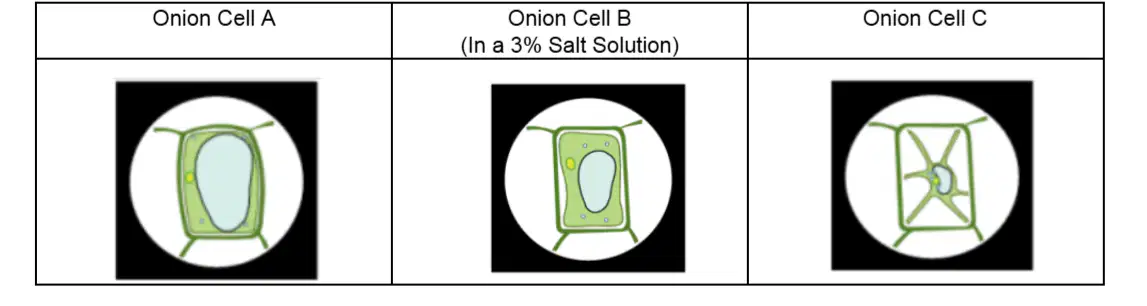
Which of the above cells is placed in an isotonic solution?
Onion Cell A
Onion Cell B
Onion Cell C
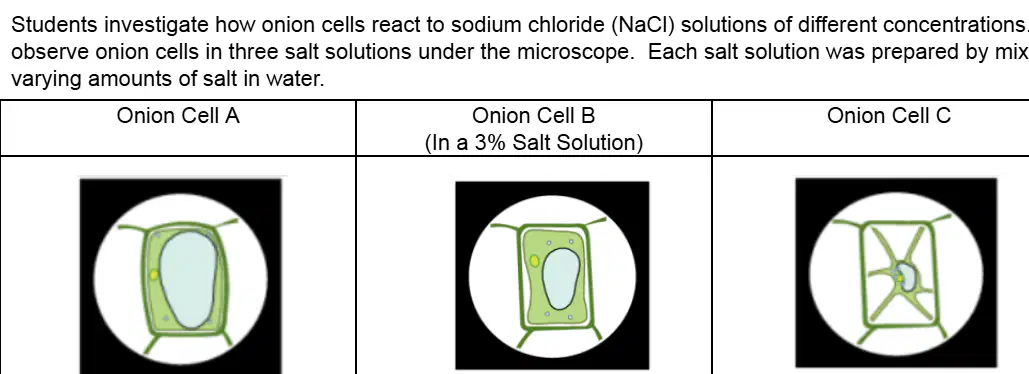
If Onion Cell B were to be placed in a 4% salt solution, what would you expect to happen over time?
Water would move into the cell
Water would move out of the cell
Water would move equally in/out of the cell
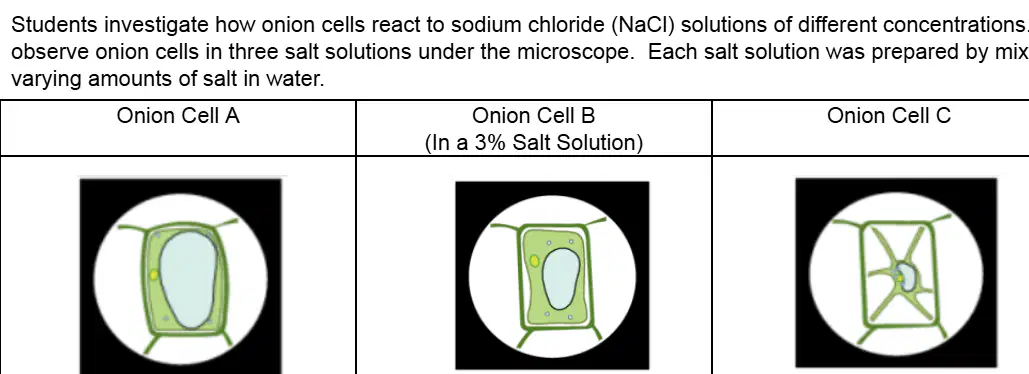
Which type of cellular transport is occurring in these onion cells?
Osmosis
Endocytosis
Active transport
Which statement best describes energy molecules used by the cell?
Glucose molecules are larger and store more energy than ATP molecules
ATP molecules are smaller and store more energy than glucose molecules
1 ATP molecule produces 36 glucose molecules at the end of cellular respiration
Glucose molecules are used to directly power cellular processes, like active transport
Which statement incorrectly describes autotrophs and heterotrophs?
Autotrophs carry out photosynthesis or chemosynthesis.
Autotrophs carry out aerobic cellular respiration.
Heterotrophs carry out photosynthesis or chemosynthesis.
Heterotrophs carry out aerobic cellular respiration.
Which macromolecule forms enzymes?
Proteins
Carbohydrates
Lipids
Nucleic acids
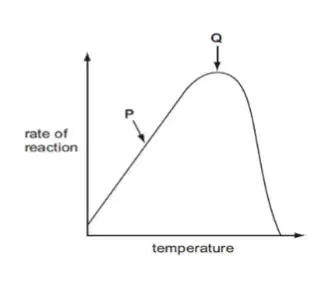
Choose the best explanation for what is happening to the enzyme after point Q on the graph above.
The rate of reaction is increasing as the substrates are no longer able to bind to the active site.
The rate of reaction is increasing as the enzymes begin to denature.
The rate of reaction is decreasing as the substrates begin to bind to the active site.
The rate of reaction is decreasing as the enzymes begin to denature.
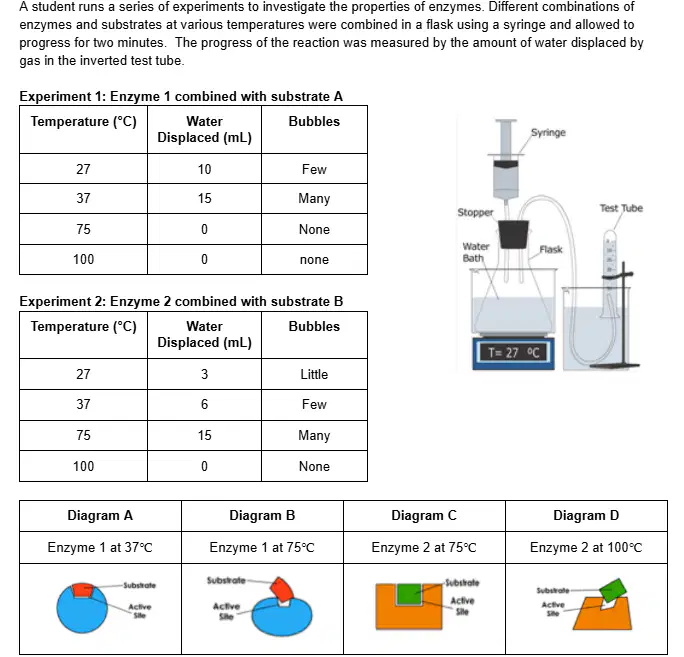
Which of the diagrams represents the relationship between Enzyme 1 and Substrate A at its optimum temperature?
Diagram A
Diagram B
Diagram C
Diagram D
Which of the diagrams illustrates the relationship between Enzyme 2 and Substrate B when the enzyme has become denatured?
Diagram A
Diagram B
Diagram C
Diagram D
When Enzyme 1 was combined with substrate B, no bubbles were produced, no matter the temperature. Which of the following explains these results?
Substrates are stable molecules and are not used up by chemical reactions.
Substrates are not always broken down by their enzymes.
Enzymes are not used up during a chemical reaction
Enzymes are highly specific and only bind and catalyze the reaction of one substrate.
Which of the following is NOT a true statement about ATP?
ATP is made in the mitochondria when glucose is broken during cellular respiration.
ADP stores energy by adding a third phosphate group, creating ATP.
ATP provides energy for basic cellular function.
ATP is discarded by the cell as waste
What happens during photosynthesis?
Heterotrophs consume ATP.
Heterotrophs produce ATP.
Autotrophs consume glucose.
Autotrophs produce glucose.
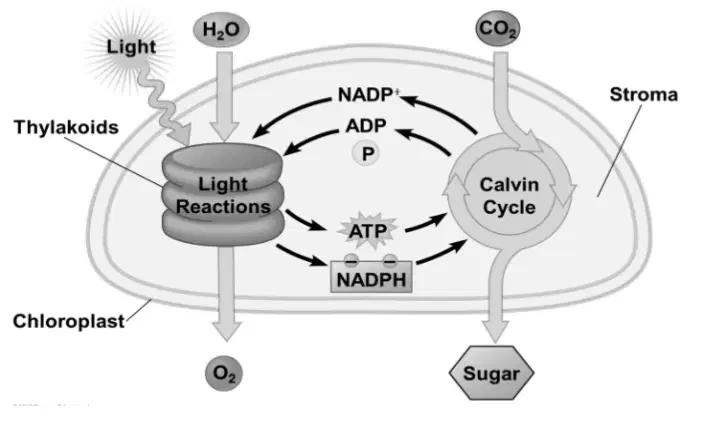
Which chemical shown in the figure to the right is a waste product of photosynthesis?
H2O
carbon dioxide (CO2)
NADP+
Oxygen (O2)

Does chlorophyll a absorb yellow light? How do you know?
It does not absorb yellow light, it reflects it, because the absorbance line is low in the yellow portion of the spectrum.
It absorbs yellow light, because there is no line in the yellow portion of the spectrum.
It does not reflect yellow light, it absorbs it, because its line forms a peak in the yellow portion of the spectrum.
It reflects yellow light, because its line forms a peak in the yellow portion of the spectrum.

If a plant only has carotenoids, what wavelength of light should be given to maximize photosynthesis?
You would want to give it violet light with the wavelength of 400 nm.
You would want to give it red light with the wavelength of 675 nm.
You would want to give it blue light with the wavelength of 475 nm.
You would want to give it violet/blue light with the wavelength of 450 nm.
How is chemosynthesis different from photosynthesis?
Chemosynthesis does not require enzymes
Chemosynthesis can occur in environments without sunlight
Chemosynthesis does not require reactants from outside the cell
Chemosynthesis produces sugars that organisms use as an energy source.
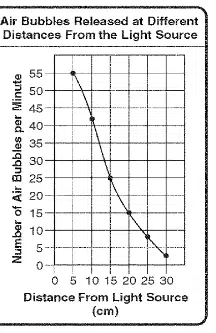
Which of the following statements is true based on the graph to the right?
The number of air bubbles increases as the plant moves away from the light source, indicating an increase in the rate of photosynthesis.
The number of air bubbles decreases as the plant moves away from the light source, indicating a decrease in the rate of photosynthesis.
The number of air bubbles decreases as the plant moves away from the light source, indicating an increase in the rate of photosynthesis.
The number of air bubbles increases as the plant moves away from the light source, indicating a decrease in the rate of photosynthesis.
Which one of the following statements is true in regards to anaerobic cellular respiration and aerobic cellular respiration?
Anaerobic cellular respiration creates more ATP than aerobic cellular respiration.
Anaerobic cellular respiration has three steps while aerobic cellular respiration has two.
Their products are the same, water, carbon dioxide and ATP.
Aerobic cellular respiration creates more ATP than anaerobic cellular respiration.
Cellular respiration is called an aerobic process because it requires __________
light
oxygen
exercise
glucose
What are the reactants in the equation for aerobic cellular respiration?
oxygen and lactic acid
glucose and oxygen
carbon dioxide and water
water and glucose
Why is it important for marathon runners to pace themselves, to better control their breathing?
They need oxygen to carry out lactic acid fermentation.
They don’t want alcohol and carbon dioxide to build up in their cells.
They need oxygen to carry out aerobic cellular respiration.
They need aerobic cellular respiration to get oxygen.
Which statement correctly describes photosynthesis and aerobic cellular respiration?
Photosynthesis traps light energy and aerobic cellular respiration releases energy for cell use.
Photosynthesis releases energy for cell use and aerobic cellular respiration traps light energy.
Photosynthesis creates carbon dioxide and aerobic cellular respiration creates ATP.
Photosynthesis creates ATP and aerobic cellular respiration creates glucose.

What are the products of the process of fermentation from the experiment?
CO₂ and O₂
H₂O and O₂
Ethanol (alcohol) and Pyruvate
Ethanol (alcohol) and CO₂
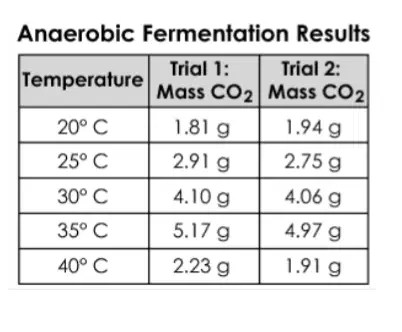
What is the optimal (best) temperature for the process of fermentation from the experiment?
20° C
25° C
30° C
35° C
40° C
Which of the following statements about cell size is correct?
It is easier for cells to move materials in and out of the cell if they are smaller.
Cells with larger volumes require fewer materials and create less waste than smaller cells.
Larger cells have multiple copies of DNA to work with; while smaller cells only have one copy.
Cells that are larger place a lower demand on their DNA than those that are smaller.
Which of the following is a true statement about DNA?
It supercoils (condenses) into chromosomes during prophase.
It provides the instructions for how to create the proteins that an organism makes.
It must be replicated (copied) during S phase before cell division.
All of the above
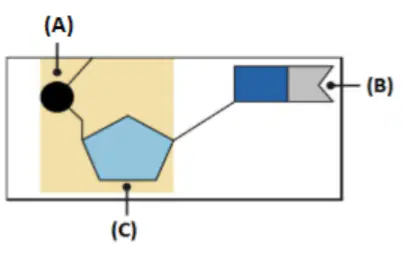
Which statement correctly identifies the image?
It is a picture of a nucleotide, the polymer of DNA
It is a picture of an amino acid, the monomer of DNA
It is a picture of a nucleotide, the monomer of DNA
It is a picture of an amino acid, the polymer of DNA
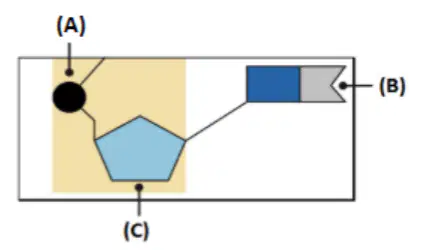
Which of the following statements accurately describes the different parts in the image?
Part (A) is a phosphate group and part (B) is a deoxyribose sugar
Part (A) is a deoxyribose sugar and part (B) is a nitrogenous base
Part (A) is a deoxyribose sugar and part (B) is a phosphate group
Part (A) is a phosphate group and part (B) a nitrogenous base
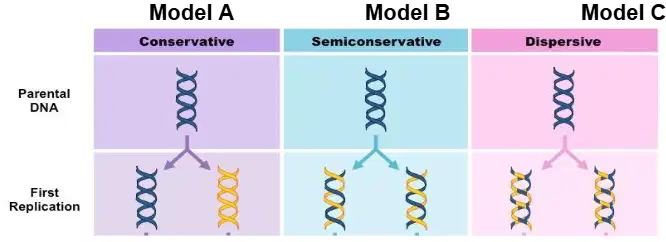
The diagram below shows three DNA molecules undergoing two rounds of DNA replication. The original DNA strands are shown in blue, while newly formed DNA is shown in yellow. Which of the above models accurately demonstrates the semiconservative model of DNA replication?
Model A
Model B
Model C
None of the above is a semi-conservative model.
Choose the correct corresponding DNA complementary strand for the following DNA template strand: TAT ATG CCA TCT ATT CCG
TAT ATG CCA TCT ATT CCG
ATA TAC GGT AGA TAA GGC
AUA AUC GGU AGA UAA GGC
UAU AUG CCA UCU AUU CCG
Which of the following statements about the enzymes involved in DNA replication is NOT correct?
DNA polymerase creates a new strand of DNA during replication.
Helicase creates a new strand of DNA during replication
Helicase separates DNA's two strands by breaking the hydrogen bonds between bases.
DNA polymerase uses old DNA strands as templates to build the new, complementary DNA strands.
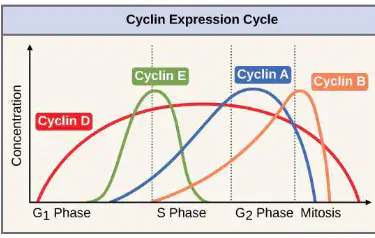
Which two cyclins are present in high concentrations at the beginning of S Phase?
A and B
A and D
D and E
D and B
Which of the statements below is NOT correct concerning mitosis and meiosis?
Growth and development of an embryo is carried out by mitosis.
Preparation of gametes for sexual reproduction is carried out by meiosis.
Sperm and egg that are involved in the self-fertilization of plants are prepared by mitosis.
Binary fission (dividing in two), a type of asexual reproduction, is carried out by mitosis.
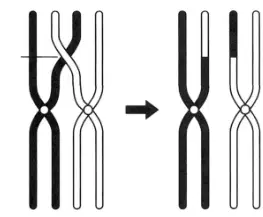
Which of the following statements is true about the picture?
It shows the condensation of nucleotides into chromosomes.
It occurs in prophase of mitosis.
It shows DNA replication.
It shows crossing over that contributes to the genetic variation of the gametes.
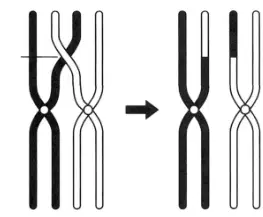
The process shown in the picture happens during…
S phase of interphase
Prophase of mitosis
Prophase I of meiosis I
Prophase II of meiosis II
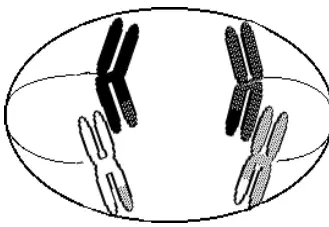
The diagram represents......
Anaphase of mitosis because sister chromatids are separating.
Anaphase I of meiosis because homologous chromosomes are separating.
Anaphase II of meiosis because sister chromatids are separating.
Anaphase of mitosis because homologous chromosomes are separating.
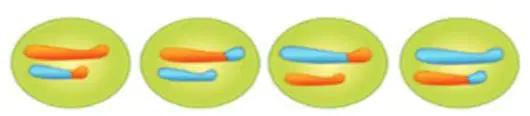
The model represents the final products of…
Mitosis
Meiosis
Interphase
DNA replication
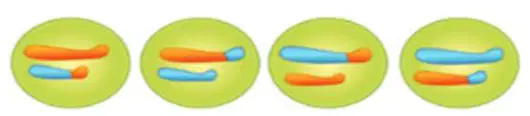
The daughter cells represented in the model…
were made in order to replace cells that were lost or damaged.
were made to participate in fertilization.
are diploid and contain two sets of homologous chromosomes.
can proceed with mitosis when they become too large.
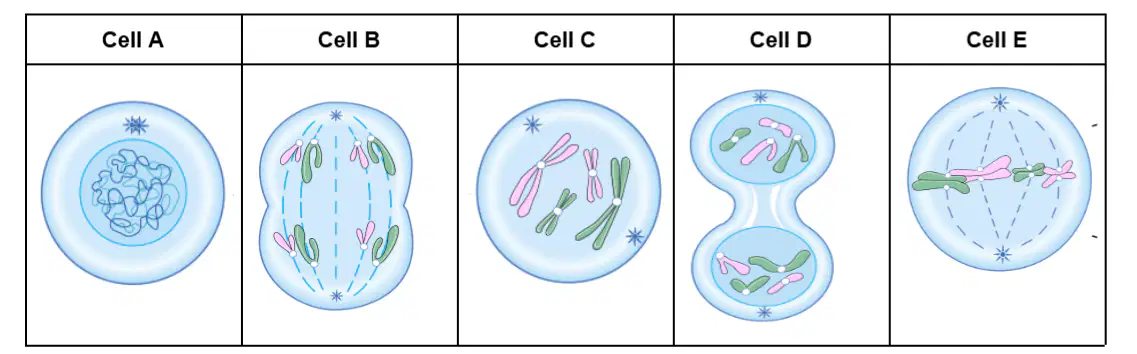
Which of the following correctly lists the events of the cell cycle in order from first to last?
A, B, C, D, E
A, C, E, B, D
A, C, B, E, D
A, B, E, D, C
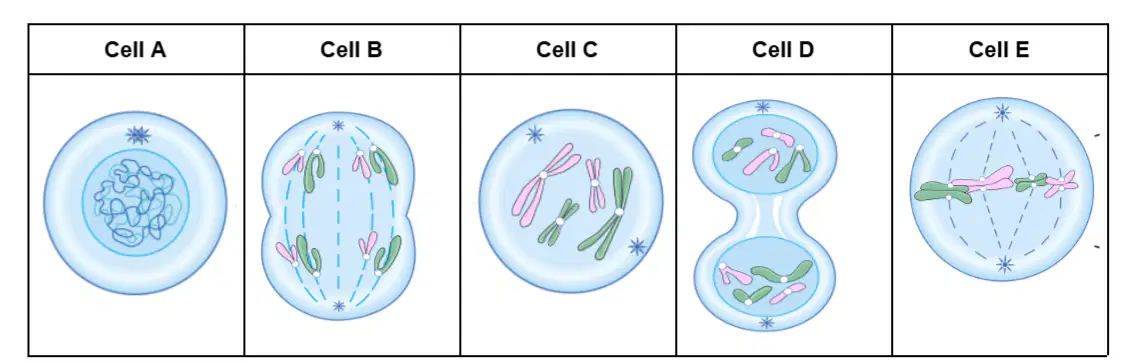
Which of the following does NOT correctly match a phase of mitosis with its diagram from the table?
A = prophase
B = anaphase
D = telophase
E = metaphase
What is the role of mRNA in protein synthesis?
mRNA holds the original instructions to create the protein and is passed on to the offspring
mRNA provides the space for protein formation
mRNA carries the DNA code out of the nucleus
mRNA strands carry the correct amino acids based on their codons
Which statement correctly identifies characteristics of DNA and RNA?
DNA has two strands, ribose sugar, and a uracil base
RNA has two strands, ribose sugar, and a uracil base
DNA has one strand, deoxyribose sugar, and a thymine base
RNA has one strand, ribose sugar, and a uracil base
Which statement correctly describes events that occur during transcription?
DNA is replicated in order to prepare for cell division.
A ribosome unwinds the double helix so that mRNA can be made.
RNA polymerase builds a strand of mRNA using DNA as a template.
tRNA molecules carry amino acids to the ribosome to build an amino acid chain
Which statement correctly describes events that occur during translation?
DNA is replicated in order to prepare for cell division.
A ribosome unwinds the double helix so that mRNA can be made.
RNA polymerase builds a strand of mRNA using DNA as a template.
tRNA molecules carry amino acids to the ribosome to build an amino acid chain

Which mRNA sequence would be produced from this DNA?
UCC-TTC-GTT
ACC-TTG-GTT
CAA-GGT-TGG
ACC-UUG-GUU

Which amino acid sequence would be produced from this DNA?
TGG-AAC-CAA
Gly - Pro - Ser
Thr - Leu - Val
Gln - Gly - Trp
Trp - Asn - Gln

Changing a mRNA codon from AGC to AGA is an example of a ______________ mutation.
Missense mutation
Silent mutation
Nonsense mutation
Frameshift mutation
A __________ mutation causes no change in the amino acid chain.
Silent mutation
Missense mutation
Nonsense mutation
Frameshift mutation
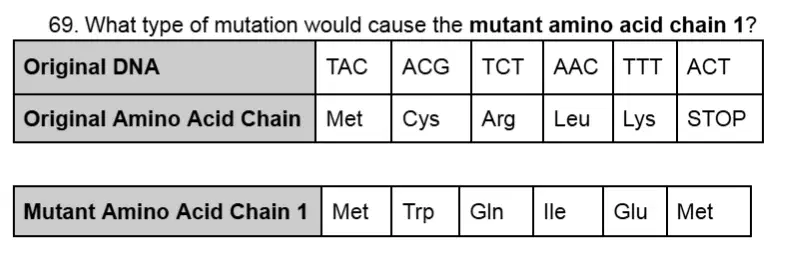
What type of mutation would cause the mutant amino acid chain 1?
Silent
Insertion
Missense
Nonsense
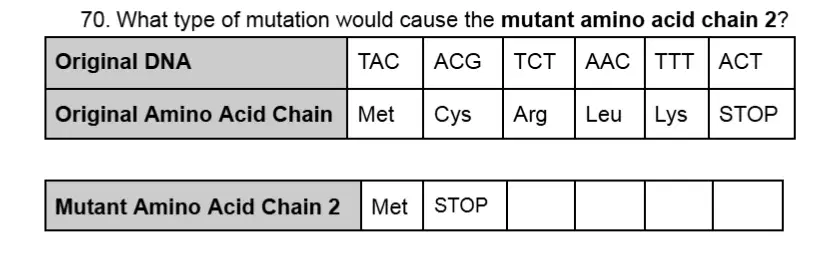
What type of mutation would cause the mutant amino acid chain 2?
Silent
Insertion
Missense
Nonsense

