
Font size
 Worksheets
Midterm Review
Total questions: 90
Worksheet time: 58mins
How long ago do they think the Big Bang occurred?
4 million years ago
14 million years ago
4 billion years ago
14 billion years ago
What evidence supports the Big Bang theory?
Existence of black holes
Cosmic microwave background radiation
Movement of tectonic plates
Formation of asteroids
What does the redshift of distant galaxies indicate?
Galaxies are moving closer together
The universe is contracting
The universe is static
Galaxies are moving away from us
Who first proposed the idea that the universe is expanding?
Edwin Hubble
Galileo Galilei
Isaac Newton
Albert Einstein
Organize these options into the right categories
sun
more updated
Earth
elliptical orbit
no updates to theory
first theory
Copernicus
Ptolemy
Which element was formed in the greatest abundance during the first few minutes after the Big Bang?
Oxygen
Iron
Carbon
Hydrogen
Organize these options into the right categories:
Earth
Mars
Mercury
Venus
Jupiter
Saturn
Uranus
Neptune
terrestrial
closer together
gas giants
farther apart
Match the following: planet with unique characteristic
Mercury
extreme temperatures
Venus
hottest overall
planet
Earth
Goldilocks planet
Mars
oxidation
causes
red color
Match the following
Jupiter
largest planet
with a giant storm
Saturn
complicated ring system
Uranus
tilted on its side;coldest
Neptune
large giant blue spot
Which planet is closest to the Sun?
Venus
Mercury
Mars
Earth
Which planet is known as the Red Planet?
Jupiter
Mars
Neptune
Saturn
Sort these into the proper categories;
giant ball of ice and dust
forms a tail near the sun
named differently based on location
-oids = in deep space
-ite= it touches Earth
can create meteor showers when entering Earth's atmosphere
typically smaller than asteroids
long elliptical orbits
What is the name of the force that keeps planets in orbit around the Sun?
Magnetic force
Nuclear force
Electrostatic force
Gravitational force
What force works with gravity to keep planets in motion?
inertia
mass
density
temperature
A solar eclipse is when....
the moon goes between the sun and earth
the sun goes between the moon and earth
The earth goes between the sun and moon
The earth and moon both face the sun
During a solar eclipse....
a shadow of the moon is on the earth
a shadow of the earth is on the moon
a shadow of the sun is on the moon
a shadow of the sun is on the earth
Which of the following is true about gravity?
The larger the object the more gravity it has
Gravity is the reason salt dissolves in water
We have higher high tides during Neap tides when the sun and moons gravity work together
The larger the object the less gravity it has
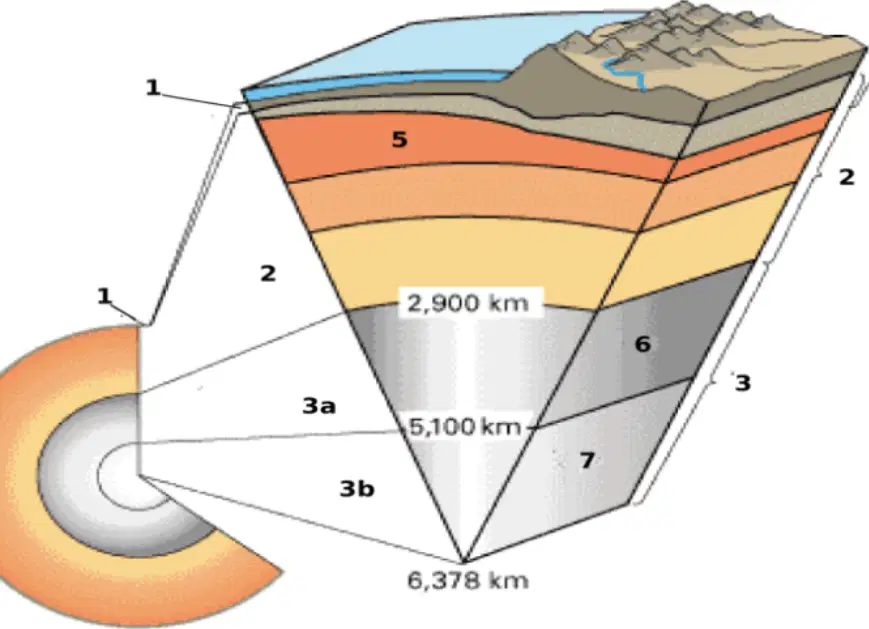
What does the diagram represent?
The structure of a volcano
The layers of the Earth
The water cycle
The solar system
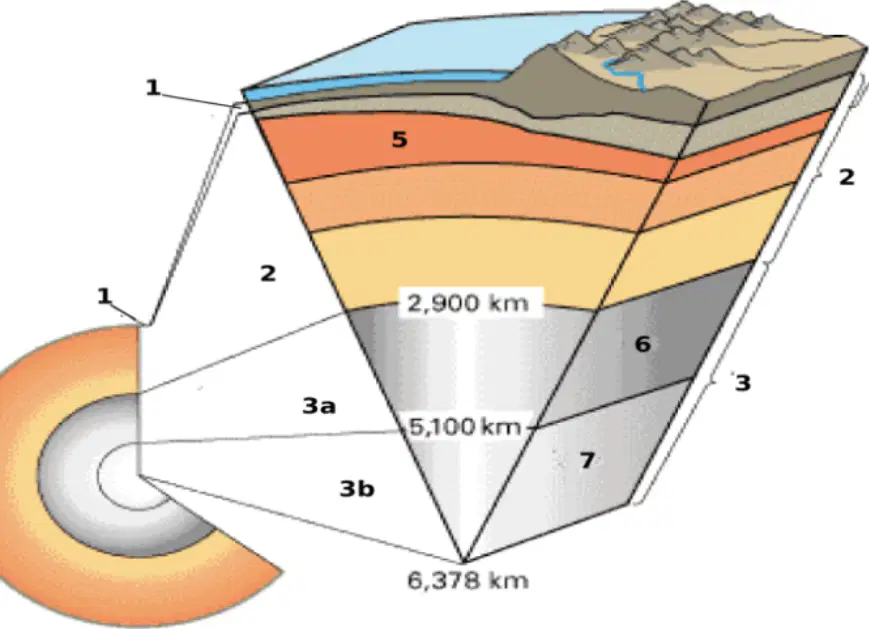
Which layer is located at a depth of 2,900 km according to the diagram?
Crust
Outer core
Mantle
Inner core
What are the two types of crust that make up the Crust?
Lithosphere
Athenosphere
Continental Crust
Oceanic Crust
Oceanic and Continental Crust
The solid, soft layer of the mantle on which tectonic plates move
Lithosphere
Inner Core
Asthenosphere
Outer Core
Continental crust does not get subducted and destroyed because it is
less dense than oceanic crust
more dense than oceanic crust
volcanic in origin
The theory of continental drift was proposed by
Alfred Wegner
Albert Einstein
Marie Curie
The lithosphere under the ocean floor being forced down under the lithosphere of the continental crust is called
shearing
subduction
a transform boundary
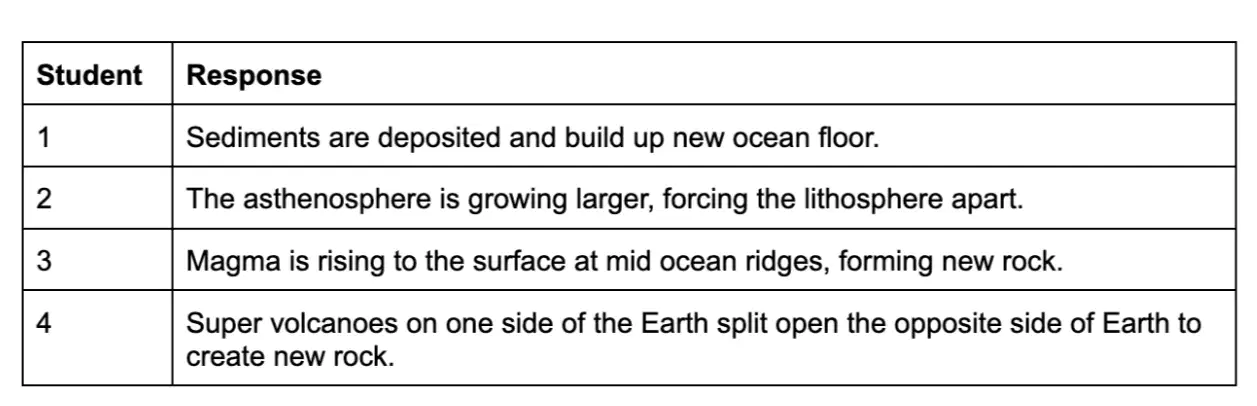
Students are studying plate movements. Which student correctly identified what causes seafloor spreading to occur?
Student 1
Student 2
Student 3
Student 4
What are the 3 forms of heat transfer?
Radiation, Conduction, Convection
Radiation, Convection, Condensation
Evaporation, Condensation, Percipitation
What are the main pieces of evidence for the Big Bang Theory?
Cosmic microwave background radiation, expansion of the universe, and abundance of light elements
Existence of black holes, gravitational waves, and dark matter
Formation of galaxies, solar flares, and asteroid impacts
Presence of quasars, pulsars, and neutron stars
According to the Big Bang Theory, the universe is:
expanding
shrinking
the same size
collapsing
What is a singularity?
a point in space where gravity is so strong that not even light can escape
a type of star that emits intense radiation
a region in space with no gravitational pull
a planet with a very high temperature
Label each model shown below.
Left: Geocentric Model
Right: Heliocentric Model
Left: Heliocentric Model
Right: Geocentric Model
Left: Solar System Model
Right: Lunar Model
Left: Earth-Centered Model
Right: Sun-Centered Model
What two things affect gravity?
mass & distance
temperature & pressure
volume & density
speed & acceleration
Who discovered that planets move around the Sun in an elliptical path?
Kepler
Newton
Galileo
Copernicus
Where is the asteroid belt located in our solar system?
Mars and Jupiter
Earth and Mars
Jupiter and Saturn
Venus and Earth
Arrange the planets by their distance from the Sun.
Mercury, Venus, Earth, Mars, Jupiter, Saturn, Uranus, Neptune
Mercury, Earth, Venus, Mars, Jupiter, Saturn, Uranus, Neptune
Venus, Mercury, Earth, Mars, Jupiter, Saturn, Uranus, Neptune
Mercury, Venus, Mars, Earth, Jupiter, Saturn, Uranus, Neptune
The force of gravity on an object is called ________, and the amount of matter is called ________.
weight, mass
mass, weight
volume, density
density, volume
As the distance between two objects increases, the gravitational force ________.
decreases
increases
remains the same
becomes zero
Inertia is:
The tendency of an object to resist changes in its motion.
The force that causes objects to accelerate.
The energy of a moving object.
The ability of an object to change shape easily.
Which moon phase occurs when the moon is between the Earth and the Sun?
Full Moon
New Moon
First Quarter
Third Quarter
What is the difference between waxing and waning?
Waxing is when the lit part of the moon gets bigger, waning is when it gets smaller.
Waxing is when the moon moves closer to Earth, waning is when it moves farther away.
Waxing is when the moon is seen during the day, waning is when it is seen at night.
Waxing is when the moon changes color, waning is when it stays the same color.
How long does the Moon take to go around Earth?
29.5 days
7 days
365 days
12 hours
What does this image show?
Solar Eclipse
Lunar Eclipse
Full Moon
Comet Passing
What does this image show?
Lunar Eclipse
Solar Eclipse
Aurora Borealis
Meteor Shower
What is a blood moon? Why does it look red?
A blood moon happens during a total lunar eclipse. Sunlight passes through earth’s atmosphere, and red light is bent onto the moon, making it look red.
A blood moon happens when the moon is closest to the sun and reflects sunlight directly.
A blood moon is seen during a solar eclipse when the moon blocks the sun and turns red.
A blood moon happens when clouds cover the moon and scatter red light.
How long does it take from new moon to full moon?
About 2 weeks
About 1 week
About 1 month
About 3 days
What is the difference between the umbra and penumbra?
The umbra is the darkest part of a shadow; the penumbra is lighter.
The umbra is the lighter part of a shadow, while the penumbra is the darkest part.
Umbra and penumbra are both equally dark regions of a shadow.
Umbra is the part of a shadow where no eclipse occurs, penumbra is where a total eclipse occurs.
Why do we see different parts of the moon lit up during different phases?
The moon's orbit and its position between Earth and the sun make different parts of the moon look lit during the lunar cycle.
The moon changes its shape during the month.
Clouds cover different parts of the moon at different times.
The sun moves around the moon, lighting it from different angles.
What is a tide?
The daily rise and fall of ocean water.
A sudden increase in ocean temperature.
The movement of fish in the ocean.
Waves formed by wind.
What causes tides?
The Moon's and Sun's gravity.
Wind over the ocean.
Earth's rotation.
Volcanic activity.
How many high and low tides occur each day?
2 high tides, 2 low tides.
1 high tide, 1 low tide.
3 high tides, 3 low tides.
4 high tides, 4 low tides.
Identify the type of tide shown in each diagram.
Left: Spring Tide; Right: Neap Tide.
Left: Neap Tide; Right: Spring Tide.
Left: High Tide; Right: Low Tide.
Left: Low Tide; Right: High Tide.
What is the difference between a spring tide and a neap tide?
Spring tides occur during new and full moons when the earth, sun, and moon are aligned, causing a large tidal range. Neap tides occur during 1st and 3rd quarter moons when the sun and moon are at 90° angles, causing a small tidal range.
Spring tides occur during 1st and 3rd quarter moons when the sun and moon are at 90° angles, causing a large tidal range. Neap tides occur during new and full moons when the earth, sun, and moon are aligned, causing a small tidal range.
Spring tides and neap tides both occur only during full moons, but spring tides have a smaller tidal range than neap tides.
Spring tides happen when the sun and moon are on opposite sides of the earth, creating no tidal range. Neap tides happen when the sun and moon are on the same side, creating a large tidal range.
What causes day and night on Earth?
Earth’s rotation on its axis.
Earth’s revolution around the Sun.
The Moon’s rotation.
The Sun’s movement around Earth.
How long does it take for Earth to complete one rotation?
24 hours.
12 hours.
48 hours.
365 days.
Label these on the diagram: equator, northern hemisphere, southern hemisphere, axis.
Equator, northern hemisphere, southern hemisphere, axis labeled on the diagram.
Equator, tropic of cancer, tropic of capricorn, axis labeled on the diagram.
Prime meridian, northern hemisphere, southern hemisphere, axis labeled on the diagram.
Equator, northern hemisphere, southern hemisphere, prime meridian labeled on the diagram.
What season would the northern hemisphere be experiencing in the picture above? What about the southern hemisphere?
Northern hemisphere: Summer; Southern hemisphere: Winter
Northern hemisphere: Winter; Southern hemisphere: Summer
Northern hemisphere: Spring; Southern hemisphere: Autumn
Northern hemisphere: Autumn; Southern hemisphere: Spring
Why does Earth have seasons?
Earth has seasons because its axis is tilted 23.5° causing parts of the earth to tilt towards or away from the sun depending on Earth’s location in its revolution around the sun.
Earth has seasons because the distance between Earth and the sun changes drastically throughout the year.
Earth has seasons because the moon’s gravity affects the Earth’s climate.
Earth has seasons because the sun’s energy output increases and decreases regularly.
How long does it take for Earth to make one revolution around the sun?
365.25 days or 1 year
24 hours
30 days
10 years
Define solstice.
A solstice is the point where the sun's apparent path is at its northernmost or southernmost extreme relative to Earth's equator. This results in the longest (summer solstice) and shortest (winter solstice) days of the year.
A solstice is the moment when the moon is closest to the Earth, causing high tides.
A solstice is the period when the Earth is closest to the sun, resulting in higher temperatures worldwide.
A solstice is the time when day and night are of equal length all over the world.
Define equinox.
One of two times a year when day and night are approximately equal in length across the entire Earth. It occurs when the Earth's axis is tilted neither toward nor away from the sun, and the sun is directly over the equator. The two equinoxes happen around March 20–21 (spring) and September 22–23 (fall).
A period when the Earth's axis is tilted at its maximum toward the sun, resulting in the longest day or night of the year.
A time when the moon is directly between the Earth and the sun, causing a solar eclipse.
A season when the Earth's orbit brings it closest to the sun, resulting in higher temperatures globally.
When does the longest day of the year occur? The shortest?
Longest: Summer Solstice (6/21); Shortest: Winter Solstice (12/21)
Longest: Winter Solstice (12/21); Shortest: Summer Solstice (6/21)
Longest: Spring Equinox (3/21); Shortest: Fall Equinox (9/21)
Longest: Fall Equinox (9/21); Shortest: Spring Equinox (3/21)
Which season is the Earth experiencing in each position?
A. Northern Hemisphere - Summer Southern Hemisphere - Winter
B. Northern Hemisphere - Fall Southern Hemisphere - Spring
C. Northern Hemisphere - Winter Southern Hemisphere - Summer
D. Northern Hemisphere - Spring Southern Hemisphere - Fall
Label the diagram: Look carefully at the numbers/layers and label correctly.
A. Crust
B. Mantle
C. Inner Core
D. Outer Core
Which mechanical layer of Earth is hard brittle rock and made up of crust and the upper portion of the mantle?
Lithosphere
Asthenosphere
Mesosphere
Core
What is the asthenosphere? What happens in the asthenosphere?
The asthenosphere is the mechanical layer made up of the upper part of the mantle (below the lithosphere). Convection currents happen here due to extreme heat and pressure.
The asthenosphere is the outermost layer of the Earth, consisting mainly of solid rock. No significant movement occurs here.
The asthenosphere is a layer of the Earth's core where volcanic eruptions originate. It is completely solid and immobile.
The asthenosphere is the Earth's crust where tectonic plates are formed. It is a cold and rigid layer.
What does the distribution of these fossils suggest about the land masses on Earth?
That they used to be part of one giant supercontinent called Pangaea.
That the land masses have always been separated by oceans.
That fossils can only be found on islands.
That the continents have never moved.
Which layer is responsible for Earth's magnetic field?
Outer Core
Crust
Mantle
Inner Core
Describe the outer core: (state of matter and composition)
The outer core is a liquid layer composed mainly of molten iron and nickel. It ranges in depth from 2,900 - 5,100 km. It is liquid due to intense heat.
The outer core is a solid layer composed mainly of silicon and oxygen. It ranges in depth from 2,900 - 5,100 km. It is solid due to low temperature.
The outer core is a gaseous layer composed mainly of hydrogen and helium. It ranges in depth from 2,900 - 5,100 km. It is gaseous due to high pressure.
The outer core is a plasma layer composed mainly of carbon and sulfur. It ranges in depth from 2,900 - 5,100 km. It is plasma due to magnetic fields.
Explain why the inner core has the most pressure:
Because there are three other heavy, dense layers surrounding it causing great amounts of pressure.
Because it is the hottest part of the Earth.
Because it is made entirely of solid metal.
Because it is closest to the Earth's surface.
What is the Continental Drift Theory? Who came up with it?
The theory that Earth's continents used to be one giant supercontinent and have slowly moved apart over time. It was developed by German meteorologist Alfred Wegener.
The theory that continents are fixed and have never moved. It was developed by Charles Darwin.
The theory that continents drift due to ocean currents. It was developed by Isaac Newton.
The theory that continents formed from volcanic eruptions. It was developed by Marie Curie.
What is Pangaea? Name three pieces of evidence to support that Pangaea existed millions of years ago.
Pangaea is the supercontinent that began breaking apart millions of years ago into the continents we know today.
Pangaea is a large ocean that covered the Earth millions of years ago.
Pangaea is a mountain range formed by volcanic activity millions of years ago.
Pangaea is a desert that existed in Africa millions of years ago.
Define density.
Density is a measure of how much mass is contained in a given volume of a substance, essentially how 'packed' the matter is.
Density is the amount of energy stored in a substance.
Density is the speed at which a substance moves.
Density is the temperature at which a substance melts.
What is the relationship between the layers of the earth, density, temperature and pressure? What happens to density, temperature, and pressure inside of Earth?
The further down you go in earth's layers, the temperature, density and pressure all increase.
The further down you go in earth's layers, the temperature, density and pressure all decrease.
The further down you go in earth's layers, only the temperature increases while density and pressure decrease.
The further down you go in earth's layers, only the pressure increases while temperature and density decrease.
What layer is the most rigid?
Crust
Mantle
Outer Core
Inner Core
What layer is a flexible solid (like plastic)?
Mantle
Crust
Core
Lithosphere
What layer is liquid rock?
Outer Core
Crust
Mantle
Inner Core
What is the Theory of Plate Tectonics?
The theory that Earth's outer mechanical layer, the lithosphere, is divided into many plates that are constantly shifting due to convection currents in the asthenosphere.
The theory that Earth's core is made entirely of solid iron and does not move.
The theory that mountains are formed only by volcanic eruptions.
The theory that the Earth's surface is completely static and never changes.
Label the boundaries shown in the diagram below.
Divergent
Convergent
Transform
Label the type of boundary, landform or process occurring in the diagram below. Match the letters (A-F) to the correct term.
Deep Ocean Trench
Subduction
Mountains
Divergent Boundary
Mid Ocean Ridge
Where are most earthquakes and volcanoes found?
Along plate boundaries
In the middle of continents
At the North and South Poles
In deserts
What famous fault in California is a transform boundary?
San Andreas Fault
Hayward Fault
Garlock Fault
Calaveras Fault
In which mechanical layer are tectonic plates located?
Lithosphere
Asthenosphere
Mesosphere
Core
At what landform is new oceanic crust constantly created?
Mid Ocean Ridge
Trench
Continental Shelf
Seamount
New crust is created at ________ boundaries, crust is destroyed at ________ boundaries and crust is neither created nor destroyed at ________ boundaries.
divergent, convergent, transform
convergent, divergent, transform
transform, divergent, convergent
convergent, transform, divergent
The process that drives the movement of tectonic plates is known as:
Convection currents in the mantle
Evaporation of ocean water
Rotation of the Earth
Solar radiation heating the crust
The process of subduction involves:
one tectonic plate sliding beneath another into the mantle
two tectonic plates moving apart from each other
the formation of mountains by plate collision
the creation of new oceanic crust at mid-ocean ridges
What landforms are created as a result of the following plate movement? continental plates collide ________ continental plates separate ________ oceanic plates collide ________ oceanic plates separate ________
mountains, rift valley, trench, mid-ocean ridge
mountains, mid-ocean ridge, rift valley, trench
trench, mountains, rift valley, mid-ocean ridge
rift valley, mountains, mid-ocean ridge, trench
What is the main cause of Earth's seasons?
The Moon's gravitational pull
Earth's tilt on its axis
Earth's distance from the Sun
Changes in Earth's speed
Which layer of the Earth is liquid and responsible for generating Earth's magnetic field?
Crust
Mantle
Inner core
Outer core
Which planet in our solar system has the most moons?
Mars
Jupiter
Earth
Venus
Which phenomenon provides evidence that the universe is expanding?
Earth's magnetic field
Redshift of light from distant galaxies
Formation of mountain ranges
Rotation of the Moon

