
 Worksheets
Biology Final Review
Total questions: 97
Worksheet time: 49mins
What are the characteristics of lipids?
Hydrophobic (non polar, insoluble in water)
Mostly hydrocarbons (C-H bonds)
Energy storage, insulation, hormones, membranes
All of the above
Fill in the blank: Lipids are ________.
hydrophobic
hydrophilic
ionic
polar
Which of the following is NOT a function of lipids?
A) Energy storage
B) Insulation
C) DNA replication
D) Hormones
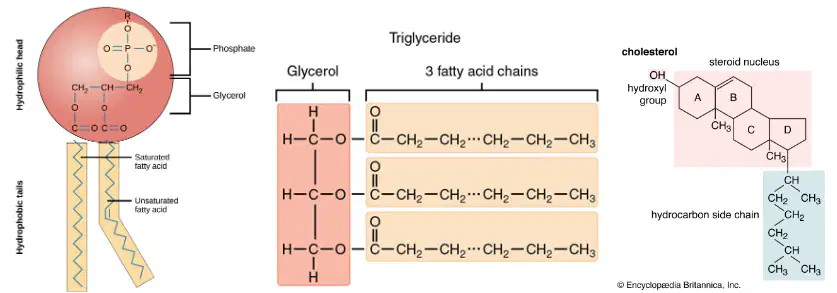
Structure of a phospholipid: A phospholipid consists of a glycerol backbone, two fatty acid tails (hydrophobic), and a phosphate head group (hydrophilic). This makes it _________.
amphipathic
hydrophobic
hydrophilic
nonpolar
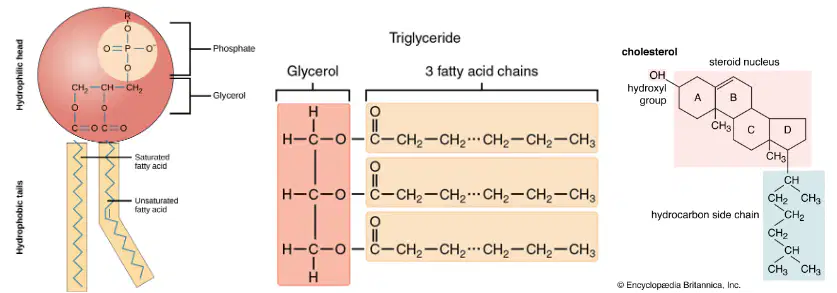
Which molecule is the main fat storage molecule?
Phospholipid
Triglyceride
Cholesterol
Protein
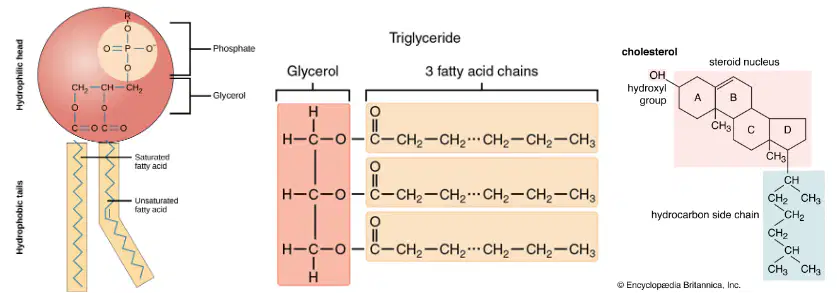
Cholesterol is a steroid that consists of four fused carbon rings and a hydrocarbon tail. It is a precursor to ________ hormones.
steroid
peptide
amino acid-derived
protein
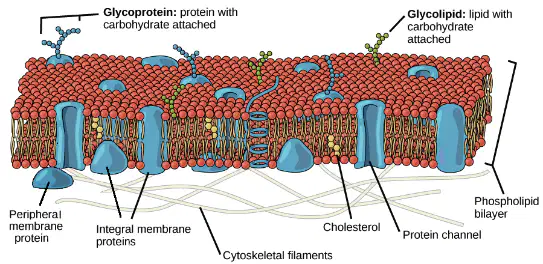
Phospholipid bilayer forms spontaneously in water because of its amphipathic structure. In the bilayer, hydrophilic heads face ________ and hydrophobic tails face ________.
water; inward
inward; water
water; water
inward; inward
Which of the following substances can cross the plasma membrane easily?
Large polar molecules
Small nonpolar molecules (O₂, CO₂)
Ions
Proteins
What four factors affect membrane permeability and how do they do so?
- Higher temperature = more fluid, higher permeability - Cholesterol stabilizes, reduces permeability at high temps, prevents solidification at low temps - Unsaturated (double bonds) = more fluid - Shorter fatty acid tails = more fluid/permeable
- Lower temperature = more fluid, higher permeability - Cholesterol increases permeability at high temps, solidifies at low temps - Saturated (no double bonds) = more fluid - Longer fatty acid tails = more fluid/permeable
- Higher temperature = less fluid, lower permeability - Cholesterol destabilizes, increases permeability at high temps, solidifies at low temps - Unsaturated (double bonds) = less fluid - Shorter fatty acid tails = less fluid/permeable
- Lower temperature = less fluid, lower permeability - Cholesterol destabilizes, increases permeability at low temps, solidifies at high temps - Saturated (no double bonds) = less fluid - Longer fatty acid tails = less fluid/permeable
Which molecules do NOT easily cross the membrane? Select all that apply.
Large molecules
Polar molecules (glucose)
Ions (Na+, Cl-)
Small nonpolar molecules
What are the different forms of passive transport across the membrane? Select all that are forms of passive transport.
Diffusion
Facilitated diffusion
Active transport
Osmosis
What is the process of osmosis?
Diffusion of water through selectively permeable membranes
Movement of molecules down concentration gradient
Movement of ions using ATP
No net water movement
What is the difference between hypertonic, hypotonic, and isotonic solutions? Fill in the blanks: - Hypertonic: solution has ______ solute concentration. Water leaves cell, cell ______. - Hypotonic: solution has ______ solute concentration. Water enters cell, cell ______. - Isotonic: solution has ______ solute concentration. No net water movement.
- Hypertonic: higher, shrinks - Hypotonic: lower, swells/bursts - Isotonic: equal, no net movement
- Hypertonic: lower, swells/bursts - Hypotonic: higher, shrinks - Isotonic: equal, no net movement
- Hypertonic: equal, no net movement - Hypotonic: higher, shrinks - Isotonic: lower, swells/bursts
- Hypertonic: lower, shrinks - Hypotonic: equal, no net movement - Isotonic: higher, swells/bursts
Which of the following are protein carriers that can transport materials via active transport? Select all that apply.
Pumps (e.g., Na+/K+ pump)
Cotransporters (symport or antiport)
Proton pumps
Diffusion channels
How is active transport different from passive transport?
Active transport requires energy and moves against concentration gradient
Passive transport requires energy and moves down concentration gradient
Active transport does not require energy
Passive transport moves against concentration gradient
You make a phospholipid bilayer with short, saturated hydrocarbon tails. You measure the permeability of this membrane to oxygen. You then double the length of the hydrocarbon tails and re-measure membrane permeability. You then double the length of the hydrocarbon tails again and make a third measurement of membrane permeability. You graph membrane permeability as a function of hydrocarbon tail length (x axis = tail length; y axis = permeability). Which of the accompanying graphs best represents the data you expect?
A)
C)
Which type of cell has no nucleus and no membrane-bound organelles?
Prokaryotes
Eukaryotes
Which type of cell contains DNA in a true nucleus and has many membrane-bound organelles?
Prokaryotes
Eukaryotes
Fill in the blank: The plasma membrane regulates ______ of substances.
entry/exit
color
temperature
shape
Fill in the blank: The cell wall provides ______ and protection.
shape
energy
color
movement
Fill in the blank: Ribosomes are responsible for ______ synthesis.
protein
lipid
carbohydrate
nucleic acid
Fill in the blank: The nucleoid is the region containing ______ DNA.
circular
linear
double-stranded
single-stranded
Fill in the blank: Plasmids are small extra DNA loops that often carry useful genes like ______ resistance.
antibiotic
heat
cold
UV
Fill in the blank: Flagella/pili are involved in ______ and attachment.
movement
digestion
photosynthesis
reproduction
Which of the following is NOT a benefit of organelle compartmentalization?
A) Efficiency
B) Allows simultaneous processes
C) Decreases surface area for reactions
D) Specialization of function
Short saturated tails in membrane lipids result in:
A) More hydrophobic interactions, less fluid membrane, lower permeability
B) Less hydrophobic interactions, more fluid membrane, higher permeability
Hydrocarbon tail length increases in membrane lipids leads to:
A) Weaker van der Waals interactions, looser packing, higher fluidity
B) Stronger van der Waals interactions, tighter packing, lower fluidity, and lower permeability
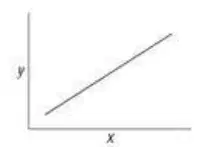
Which diagram (B or D) best represents a linear relationship between x and y?
B
D
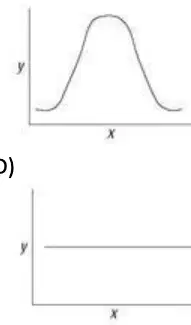
Which diagram (B or D) best represents a peak or maximum value for y as x changes?
B
D
Smooth ER is responsible for ______ synthesis and detoxification.
lipid
protein
carbohydrate
nucleic acid
Which organelle modifies, packages, and ships proteins/lipids?
Mitochondria
Golgi apparatus
Lysosomes
Peroxisomes
Mitochondria are responsible for ______ production through cellular respiration.
ATP
DNA
Glucose
Oxygen
Lysosomes in animal cells are involved in ______ and waste breakdown.
digestion
photosynthesis
respiration
protein synthesis
Peroxisomes help to detoxify ______ substances.
harmful
nutritious
pleasant
neutral
The cytoskeleton provides support and movement through structures such as ______, microfilaments, and intermediate filaments.
microtubules
ribosomes
lysosomes
centrioles
Centrosomes/centrioles in animal cells organize ______ fibers in mitosis.
spindle
actin
collagen
elastic
Chloroplasts in plant cells are the site of ______.
photosynthesis
respiration
protein synthesis
digestion
The large central vacuole in plants maintains ______ pressure.
turgor
osmotic
hydrostatic
atmospheric
Cell wall in plants provides ______ and support.
structure
energy
color
movement
The plasma membrane acts as a ______ barrier.
selective
impermeable
rigid
conductive
The endomembrane system plays which role in a cell?
It synthesizes, modifies, and transports cellular products.
It produces energy through cellular respiration.
It provides structural support to the cell.
It stores genetic information.
Apply knowledge of the impact of cancer on cellular structure. What are some structural impacts of cancer on cells?
Cancer can cause abnormal cell shapes and loss of normal organization.
Cancer cells always become larger than normal cells.
Cancer leads to increased cell wall thickness.
Cancer causes cells to develop more mitochondria than normal.
Which of the following is an example of kinetic energy?
Water behind a dam
Glucose
A moving car
Heat
Stored energy, such as water behind a dam or chemical bonds, is called ______ energy.
potential
kinetic
thermal
electrical
Energy stored in molecular bonds, such as glucose or ATP, is called ______ energy.
chemical
thermal
kinetic
electrical
Random molecular motion is an example of ______ energy.
thermal
chemical
electrical
mechanical
Sunlight, which drives photosynthesis, is an example of ______ energy.
radiant/light
chemical
mechanical
electrical
Entropy (S) is a measure of ______ or randomness.
disorder
energy
temperature
pressure
Enthalpy (H) is the total ______ in a system (heat content).
energy
mass
volume
pressure
Which of the following is an example of an exergonic reaction?
A) Photosynthesis
B) Cellular respiration
C) Building macromolecules
D) Active transport
Which of the following reactions requires input of free energy (ΔG > 0, nonspontaneous)?
Cellular respiration
Hydrolysis of ATP
Photosynthesis
Release of usable energy
Free energy (G) is defined as:
Energy released during a reaction
Energy available to do work
Energy stored in ATP
Energy required for photosynthesis
The ΔG of an exergonic reaction is negative because the products have lower free energy than the reactants.
True
False
Fill in the blank: The ΔG of an endergonic reaction is ________ because forming the products requires an energy investment, leaving the products at a higher free energy level than the reactants.
positive
negative
zero
neutral
Which process is driven by ATP hydrolysis (exergonic)?
Active transport
Photosynthesis
Building macromolecules
Cellular respiration
Cells pair an exergonic reaction with an endergonic reaction so the overall ΔG is negative.
True
False
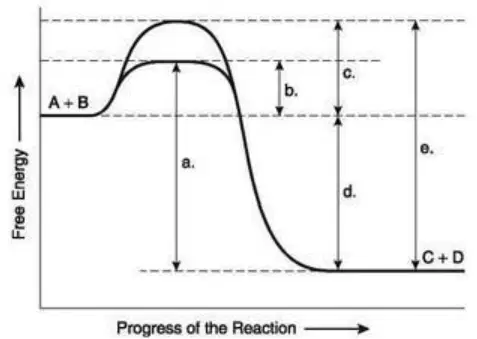
Which of the following terms best describes the forward reaction in the figure above?
A) endergonic, ΔG > 0
B) exergonic, ΔG < 0
C) endergonic, ΔG < 0
D) exergonic, ΔG > 0
E) chemical equilibrium, ΔG = 0
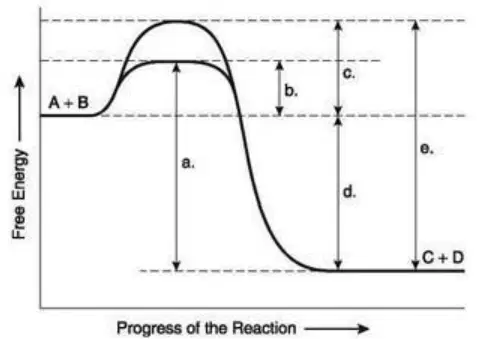
Which letter in the figure above represents the ΔG of the reaction?
D
A
B
C
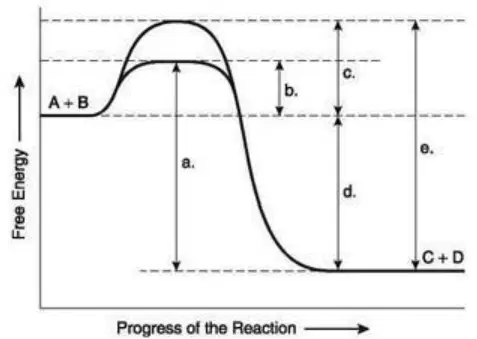
Which letter corresponds to the activation energy in the event an enzyme is NOT involved?
B
A
C
D
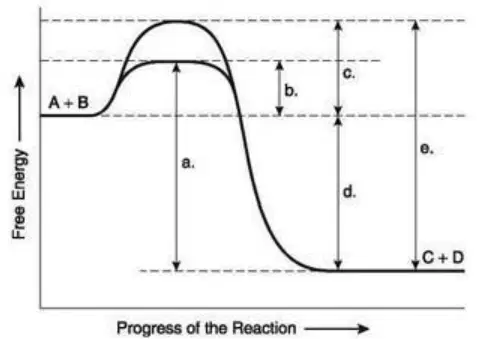
Is this reaction spontaneous or nonspontaneous?
Spontaneous
Nonspontaneous
Reversible
Irreversible
Which of the following increases the strength of the hydrophobic interactions in lipid bilayers making them less permeable to polar molecules?
the presence of double bonds
increasing temperature
removing cholesterol
increasing length of the hydrocarbon chains
Celery stalks that are immersed in freshwater for several hours become stiff. Similar stalks left in a 0.15 M salt solution become limp. From this we can deduce that the freshwater _____
and the salt solution are both hypertonic to the cells of the celery stalks.
and the salt solution are both hypotonic to the cells of the celery stalks.
is hypotonic and the salt solution is hypertonic to the cells of the celery stalks.
is hypertonic and the salt solution is hypotonic to the cells of the celery stalks.
is isotonic and the salt solution is hypertonic to the cells of the celery stalks.
All cells have which four things?
Cell membrane, cytoplasm, DNA, ribosomes
Cell wall, nucleus, mitochondria, chloroplasts
Cell membrane, nucleus, mitochondria, ribosomes
Cell wall, cytoplasm, DNA, mitochondria
(7) Briefly explain what energetic coupling is and the importance of it in allowing nonspontaneous reactions to occur.
Energetic coupling is the process where energy released from a spontaneous reaction is used to drive a nonspontaneous reaction, making it possible for the latter to occur.
Energetic coupling is the process of combining two spontaneous reactions to increase energy output.
Energetic coupling is the method by which enzymes lower activation energy for all reactions.
Energetic coupling is the transfer of energy from nonspontaneous reactions to spontaneous reactions to slow down metabolism.
In addition to ATP, what are the end products of glycolysis?
CO2 and H2O
CO2 and pyruvate
pyruvate and NADH
H2O, FADH2, and citrate
Glycolysis is active when cellular energy levels are ________; the regulatory enzyme, phosphofructokinase, is ________ by ATP.
low; activated
low; inhibited
high; activated
high; inhibited
In the absence of oxygen, yeast cells can obtain energy by fermentation, resulting in the production of ________.
ATP, CO2, and ethanol (ethyl alcohol)
ATP, CO2, and lactate (lactic acid)
ATP, NADH, and pyruvate
ATP, pyruvate, and oxygen
ATP, pyruvate, and acetyl CoA
The ATP made during fermentation is generated by ________.
the electron transport chain
oxidative phosphorylation
substrate-level phosphorylation
photophosphorylation
When oxygen is released as a result of photosynthesis, it is a direct by-product of ________.
reducing NADP+
splitting water molecules
chemiosmosis
the electron transfer system of photosystem I
the electron transfer system of photosystem II
The electrons of photosystem II are excited and transferred to electron carriers. From which molecule or structure do the photosystem II replacement electrons come?
water
photosystem I
the electron carrier, plastocyanin
oxygen
In mitochondria, chemiosmosis moves protons from the matrix into the intermembrane space, whereas in chloroplasts, chemiosmosis moves protons from the ________.
stroma to photosystem II
matrix to the stroma
stroma to the thylakoid space
intermembrane space to the matrix
thylakoid space to the stroma
Which of the following are directly associated with photosystem I?
harvesting of light energy by ATP
receiving electrons from the thylakoid membrane electron transport chain
generation of molecular oxygen
extraction of hydrogen electrons from the splitting of water
passing electrons to the cytochrome complex
Plants photosynthesize ________.
only in the light but respire only in the dark
only in the dark but respire only in the light
only in the light but respire in light and dark
and respire only in the light
and respire only in the dark
The two components of a photosystem are:
the light-harvesting complex and the reaction center
the electron transport chain and ATP synthase
chlorophyll and stroma
thylakoid membrane and grana
The first step in the Calvin cycle is fixation. “Fixation” means that ___ is combined with _, with the help of the enzyme _. Does this step use any energy from the light dependent reactions? [circle one]
NO
YES
SOMETIMES
ONLY IN PLANTS
12. Which is the better bulb in a “grow lamp” to promote growth of a plant, a green bulb or a blue bulb? WHY?
A green bulb is better because plants absorb green light most efficiently.
A blue bulb is better because blue light promotes plant growth.
Both bulbs are equally effective for plant growth.
A blue bulb is better because plants reflect blue light.
In what way are ATP synthesis and electron transport coupled?
The flow of electrons through the electron transport chain creates the proton gradient, which drives ATP synthase to make ATP.
ATP synthesis directly provides electrons for the electron transport chain.
Electron transport occurs only after ATP is synthesized.
ATP synthase breaks down the proton gradient, which then powers electron transport.
14. One way that fermentation and anaerobic respiration are similar is that both occur without oxygen. One way they are different is that anaerobic respiration uses an electron transport chain, while fermentation does not. Which of the following statements correctly describes a similarity and a difference between fermentation and anaerobic respiration?
Both occur without oxygen; anaerobic respiration uses an electron transport chain, fermentation does not.
Both require oxygen; fermentation uses an electron transport chain, anaerobic respiration does not.
Both produce the same amount of ATP; fermentation uses an electron transport chain, anaerobic respiration does not.
Both occur with oxygen; anaerobic respiration uses an electron transport chain, fermentation does not.
Give, in order, the four processes of cellular respiration. Where in this sequence of processes is the majority of ATP produced?
The four processes of cellular respiration, in order, are glycolysis, pyruvate oxidation, citric acid cycle, and oxidative phosphorylation. The majority of ATP is produced during oxidative phosphorylation.
The four processes of cellular respiration, in order, are glycolysis, citric acid cycle, pyruvate oxidation, and oxidative phosphorylation. The majority of ATP is produced during the citric acid cycle.
The four processes of cellular respiration, in order, are glycolysis, oxidative phosphorylation, pyruvate oxidation, and citric acid cycle. The majority of ATP is produced during glycolysis.
The four processes of cellular respiration, in order, are pyruvate oxidation, glycolysis, citric acid cycle, and oxidative phosphorylation. The majority of ATP is produced during pyruvate oxidation.
The overall equation of cellular respiration can be described as which of the following in terms of free energy change, type of metabolic process, change in enthalpy, and change in entropy?
Exergonic, catabolic, decrease in enthalpy, increase in entropy
Endergonic, anabolic, increase in enthalpy, decrease in entropy
Exergonic, anabolic, increase in enthalpy, decrease in entropy
Endergonic, catabolic, decrease in enthalpy, increase in entropy
Describe the overall equation of photosynthesis in terms of free energy change (endergonic or exergonic), type of metabolic process (anabolic or catabolic), change in enthalpy (increase or decrease) and change in entropy (increase or decrease).
Photosynthesis is an endergonic, anabolic process with an increase in enthalpy and a decrease in entropy.
Photosynthesis is an exergonic, catabolic process with a decrease in enthalpy and an increase in entropy.
Photosynthesis is an endergonic, catabolic process with an increase in enthalpy and a decrease in entropy.
Photosynthesis is an exergonic, anabolic process with a decrease in enthalpy and an increase in entropy.
Consider oxygen. Is it an input or output for cellular respiration? Is it an input or output for photosynthesis? Where do we “see” it in the process of cellular respiration? And in the process of photosynthesis? Would a lack of oxygen negatively affect photosynthesis?
Oxygen is an input for cellular respiration and an output for photosynthesis; it is used in the electron transport chain during respiration and produced during the light reactions of photosynthesis; a lack of oxygen does not negatively affect photosynthesis.
Oxygen is an output for cellular respiration and an input for photosynthesis; it is produced in glycolysis and used in the Calvin cycle; a lack of oxygen negatively affects photosynthesis.
Oxygen is an input for both cellular respiration and photosynthesis; it is used in the Krebs cycle and the Calvin cycle; a lack of oxygen negatively affects photosynthesis.
Oxygen is an output for both cellular respiration and photosynthesis; it is produced in the electron transport chain and the light reactions; a lack of oxygen negatively affects photosynthesis.
Label each of the following as either a mitochondrion or a chloroplast. Label the compartments of the mitochondria and the compartments of the chloroplast.
Mitochondria: intermembrane space, matrix. Chloroplast: intermembrane space, stroma, lumen.
Mitochondria: stroma, lumen. Chloroplast: matrix, intermembrane space.
Mitochondria: lumen, stroma. Chloroplast: matrix, intermembrane space.
Mitochondria: intermembrane space, stroma. Chloroplast: matrix, lumen.
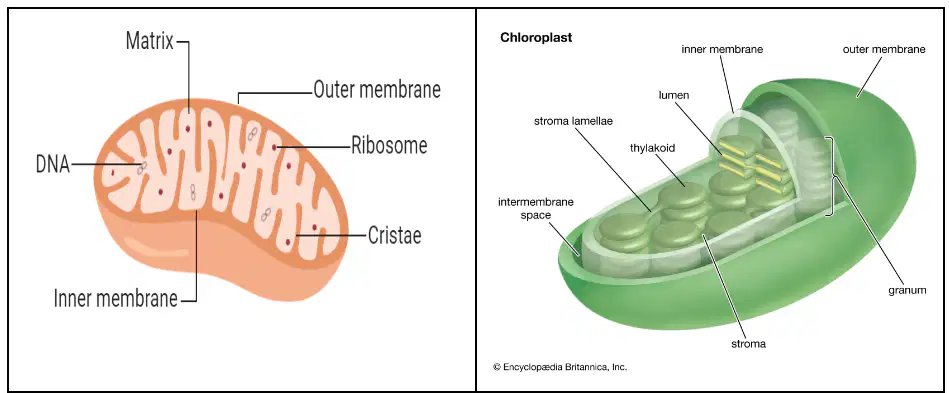
Look at the diagram of the mitochondrion. What is the name of the part labeled as 'Matrix'?
Matrix
Cristae
Intermembrane space
Outer membrane
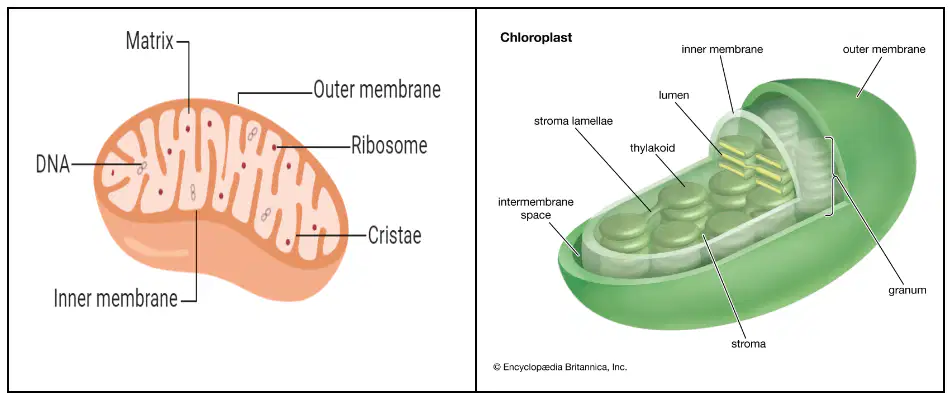
What is the name of the part labeled as 'Outer membrane'?
Outer membrane
Cell wall
Cytoplasm
Nucleus
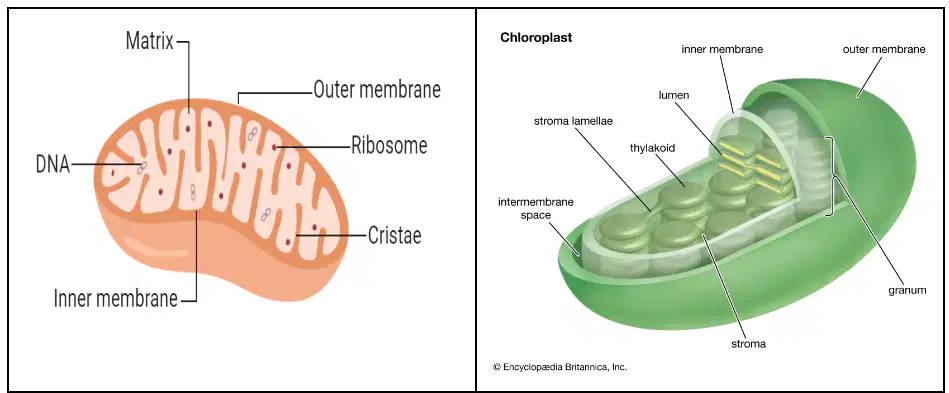
Look at the diagram of the mitochondrion. What is the name of the part labeled as 'DNA'?
DNA
Cristae
Matrix
Outer membrane
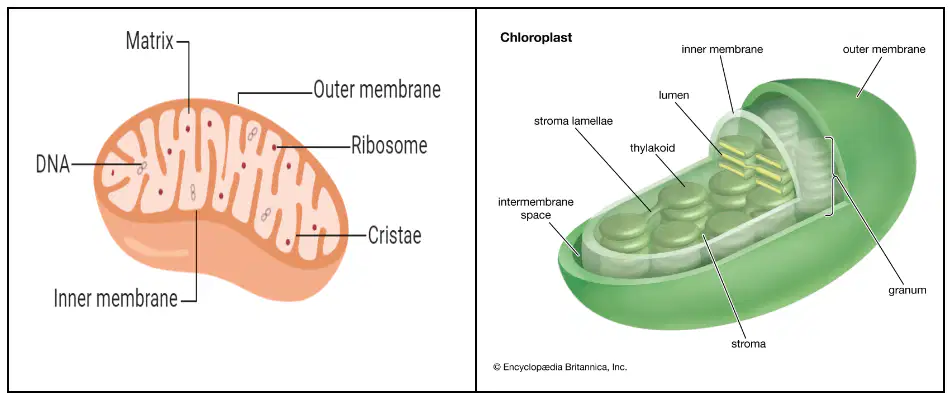
Look at the diagram of the mitochondrion. What is the name of the part labeled as 'Ribosome'?
Ribosome
Cristae
Matrix
Outer membrane
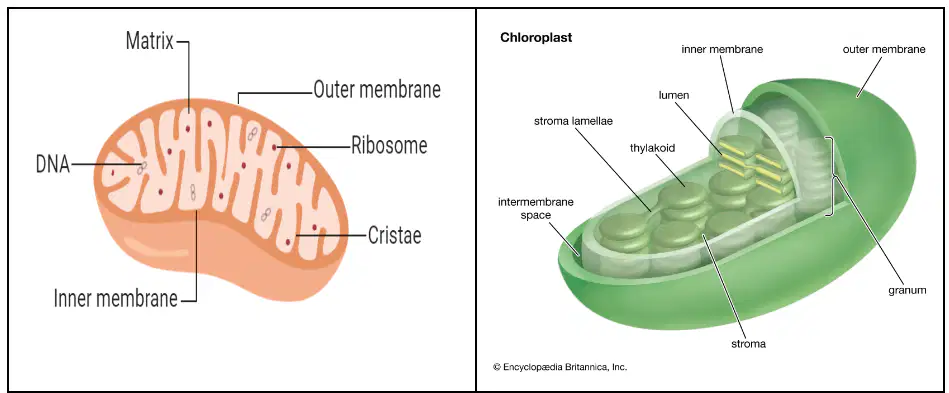
Look at the diagram of the mitochondrion. What is the name of the part labeled as 'Cristae'?
Cristae
Matrix
Outer membrane
Ribosome
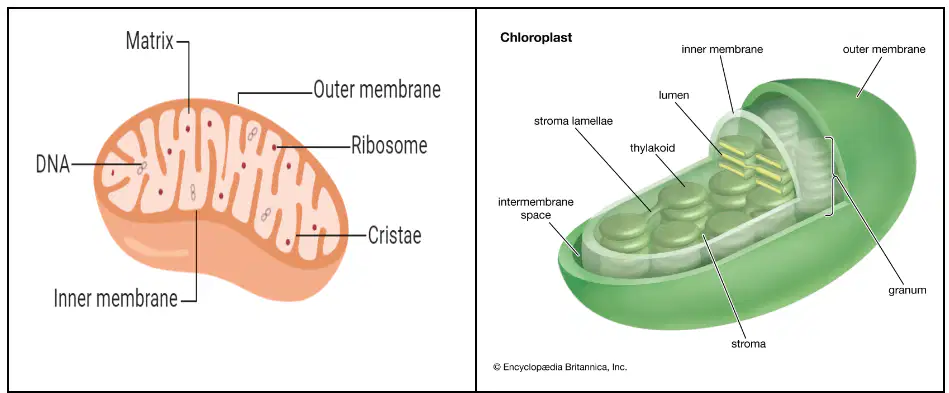
Look at the diagram of the mitochondrion. What is the name of the part labeled as 'Inner membrane'?
Inner membrane
Outer membrane
Cristae
Matrix
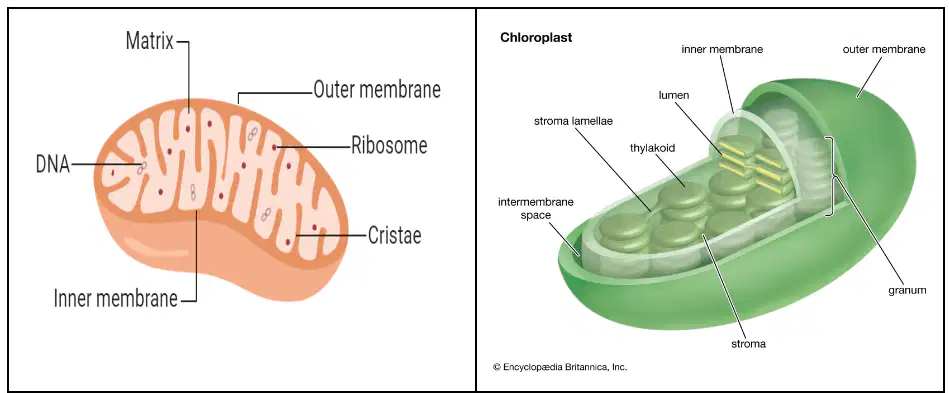
Look at the diagram of the chloroplast. What is the name of the part labeled as 'Stroma'?
Stroma
Thylakoid
Granum
Matrix

What is the name of the part labeled as 'Granum'?
Granum
Stroma
Thylakoid
Cristae
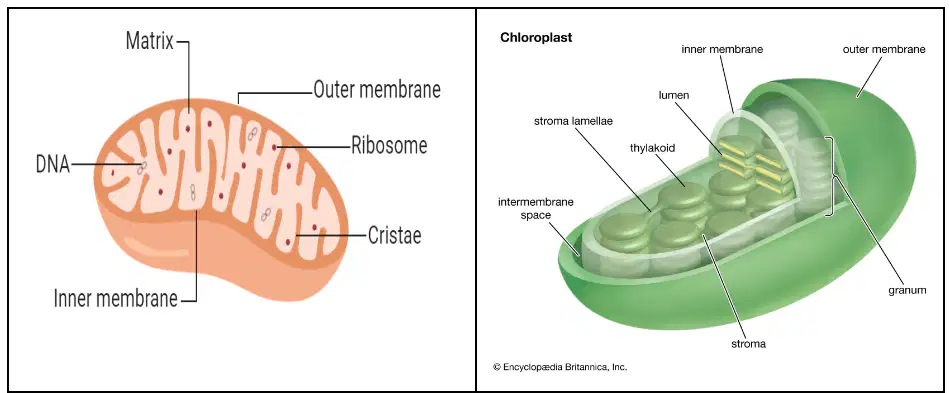
Look at the diagram of the chloroplast. What is the name of the part labeled as 'Thylakoid'?
Thylakoid
Stroma
Granum
Matrix
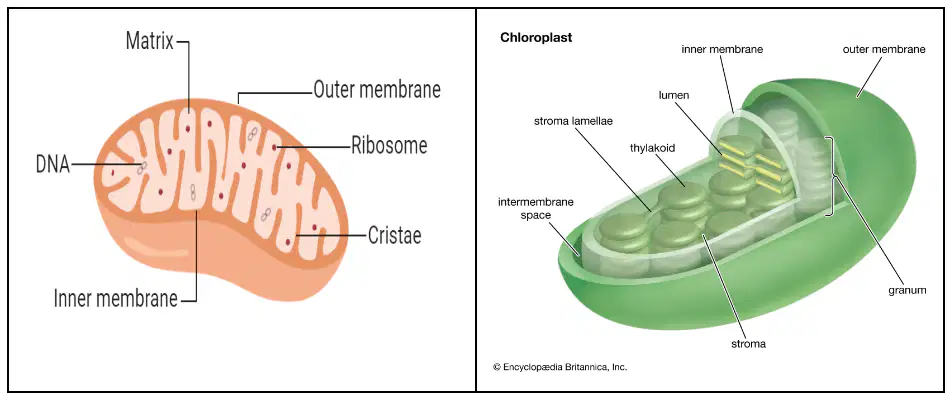
Look at the diagram of the chloroplast. What is the name of the part labeled as 'Stroma lamellae'?
Stroma lamellae
Thylakoid membrane
Granum
Outer membrane
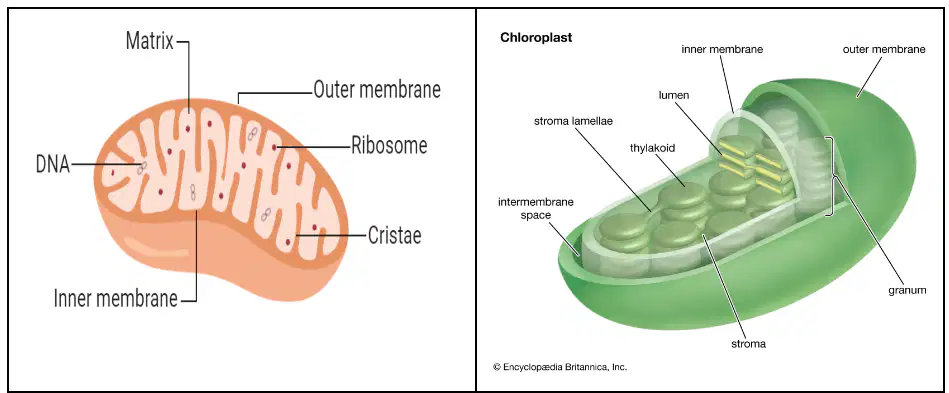
What is the name of the part labeled as 'Lumen'?
Lumen
Epithelium
Mucosa
Serosa
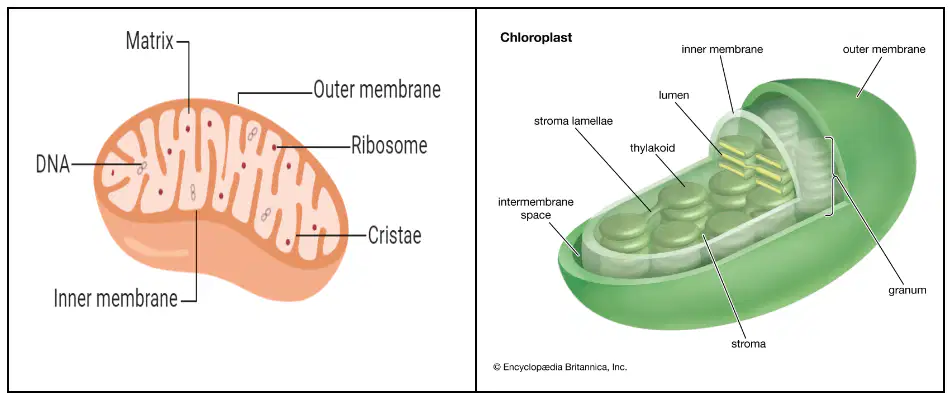
What is the name of the part labeled as 'Intermembrane space'?
Intermembrane space
Matrix
Cristae
Outer membrane
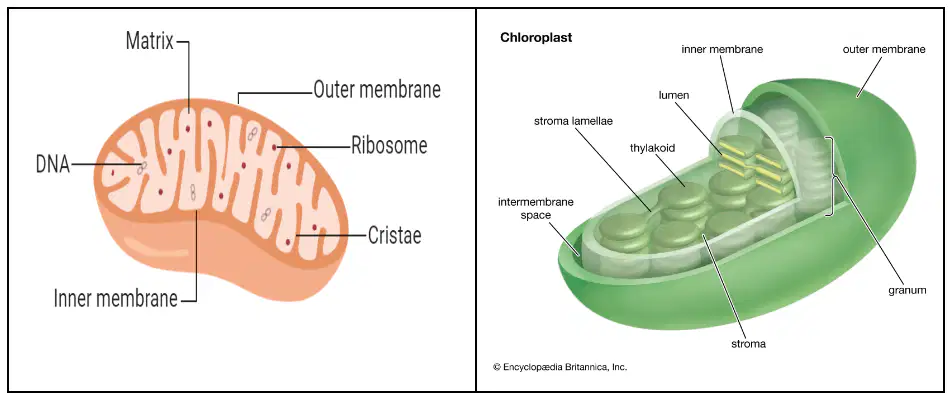
Look at the diagram of the chloroplast. What is the name of the part labeled as 'Inner membrane'?
Inner membrane
Thylakoid
Stroma
Granum
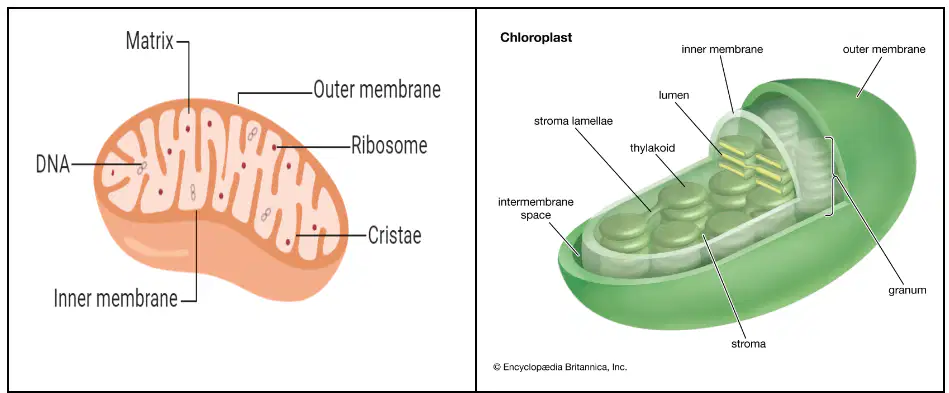
Look at the diagram of the chloroplast. What is the name of the part labeled as 'Outer membrane'?
Outer membrane
Thylakoid
Stroma
Inner membrane

