
 Worksheets
HPC Unit 2 Part 1 Final Review
Total questions: 131
Worksheet time: 3hrs 5mins
What below is NOT considered matter?
Carbon atoms
Gravity
Bacteria
Air
Matter is anything that.....
Has mass and takes up space
Has mass and is visible
Takes up space and has energy
Has energy and is visible
What particle view below is a mixture?


What is the best classification for this substance?
An element
A compound
A mixture

Is this a pure substance?
Yes
No

What is the best classification of this substance?
An element
A compound
A mixture of 2 elements
A mixture of 2 compounds
What is the best classification of this substance? H2SO4
An element
A compound
A mixture
What is the best classification of this substance? CO2 & H2S
An element
A compound
A mixture of 2 compounds
A mixture of many elements

How would you name this sample? T = triangle, Sq = square, C = circle.
T + Sq + C
TC + Sq
TC4 + Sq3
TCSq
What is an example of a physical property?
Silver is shiny
Alcohols are flammable
Alkali metals are reactive with water
Acids are sometimes corrosive
What is an example of a chemical change?
Tearing paper
Dissolving salt in water
Melting ice
Burning wood

Does this particle view show an element or a compound?
element
compound

Is this image showing a homogeneous or a heterogeneous mixture? Image: Cesar salad
homogeneous
heterogeneous

Is this image showing a homogeneous or a heterogeneous mixture? Image: Milk
homogeneous
heterogeneous

Does this image represent a chemical or a physical change?
Chemical change
Physical change

Does this image represent a chemical or physical change?
Chemical change
Physical change
Which below shows a CHEMICAL change?


How many different TYPES of ATOMS are in this image?
1
2
3
4
How many TOTAL MOLECULES are in this image?
4
5
15
2
How many different TYPES of MOLECULES are in this image?
1
2
4
5

Suppose you have two gases numbered 1 and 2.
Which equation represents make the most sense to calculate the total pressure exerted by both gases?
Multiply their pressures :
Ptotal = P1 × P2
Divide their pressures :
Ptotal = P1 ÷ P2
Add their pressures :
Ptotal = P1 + P2
Subtract their pressures :
Ptotal = P1 – P2
Average their pressure :
Ptotal = (P1 + P2)/2
A container holds three gases: oxygen, carbon dioxide, and helium. The partial pressures of the three gases are 2.00 atm, 3.00 atm, and 4.00 atm, respectively. What is the total pressure inside the container?
900 atm
0.90 atm
9.00 atm
920 atm
A container holds a mixture of two different gases. The oxygen in a container exerts 80 mmHg of pressure on the inside of the container. The total pressure inside the container is 120 mmHg. What is the pressure of the other gas in the container?
200 mmHg
80 mmHg
40 mmHg
120 mmHg
Three gases, Ar, N2 and H2 are mixed in a 500 L container. Ar has a pressure of 30 torr, N2 has a pressure of 40 torr and H2 has pressure of 60 torr.
What is the total pressure in the container?
(a)
A gas container contains hydrogen gas and water vapor. The pressure of the water is 20 torr. If the total pressure is measured to be 750 torr, what is the pressure of only the hydrogen gas?
770 torr
730 torr
37.5 torr
15,000 torr
P1 is 450mmHg and the Ptotal is 750mmHg. What is the pressure of the second gas, P2?
200mmHg
300mmHg
450mmHg
750mmHg
What is the partial pressure of O2 in air at a total atmospheric pressure of 97.8 kPa, given that air is about 21% oxygen?
22 kilopascals
19.8 kilopascals
21.5 kilopascals
20.5 kilopascals
What is the vapor pressure of water at 19 degrees Celsius?
4.2 kilopascals
1.2 kilopascals
2.2 kilopascals
3.2 kilopascals
In a gas mixture, the partial pressure of oxygen is 51 of the total pressure which is 100 kPa. What is the partial pressure of oxygen?
20 kPa
50 kPa
5 kPa
25 kPa
A mixture of nitrogen and oxygen gas has a total pressure of 4.2 atm. If 4/7 of the mixture is N2, what is the partial pressure of O2?
2.4 kPa
2.4 atm
1.8 kPa
1.8 atm
A mixture of two gases with a total pressure of 520 mmHg is enclosed in a sealed container. If 70% of the mixture is NO2, what is the partial pressure of the other gas?
520 mmHg
364 mmHg
156 mmHg
A sample of four mixed gases is at 760 mmHg. The partial pressures of gases A= 14. 8% and B = 41.6%. If gases C and D have equal partial pressures, what is the partial pressure of gas C?
331.36 mmHg
165.68 mmHg
428.64 mmHg

When collecting a gas over water, the total pressure in the column is equal to the pressure of the collected gas ___
plus atmospheric pressure
minus atmospheric pressure
plus the vapor pressure of the water
minus the vapor pressure of the water

The vapor pressure of water, which is the partial pressure of water vapor in the gas above it, is dependent on ___
the total pressure
the molar mass of water
the volume of the water
the temperature of the water

The ratio of moles of the individual gases in a mixture to the total number of moles is called ___
fractional molarity
fractional distillation
the mole fraction
the empirical formula
Type of intermolecular force present in I2, Br2, and Cl2.
dipole dipole
H-bond
London dispersion
metallic
Which substance would have the weakest intermolecular forces of attraction?
CH4
NaCl
H2O
MgF2

Intermolecular forces for: NH3
London dispersion Forces
Dipole dipole
Hydrogen bonding

Intermolecular forces for: CO2
London dispersion Forces
Dipole dipole
Hydrogen bonding
Water has an unusually high boiling point for a molecular compound because it has
hydrogen bonding
ion-ion attractions
a high density
a large gram formula mass
The weaker the intermolecular forces of a substance the _____________ the boiling point
higher
lower
Which molecule: Br2, HCl, H2S, or NH3, will most likely have London dispersion forces as the MOST important IMF considered when determining melting/boiling points?
Br2, it only has dispersion forces when interacting
HCl, it can participate in dipole-dipole interactions and also dispersion forces
H2S, it can participate in dipole-dipole interactions and also dispersion forces
NH3, it can participate in hydrogen bonding and also dispersion forces
Which noble gas should have the highest boiling point? (Hint: Think about how size affects IMFs)
He
Ne
Kr
Xe
Which of the following will NOT have hydrogen bonding?


Which of the following will have the lowest melting point?


Which substance has the weakest intermolecular forces?
Substance A, boiling point of 75 °C
Substance B, boiling point of 105 °C
Substance C, boiling point of 25 °C
Substance d, boiling point of 45 °C

Which type of IMF is responsible for the attraction pictured above?
Dipole-Dipole Interaction
Ion-Dipole Interaction
Hydrogen Bonds
Covalent Bond
Ionic Bond
Which of these is not an intermolecular force?
covalent bonding
London dispersion forces
hydrogen bonding
dipole-dipole forces
Hydrogen bonding is a special type of what force?
London dispersion forces
ion-dipole forces
dipole-dipole forces
covalent force
What type of intermolecular force is present in all substances, regardless of polarity?
London dispersion forces
ion-dipole forces
dipole-dipole forces
hydrogen bonding


Ink can be separated by a method of -----------------------------------------------
distillation
filtration
chromatography
sedimentation
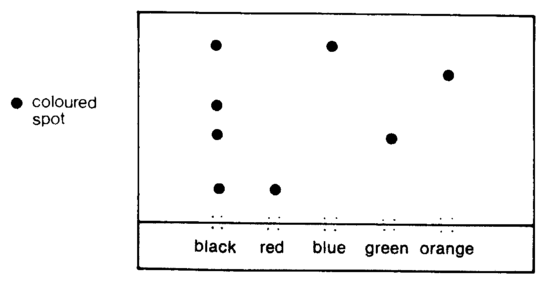

What is chromatography?
A way to see pretty colors
A laboratory technique used to separate a mixture.
A form of distillation
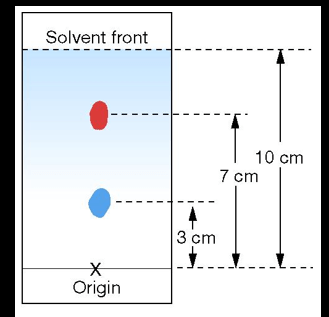
In paper chromatography, the LEAST soluble solute ____.
does not move from the start point
stays closest to the start point
travels furthest away from the start point
can be found in the middle of the chromatogram


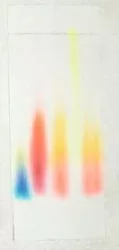
Here is chromatography of markers with the paper placed in water. What is true.
Blue dissolves best in water.
Yellow dissolves best in water.
Green dissolves best in water.
Pink dissolves best in water
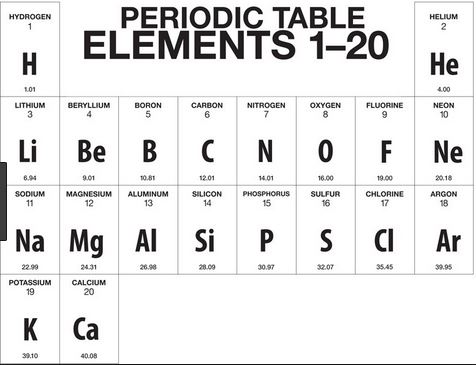
How many valence electrons does Hydrogen Have?
1 Valence electron
2 Valence electron
3 Valence electron
4 Valence electron
5 Valence electron
How many valence electrons does Helium Have?
1 Valence electron
2 Valence electron
3 Valence electron
4 Valence electron
5 Valence electron
How many valence electrons does Nitrogen Have?
1 Valence electron
2 Valence electron
3 Valence electron
4 Valence electron
5 Valence electron


Which of these is incorrect?


This is a Bohr Diagram of Neon. How many valence electrons does Neon have?
2
4
6
8

This is a Bohr Diagram of Helium. How many valence electrons does Helium have?
2
4
6
8

This is a Bohr Diagram of Aluminum. How many valence electrons does Aluminum have?
3
4
5
How would you draw a Lewis dot diagram for Magnesium?


Which of these is correct?


What is the correct Lewis Dot Structure for ammonia NH3


Which is the correct molecular structure for carbon dioxide?


How many total valence electrons are participating in bonding in the molecule above?
8
4
2
3

CO2 has how many lone pairs?
0
1
2
3
4
NH3 has how many lone pairs?
0
1
2
3
CCl4 has how many double bonds?
0
1
2
3
Carbonate (CO32-) has how many double bonds?
0
1
2
3
In HCN (Carbon is usually the central atom) what kind of bond is between the C and N
Single
Double
Triple
CHCl3 has how many double bonds?
0
1
2
3
CH2O has which of the following?
Multiple double bonds
Multiple single bonds
One double bond
One single bond
A lone pair
Which of the following elements are an exception to the octet rule and require less than 8 valence electrons?
H
Li
Be
B
C

Is this molecule polar or non-polar?
Polar
Non-polar

Is this molecule polar or non-polar?
Polar
Non-polar


Why is the molecule polar?
There is a non bonding pair electrons on the central atom.
There are different types of elements bonded to the central atom.
There are no non bonding pairs on the central atom and all of the atoms bonded to the central atom are the same.

Is this molecule polar or non-polar?
Non-polar
Polar

Classify the above molecule.
Polar
Non polar


What is the molecular geometry for this molecule?
Bent
Trigonal pyramidal
Trigonal planar
Linear


Is this molecule polar or non-polar?
Non-polar
Polar

Choose the correct shape for this molecule:
Trigonal planar
Trigonal pyramidal
Bent
Tetrahedral

Is this molecule polar or non-polar?
Non-polar
Polar

Is this molecule polar or non-polar?
Non-polar
Polar

