
 Worksheets
Midterm Review
Total questions: 72
Worksheet time: 36mins
Renee rolls a steel ball down a ramp. She conducts multiple trials by releasing the ball from varying heights on the ramp. For each trial, she measures and records the release height of the ball and the distance the ball travels away from the ramp before falling to the ground. The figure below shows the experiment. In this experiment, which variable is the independent variable?
distance traveled by the ball
path of ball once it leaves the ramp
height from which the ball is released
time it takes the ball to hit the ground
The school physician performed an experiment to investigate the effects of aerobic exercise on high school freshmen. He examined 25 student volunteers and found them to be in good health. He then had the students perform aerobic exercises, such as jogging, swimming, and bicycling. The doctor recorded the students’ pulse rates before each activity, during each activity, and after each activity. Which was the dependent variable in this experiment?
the physician
the exercises
the volunteers
the pulse rates
Jason wants to know how far a shot-putter from the track team can throw a shot. During the experiment, Jason measures Independent (test) and Dependent (outcome) variables. The drawings below show three trials from the experiment. Which of the following is correct.
The Independent variable is the distance traveled by the shot and the dependent variable is the angle of the shot thrown.
The Independent variable is the angle of the shot thrown and the dependent variable is the distance traveled by the shot.
The Independent variable is the force exerted on the shot and the dependent variable is the angle of the shot thrown.
The Independent variable is the angle of the shot thrown and the dependent variable is the force exerted on the shot.
Jeremy hypothesized that adults with blue eyes are shorter than adults with brown eyes. He collected data by visiting all of the teachers in his school and found that his hypothesis was false. Should Jeremy consider his hypothesis useful?
Yes; a false hypothesis gives a scientist new information to use.
No; a false hypothesis makes a scientist look silly.
No; false hypothesis are a waste of time.
Yes; now he knows that the exact opposite of his hypothesis must be true.
New experimental data does not support a currently accepted hypothesis. Which course of action should the researcher take?
Do the experiment again.
Change the data to fit the hypothesis.
Form a new hypothesis and plan a new experiment.
Change the procedure to obtain the desired outcome.
Which of the following statements is true regarding scientific hypotheses?
A testable hypothesis is valuable only if all evidence supports it.
Every hypothesis is valuable, whether or not it is testable.
There are no valuable hypotheses.
A testable hypothesis is valuable, even if evidence shows that it is false.
What is the difference between replication and repetition?
Replication occurs when the same exact measurement occurs more than once during a scientific investigation. Repetition occurs when the same scientific question is investigated, but a different procedure is used.
Repetition occurs when multiple sets of measurements are made during one scientific investigation. Replication occurs when a scientific investigation is reproduced by another person.
Repetition occurs when multiple sets of measurements are made during one scientific investigation. Replication occurs when a scientific investigation is reproduced by another person.
Replication occurs when multiple sets of measurements are made during one scientific investigation. Repetition occurs when a scientific investigation is reproduced by another person.
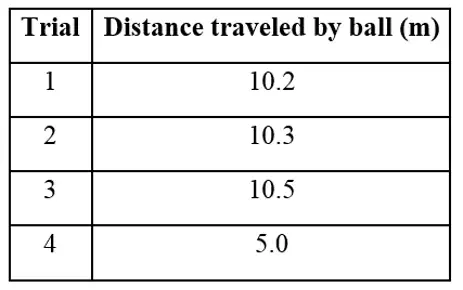
A science class was investigating how far a ball could be thrown. The table below shows their results. Based on the class’s data, how can they improve the accuracy of the investigation?
Do more trials.
Use a different ball.
Omit trial 4 from the data.
Average the data to account for the short distance in trial 4.
Why do many experiments include several trials as opposed to a single trial?
Repetition of trials makes data easier to analyze.
Repetition of trials increases the sample size of the data.
Repetition of trials lets the experimenter spend less time making observations.
Repetition of trials lets the experimenter change procedures to make the experiment simpler.
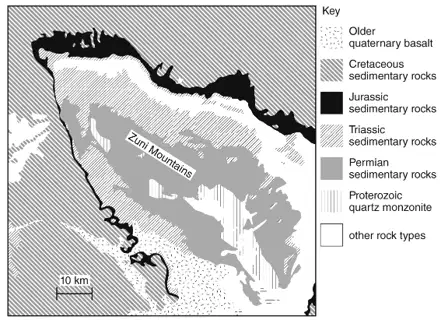
Examine the map shown in the figure below. Some of the information used to create the map was most likely gathered during what type of investigations?
fieldwork by geologist working in the area
biologists observing the animals in the area
laboratory experiments done far away from the area
surveys of people living in the area
A microbiologist investigates the outbreak of an unknown illness, which is thought to be caused by a new strain of bacteria. Doctors have determined the bacteria are located in the lungs. Initial work on treating the illness is dependent upon analysis of the bacteria. Which investigational method should the microbiologist use to start the process to analyze the bacteria?
Review the patients' medical charts.
Interview people who have become sick.
Review the treatment medications and their effectiveness.
Take samples of the bacteria and grow cultures in a lab setting.
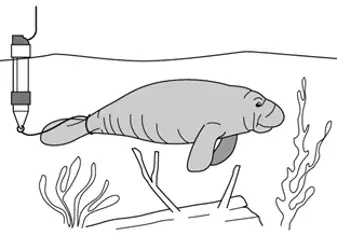
Biologists study the migration patterns of the Florida manatee. To gather evidence, they sometimes put radio tracking devices on the manatees. The picture shows a manatee wearing such a device. The belt that holds the device on the manatee is designed to be breakable. Why would biologists design a belt that would break in certain situations?
to discourage other animals from coming near the manatees
to destroy a tracking device the biologists consider to be faulty
to prevent manatees from being trapped if the device snags on something
to avoid collecting information on a manatee that migrates outside its range
More than 2,000 years ago, in about 400 BCE, Democritus proposed that all matter is made up of atoms. Scientists have revised the atomic theory many times since Democritus first used the word atom. Why has the atomic theory changed over time?
The feelings of scientists changed over time.
After new, relevant evidence emerged, scientists reevaluated the theory.
Other scientists interpreted Democritus' evidence differently.
Theories always change over time.
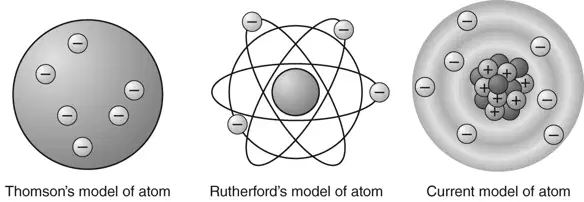
The figure below shows how the view of an atom changed over time. Why did this scientific knowledge change over
time?
Thomson, Rutherford, and current scientists have different opinions of atoms.
New empirical evidence lead to modifications of exisiting models.
Older models were based on opinions, whereas current models are based on facts.
Thomson and Rutherford's ideas were completely incorrect.
In 1897, Joseph Thomson discovered that atoms contained electrons. He proposed a change in the atomic theory of that time, and the theory was modified because of his discovery. Since Thomson’s discovery, atomic theory has been further modified. What is the best explanation for why scientific theories are modified?
Theories more than five years old are out of date.
New evidence that supports a revision prompts scientists to modify the earlier theories.
Scientists want to prove that the work of other scientists is wrong.
So much information is available today that it is harder to focus research and disproves theories.
The theory of evolution describes how organisms change over time. Scientists now use information in the DNA of living organisms to understand how they are related. The theory of evolution was developed before scientists discovered DNA; however, the theory supports these new data. What does this sequence of events tell us about the theory of evolution?
It is a bad theory because it makes scientists biased.
It is a good theory because it has changed greatly over time.
It is a good theory because it is able to explain new evidence.
It is a bad theory because it was formed before the discovery of DNA.
During a class project, Felicia makes a poster to compare scientific laws and scientific theories. Which of the following statements should Felicia include on her poster to summarize the difference between scientific laws and scientific theories?
Scientific theories explain why something happens, and scientific laws describe what happens.
Scientific theories require scientific evidence and scientific laws do not.
Scientific theories are based on observations, and scientific laws are based on opinions.
Scientific laws are frequently modified, but scientific theories are rarely changed as new information becomes available.
Which of these answers describes a scientific law?
An interesting idea based on various scientific opinions
A well-supported and widely accepted explanation of nature
A specific relationship under given conditions in the natural world
An explanation of why particular events happen in the natural world
Joe tells Mai his theory about why sea turtles nest on the beach instead of in the ocean. He says, “The turtle eggs would sink to the bottom of the ocean, and the baby turtles would drown.” Joe says his uncle is a fisherman, who told Joe this information. Mai tells Joe that his theory is not scientific. Which explanation supports Mai’s evaluation of Joe’s theory?
Joe's idea is already a scientific law.
Joe's idea is not supported by scientific evidence.
Joe's idea is a good guess that can be tested by experiments.
Joe's idea accurately explains why sea turtles nest on the beach.
In which statement does the word theory mean scientific theory?
In theory, the experiment will work as planned.
She has a theory about why the storm arrived later than predicted.
The atomic theory explains that materials are made up of atoms.
The doctor's prescription for curing a cold is based on his best theory or guess.
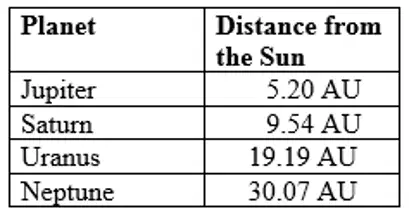
Astronomers measure distances in the Solar System in astronomical units (AU). Earth is 1 AU from the sun. The table below shows information about the distances of the gas giant planets from the sun. Which gas giant planet is about 10 times farther from the sun than Earth is?
Jupiter
Saturn
Uranus
Neptune
The bodies of space can be classified based on their relative sizes. Which of the following generally lists the bodies of space in order from smallest to largest?
universe, moon, galaxy, solar system, star, planet
star, galaxy, planet, moon, solar system, universe
moon, planet, star, solar system, galaxy, universe
galaxy, universe, moon, planet, star, solar system
A light-year (ly) is the distance light travels in one year. If a star is 218 ly away from Earth, how long does it take that star’s light to travel far enough to reach Earth?
218 minutes
218 hours
218 years
218 light years
Space exploration has advanced our knowledge of the universe. Which space journey would take the longest?
A journey from Earth to the moon
A journey from Earth to the dwarf planet, Pluto
A journey from Earth to the next closest star, Proxima Centauri
A journey from Earth to the next galaxy, Andromeda
Scientists use the light-year to describe the relationships between bodies in space. What does a light-year measure?
the distance that light can travel in one year
the brightness of light traveling through space
the number of years it takes light to travel to Earth
the time it takes light to travel 1 million km
Which two objects in space are farthest apart?
Earth and Pluto
Sun and Proxima Centauri (next closest star)
Earth and the moon
the Milky Way Galaxy and the Andromeda Galaxy
What would be the best unit to describe how big the universe is?
millions of kilometers
millions of astronomical units (A.U.)
millions of miles
millions of light years (l.y.)
The Milky Way Galaxy contains…
all of the stars in the Universe.
billions of stars but not the objects in orbit around them.
billions of stars and the objects in orbit around them.
only the objects found in the Solar System.
There are _______ of galaxies in the _______.
millions; solar system
billions; solar system
millions; universe
billions; universe
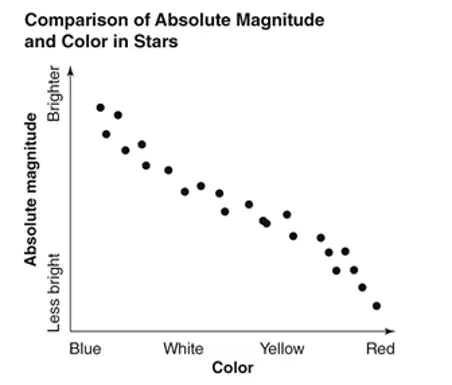
Which of the following statements best correlates a star’s color and relative temperature?
A blue star has a relatively low temperature.
A red star has a relatively high temperature.
A blue-white star has a relatively low temperature.
A yellow star has a relatively low temperature.
Gloria is at the observatory and is examining a newly discovered star through a powerful telescope. She wants to find out how bright the star actually is. What information does she need to calculate the absolute magnitude of a star?
color and temperature of the star
composition and motion of the star
apparent magnitude and distance from Earth
color and distance from Earth
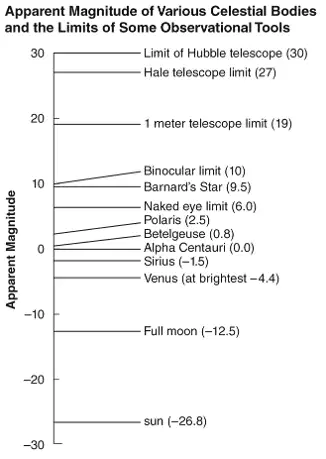
The following chart describes the apparent magnitude of various objects in the sky. Which of the following can be concluded from the information in the chart?
The Sun has the greatest absolute magnitude of the objects listed.
Sirius’ apparent magnitude is greater than Betelgeuse’s but dimmer than Alpha Centauri’s.
No tool is listed that can see objects with an apparent magnitude greater than 30.
People can see all of the celestial bodies listed in the chart without using any special tools.
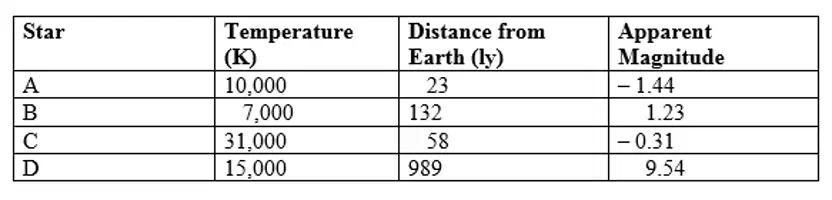
Natasia examined a chart listing the characteristics of four stars. Which star would look the dimmest from Earth’s surface?
Star A
Star B
Star C
Star D
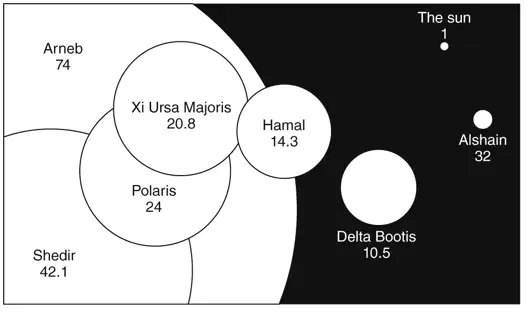
Solar radius is used to measure the size of stars. Using the chart, identify which of the following statements is true about star size.
Hamal is 14 times smaller than the sun.
Polaris is a smaller star than Xi Ursa Majoris.
Arneb is 74 times larger than the sun.
Hamal is smaller star than Delta Bootis.
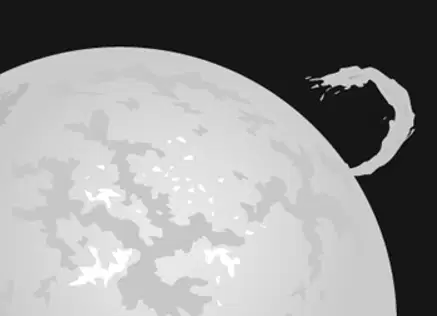
Here is an image of the sun. Which of these choices best describes what is seen in this picture of the sun?
Aurora
Prominence
solar flare
sunspot
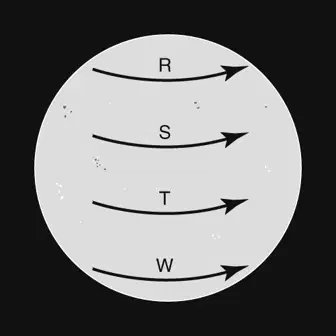
The sun does not rotate in the same way the Earth does. Different parts of the sun rotate at different speeds. The figure below shows the rotation of the sun. Which arrow shows the parts of the sun that rotates the fastest?
R and W
S and T
T and W
R and S
A satellite took x-ray pictures of a solar flare. How did the solar flare most likely appear on the x-ray pictures?
as a dark spot
as a swirl of red flames
as a flamelike projection
as an area of bright white light
Dark areas can form in the photosphere of the sun. These areas are cooler than surrounding areas. They also have a strong magnetic field. Which term best describes these dark areas?
a sunspot
solar wind
a solar flare
a prominence
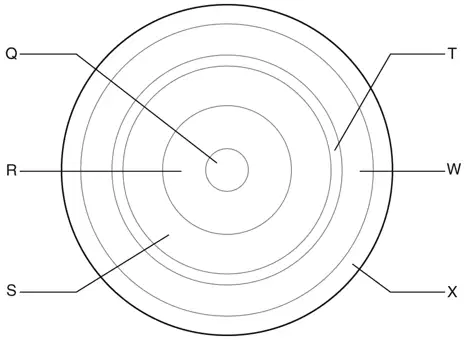
The diagram below shows the different layers of the sun. The sun can be divided into six layers that are different from each other based on certain characteristics, such as temperature and composition. Which layer of the sun is represented by letter T?
Chromosphere
Corona
Photosphere
radiative zone
Which statement is true about gas giants?
Gas giants must form close to the sun in order to contain deep, gaseous atmospheres.
Gas giants have gaseous cores and rocky surfaces because the planets are far from the sun
Gas giants contain no rock or metals because the planets are too cold for these materials to condense.
Gas giants have deep, gaseous atmosphere because the planets are far enough from the sun that the gases could condense around the rocky core.
The distance between objects along with the masses of the objects affect the gravitational force between the objects. Which statement is true according to Newton’s law of universal gravitation?
When the masses of objects increase, gravitational force decreases.
When distance between objects increases, gravitational force decreases.
When distance between objects decreases, gravitational force decreases.
When the masses of objects decrease, the distance between objects decreases.
Cara is explaining to her sister how the solar system formed. Which description would she use to explain the solar nebula?
a rotating cloud of dust and gas
a disk of material surrounding a young star
a small body from which a planet originates
a rocky core surrounds by a deep atmosphere of gas and ice
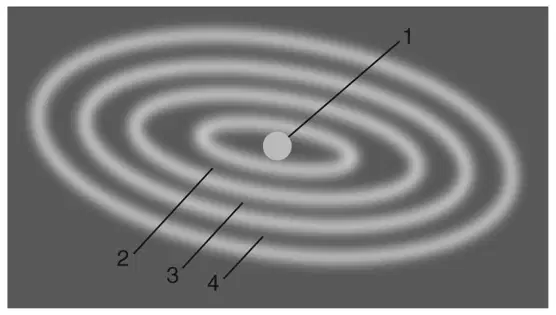
The diagram below shows a solar nebula. At which location is a terrestrial planet most likely to form?
1
2
3
4
Pluto's orbital year is 248 years long. That means that Earth with go around the sun 248 times while Pluto will orbit the sun once. Why is a year for this dwarf planet so long?
Pluto's orbit is the most elliptical orbit in the solar system
Pluto's atmosphere is very thin compare to the rest of the planets
Pluto's rotational speed is very fast compared to the rest of the planets
Pluto's orbit is one of the longest in the solar system
The planets in the Solar System have a wide range of temperatures. Earth’s temperatures range from about –88 °C to about 58 °C. How do the temperatures on Mercury compare to Earth’s temperatures?
much hotter
much colder
slightly cooler
slightly warmer
Many historical models of the Solar System were geocentric. Which of these phrases describes a heliocentric solar system?
the sun as a reference point
existing in a star system
Earth as a reference point
circular, orbital path of travel
In the diagram below, the South Hemisphere is tilted toward the sun. Which statement is true about the solar energy received when the South Hemisphere is tilted toward from the sun?
The Southern Hemisphere receives less direct solar energy and is cooler
The Southern Hemisphere receives less direct solar energy and is warmer.
The Southern Hemisphere receives more direct solar energy and is cooler.
The Southern Hemisphere receives more direct solar energy and is warmer.
What two factors impact the length of a season?
Earth's rotational speed and Earth's position in its orbit around the sun
Earth's tilt relative to the moon and Earth's rotational speed
Earth's tilt relative to the sun and Earth's position in its orbit around the sun
Earth's tilt relative to the sun only
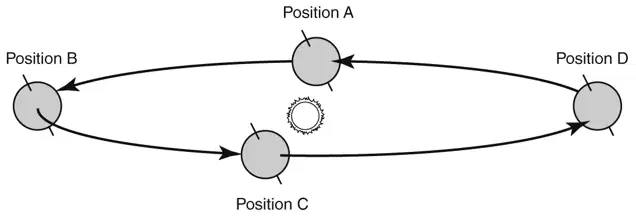
The part of Earth that is tilted toward the sun changes throughout the year, as shown in the diagram below. In which position is Earth when the Northern Hemisphere is experiencing winter?
Position A
Position B
Position C
Position D
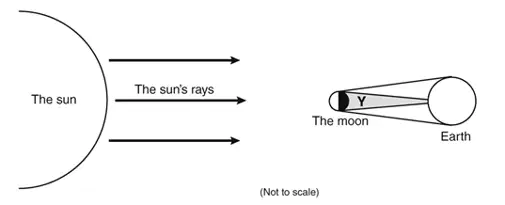
What solar system event takes place when Earth, the sun, and the moon are aligned as shown in the diagram below? Which solar system event is happening?
a solar eclipse
a lunar eclipse
a first quarter moon
a third quarter moon
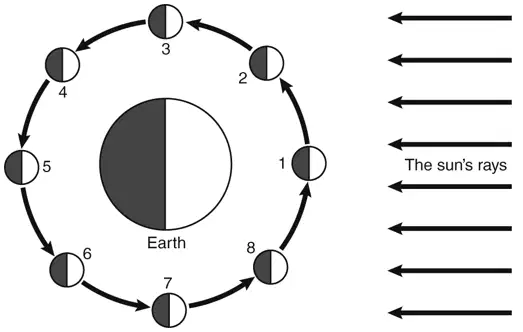
Although half of the moon is always illuminated, usually only a portion of the illuminated side is visible from Earth. The diagram below presents the relative positions of Earth, the sun, and the moon. The positions of the moon are labeled 1–8. Which of the moons in the figure are waxing moons?
2 and 4
2 and 8
4 and 6
6 and 8
Augustin observes the moon every 3 days for 15 days. He notices that over this 15-day period, the moon looks different. What accounts for the differences in the appearance of the moon over this time period?
the speed of the moon's orbit
the position of Augustin
the distance between Earth and the moon
the position of the moon in its orbit around Earth
During which two phases of the moon do spring tides take place?
new moon, full moon
new moon, first quarter moon
third quarter moon, full moon
first quarter moon, third quarter moon
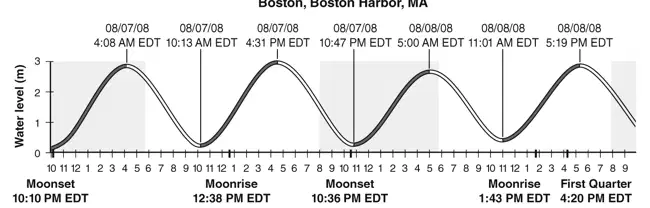
The graph below shows tides in Boston Harbor. Which statement best explains the shift in times of high and low tides each day?
The moon rises and sets later each day.
The sun rises and sets later each day.
The moon rises and sets earlier each day.
The sun rises and sets earlier each day.
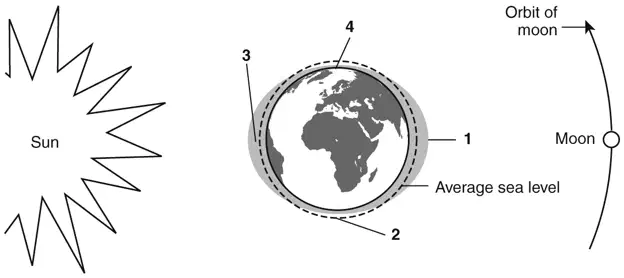
The diagram below shows the alignment of the sun, the moon, and Earth. In which locations are neap tides taking place?
1 and 2
1 and 3
2 and 4
3 and 4
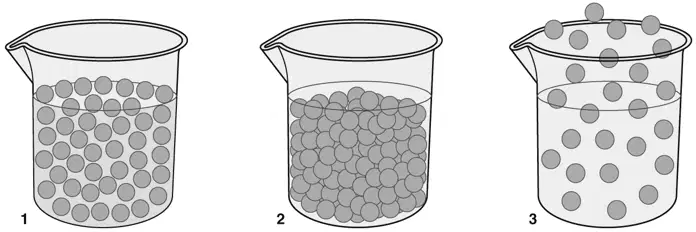
Tyson draws a model to show how the particles in a liquid appear. Which model (or models) above could be Tyson’s drawing of particles in a liquid?
model 1
model 3
model 1 and model 2
model 1, model 2, and model 3
How can the motion of the particles in a gas best be described?
particles that are far apart and do not move
particles that are close together and vibrate in place
particles that are close together and slide past each other
particles that are far apart and move rapidly in all directions
Nora notices water droplets on the grass in the morning. It did not rain during the night. How can the water particles in the air form water droplets on the grass during the night?
Energy was added to the water particles, causing them to move farther.
Energy was added to the water particles, causing attraction that makes them move closer together.
Energy was taken away from the water particles, allowing them to move farther apart.
Energy was taken away from the water particles, allowing them to move closer together.
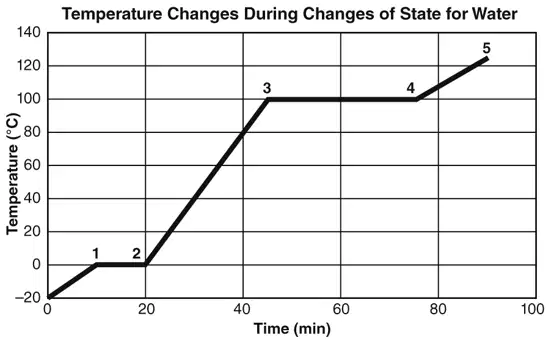
Adnan measures the temperature of water as it changes states. He makes a graph of his data. He wants to add the properties of water that exist at each part of his graph. What labels can he add to the line between point 4 and point 5?
definite volume, definite shape
definite volume, changes shape
changes volume, definite shape
changes volume, changes shape
Jamal found a solid substance that is shiny, malleable, and a good conductor of thermal energy. Which of the following kinds of elements have properties similar to those of the substance Jamal found?
Gases
Metalloids
Metals
Nonmetals
Webb is testing samples of different elements. One sample is a dull, yellow solid that breaks into powdery pieces when he hits it with a hammer. How should Webb classify the yellow solid?
as a gas
as a nonmetal
as a metal
as a metalloid
Which of the following describes how elements are arranged in the periodic table?
by decreasing atomic mass
by increasing atomic number
by chemical name
by repeating atomic number
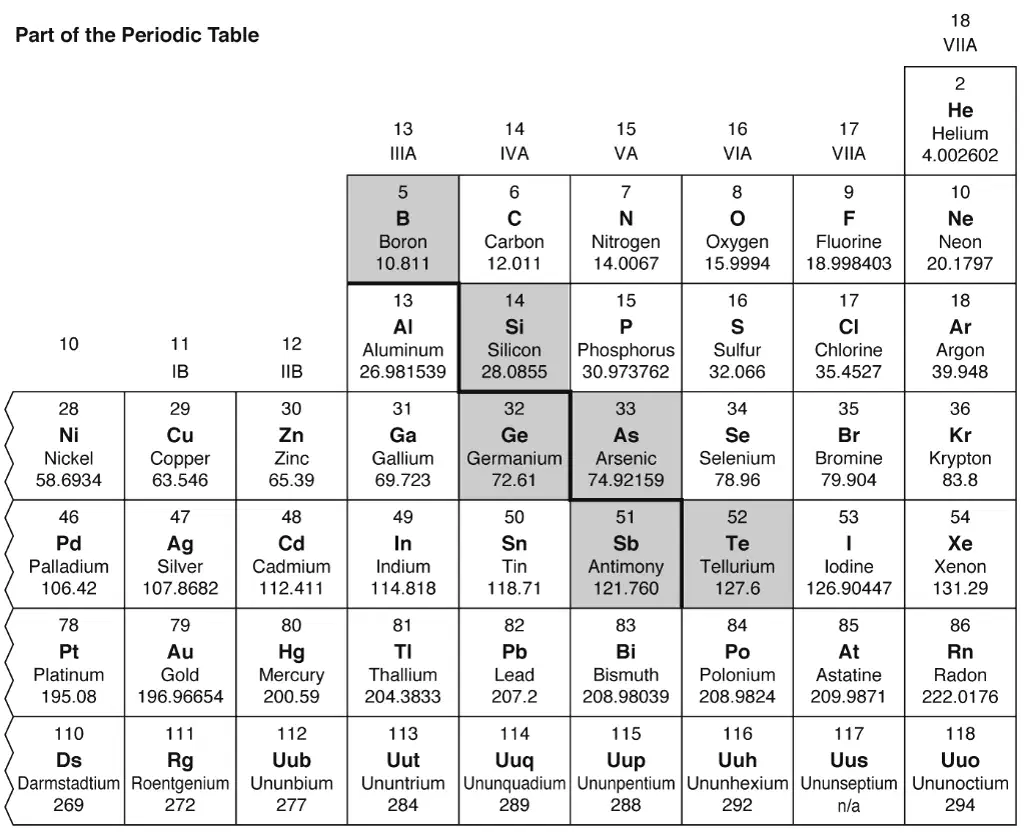
Find chlorine and bromine in this section of the periodic table. What is true about these two elements?
They both are metalloids.
They are in the same period.
They have the same average atomic mass.
They are in the same group.

Which of the following information if false?
The atomic number for Silicon is 14.
The mass number for Silicon is 14.
The mass number for Silicon is 28.086.
The number of protons in an atom of Silicon is 14.

Each element is made up of different atoms. The table below compares two elements. What do the elements in the table have in common?
Atoms in each element have 10 nuclei.
Atoms in each element have 10 protons.
Atoms in each element have 10 neutrons.
Atoms in each element have 10 electrons.
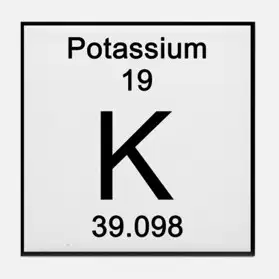
How many protons, neutrons, and electrons does the element Potassium have?
19 protons, 19 neutrons, 19 electrons
19 protons, 20 neutrons, 19 electrons
19 protons, 39 neutrons, 19 electrons
39 protons, 19 neutrons, 39 electrons
Look at the pairs of particles listed. Which pair has masses that are most similar?
neutron and proton
electrons and proton
nucleus and neutron
electron and neutron
Which of the following is incorrect?
Protons have a positive charge.
Neutrons have no charge.
Electrons have an electrical charge.
Electrons have a negative charge.

Some compounds are classified as acids or bases. The pH scale shows how acidic or how basic these compounds are. The lower the pH, the more acidic a compound is. The higher the pH, the more basic it is. Sodium hydroxide, a compound commonly found in drain cleaners, has a pH of 13. Which of these phrases describes sodium hydroxide?
highly basic
highly acidic
slightly basic
slightly acidic
What are pure substances?
elements and mixtures
elements and compounds
compounds and mixtures
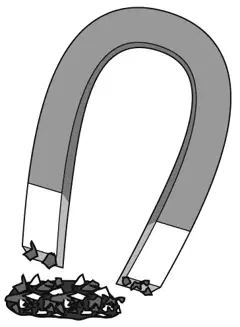
A magnet was placed near a pile that contained both iron and sulfur. The magnet was moved gradually closer to the pile. As it neared the pile, the magnet started attracting small pieces of iron from the pile. Which of these statements best describes the contents of the pile?
It is a homogeneous mixture of iron and sulfur.
It is a heterogeneous mixture of iron and sulfur.
It is a compound that contains both iron and sulfur.
It is a compound that can be separated by magnetism.
Solution is another name for what type of matter?
element
compound
homogeneous mixture
heterogeneous mixture

