
Font size
 Worksheets
Forces and States of Matter
Total questions: 117
Worksheet time: 1hrs 20mins
Matter with a set volume and shape
Solid
Liquid
Gas
Matter with a set volume but no set shape
Solid
Liquid
Gas
Matter with no set volume and no set shape
Solid
Liquid
Gas
To group together based on similar traits
classify
freezing
melting
The change in state from liquid to solid
classify
freezing
melting
The change in state from solid to liquid
classify
freezing
melting
A change in position
motion
push
pull
A force that causes something to move closer.
motion
push
pull
A force that causes something to move away.
motion
push
pull
A push or a pull
motion
force
classify
a pushing or pulling force produced by a magnet
push
pull
magnetism
solid
to push away
repel
attract
to pull together
repel
attract
the force that causes objects with mass to attract each other
gravity
magnetism
push
melting
"A body at rest tends to remain at rest, and a body in motion, tends to remain in motion, unless acted upon by an unbalanced force."
This is describing the law of
forces
inertia
velocity
gravity
Water (H2O), is not found on the periodic table because water is a...
atom
liquid
mixture
compound

Looking at the image. Decide if this is balanced or unbalanced.
Unbalanced
Balanced
Weight can be defined as
A measure of the amount of matter in an object
A push or a pull that causes objects to move, change position or experience tension or compression.
The amount of matter in a given space. (mass/volume)
A measure of the force of gravity on an object
Mass is
A measure of the amount of matter in an object
A push or a pull that causes objects to move, change position or experience tension or compression.
The amount of matter in a given space. (mass/volume)
A measure of the force of gravity on an object
Gravity's definition is
A measure of the force of gravity on an object
A push or a pull that causes objects to move, change position or experience tension or compression.
The amount of space an object takes up
A force of attraction between objects that is due to their masses and distance to each other.
Volume can be defined as
A measure of the force of gravity on an object
A push or a pull that causes objects to move, change position or experience tension or compression.
The amount of space an object takes up
A force of attraction between objects that is due to their masses and distance to each other.

acting or going in the reverse direction
Opposite
Same
Cause
Effect

how fast an object is moving
Speed
Velocity
Force
Friction

speed in a particular direction
Velocity
Friction
Mass
Kinetic Energy

the amount of matter that makes up an object
Mass
Matter
Energy
Force

the energy that an object has because it is moving
Kinetic Energy
Collision
Friction
Speed

to reach a conclusion using evidence and reasoning
Infer
Opposite
Equal
Effect

a force between an object and the surface it is moving over
Friction
Kinetic Energy
Collision
Speed

a push or a pull that can change the motion of an object
Force
Velocity
Exert
Mass

to apply a force
Exert
Effect
Infer
Energy
Which word explains why my blender blade will still spin right after I turn off my blender?
Acceleration
Inertia
Gravity
Which would be easier to stop: a car loaded with watermelons or a car loaded with sunflower seeds?
Watermelons
Sunflower seeds
They would stop at the same time.
What’s the main difference between inertia and momentum?
Momentum deals with how hard it is to change movement. Inertia deals with how hard it is to stop movement.
Inertia deals with how hard it is to change movement. Momentum deals with how hard it is to stop movement.
They mean the same thing.
Finish this formula:
Force =
momentum x acceleration
mass x acceleration
mass x velocity
Potential energy is stored energy.
Which of these is a good example of stored energy?
The glow from a snapped glowstick. (Light energy)
A lit match. (Thermal energy)
A battery. (Chemical energy)
When a bowling ball hits the pins, this is an example of a ______.
Variable
Collision
Decrease
Speed
When two objects with different sizes collide, what happens during the collision?
The larger object always stops
The smaller object always stops
Energy is transferred between the objects
Both objects disappear
True or False: When two objects collide, they always stick together.
True
False
Which of the following can NOT produce energy?
Humans
Air
Water
Garden
True or False: A magnet is attracting when it pushes objects away from each other.
True
False
How can magnets cause objects to have kinetic energy?
A magnetic force can convert kinetic energy stored in a magnetic field to potential energy.
Kinetic energy can convert potential energy stored in a gravitational field.
A magnetic energy can convert potential energy stored in a gravitational field to kinetic energy.
A magnetic force can convert potential energy stored in a magnetic field to kinetic energy.
The ability to make things move or change
Transfer
Energy
Repel
Convert
The energy something has because it's moving.
kinetic energy
potential energy
magnetic energy
force
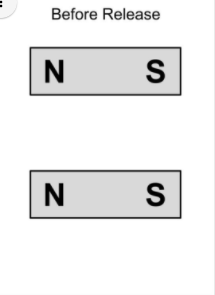


A child moves a blue magnet towards the red magnet that cannot move. What happens to the potential energy in the system of magnets?
Potential energy decreases because the blue magnet train moves in the same direction as the magnetic force.
Potential energy decreases because the blue magnet train moves against the magnetic force.
Potential energy increases because the blue magnet train moves against a magnetic force.
Potential energy does not change because the magnets in the system do not change.
A group of atoms that has all like poles pointing in the same direction are called
magnetic forces
magnetic fields
magnetic domains
magnetic poles
The place on a magnet where the force it exerts is the strongest is called
a magnetic pole
a magnetic field line
a domain
What is the magnetic attraction or repulsion of a magnet called?
the magnetic domain
the magnetic field
the magnetic pole
the magnetic force
Which type of magnet loses magnetism outside of a magnetic field?
a strong magnet
a temporary magnet
a permanent magnet
an electromagnet
Which item would the magnetic domains be the most unaligned?
glass jar
steel nail
bar magnet
Which item would have the most aligned domains?
a pencil eraser
an iron railing
an aluminum can
Which type of magnet does not lose it's magnetic properties easily.
a permanent magnet
an electromagnet
a temporary magnet
a nail rubbed across the north pole of a magnet
The space in which the magnetic effects exists is called
the magnetic field
the magnetic equator
the magnetic material
Paper clips and staples are attracted to magnets because paper clips and staples are
permanent magnets
temporary magnets
magnetic materials
magnetic domains
What are the two magnetic forces?
attraction
equilibrium
magnetic acceleration
repulsion


The history of Magnet is from...
Lodestone
Red stone
Magnetized
Black stone
How does the amplitude of a soundwave affect its loudness?
Higher amplitude produces a louder sound
Amplitude affects the pitch of the soundwave
Amplitude has no effect on loudness
Lower amplitude produces a louder sound
Explain the concept of frequency in relation to soundwaves.
The color of the sound
The temperature of the sound
The number of cycles of a wave that occur in a second
The size of the sound
How are soundwaves used in medical imaging?
CT scan imaging
X-ray imaging
MRI imaging
Ultrasound imaging
What are some common applications of ultrasonic waves?
Playing music
Cooking food
Transportation
Medical imaging, industrial testing, and cleaning
How are soundwaves used in communication systems?
By using them to cook food
By converting them into light
By creating earthquakes
By transmitting information through the air or other mediums.
What are the properties of soundwaves that make them suitable for use in music and entertainment?
Soundwaves have properties such as taste, smell, and temperature that allow for the creation of different sensory experiences, making them suitable for use in music and entertainment.
Soundwaves have properties such as frequency, amplitude, and timbre that allow for the creation of different pitches, volume levels, and tones, making them suitable for use in music and entertainment.
Soundwaves have properties such as weight, density, and volume that allow for the creation of different physical sensations, making them suitable for use in music and entertainment.
Soundwaves have properties such as color, texture, and shape that allow for the creation of different visual effects, making them suitable for use in music and entertainment.
Soundwaves move faster through ________.
Solid
Liquid
Gas
Plasma
What type of energy does a sound wave have?
Mechanical
Radiant
Electrical
Sound
Sound is produced by -----
Heat energy
Low temperatures
Vibrations
Friction
True or False: Sound needs a medium.
True
False
Sound waves are also known as ----- waves.
Compression
Longitudinal
Neither
Both longitudinal and compression
True or False: Sound waves are faster than light.
False
True

Areas of increased pressure on a sound wave are known as a ----
Rarefaction
Compression
Frequency
Amplitude

The distance from the beginning of one compression to the beginning of the next compression is called a -----
Rarefaction
Frequency
Wavelength
Compression

Spread out areas or areas of decreased pressure on a sound wave are known as a ---
Rarefaction
Amplitude
Compression
Hertz
The number of wavelengths that pass a fixed point each second is known as ----
Hertz
Amplitude
Frequency
The unit for measuring frequency is the ---
Joule
Hertz
Gram
Newton

The measure of the amount of energy in a wave is ----
Wavelength
Hertz
Frequency
Amplitude
The Tacoma Narrows Bridge, musical instruments, and crystal stemware are examples of -----
Frequency
Resonance
Interference
Speed
The speed of sound depends on these two things:
The type of medium and the temperature of the medium
Speed of the medium and temperature of the medium
Temperature of the medium and sound of the medium
None of the above
Sound waves travel the fastest through ---
Liquids
Gases
Solids
Sound waves that are beyond the range of human ear are known as ----
Infrasonic waves
Ultrasonic waves

Sonar and echolocation use ----- to detect objects under water.
Refraction
Reflection

What is the arrow showing?
Amplitude
Wavelength
Trough
Direction of sound

What is this arrow showing?
trough
amplitude
wavelength
equilibrium
What is a device for viewing soundwaves?
oscilloscope
microscope
barometer
octoscope

Place the waves in order from highest pitch to lowest pitch.
4, 3, 2, 1
1, 2, 4, 3
4, 2, 1, 3
3, 2 ,1 ,4
True or False: Frequency and Pitch are the same thing.
True
False
High pitch sounds have wavelengths that are
(a)
Low pitch sounds have wavelengths that are
(a)

What is the black vertical line displaying?
crest
trough
pitch
equilibrium
Sound is a form of energy caused by....
conduction
convection
radiation
Vibration
Which of the following does not allow sound waves to propagate?
vacuum
liquid
solid
gas
Which of the following affects the pitch of sound?
Loudness of sound
Amplitude of sound
Reflection of sound
Frequency of sound
What is the speed of sound in air at room temperature?
343 m/s
299,792 km/s
1,480 m/s
3,000 m/s
Which of the following materials will sound travel through the fastest?
Air
Water
Steel
Vacuum
What is the term for the number of sound wave cycles per second?
Amplitude
Frequency
Wavelength
Velocity
Which part of the human ear is responsible for converting sound waves into electrical signals?
Eardrum
Cochlea
Auditory Canal
Pinna

