
NEW
Font size
 Worksheets
2025 - 2026 | ASTRONOMY MIDTERM EXAM
Total questions: 59
Worksheet time: 30mins
Zenith refers to:
The point directly overhead at 90° altitude
The north direction on the horizon
The ecliptic's intersection with the equator
The lowest point below the horizon
The ecliptic is:
The projection of Earth's equator onto the celestial sphere.
The apparent path of the Sun, Moon, and planets across the sky.
The boundary line for circumpolar constellations.
The angular measurement from the horizon.
A constellation is officially defined as:
A random grouping of bright stars.
A region of the sky with fixed boundaries.
The path of the Sun through the sky.
An imaginary line connecting the equator to the poles.
Astronomy is primarily the scientific study of:
Earth's weather patterns and atmosphere
Everything in the universe beyond Earth's atmosphere
Geological formations on planets
Biological life in outer space
Cosmology is the study of:
Star patterns and navigation
The origin, structure, and evolution of the universe
Planetary motions and orbits
Earth's rotation and tilt
Which two imaginary lines cross each other during both equinoxes?
The north and south celestial poles
The ecliptic and celestial equator
The celestial equator and geographical equator
The equator and prime meridian
In 1928, how many constellations were officially recognized by the IAU?
44 in the Northern Hemisphere only
88 (44 in each hemisphere)
12 along the path of the ecliptic
24 along the path of the celestial equator
From here on Earth, the Sun, Moon, and planets seem to follow a path across the sky, known as the ecliptic. In reality, it is actually -
The imaginary projection of Earth's equatorial plane.
Earth's orbit around the Sun that is projected onto the sky.
Earth's rotation around Wise axis.
The imaginary projection of Earth's prime meridian.
Which star is known as the second North Star?
Rigel
Vega
Betelgeuse
Dubhe
An asterism can be found:
Within a constellation, or among stars from different constellations.
Only within a constellation.
Only outside of a constellation.
Within a constellation with more than 20 stars.
Historians and archaeologists believe Stonehenge, located in southeast England, was built as an astronomical calendar used to observe both the -
A. Summer and Winter Solstice
B. Spring and Autumn Equinox
C. Spring and Autumn Solstice
D. Summer and Winter Equinox
What three aspects of everyday life did ancient cultures use their observations of the sky to track?
Keeping track of time
Marking the change in seasons
Developing tools for navigation
All of the above
The Earth-centered model of the solar system is known as:
The Geocentric Model of the solar system
The Heliocentric Model of the solar system
The Astrometric Model of the solar system
The Metrocentric Model of the solar system
The Sun-centered model of the solar system is known as:
The Heliocentric Model of the solar system
The Geocentric Model of the solar system
The Astrometric Model of the solar system
The Metrocentric Model of the solar system
The word “planet” is derived from the Greek word “planētes” which means
A. "wanderer"
B. "traveler"
C. "messenger"
D. "warrior"
Which of these ancient Greek astronomers designed the first geocentric model of the solar system?
A. Aristotle
B. Aristarchus
C. Socrates
D. Plato
The first modern astronomer to develop a Sun-centered model of the solar system.
Nickolaus Copernicus
Issac Newton
Galileo Galilei
Albert Einstein
Used actual scientific evidence to support a sun-centered model of the solar system.
Galileo Galilei
Aristotle
Isaac Newton
Albert Einstein
Which of these is NOT one of the points Copernicus made in support of heliocentrism?
Only the Sun rotates on an axis.
The Earth is not at the center of the Solar System.
All planets revolve around the Sun and not the Earth.
The Moon is the only body that orbits the Earth.
Galileo helped prove that the Sun was at the center of the solar system by studying the phases of which planet?
Venus
Jupiter
Mercury
Mars
The protoplanetary disc is believed to be where:
Planets form by accumulating nearby material
Stars first ignite
Moons escape planetary gravity
Asteroids are destroyed
One piece of evidence we see today supporting the formation of planets within the protoplanetary disk is the similarity in all the planets’
Orbits
Size
Age
Temperature
High-speed collisions between planetesimals led to:
Fragmentation and the formation of numerous proto-moons
The destruction of all protoplanets
The end of the Solar System
Immediate planet formation
The smallest fragments that escaped capture by planets became:
Asteroids
Moons
Comets
Stars
One Astronomical Unit (AU) is equal to:
The average distance between Earth and the Sun
The distance from the Sun to Jupiter
The speed of light
The diameter of the Sun
Light time in astronomy refers to:
How long it takes light or electromagnetic radiation to reach Earth
The time it takes for planets to orbit
The lifespan of a star
The delay in satellite launches
Why is one day added to the month of February every four years?
To honor historical figures such as Julius Caesar.
To synchronize the calendar with Earth's orbit and the seasons.
To adjust for the Earth's slowing rotation.
To ensure all months have the same number of days.
The point in Earth's orbit where one pole is tilted toward the Sun is known as a?
Aphelion
Perihelion
Solstice
Equinox
The point in Earth's orbit where neither pole is tilted toward the sun, and most locations on Earth receive equal hours of daylight and darkness is known as?
Aphelion
Perihelion
Solstice
Equinox
The lunar cycle begins and ends with which lunar phase?
The New Moon
The Full Moon
The First Quarter Moon
The Last Quarter Moon
The synchronous rotation of the Moon with Earth means:
It does not rotate at all.
It rotates faster than Earth.
It wobbles unpredictably.
It rotates once per orbit, so we always see the same side.
At latitudes near the equator, the average number of daylight hours
are more consistent from month to month
varies greatly from month to month
exactly 24 hours year-round
exactly 6 hours year-round
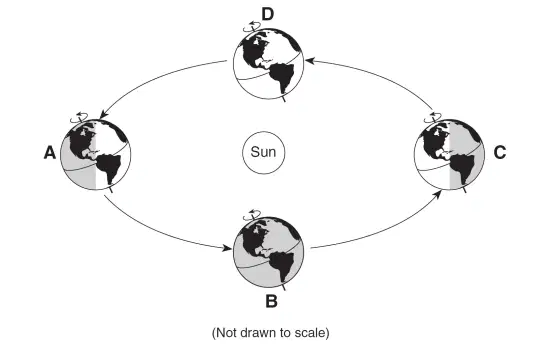
Which season is the Southern Hemisphere experiencing at Point C?
Summer
Winter
Spring
Autumn (Fall)
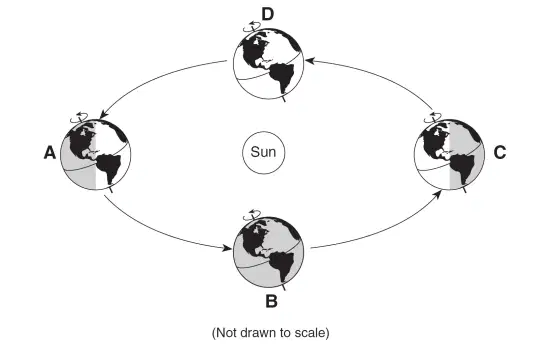
Which hemisphere is experiencing a polar night at Point A?
Southern Hemisphere
Northern Hemisphere
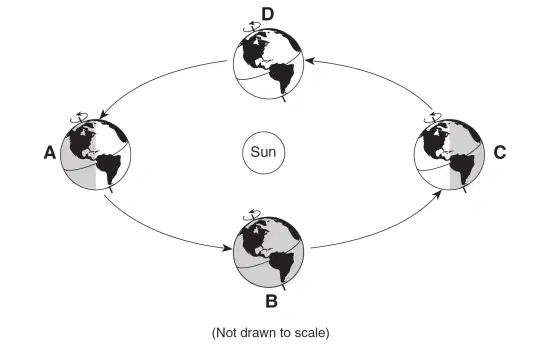
Which season is the Northern Hemisphere experiencing at Point D?
Spring
Autumn (Fall)
Winter
Summer
Which season is the Northern Hemisphere experiencing at Point B?
Spring
Autumn (Fall)
Winter
Summer
Which season is the Southern Hemisphere experiencing at Point D?
Spring
Autumn (Fall)
Winter
Summer
Which season is the Southern Hemisphere experiencing at Point B?
Spring
Autumn (Fall)
Winter
Summer
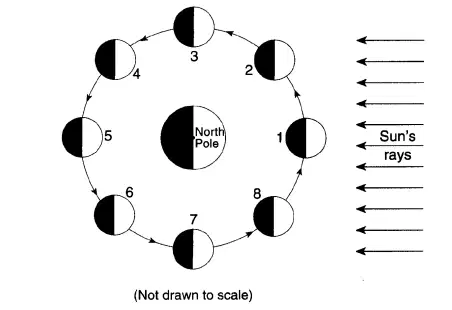
Which lunar phase would be visible from Earth at Point 1?
New Moon
Full Moon
First Quarter
Third Quarter
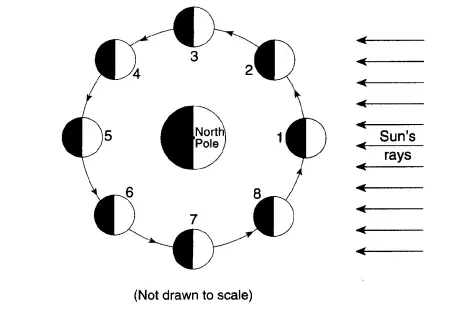
Which lunar phase would be visible from Earth at Point 5?
New Moon
Full Moon
First Quarter
Third Quarter
Which lunar phase would be visible from Earth at Point 3?
New Moon
Full Moon
First Quarter
Third Quarter
Which lunar phase would be visible from Earth at Point 7?
New Moon
Full Moon
First Quarter
Third Quarter
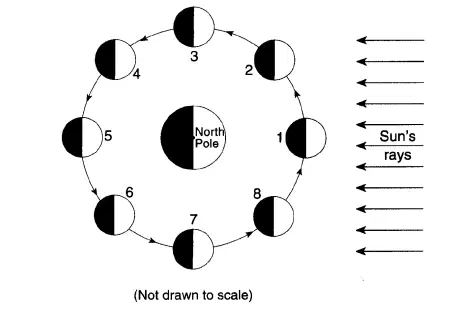
As the moon orbits from Point 5 to Point 1, the light on the surface of the moon is -
increasing
decreasing
As the moon orbits from Point 1 to Point 5, the light on the surface of the moon is -
increasing
decreasing
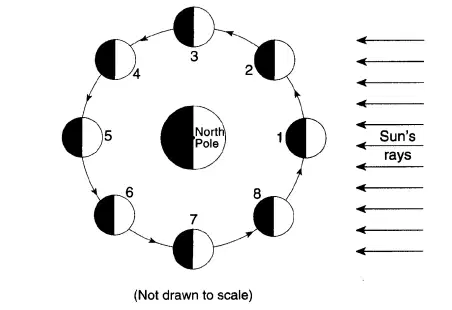
Which lunar phase would be visible from Earth at Point 6?
Waning Crescent
Waxing Crescent
Waning Gibbous
Waxing Gibbous
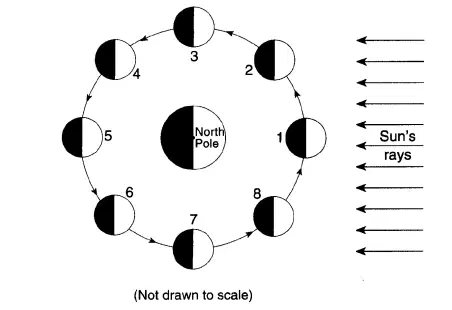
Which lunar phase would be visible from Earth at Point 2?
Waning Crescent
Waxing Crescent
Waning Gibbous
Waxing Gibbous
Which lunar phase would be visible from Earth at Point 4?
Waning Crescent
Waxing Crescent
Waning Gibbous
Waxing Gibbous
Which lunar phase would be visible from Earth at Point 8?
Waning Crescent
Waxing Crescent
Waning Gibbous
Waxing Gibbous
What is the approximate age of the Solar System?
4.6 billion years
13.7 million years
4.6 million years
13.7 billion years
Which IAU criterion did Pluto fail, leading to its reclassification as a dwarf planet?
It does not orbit the Sun
It is not nearly round enough in shape
It has not cleared smaller objects from its orbital zone
It lacks a dense core
What is the orbital period of a planet?
The speed at which it rotates on its axis
The time it takes to orbit the Sun once
The distance from the Sun
The shape of its orbit
What is the orbital velocity of a planet?
The rate at which it spins on its axis
The time it takes to complete one rotation
The speed at which it moves along its orbit
The angle of its axial tilt
What is the study of comparative planetology?
The systematic study of similarities and differences between planets.
The measurement of planetary temperatures.
The classification of asteroids and comets.
The study of only Earth's geology.
Which of the following is a characteristic of the inner (terrestrial) planets?
Thick gaseous atmospheres of hydrogen and helium
Numerous moons and ring systems
Small, dense cores
Rocky surfaces and thin atmospheres
Which of the following is a characteristic of the outer (Jovian) planets?
Thick gaseous atmospheres of hydrogen and helium
Rocky surfaces and thin atmospheres
Few or no moons
Small, dense, iron cores
Which inner planet is closest to Earth in diameter and density?
Mercury
Mars
Neptune
Venus
Which planet rotates on its side?
Uranus
Venus
Jupiter
Mars
The farther a planet is from the sun, the ___________ its orbital period becomes.
longer
shorter
The closer a planet is to the sun, the ___________ its orbital period becomes.
longer
shorter

