
 Worksheets
Geology final
Total questions: 124
Worksheet time: 1hrs 2mins
Which of the following concepts is associated with the birth of modern geology?
Catastrophism
Uniformitarianism
Fossil correlation
Radioactive decay
What does relative dating in geology involve?
Assigning specific ages to events
Placing dates in their proper sequence or order
Measuring radioactive decay
Determining the exact time of fossil formation
Why is an appreciation for the magnitude of geologic time important?
It helps understand rapid geological processes
It explains why most geological processes are gradual
It determines the exact age of fossils
It focuses on short-term geological changes
Which principle of geologic time states that layers of sediment are originally deposited horizontally?
Superposition
Original horizontality
Cross-cutting relations
Fossil succession
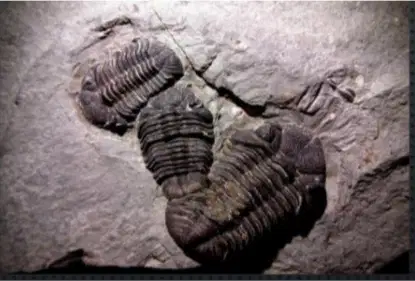
What marks the beginning of the Paleozoic Era and the Cambrian Period?
The appearance of dinosaurs
The extinction of trilobites
The appearance of trilobites with hard shells
The formation of radioactive elements
What is the half-life of K^40 to Ar^40 in radioactive decay?
1.3 million years
1.3 billion years
2.6 billion years
4.5 billion years
What are the two main components of the scientific method?
Gathering facts through observation and formulating hypotheses and theories
Conducting experiments and publishing results
Memorizing facts and following a fixed path
Collecting data and avoiding hypotheses
Which statement about the scientific method is true?
There is no fixed path that scientists follow to gain scientific knowledge
Scientists must always follow a strict sequence of steps
The scientific method only involves conducting experiments
Hypotheses are not part of the scientific method
What percentage of the geologic time scale does the Precambrian period represent?
88%
50%
75%
95%
Which of the following is NOT one of the Earth's spheres?
Hydrosphere
Atmosphere
Biosphere
Lithosphere
What does Earth System Science aim to study?
The Earth's weather patterns
Earth as a system composed of numerous interacting parts or subsystems
The Earth's magnetic field
The Earth's geological history
What is a system, as defined in Earth System Science?
A group of non-interacting parts
A single part of Earth's surface
Any size group of interacting parts that form a complex whole
A static and unchanging structure
Which type of feedback mechanism maintains the status quo in a system?
Positive feedback
Negative feedback
Neutral feedback
Dynamic feedback
What powers the Earth's external processes?
The Earth's interior
The moon's gravitational pull
The sun
The Earth's magnetic field
What is the Nebular Hypothesis?
A theory about the Earth's magnetic field
A theory of how Earth and the Sun were made
A theory about the Earth's weather patterns
A theory about the Earth's tectonic plates
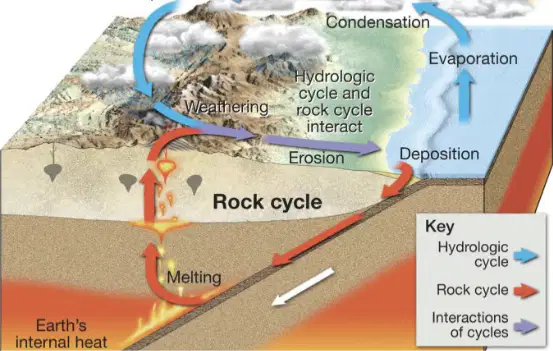
A diagram showing the hydrologic cycle, rock cycle, and interactions of cycles, including processes like precipitation, evaporation, weathering, erosion, and melting. What does this diagram primarily illustrate?
The interactions between the hydrologic cycle and rock cycle, including processes such as precipitation, evaporation, weathering, erosion, and melting.
The process of photosynthesis in plants and its effect on the atmosphere.
The movement of tectonic plates and formation of mountains.
The food chain in a terrestrial ecosystem.
What event marked the beginning of the nebula's contraction that led to the formation of the solar system?
About 10 billion years ago
About 5 billion years ago
About 2 billion years ago
About 1 billion years ago
Which of the following describes the formation of the larger outer planets?
They formed from metallic and rocky surfaces.
They formed from fragments of ices like H₂O and CO₂.
They formed from molten rock rising to the surface.
They formed from the contraction of the lithosphere.
What process led to the formation of Earth's primitive crust?
Metals sank to the center.
Molten rock rose to the surface.
Chemical segregation occurred.
Gases evolved from Earth's interior.
Which layer of Earth's internal structure is defined as the first layer by physical properties?
Asthenosphere
Lithosphere
Mesosphere
Inner Core
What is the most prominent feature of continents?
Oceanic Trenches
Abyssal Plains
Mountain Belts
Continental Margins
What are the components of the continental margins in the ocean basin?
Abyssal Plains and Oceanic Trenches
Continental Shelf, Continental Slope, and Continental Rise
Shields and Stable Platforms
Lithosphere and Asthenosphere
What is the most prominent topographic feature on Earth found in the oceanic ridge system?
Seamounts
Oceanic Ridge System
Continental Shelf
Abyssal Plains
Which type of rock is formed by changing preexisting igneous or sedimentary rocks under heat and pressure?
Sedimentary Rock
Igneous Rock
Metamorphic Rock
Fossil Rock
Which of the following is an example of a sedimentary rock?
Gneiss
Marble
Limestone
Basalt
What is the driving force behind the formation of metamorphic rocks?
Erosion and weathering
Heat and pressure
Deposition and compaction
Cooling and solidification
What does the rock cycle illustrate?
The process of weathering and erosion only
The loop by which one rock changes to another
The formation of igneous rocks only
The deposition of sediments in oceans
Who first proposed the Continental Drift Hypothesis, and in what year?
Alfred Wegener, 1915
Charles Darwin, 1859
James Hutton, 1785
Harry Hess, 1962
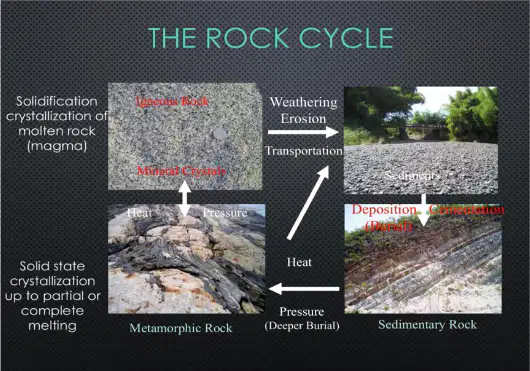
A diagram illustrating the rock cycle, showing processes like solidification, weathering, erosion, transportation, deposition, and metamorphism. Which of the following processes is NOT part of the rock cycle?
Solidification
Weathering
Photosynthesis
Metamorphism
Who proposed the hypothesis of seafloor spreading in the early 1960s?
Alfred Wegener
Harry Hess
Charles Darwin
James Hutton
What was the name of the supercontinent that began breaking apart about 200 million years ago, according to Alfred Wegener's hypothesis?
Gondwana
Laurasia
Pangea
Rodinia
Which of the following was NOT used as evidence to support Wegener's hypothesis of continental drift?
Fit of the continents
Rock type and structural similarities
Fossil evidence of dinosaurs
Paleoclimatic evidence
What was one of the objections to Wegener's hypothesis of continental drift?
Lack of evidence for the fit of continents
Incorrect suggestion that continents broke through the ocean like icebreakers
No evidence of paleoclimatic changes
Lack of evidence for rock type similarities
What does polar wandering indicate about the movement of continents?
Continents have remained stationary over time
Continents have moved closer to the poles
Continents have shifted positions over time
Continents have moved away from the equator
What is the term for the periodic reversal of Earth's magnetic field, where the north magnetic pole becomes the south magnetic pole and vice versa?
Magnetic drift
Geomagnetic reversals
Polar wandering
Magnetic anomalies
What technological advancement during the 1950s and 1960s allowed for extensive mapping of the ocean floor?
Satellite imaging
Sonar technology
Deep-sea drilling
Submarine exploration
What evidence did Vine and Matthews use in 1963 to support Hess's concept of seafloor spreading?
Fossil records in the ocean crust
Magnetic stripes in the ocean crust near ridges
Changes in ocean water temperature
Sediment layers on the ocean floor
What is the primary method for determining plate motions according to paleomagnetism?
Observing volcanic eruptions
Studying paleomagnetism stored in rocks on the ocean floor
Measuring earthquake frequencies
Analyzing sediment deposits
Which of the following statements about the lithosphere is correct?
It is the weakest region in the mantle.
It consists of the uppermost mantle and overlying crust.
It is composed entirely of liquid magma.
It is located below the asthenosphere.
What is the largest lithospheric plate on Earth?
The Atlantic Plate
The Pacific Plate
The Eurasian Plate
The Indian Plate
What is a key characteristic of Earth's major lithospheric plates?
They are stationary and unchanging.
They include only oceanic regions.
They are in motion and continually changing in shape and size.
They are composed entirely of continental crust.
What is the term for the weaker region in the mantle that the lithosphere overlies?
The asthenosphere
The mesosphere
The core
The crust
What was the most convincing evidence for the concepts of continental drift and seafloor spreading?
Fossil evidence
Geomagnetic reversal
Ocean water salinity
Sediment thickness
What is the approximate rate at which tectonic plates move relative to each other?
About 5 centimeters (2 inches) per year
About 10 centimeters (4 inches) per year
About 1 centimeter (0.5 inches) per year
About 20 centimeters (8 inches) per year
What happens to cooler, denser slabs of oceanic lithosphere?
They rise to the surface of the ocean
They descend into the mantle
They remain stationary
They break apart into smaller pieces
What type of plate boundary is most commonly located along the crests of oceanic ridges?
Convergent plate boundaries
Divergent plate boundaries
Transform plate boundaries
Subduction zones
What is a characteristic of oceanic ridges and seafloor spreading?
The seafloor is elevated, forming oceanic ridges
The seafloor sinks into the mantle
The seafloor remains flat and unchanged
The seafloor is covered by continental crust
What is the process called when landmasses split into two or more smaller segments along a continental rift?
Subduction
Continental rifting
Seafloor spreading
Ridge topography
What type of plate boundary is produced by extensional forces acting on lithospheric plates?
Convergent plate boundaries
Transform fault boundaries
Divergent plate boundaries
Subduction zones
Which of the following is an example of a divergent plate boundary?
East African Rift Valleys
Andes Mountains
San Andreas Fault
Hawaiian Islands
What is the surface expression of a descending plate in a convergent plate boundary called?
Rift valley
Ocean trench
Transform fault
Mantle plume
Which type of plate boundary involves plates sliding past one another without creating new lithosphere?
Divergent plate boundaries
Convergent plate boundaries
Transform fault boundaries
Subduction zones
What is the primary cause of hot spots and mantle plumes?
Subduction of oceanic plates
Rising plumes of mantle material
Collision of continental plates
Movement along transform faults
Which of the following is an example of a transform fault boundary?
East African Rift Valleys
San Andreas Fault
Andes Mountains
Hawaiian Islands
What are the characteristics of long-lived structures in plate tectonics?
They are temporary and change frequently.
They originate at shallow depths and are highly mobile.
They are largely fixed and provide direction and rate for plate motion relative to the mantle framework.
They are formed only at the Earth's surface.
Which of the following methods is used to measure plate velocities from space?
Seismic wave analysis
Very Long Baseline Interferometry (VLBI)
Ocean floor drilling
Magnetic field mapping
What is the basic driving force of plate tectonics according to researchers?
Gravitational pull from the Moon
Convective flow in the mantle
Earth's magnetic field
Solar radiation
How can plate motion and rate be determined relative to the navigation satellite framework?
By analyzing volcanic eruptions
By using Global Positioning System (GPS)
By studying fossil records
By measuring ocean currents
What is one of the forces that drive plate motion?
Solar wind
Mantle convection
Earth's rotation
Atmospheric pressure
What is one of the forces involved in plate tectonics?
Slab-pull
Magnetic repulsion
Oceanic drift
Atmospheric pressure
Which of the following is a model of plate-mantle convection?
Layering at 660 kilometers
Crustal folding
Oceanic spreading
Continental drift
What must any model of plate-mantle convection be consistent with?
Observed physical and chemical properties of the mantle
The speed of tectonic plate movement
The temperature of the Earth's core
The density of the oceanic crust
Analyze the diagram and explain how slab-pull and ridge-push contribute to plate movement.
Slab-pull occurs as a dense plate sinks into the mantle, pulling the rest of the plate with it, while ridge-push occurs as magma rises at mid-ocean ridges, pushing plates apart.
Slab-pull and ridge-push both occur due to the movement of ocean currents.
Slab-pull is caused by the gravitational pull of the moon, while ridge-push is caused by volcanic eruptions.
Slab-pull and ridge-push are unrelated processes that do not affect plate movement.
Evaluate the differences between the whole-mantle convection model and the deep-layer model of plate-mantle convection.
The whole-mantle convection model involves the entire mantle in circulation, while the deep-layer model suggests separate layers of convection.
The whole-mantle convection model focuses on the crust, while the deep-layer model focuses on the core.
The whole-mantle convection model is based on oceanic processes, while the deep-layer model is based on atmospheric processes.
The whole-mantle convection model and the deep-layer model are identical in their approach.
What is the primary function of mantle plumes in the Earth's mantle?
To cool the Earth's core
To transport heat from the core to the surface
To create oceanic ridges
To prevent volcanic activity
Which layer of the Earth is directly above the core in the Whole-Mantle Convection model?
Upper mantle
Lower mantle
Crust
Oceanic plate
In the Deep-Layer model, what is the role of the upper mantle?
It acts as a rigid layer that does not move.
It facilitates the movement of mantle plumes.
It prevents heat transfer from the core.
It forms the Earth's crust.
What geological feature is commonly associated with hot spots in the Earth's mantle?
Oceanic ridges
Volcanic trails
Descending ocean plates
Lower mantle currents
Why is the study of plate tectonics important?
It explains the movement of ocean currents.
It helps understand the formation of Earth's surface features.
It describes the behavior of the Earth's atmosphere.
It focuses on the Earth's magnetic field.
What does the theory provide explanations for?
Earth's major surface processes, geologic distribution of earthquakes, and ancient organisms
Earth's weather patterns and climate changes
The formation of galaxies and stars
The behavior of animals in different ecosystems
Which of the following is NOT a characteristic of a mineral?
Naturally occurring
Generally inorganic
Liquid substance
Orderly crystalline structure
What is the definition of a rock?
A naturally occurring liquid
A solid mass of minerals or mineral-like matter that occurs naturally
A gaseous substance found in the atmosphere
A synthetic material created in laboratories
Which of the following is a characteristic of a mineral's chemical composition?
It is indefinite and varies widely
It is definite and consistent
It is always organic
It is always liquid
What is the smallest particle of matter that cannot be chemically split?
Atom
Molecule
Mineral
Rock
Which subatomic particle has a positive charge?
Proton
Neutron
Electron
Nucleus
What surrounds the nucleus of an atom?
Protons
Neutrons
Electrons
Minerals
What is the term for the cloud of negative charges surrounding the nucleus of an atom?
Electron cloud
Proton shell
Neutron field
Atomic layer
Which of the following is an example of a mineral?
Quartz
Rock
Mountain
Planet
What is the correct order of organization from smallest to largest in the given diagram?
Atom → Mineral → Rock → Mountain → Planet → Solar System → Galaxy
Atom → Rock → Mineral → Mountain → Planet → Galaxy → Solar System
Mineral → Atom → Rock → Mountain → Planet → Solar System → Galaxy
Atom → Mineral → Rock → Planet → Mountain → Galaxy → Solar System
What does the atomic number of an atom represent?
The number of neutrons in the nucleus of an atom
The number of protons in the nucleus of an atom
The number of electrons in the outer shell of an atom
The total number of particles in the atom
What is the octet rule in chemical bonding?
Atoms tend to gain, lose, or share electrons until they are surrounded by eight valence electrons
Atoms always share electrons equally
Atoms form bonds to achieve a total of ten valence electrons
Atoms lose all their valence electrons to form stable compounds
What type of bonding involves the sharing of a pair of electrons?
Ionic bonding
Covalent bonding
Metallic bonding
Hybrid bonding
Which of the following best describes an element?
A group of different kinds of atoms
A group of the same kind of atoms
A compound formed by combining two or more atoms
A mixture of atoms and molecules
How does metallic bonding contribute to the properties of metals?
By forming rigid structures that do not conduct electricity
By allowing valence electrons to migrate freely among atoms
By sharing a pair of electrons between atoms
By transferring electrons to form oppositely charged ions
Why do ionic bonds form between oppositely charged ions?
Because oppositely charged ions repel each other
Because oppositely charged ions attract each other
Because ions with the same charge attract each other
Because ions with the same charge repel each other
How do hybrid bonds differ from purely ionic or covalent bonds?
Hybrid bonds involve only electron transfer
Hybrid bonds involve only electron sharing
Hybrid bonds exhibit both electron sharing and electron transfer
Hybrid bonds do not involve electrons at all
Which of the following processes is NOT a way minerals can form?
Precipitation of mineral matter
Crystallization of molten rock
Deposition as a result of biological processes
Combustion of organic material
What happens when ions in an aqueous solution reach saturation?
They dissolve completely.
They start forming crystalline solids.
They evaporate into the atmosphere.
They lose their chemical properties.
What is the role of marine organisms in the formation of minerals?
They secrete calcium carbonate (CaCO3).
They dissolve existing minerals.
They increase the temperature of magma.
They prevent crystallization of minerals.
Which property of minerals is determined by observation or performing a simple test?
Optical properties
Primary diagnostic properties
Chemical composition
Magnetic properties
What does the term "luster" refer to in the context of minerals?
The ability of a mineral to transmit light
The appearance of a mineral in reflected light
The hardness of a mineral
The density of a mineral
Which of the following is NOT a basic category of luster?
Metallic
Nonmetallic
Transparent
Opaque
What happens to atoms in magma as it cools?
They become more mobile.
They slow down and begin to chemically combine.
They evaporate into the atmosphere.
They dissolve into the surrounding rock.
What is the term for a mineral's ability to transmit light?
Luster
Transparency
Optical property
Opaque
What does the term "streak" refer to in mineral identification?
The color of a mineral in its powdered form
The way a mineral reflects light
The ability of a mineral to resist scratching
The tendency of a mineral to break along planes
Which type of bond is associated with minerals that are brittle and shatter easily?
Ionic bonds
Metallic bonds
Covalent bonds
Hydrogen bonds
What is the Mohs Scale of Hardness used for?
Measuring the density of minerals
Comparing the resistance of minerals to abrasion or scratching
Determining the color of minerals in powdered form
Identifying the specific gravity of minerals
What is the difference between cleavage and fracture in minerals?
Cleavage refers to smooth and flat surfaces, while fracture is the absence of cleavage
Cleavage is the color of a mineral in powdered form, while fracture is its density
Cleavage is the resistance to scratching, while fracture is the ability to bend
Cleavage is the tendency to shatter, while fracture is the ability to deform
What is specific gravity in the context of minerals?
The ratio of the weight of a mineral to the weight of an equal volume of water
The mass of a mineral per unit volume
The resistance of a mineral to breaking or deforming
The ability of a mineral to reflect light
Which era are we currently in?
Mesozoic
Precambrian
Paleozoic
Cenozoic
In radioactive decay, an unstable ________ isotope will decay into a stable ________ isotope.
ion; carbon
parent; daughter
daughter; parent
neutron; ionized

Using the geologic cross section above, put the rock layers in order from youngest to oldest
h
h
m
x
p
c
z
t
t
z
c
p
x
m
h
Faults, fractures are younger than the rocks they cut through.
Cross-Cutting Relationships
Superposition
Unconformities
Inclusions
Lateral continuity
The oldest is on the bottom, the youngest on top.
Cross-Cutting Relationships
Superposition
Unconformities
Inclusions
Lateral continuity
Missing time
Cross-Cutting Relationships
Superposition
Unconformities
Inclusions
Lateral continuity
Chunks of weathered rock are older than the rock they are contained in.
Cross-Cutting Relationships
Superposition
Unconformities
Inclusions
Lateral continuity
Rocks extend in all directions until they reach the edge of a basin or pinch out.
Cross-Cutting Relationships
Superposition
Unconformities
Inclusions
Lateral continuity
Sedimentary layers/lava are deposited in horizontal layers.
Cross-Cutting Relationships
Superposition
Original horizontality
Inclusions
Lateral continuity
What is the definition of relative dating?
Putting events in order from first to last
Using radioactive materials to determine an age
Counting tree rings to determine an age
Calculating dates based on the theory of relativity
A(n) ________ is a type of unconformity with parallel beds above and below the erosional surface.
fossil conformity
nonconformity
disconformity
angular unconformity
What is an index fossil?
An organism that existed for a vast period of time and is representative of an era
An organisms that is restricted to one small, geographic setting
A trace fossil that defines a colony of organisms
An organism that was geographically widespread but limited to a short span of geologic time
What scientific development made accurate numerical dating possible?
Discovery of radioactivity
Correlation of rock layers
Development of radar
Discovery of X-rays
________ is a term used to define 88% of Earth's history prior to the start of the Paleozoic era.
Quaternary
Precambrian
Paleogene
Jurassic

What kind of unconformity is visible in this figure?
Angular unconformity
Disconformity
Nonconformity
All these sedimentary layers are conformable.
Which two conditions are the most important in order for an organism to become fossilized?
Rapid death and oxygen-free environment
Rapid burial and possession of hard parts
Rapid mineralization and rapid desiccation
Rapid decay and possession of soft tissues
What is the effective maximum range for carbon-14 dating?
150,000 years
70,000 years
10,000 years
3,000 years
The Mississippi River cuts through Silurian-aged dolomite between northwestern Illinois and eastern Iowa. Which is older? How do you know?
Dolomite; the principle of superposition
Mississippi; the principle of original horizontality
Dolomite; the principle of cross-cutting relationships
Mississippi; the principle of lateral continuity
What is a fossil?
Evidence of past life that can include skeletal as well as trace material
Only the hard parts of a skeletal structure that have been preserved
Mudcracks preserved in sedimentary rock
A really old geologist
The white granite of the Idaho Batholith near Boise, Idaho, contains dark gray xenoliths of metamorphic material. Which is older? How do you know?
Granite; the principle of superposition
Xenoliths; the principle of cross-cutting relations
Granite; the principle of unconformities
Xenoliths; the principle of inclusions
What is the definition of an inclusion?
A fossil of an organism that existed for a short period of geologic time
A fragment of one rock unit enclosed in another rock unit
An unstable isotope decaying into a stable form
A fault bisecting a layer of rock
________ is the scientific study of fossils.
Quaternary geology
Volcanology
Geomorphology
Paleontology
Which of the following is an example of a relative date?
The Cenozoic era began 65 million years ago.
A headstone in a cemetery has the date a person died.
The Declaration of Independence was written in 1776.
The Silurian period came before the Devonian period.

Which rock layer is the oldest in this image?
Kaibab Limestone
Toroweap Formation
Coconino Sandstone
Hermit Shale
Supai Group
What materials are best dated with carbon-14?
Igneous rocks
Volcanic rocks
Organic materials
Sandstones

