Wayground logo

Free Printable Worksheets

Font size

S
M
L
XL
Worksheets

Fults Science Midterm Study Review

Total questions: 71

Worksheet time: 2hrs 45mins

Name
Class
Date
1.
What causes tectonic plates to move along the Earth's surface?
a)
wind
b)
ocean currents
c)
convection in the mantle
d)
expansion of the Earth
2.
What type of boundary occurs when two plates move away from each other?
a)
transform
b)
subduction
c)
convergent
d)
divergent
3.
What forms at a divergent boundary between two oceanic plates?
a)
rift valley
b)
mountain
c)
mid-ocean ridge
d)
trench
4.
Which type of crust is more dense?
a)
oceanic
b)
continental
c)
divergent
d)
pizza
5.
What type of boundary occurs when two plates move toward each other?
a)
convergent
b)
divergent
c)
transform
d)
lateral
6.
What forms at a convergent boundary between a continental plate and an oceanic plate?
a)
volcanoes
b)
rift valleys
c)
faults
d)
mid-ocean ridges
7.
A rift valley occurs at a ____________ boundary.
a)
divergent
b)
convergent
c)
transform
d)
horizontal
8.
What is the process in which hot molten rock rises, then cools and sinks back to the core?
a)
plate tectonics
b)
continental drift
c)
convection
d)
divergence
9.
A trench forms at a _________ boundary.
a)
convergent
b)
divergent
c)
transform
d)
vertical
10.
Mountains form at a ___________ boundary.
a)
transform
b)
divergent
c)
convergent
d)
subduction
11.
What type of boundary occurs when two plates slide past each other?
a)
divergent
b)
transform
c)
lateral
d)
convergent
12.
A fault forms at a _________ boundary.
a)
transform
b)
divergent
c)
horizontal
d)
convergent
13.
What type of boundary is shown at A?
a)
transform
b)
convergent
c)
divergent
d)
subduction
14.
What is happening at point B?
a)
subduction
b)
a divergent boundary
c)
convection
d)
an earthquake
15.
What is the process in which two plates move toward each other but one sinks under the other?
a)
subduction
b)
convection
c)
divergence
d)
transformation
16.
What type of event will occur at this boundary?
a)
Earthquake
b)
Volcano Eruption
c)
Tornado
d)
Mountain Building
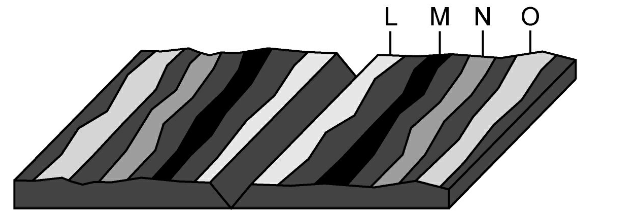
17.
Where would the oldest rock be found?
a)
L
b)
M
c)
N
d)
O
18.

Who is the scientist who proposed Continental Drift Theory?

a)
Albert Einstein
b)
Alfred Wegener
c)
Isaac Newton
d)
John Dalton
19.
What was Wegener's hypothesis called?
a)

The Theory of Pangea 

b)

The Theory of Moving Continents

c)

The Theory of Continental Drift

d)

The Theory of Techtonic Plates

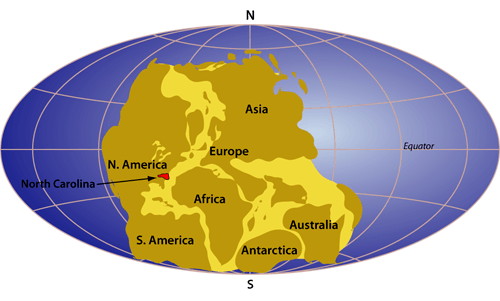
20.
What is this a picture of?
a)
plate tectonics
b)
continental drift
c)
pangea
d)
glacier scaring
21.
What evidence did Wegener use in his theory?
a)
Continents and fossils fitting together/matching-up like puzzle pieces 
b)
glacier scars and evidence from temperature
c)
mountain ranges and coal deposits line up across continents
d)
all of the above
22.
Why did no one believe Wegener's thoery?
a)
He could not explain HOW the continents moved
b)
He didn't have evidence
c)
His data was wrong
d)
He didn't use the right technology to gather data
23.
What type of evidence was NOT used by Alfred Wegener to support his continental drift hypothesis?
a)
evidence from landforms
b)
evidence from fossils
c)
evidence from human remains
d)
evidence from climate
24.
Which rock layer in the diagram seems to be the oldest?
a)
F
b)
E
c)
B
d)
A
25.
According to the law of superposition, which layer is the youngest?
a)
A
b)
B
c)
C
26.

Where do hurricanes form?

a)

In the ocean; near the equator

b)

In the ocean; near the poles

c)

On land; near the equator

d)

On land; near the poles

27.

What type of air powers hurricanes?

a)

Cold, dry air

b)

Warm, moist air

c)

Warm. dry air

d)

Cold, moist air

28.

When do most hurricanes form?

a)

Summer and Fall

b)

Spring and Summer

c)

Winter and Spring

d)

Fall and Winter

29.

What type of weather does this symbol represent?

a)

clear skies and sunny

b)

warm weather and light showers

c)

heavy rains and strong winds

d)

cold weather and crazy storms

30.

What type of front is headed for Dallas, TX?

a)

cold front

b)

warm front

c)

occluded front

d)

stationary front

31.

The number one thing hurricanes need is...

a)

warm water

b)

cold air from cold fronts

c)

cold water

d)

strong warm front

32.

What causes global convection currents

a)

Forests

b)

greenhouse gases

c)

more land forms

d)

uneven heating of the Earth's surface

33.

How to warm waters contribute to hurricane development

a)

evaporating water adds heat to the atmosphere

b)

rising tides cause the ocean level to rise

c)

waves cause the hurricane to develope

d)

currents carry the warm water to the hurricane

34.

(Paragraph A)

The location of the Sun within our Milky Way galaxy is:

a)

At the center of the galaxy

b)

In one of the spiral arms, away from the center

c)

At the edge of the galaxy

d)

In the galactic halo

35.
In the diagram given, what happens as we move to the left?
a)
Stars Get Larger
b)
Stars get Colder
c)
Stars get hotter
36.
Which star is the coldest?
a)
Yellow Star
b)
Red Star
c)
Orange Star
d)
Blue Star
37.
Which category is our Sun located in?
a)
White Dwarfs
b)
Supergiants
c)
Main Sequence
d)
Giants
38.

What characteristics are used to classify stars?

a)

Flammability, weight, and reactivity

b)

Temperature/color and brightness

c)

Conductivity, luster, and density

d)

Malleability, distance, and viscoscity

39.

Which star is brighter than the sun?

a)

Sirius B

b)

Procyon B

c)

Van Maanan's Star

d)

Aldebaran

40.

How does the mass of a hot, bright main sequence star compare to a cool, faint main sequence star?

a)

They have more mass

b)

They have the same mass

c)

They have less mass

41.
In the diagram given, what happens as we move to the left?
a)
Stars Get Larger
b)
Stars get Colder
c)
Stars get hotter
42.
The Hertzprung Russell Diagram consists of two axis that are labelled...
a)
Luminosity and Size
b)
Luminosity and Temperature
c)
Luminosity and Age
43.
The lowest part of the wave is?
a)
trough
b)
crest
c)
point of origin
d)
compression point
44.
The highest point of a wave is?
a)
crest
b)
trough
c)
point of origin
d)
comppression point
45.
What is the measure of how many waves pass a point in a certain amount of time?
a)
frequency
b)
wavelength
c)
midpoint
d)
crest and trough
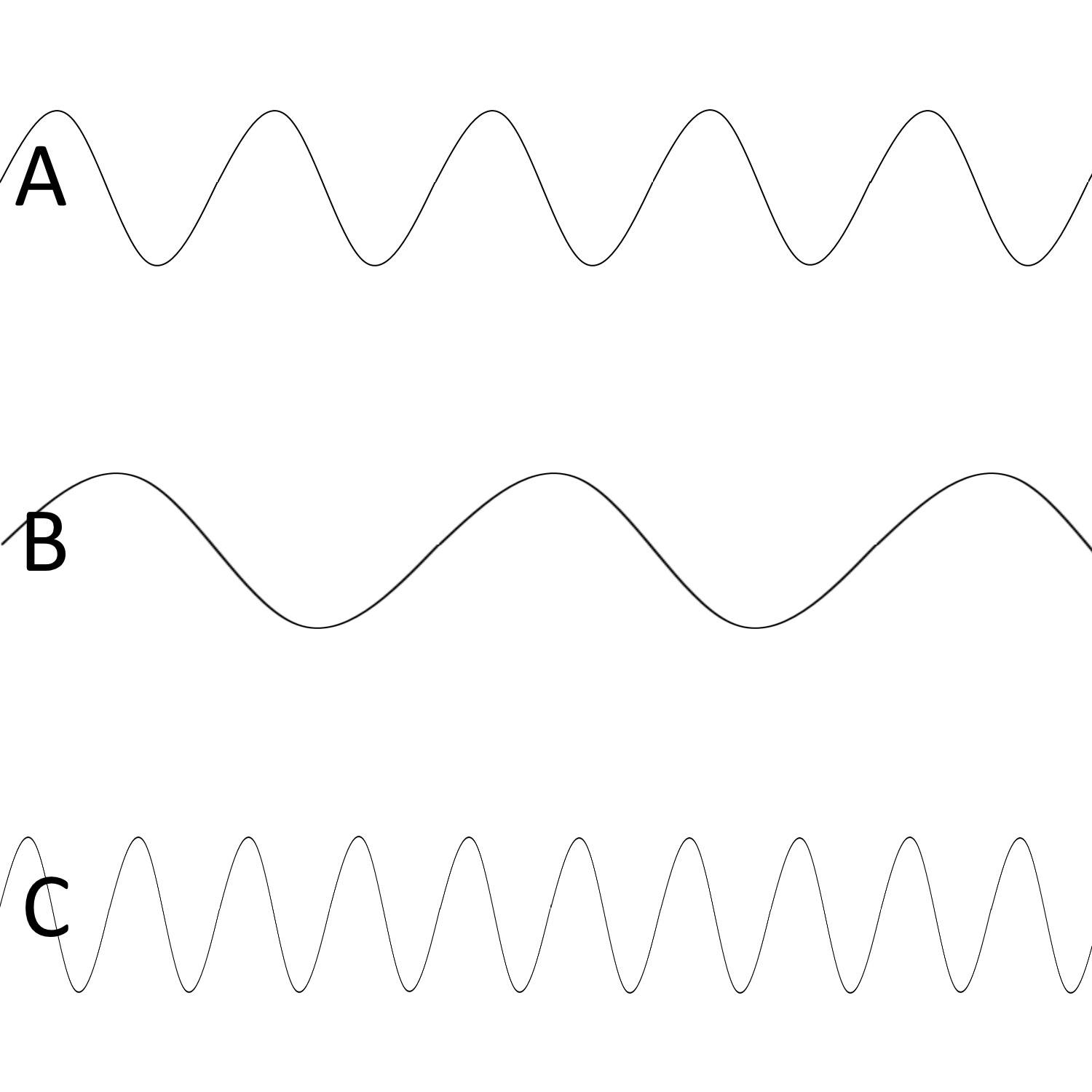
46.
Which wave has a greater frequency?
a)
A
b)
B
47.
What number represents the amplitude?
a)
1
b)
2
c)
3
d)
4
48.
What kind of wave is pictured below?
a)
compressional wave
b)
transverse wave
c)
sound wave
d)
mechanical wave
49.
Which wave has the largest wavelength?
a)
A
b)
B
c)
C
d)
None (same wavelength)
50.
Which wave has the largest frequency?
a)
A
b)
B
c)
C
d)
None (same frequency)
51.

What amount of force needs to be applied to a 20-kg bowling ball to give it an acceleration of 5 m/s2?

a)

4 N

b)

25 N

c)

100 N

d)

250 N

52.

In which of the following situations will the ball have the greatest acceleration?

a)

A golf ball with a mass of 0.045 kg is struck with a force of 1 N

b)

A baseball with a mass of 0.142 kg is hit with a force of of 5 N

c)

A soccer ball with a mass of 0.45 kg is kicked with a force of 20 N

d)

A bowling ball with a mass of 7.2 kg is thrown with a force of 60 N

53.

In which of the following graphs below are both runners moving at the same speed?

a)
b)
c)
d)
54.

Match the description to the graph:

"The car is stopped."

a)
b)
c)
d)
55.

Match the description to the graph:

"The car is moving at a constant speed away from the starting line."

a)
b)
c)
d)
56.

Match the description to the graph:

"The speed of the car is decreasing."

a)
b)
c)
d)
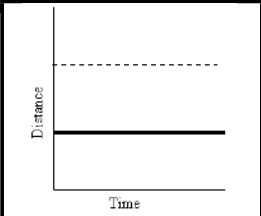
57.

Match the description to the graph:

"The car is coming back."
a)
b)
c)
d)
58.

What does this graph represent?

a)

Constant (non-zero) speed

b)

Acceleration

c)

Not moving

59.

Which statement about chemical and physical changes is correct?

a)

1 only

b)

2 only

c)

2 and 3

d)

4 only

60.

Which process represents a physical change?

a)

Roasting a marshmallow over a campfire

b)

Melting chocolate in a pan on the stove

c)

Bubbling due to an antacid tablet in vinegar

d)

Bruising of a banana's skin after dropping on the floor

61.

When making pancakes for breakfast, a student mixes milk and vinegar, to make buttermilk. As a result of mixing milk and vinegar, the milk curdles. What type of change in matter does milk curdling represent?

a)

Change in shape

b)

Change in state

c)

Chemical change

d)

Physical change

62.

Students conduct a laboratory investigation by rolling a toy car across a 2-meter table top. The students conduct three trials and record data in the table. What is the average speed of the toy car?

a)

4.5 m/s

b)

18 m/s

c)

0.18 m/s

d)

16.5 m/s

63.

A student constructs a table of distances and times. Using the data, which section of the table represents the highest average speed?

a)

Section A

b)

Section B

c)

Section C

d)

Section F

64.

A train travels 800 kilometers in 6 hours. What is the average speed of the train?

a)

150 km/h

b)

133 km/h

c)

806 km/h

d)

4,800 km/h

65.

How many nitrogen atoms are in the chemical formula 5C8H10N4O2

a)

20

b)

4

c)

24

d)

144

66.

The chemical formula for sulfuric acid is H2SO4


Which of the following correctly represents how many atoms of each element are present in the compound?

a)

H-8 atoms, S-1 atoms, O-4 atoms

b)

H-6 atoms, S-4 atoms, O-4 atoms

c)

H-2 atoms, S-1 atoms, O-4 atoms

d)

H-2 atoms, S-2 atoms, O-4 atoms

67.

How many oxygen atoms are in the following chemical formula?

Al2(CO3)3

a)

3

b)

6

c)

9

d)

18

68.

What happens to the total mass of the substances after a chemical reaction?

a)

It decreases.

b)

It increases.

c)

 It remains the same.

d)

It increases then decreases.

69.

Jin bought a heat pack that weighs 15 g. He shook it so it would release heat to warm his hands. The release of heat indicates a chemical reaction took place in a closed system. What would be the mass of the heat pack after the chemical reaction?

a)

5 g

b)

10 g

c)

12 g

d)

15 g

70.

The chemical formula for baking soda is NaHCO3NaHCO_3   . How many O atoms does it have?

a)

1

b)

2

c)

3

d)

4

71.

The Coefficient (3) in the Chemical Formula, 3H2O, tells you how many _____________ there are.

a)

Atoms of Hydrogen

b)

Atoms of Oxygen

c)

Atoms of Water

d)

Molecules of Water