wayground logo

Free Printable Worksheets

Font size

S
M
L
XL
Worksheets

Chemistry Quarter 1 Review-BHS

Total questions: 70

Worksheet time: 2hrs 22mins

Name
Class
Date
1.
A series of steps used by scientists to solve a problem or answer a question. 
a)
scientific method
b)
recipe
c)
data collection
d)
metric system
2.
A possible explanation to a problem that has not yet been tested. 
a)
data
b)
theory
c)
hypothesis
d)
fact
3.
The factors in an experiment that can be changed. 
a)
variables
b)
quantitative data
c)
hypothesis
d)
steps
4.
This variable in an experiment is the one being deliberately changed by the scientist. 
a)
dependent variable
b)
independent variable
c)
data
d)
control group
5.
There are two types of data. Which type of data involves numbers that are obtained by counting or measuring?
a)
quantitative
b)
qualitative
6.
There are two types of data. Which type of data involves descriptions that cannot be counted or measured?
a)
qualitative
b)
quantitative
7.
Testing a hypothesis often involves a(n):
a)
answer
b)
experiment
c)
problem
d)
safety check
8.
Observations made during an experiment are called:
a)
data
b)
problems
c)
conclusions
d)
questions
9.
The summary at the end of an experiment that explains the results. 
a)
conclusion
b)
procedures
c)
materials
d)
responding variable
10.
This is the data that you get from your experiment.
a)
Results
b)
conclusion
c)
Hypothesis
d)
Experiment
11.
Data that are qualitative are always-
a)
described in words
b)
represented in numbers
c)
repeated for verification
d)
the most accurate type of data
12.
The purpose of a controlled experiment is to allow a scientist to isolate and test-
a)
a single variable
b)
several variables
c)
many data
d)
a conclusion
13.
Which of the following must be done for the results of an experiment to be considered valid?
a)
the experiment must be repeated numerous times and the same results are obtained
b)
the results must be published in a national journal
c)
the results must be shown in a graph
d)
the results must be only quantitative
14.

What amount of sunlight makes pea plants grow tallest? What is the independent variable?

a)

height of pea plants

b)

amount of sunlight

c)

type of soil

15.

Select whether the following observation is quantitative or qualitative.

About 52% of a chimp's diet comes from fruit.

a)

quantative

b)

qualitative

16.
285 kg = ____ g
a)
285,000
b)
285
c)
2,850
d)
28,500
17.
Is 20 g greater than, less than, or equal to 2 kg?
a)
greater than
b)
less than
c)
equal to
18.
5,000 mg = ____ g
a)
50
b)
5
c)
500
d)
5,000
19.
Convert 300 cm to m:
a)
3 m
b)
30 m
c)
0.3 m
d)
0.03 m
20.
Convert 5 cm to mm:
a)
5,000mm
b)
0.5 mm
c)
0.05 mm
d)
50 mm
21.

What will the resulting units be?

a)

inches

b)

feet

c)

meters/ft

d)

inches/ft

22.

Convert 62 miles/hour to feet/second. (5,280 ft = 1 mi)

a)

5,456 ft/s

b)

.003 ft/s

c)

91 ft/s

d)

909 ft/s

23.

How many kilograms of calcium are there in 173 pounds of calcium? (1 lb = 454 g; 1 kg = 1000 g)

a)

1.10 kg

b)

78.5 kg

c)

110 kg

d)

78500 kg

24.
How many significant figures does the following number have: 0.002040
a)
6
b)
4
c)
3
d)
2
25.
Solve and round accordingly.
25.0 x 17 = ?
a)
430
b)
425
c)
425.0
d)
430.0
26.
calculate the following to the correct number of sig figs.
32.451 - 21.5
a)
11.0
b)
10.951
c)
11
d)
10.95
27.
How many sig figs are there?
100.00
a)
1
b)
3
c)
4
d)
5
28.
calculate the following to the correct number of sig figs.
13.2017/ 17.10
a)
.772
b)
.7720
c)
.772030
d)
.77
29.
How many sig figs are there?
4004
a)
1
b)
2
c)
3
d)
4
30.
How many sig figs are there?
5.00000008
a)
2
b)
6
c)
9
31.
What is 9.2 x 10in standard notation?
a)
9,200
b)
92,000
c)
920,000
d)
920
32.
What is 416,000,000 in scientific notation?
a)
4.16 x 10⁸
b)
4.16 x 10⁹
c)
4.16 x 10⁻⁸
d)
4.16 x 10⁻⁹
33.
What does a negative exponent mean in scientific notation? (example:  1.19 x 10⁻³)
a)
It means the number is very large
b)
It means the number is very small
34.
Multiply:
(3.4 x 10⁵)(1.2 x 10⁻³)
a)
4.08 x 10⁻⁸
b)
4.8 x 10²
c)
4.08 x 10²
d)
4.08 x 10⁻¹⁵
35.
Cell A=4.2 x 10⁻⁴ 
Cell B=2.1 x 10⁻⁵ 
Cell C=8.4 x 10⁻⁴

Cell C is ___ larger than cell A.
a)
2x
b)
20x
c)
.2x
d)
4x
36.

(9 x 10¹⁸) ÷ (3 x 10¹⁶)

a)

3 x 10²

b)

6 x 10²

c)

27 x 1034

d)

3 x 1034

37.
What is the simplified version of
a)
3.9 x 10⁶
b)
4 x 10²⁰
c)
4 x 10⁶
d)
3.9 x 10²⁰
38.
Which is the more precise measurement?
a)
4 mL
b)
4.3 mL
39.
a)

low precision, low accuracy

b)

high precision, low accuracy

c)

low precision, high accuracy

d)

high precision, high accuracy

40.
a)

low precision, low accuracy

b)

high precision, low accuracy

c)

low precision, high accuracy

d)

high precision, low precision

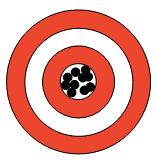
41.
?
a)
High Accuracy & High Precision
b)
High Accuracy & Low Precision
c)
Low Accuracy & High Precision
d)
Low Accuracy & Low Precision
42.

How CONSISTENT or close the numbers are regardless of to the actual value is the definition of .......

a)

accuracy

b)

target value

c)

uncertainty

d)

precision

43.

How close a measurement is to the accepted value is called..

a)

Accuracy

b)

Precision

c)

Significant

d)

Estimate

44.
It is a measure of how close measurements come to each other when they are made in the same way
a)
Accuracy
b)
Precision
c)
Error
d)
Extrapolation
45.

Which Student is the most Precise?

a)

Alex

b)

Shandra

c)

Luis

46.
The attendance for the basketball game was estimated to be 15,000 people but 12,500 people attended. What was the percent error?
a)
16.67%
b)
20%
c)
2500%
d)
80%
47.

The students measured length during a science experiment, they got 12 cm. But the actual measurement was 14.25 cm. What was the percent error?

a)

15.79%

b)

18.75%

c)

2.25%

d)

18%

48.
Jessie estimates the weight of her cat to be 8 pounds.  The actual weight of the cat was 10 pounds.  Find the percent error.  
a)
15%
b)
20%
c)
25%
d)
30%
49.

What type of association does this graph have?

a)

Negative

b)

no association

c)

positive

50.

What type of association does this graph have?

a)

positive

b)

negative

c)

non linear

d)

all of the above

51.

How can you tell which category is the most popular or has the highest frequency in a bar graph?

a)

It has the shortest bar

b)

It is the first bar on the left

c)

It has the tallest bar

d)

It is the last bar on the right

52.
To find the average of a set of numbers, add up all the items and divide by...
a)
2
b)
The minimum
c)
The maximum
d)
The number of items
53.
What is the range?
a)
average
b)
biggest-smallest
c)
the middle #
d)
# happening the most
54.
The heights of some students are given.
158cm     172cm      164cm
164cm     167cm      159cm
 What is the range of the heights?
a)
13cm
b)
14cm
c)
164cm
d)
330cm
55.
Find the mode.
7, 1, 1, 7, 1, 4, 1
a)
7
b)
3
c)
1
d)
4
56.

Find the median for the set of numbers:

85, 42, 64, 71, 39, 56, 26

a)

71

b)

42

c)

56

d)

60

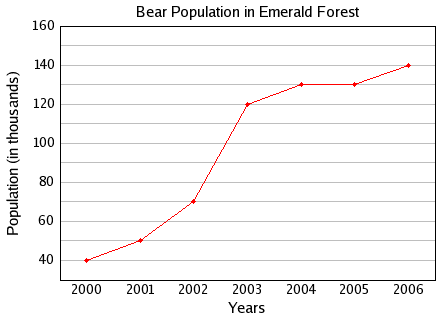
57.

What kind of graph is this?

a)

Bar

b)

Line

c)

Birthday

d)

Rainbow

58.
What was the bear population in 2001?
a)
40
b)
45
c)
50
d)
55
59.

Which of these is not a purpose of chemistry?

a)

improve quality of life

b)

explain reactions

c)

solve problems

d)

explain life processes

60.

Identifies an unknown through by determining its composition.

a)

analytical

b)

physical

c)

organic

d)

biochemistry

61.
The study of chemicals that, in general, do not contain carbon. 
a)
applied chemistry
b)
inorganic chemistry
c)
organic chemistry
d)
biochemistry
62.

____________ is the branch of chemistry that would analyze the composition of medicines and research how it reacts in the body. (Select all that apply)

a)

Analytical Chemistry

b)

Organic Chemistry

c)

Biochemistry

d)

Inorganic Chemistry

63.

A well-tested explanation for a broad set of observations

a)

scientific law

b)

theory

c)

observation

d)

hypothesis

64.

Pollutant

a)

is a proposed explanation for an observation

b)

applies science to the production of biological products or processes

c)

is a material found in air, water, or soil that is harmful to humans or other organisms

d)

is anything that has mass and takes up space

65.

In the ________ world, objects are large enough to see with the unaided eyes and in the _______ world, magnification is required to see objects.

a)

microscopic; macroscopic

b)

macroscopic; microscopic

c)

macroscopic; large

d)

small; microscopic

66.

________ chemistry is directed to a practical goal or application.

a)

Pure chemistry

b)

Analytical chemistry

c)

Physical chemistry

d)

Applied chemistry

67.

If you're determining the energy transfer when water boils what branch of chemistry are you working in?

a)

Analytical chemistry

b)

Physical chemistry

c)

Organic chemistry

d)

Biochemistry

68.

The branch of chemistry which deals with the study of carbon compounds is ?

a)

Biochemistry

b)

Organic Chemistry

c)

Inorganic Chemistry

d)

Polymer Chemistry

e)

Physical Chemistry

69.

What is Alchemy

a)

Turning Metals into Gold

b)

Turning Metals into Diamonds

c)

Turning Diamonds into metals

d)

Turning Gold into Metals

70.

Chemistry is a branch of science to study

(I) Interactions between matter

(II) Structure of matter

(III) Composition of matter

(IV) Properties of matter

a)

I, II, and III

b)

I, II, and IV

c)

II, III, and IV

d)

I, II, III, and IV