
 Worksheets
8th Fall 2025 Review
Total questions: 143
Worksheet time: 1hrs 12mins
How are distance and displacement similar?
Both describe how far an object is from a reference point using units of length.
Both always require a direction and are vectors.
Both measure the shortest path between start and finish.
How are distance and displacement different?
Distance is total path length; displacement is change in position with direction.
Distance includes direction; displacement does not.
Distance is measured in meters; displacement is measured in seconds.
What are the 3 steps to describing position in 2 dimensions? Choose the best ordered list.
Choose a reference point; define x- and y-directions (axes); give distances along each axis.
Measure speed; choose time interval; compute slope.
What are the two components of position?
Distance and direction from a reference point.
Speed and time.
How do you know something is moving?
Its position changes relative to a chosen reference point over time.
Its mass decreases.
What do you call displacement that is away from the reference direction?
Negative displacement.
Positive displacement.
What do you call displacement that is towards the reference direction?
Positive displacement.
Negative displacement.
What does a flat, horizontal line mean on a distance vs. time graph?
The object is not changing position (stopped).
The object is speeding up.
What is the difference between speed and velocity?
Velocity includes direction; speed does not.
Speed includes direction; velocity does not.
How do you know you have a constant speed from a distance vs. time graph?
The graph is a straight line with a constant slope.
The graph is a horizontal line at y = 0.
How do you know you have a constant speed from a velocity vs. time graph?
The graph is a horizontal line (velocity stays the same).
The graph is a line with increasing slope.
How is calculating average speed different from regular (instantaneous) speed?
Average speed uses total distance divided by total time for a trip; instantaneous speed is speed at a specific moment.
Average speed is measured in seconds; instantaneous speed is measured in meters.
How can you tell something is speeding up on a distance vs. time graph?
The slope increases—the line or curve becomes steeper over time.
The slope decreases and flattens.
How can you tell something is slowing down on a distance vs. time graph?
The slope decreases—the line or curve becomes less steep over time.
The slope increases.
What are the 5 steps to calculate average speed on a graph? Choose the best ordered list.
Identify total time from the x-axis; identify total distance from the y-axis; use start and end points; compute distance ÷ time; include units.
Pick any point; read its slope; multiply by time; add mass; report value.
What are the 3 ways velocity can change?
Speed increases.
Speed decreases.
Direction changes.
What are the 3 ways an object can accelerate?
Speeding up.
Slowing down.
Changing direction.
When can acceleration be positive?
When velocity increases in the positive reference direction.
Whenever speed decreases.
When can acceleration be negative?
When velocity decreases in the positive reference direction (or increases in the negative direction).
Only when the object moves in a circle.
How do you know you have constant acceleration on a distance vs. time graph?
The graph is a smooth curve whose slope increases at a steady rate (parabolic shape).
The graph is a straight line with constant slope.
How do you know you have constant acceleration on a velocity vs. time graph?
The graph is a straight line with constant, nonzero slope.
The graph is a horizontal line at any value.
How do you know you have constant acceleration on an acceleration vs. time graph?
The graph is a horizontal line at a constant value.
The graph is a line with changing slope.
What are the 5 ways motion can be described? Select all that apply.
Position.
Distance.
Displacement.
Speed.
Velocity.
Which is an example of a contact force?
Friction
Gravity
Magnetism
Electric force
Which is an example of a noncontact force?
Friction
Normal force
Gravity
Applied push
How does increasing an object’s mass affect the gravitational force it exerts?
It increases the gravitational force.
It decreases the gravitational force.
It does not change the gravitational force.
It makes the gravitational force become zero.
How does decreasing the distance between two objects affect the gravitational force they exert on each other?
It increases the gravitational force.
It decreases the gravitational force.
It does not change the gravitational force.
Only the direction changes, not the strength.
Select the three types of friction.
Static friction
Sliding friction
Rolling friction
Gravitational friction
Magnetic friction
Which method best reduces friction between two surfaces?
Add oil or another lubricant.
Increase the roughness of the surfaces.
Increase the weight on the surfaces.
Press the surfaces tighter together.
Which statement correctly describes one difference between mass and weight?
Mass is the amount of matter; weight is the gravitational force that can change with location.
Mass is the gravitational force; weight is the amount of matter and never changes.
Mass and weight are the same and always stay constant.
Weight measures volume; mass measures inertia only.
What does weight tell you?
The amount of matter in an object.
How much an object resists changes in motion.
The gravitational force acting on an object.
The volume of an object.
When all forces on an object are balanced, what is the net force?
Zero
Positive
Negative
Equal to the object’s weight
If the net force on an object is zero, does its velocity change?
Yes, it increases.
Yes, it decreases.
No, it remains constant.
It instantly becomes zero.
If a force pushes to the right or upward, is it positive or negative?
Positive
Negative
Zero
Cannot be determined
If a force pushes downward or to the left, is it positive or negative?
Positive
Negative
Zero
Cannot be determined
Does an object have more inertia if it has more mass?
Yes, more mass means more inertia.
No, inertia is unrelated to mass.
Only if the object is accelerating.
Only in space.
With zero net force, what happens to an object at rest according to Newton’s first law?
It remains at rest.
It starts moving.
It speeds up.
It moves in a circle.
With zero net force, what happens to an object in motion according to Newton’s first law?
It continues at constant velocity in a straight line.
It stops immediately.
It accelerates.
It changes direction randomly.
What direction does centripetal force point?
Outward from the center
Tangential to the motion
Toward the center of the circle
Parallel to the object’s velocity
What is the unit for mass?
Kilogram (kg)
Newton (N)
Meter per second squared (m/s^2)
Joule (J)
What is the unit for acceleration?
Meter per second squared (m/s^2)
Newton (N)
Kilogram (kg)
Meter (m)
What is the unit for force?
Newton (N)
Kilogram (kg)
Meter per second squared (m/s^2)
Pascal (Pa)
Which equation represents Newton’s second law?
F=ma
v=td
W=mg
p=mv
According to Newton’s third law, can a force ever exist by itself, without a partner?
Yes, sometimes a single force acts alone.
No, every force has an equal and opposite partner.
Only in outer space.
Only for gravitational forces.
Force pairs are equal in magnitude but exerted in opposite what?
Directions
Masses
Times
Accelerations
Can momentum ever completely disappear assuming there are no outside forces? Why or why not?
No, because total momentum is conserved in a closed system without external forces.
Yes, because objects can come to rest on their own.
Yes, because energy can change forms and vanish.
No, because mass cannot change during motion.
What two things are required for work to be done?
A force and a displacement in the direction of that force
Mass and distance traveled
Energy and speed
Time and acceleration
What is the unit for work?
Joule
Watt
Newton
Kilogram
What is one joule equal to?
One newton-meter
One watt-second
One kilogram-meter
One newton per second
What is the only part of an applied force that can contribute to doing work?
The component of the force parallel to the displacement
The component of the force perpendicular to the displacement
The total applied force regardless of direction
Only the frictional force
Work to lift an object equals what specific force times the distance lifted?
The object’s weight
Frictional force
Normal force
Air resistance
What is kinetic energy and when does it occur?
The energy an object has due to motion; it occurs when the object is moving
The energy stored by position; it occurs when the object is at rest
Thermal energy from temperature; it occurs when the object heats up
Chemical energy from food; it occurs during digestion
What is potential energy and when does it occur?
Energy stored due to position or shape; it occurs when an object is raised or stretched/compressed
Energy of motion; it occurs when an object moves
Energy from heat; it occurs when temperature increases
Energy from sound; it occurs when something vibrates
How do you increase potential energy?
Raise the object higher in a gravitational field
Lower the object to the ground
Reduce the object’s mass
Move the object perpendicular to gravity
How do you increase kinetic energy?
Increase the object’s speed
Decrease the object’s speed
Lower the object’s height
Reduce the gravitational field strength
What is power?
The rate at which work is done
The amount of force applied
The total energy an object has
The product of mass and acceleration
What is the unit for power?
Watt
Joule
Newton
Pascal
How do power and work vary?
Power depends on how quickly work is done; doing more work in less time means greater power
Power is the same as work and does not depend on time
Power depends only on force, not on work
Power decreases when more work is done in less time
How are power and work similar?
Both describe energy transfer caused by forces acting on objects
Both are measured in watts
Both are independent of time
Both measure force directly
What is one thing machines do?
They change the size or direction of a force to make work easier
They create energy from nothing
They eliminate all friction
They reduce the total work required by a task to zero
What do machines not do?
They do not reduce the total amount of work that must be done
They do not change the direction of a force
They do not allow forces to act over longer distances
They do not help with lifting objects
How do you calculate input work and output work for a machine?
Input work equals Win=Fin×din and output work equals Wout=Fout×dout
Input work equals Win=Fout×din and output work equals Wout=Fin×dout
Input work equals Win=m×v and output work equals Wout=m×a
Input work equals Win=P×t and output work equals Wout=P÷t
What are three ways that machines make work easier?
By changing the size of the force
By changing the distance over which the force is applied
By changing the direction of the force
By increasing the object’s mass
What’s mechanical advantage?
The ratio of output force to input force
The ratio of input work to output work
The product of mass and acceleration
The rate at which work is done
If the mechanical advantage is greater than one, which is greater, the output force or input force?
Output force
Input force
They are equal
Neither can be compared
What is efficiency?
The ratio of output work to input work, often expressed as a percentage
The ratio of input force to output force
The total work done by a machine
The amount of friction produced by a machine
How does efficiency affect friction?
Greater efficiency means less energy lost to friction
Greater efficiency increases friction
Efficiency and friction are unrelated
Friction determines the direction of efficiency
Radiant: What is an example of radiant energy?
Light from the Sun
Heat from a stovetop
Kinetic: What is an example of kinetic energy?
A parked car
A rolling ball
Electric: What is an example of electric energy?
A flashlight battery powering a circuit
A stone sitting on a hill
Gravitational potential: What is an example of gravitational potential energy?
A ball at the top of a hill
A moving skateboard
Chemical potential: What is an example of chemical potential energy?
Fuel in a car’s tank
A falling raindrop
What are some sources of energy that can be traced back to the Sun? Select all that apply.
Wind
Hydroelectric
Biomass
What is an advantage of using nonrenewable energy?
It is produced only by wind and sunlight
It is widely available with high energy density and existing infrastructure
It never creates any pollution
It cannot be stored or transported
What is a disadvantage of using nonrenewable energy?
It is unlimited and cannot run out
It often produces pollution and is a limited resource
It requires only simple technology and zero cost
It depends on daily weather for every use
What is an advantage of using renewable energy?
It relies on fossil fuels to operate
It can be replenished naturally and usually has low emissions
It always works at night and on calm days
It is the only energy that can power cars
What is a disadvantage of using renewable energy?
It is always available at a constant rate
It can be intermittent and may need storage or backup
It always increases air pollution
It cannot generate electricity
What is the difference between heat and temperature?
Heat is the movement of thermal energy, while temperature measures the average kinetic energy of particles
Heat and temperature both measure how fast Earth orbits the Sun
Temperature is energy transfer between objects, while heat is the average speed of particles
Heat is stored energy only, while temperature is mechanical energy
What is the difference between thermal energy and mechanical energy?
Thermal energy is the sum of the kinetic and potential energy of the particles in a material, while mechanical energy is the kinetic and potential energy of a whole object
Thermal energy and mechanical energy are identical and always equal
Mechanical energy is the average kinetic energy of particles, while thermal energy is energy of motion of planets
Mechanical energy is only potential energy, while thermal energy is only kinetic energy
What will particle motion look like with a high temperature?
Particles move slowly and stay close together
Particles move quickly with more energetic motion
Particles stop moving completely
Particles move only in straight lines
What will particle motion look like with a low temperature?
Particles move slowly with less energetic motion
Particles move faster than at high temperature
Particles always form gases
Particles gain energy and speed up
What are the three temperature scales?
Kelvin, Celsius, Fahrenheit
Kelvin, Joule, Watt
Celsius, Meter, Second
Fahrenheit, Newton, Pascal
Which temperature scale has never reached zero?
Celsius
Fahrenheit
Kelvin
All of them have reached zero
Match each temperature scale to the boiling point of water on that scale.
Kelvin
373
Celsius
100
Fahrenheit
212
Match each temperature scale to the freezing point of water on that scale.
Kelvin
273
Celsius
0
Fahrenheit
32
Jeremy bikes 20 miles north in 1 hour before stopping for lunch for .75 hours. He then continues 8 miles north in 0.5 hours before realizing that he missed his stop and he has to go 5 miles south, which takes him 0.25 hours. What is his total distance traveled?
28 miles
33 miles
25 miles
20 miles
Jeremy bikes 20 miles north in 1 hour before stopping for lunch for .75 hours. He then continues 8 miles north in 0.5 hours before realizing that he missed his stop and he has to go 5 miles south, which takes him 0.25 hours. What is his displacement?
5 miles south
23 miles north
13 miles north
28 miles north
Jeremy bikes 20 miles north in 1 hour before stopping for lunch for .75 hours. He then continues 8 miles north in 0.5 hours before realizing that he missed his stop and he has to go 5 miles south, which takes him 0.25 hours. What is his speed the first hour?
15 mph
20 mph
25 mph
8 mph
Jeremy bikes 20 miles north in 1 hour before stopping for lunch for .75 hours. He then continues 8 miles north in 0.5 hours before realizing that he missed his stop and he has to go 5 miles south, which takes him 0.25 hours. What is his average speed?
10.0 mph
13.2 mph
15.0 mph
18.9 mph
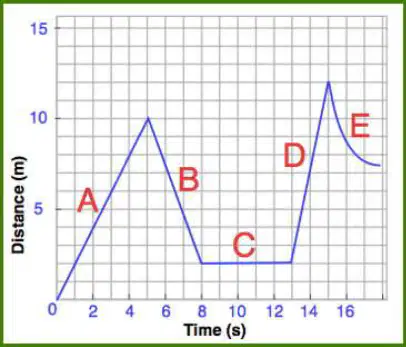
Use the graph to answer the questions below. Which line does not have a constant velocity? How do you know?
A, it has a steady slope
C, it is horizontal
D, it is straight with constant slope
E, its slope changes (curved)
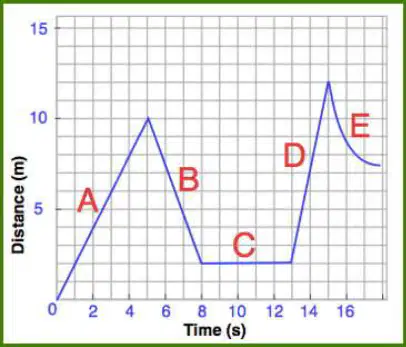
Use the graph to answer the questions below. During what time period was the object completely stopped?
0–2 s
6–8 s
8–12 s
12–14 s
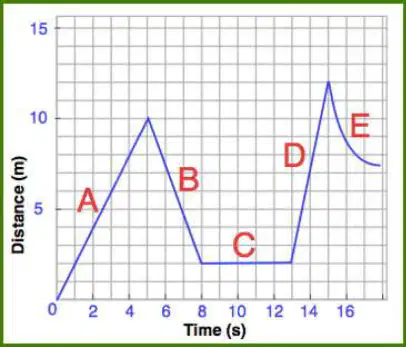
Use the graph to answer the questions below. What was the average speed for line A?
0 m/s
1 m/s
2 m/s
4 m/s
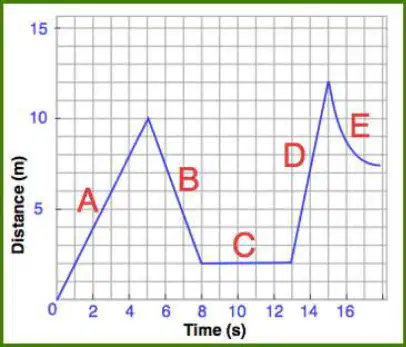
Use the graph to answer the questions below. What was the average speed for line D?
1.3 m/s
2.0 m/s
2.7 m/s
3.5 m/s
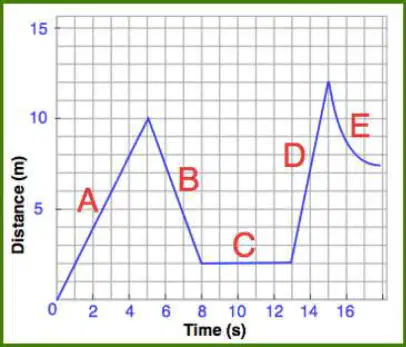
Use the graph to answer the questions below. What do we know is present along line E?
Constant speed
Acceleration (changing velocity)
Rest (zero speed)
Uniform motion with fixed slope
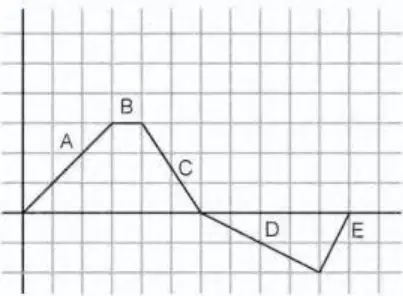
Use the graph to answer the questions below. What type of graph is this?
Distance vs. time graph
Velocity vs. time graph
Acceleration vs. time graph
Position vs. time graph
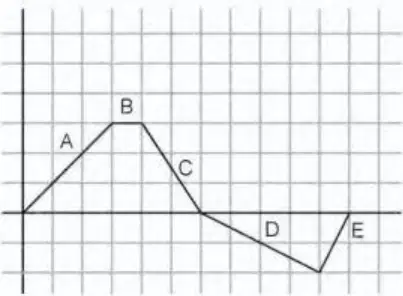
Use the graph to answer the questions below. What is happening along line B?
Acceleration upward
Constant velocity
Object at rest
Negative acceleration
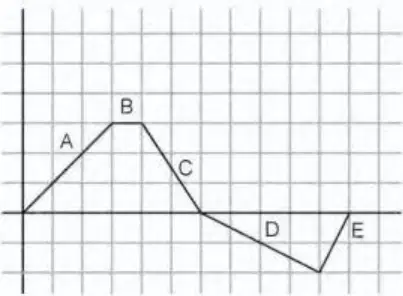
Use the graph to answer the questions below. What lines have negative acceleration? How do you know?
A
B
C
D
E
Draw an acceleration v. time graph that shows a constant acceleration of 3m/s2 .
A horizontal line at 3 m/s2
A horizontal line at −3 m/s2
A line that increases upward with time
A line at 0 m/s2
Mark is riding his skateboard when he starts going down a hill. His speed increases from 9 m/s to 27 m/s in 7.2 seconds. What is his acceleration?
0.4 m/s2
2.5 m/s2
18 m/s2
−2.5 m/s2
Anna is running along a trail at 2.5 m/s when she decides to slow down to 0 m/s and rest. It takes her 3.1 seconds to come to a complete stop. What is her acceleration?
0.81 m/s2
−0.81 m/s2
−0.12 m/s2
−3.1 m/s2
Thing 1 is racing around with an acceleration of 3.4 m/s^2 and a starting speed of 5 m/s. What will his new speed be in 6 seconds?
23.4 m/s
25.4 m/s
28.4 m/s
30.4 m/s
Thing 2 has a starting speed of 2.3 m/s and reaches a top speed of 7 m/s in 4.8 seconds. Who has a faster acceleration, Thing 1 or Thing 2?
Thing 1
Thing 2
They accelerate equally
Not enough information
A dog pulls with a force of 65 N to the left, while a little kid pulls with a force of 22 N to the right. Calculate the net force and direction.
87 N to the left
43 N to the left
43 N to the right
22 N to the left
Two oxen pull a cart to the right, each pulling with a force of 98 N. Calculate the net force and direction.
98 N to the right
196 N to the right
196 N to the left
0 N (balanced)
You are pushing a couch across a room to the right with a force of 22 N. One friend pushes in the same direction with a force of 30 N. Another friend pushes against you with a force of 22 N to the left. Calculate the net force and direction.
30 N to the right
52 N to the right
8 N to the right
0 N (balanced)
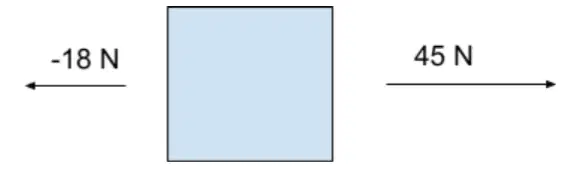
Calculate the net force using the image. Indicate if the forces are balanced or unbalanced.
27 N to the right; unbalanced
27 N to the left; unbalanced
63 N to the right; unbalanced
0 N; balanced
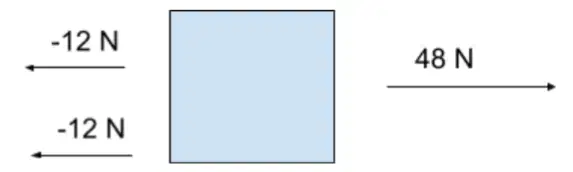
Calculate the net force using the image. Indicate if the forces are balanced or unbalanced.
24 N to the right; unbalanced
24 N to the left; unbalanced
48 N to the right; balanced
0 N; balanced
Calculate the force acting on a 20 kg×8 m/s2 object that accelerates at 8 m/s^2.
20 N
80 N
160 N
200 N
A 68 N force acts on a 2.5 kg object. What is the object’s acceleration?
2.7 m/s^2
13.6 m/s^2
27.2 m/s^2
34.0 m/s^2
A cart accelerates at 12.2 m/s^2. If its total force is 96 N, what is the mass of the cart?
6.5 kg
7.9 kg
9.2 kg
12.2 kg
A Great Dane can accelerate at 5.4 m/s^2. If the mass of an adult Great Dane is 80 kg, what is the net force it exerts?
352 N
432 N
520 N
640 N
A Great Dane puppy can accelerate at 3.6m/s2 and has a mass of 20kg . How much less is the force a Great Dane puppy can exert compared with the adult Great Dane above?
72 N less
160 N less
288 N less
360 N less
A 7.5-kg bowling ball is rolling down a lane at a velocity of 8 m/s. What is the momentum of the bowling ball?
15 kg·m/s
30 kg·m/s
60 kg·m/s
80 kg·m/s
A 1.8-kg bird is flying and has a momentum of 28 kg·m/s. What is its velocity?
12.2 m/s
15.6 m/s
18.0 m/s
28.0 m/s
Calculate the work necessary to lift a 55 N object up 1.75 m.
96.25 J
31.40 J
55.00 J
97.50 J
What is the force required to do 172 J of work and push an object 2.5 m.
68.8 N
69.8 N
43.0 N
172.0 N
How far can a 98 N object be lifted if 280 J of work are exerted?
2.86 m
0.35 m
1.98 m
3.57 m
Calculate the power exerted when 345 J of work is done in 7.5 seconds?
46 W
7.5 W
345 W
52 W
A cheetah can exert 295 N of force over a distance of 15.8 m. How much work is exerted?
4661 J
3110 J
295 J
15.8 J
If the cheetah exerts this work over the course of 6.23 seconds, how much power is produced?
748 W
615 W
4661 W
189 W
A pulley has an input force of 89 N and an output force of 25 N. What is the mechanical advantage?
0.28
3.56
1.26
0.75
A lever has an input force of 35 N and an output force of 128 N. What is the mechanical advantage?
3.66
0.28
2.91
1.00
Calculate the efficiency of a machine that has an input work of 86 N and an output force of 225 N.
262%
38%
100%
Cannot be determined from the given information
Select all sources of energy that can be traced back to the Sun.
Solar energy
Wind energy
Hydroelectric energy
Biomass energy
Geothermal energy
What is the source of energy for a hydroelectric power plant?
Moving water in rivers or reservoirs
Sunlight heating solar panels
Heat from Earth’s interior
Wind turning turbines
What is the source of energy for a nuclear power plant?
Nuclear fission of uranium fuel
Burning coal
Sunlight
Flowing water
Which are examples of fossil fuels? Select all that apply.
Coal
Uranium
Natural gas
Oil
Biomass
Fossil fuels are renewable or nonrenewable? Choose the best explanation.
Renewable, because they are replaced each year by new plants
Nonrenewable, because they take millions of years to form
Renewable, because they can be recycled easily
Nonrenewable, because they cannot store energy
Which statement correctly contrasts coal and natural gas?
Coal is a solid fuel, while natural gas is a gaseous fuel
Coal forms from recent plants, while natural gas forms from sunlight
Coal produces no air pollution, while natural gas does
Coal is renewable, while natural gas is nonrenewable
How does burning fossil fuels affect the environment?
It decreases greenhouse gases and improves air quality
It increases air pollution and adds carbon dioxide to the atmosphere
It has no effect on the environment
It creates only water vapor with no other emissions
What are two things that nuclear power plants produce? Select two.
Electricity
Radioactive waste
Large amounts of carbon dioxide from combustion
Wind energy
Geothermal heat
Select the five sources of renewable energy.
Solar
Wind
Hydroelectric
Geothermal
Biomass
Which actions are ways to conserve energy resources? Select two.
Using LED bulbs and energy-efficient appliances
Carpooling or using public transportation
Leaving lights on when not needed
Running the air conditioner with windows open
Wasting water during long showers
What type of energy is used the most in the US?
Petroleum
Solar
Nuclear
Wind
What is an advantage of using nonrenewable energy?
High energy density and an established, reliable supply
It produces no pollution
It cannot be stored for later use
It depends on weather conditions
What is a disadvantage of using nonrenewable energy?
It is unlimited and never runs out
It emits greenhouse gases and is finite
It is only available in windy places
It cannot generate electricity
What is an advantage of using renewable energy?
Lower pollution and a sustainable supply
Always available at night
Produces more carbon dioxide than coal
Requires uranium fuel
What is a disadvantage of using renewable energy?
It is always constant and easy to store
It can be intermittent and may require large areas or specific locations
It emits more greenhouse gases than fossil fuels
It is nonrenewable
How will particle motion at a high temperature vary from that at a low temperature?
Particles move faster and have greater average kinetic energy at higher temperature
Particles move slower at higher temperature
Particle motion does not change with temperature
Particles stop moving at higher temperature
What affects the rate at which something heats up?
Only its color
Its mass and specific heat capacity
Its shape alone
Its latitude on Earth
What is the temperature at which all particle motion stops?
0 K
0∘C
32∘F
100∘C
When you hold an ice cube, which description correctly uses the terms thermal energy, heat, and temperature?
Heat flows from the warmer hand to the colder ice; the ice gains thermal energy and your hand’s temperature decreases
Heat flows from the ice to your hand; the ice gains thermal energy and your hand warms
No heat flows because both objects have the same temperature
Heat and thermal energy are the same, so nothing changes
What is one difference between temperature and thermal energy?
Temperature is the average kinetic energy of particles, while thermal energy is the total energy of all particles and depends on mass and temperature
Temperature is the total energy of all particles, while thermal energy is the average kinetic energy
Both measure the same thing
Thermal energy depends only on temperature and not on the amount of matter

