
Font size
 Worksheets
Chemistry Final Study Guide — Worksheet Questions (Grade 10)
Total questions: 114
Worksheet time: 57mins
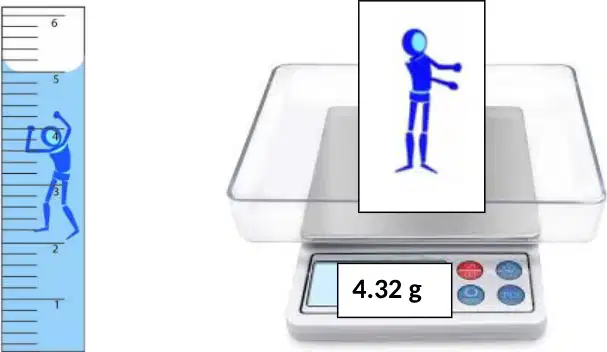
Use the pictures showing a robot causing water displacement in a graduated cylinder and a digital scale reading to determine the robot’s volume. Report the volume with proper units.
1.2 mL
1.6 mL
2.0 mL
0.8 mL
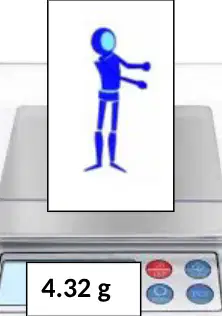
According to the scale shown, what is the mass of the robot? Use proper units.
3.20 g
4.32 g
5.00 g
4.23 g
Using the measured mass and volume, what is the density of the robot? Use proper units.
2.7 g/mL
3.0 g/mL
4.5 g/mL
1.6 g/mL
Based on the calculated density and the table of densities for titanium (4.5 g/mL), iron (7.8 g/mL), gold (19.3 g/mL), silver (10.5 g/mL), and aluminum (2.7 g/mL), what metal is the robot made of?
Titanium
Iron
Aluminum
Silver
What lab equipment was used to measure the volume of the robot?
Graduated cylinder
Beaker
Volumetric flask
Burette
What lab equipment was used to measure the mass of the robot?
Digital balance
Triple-beam lever
Volumetric flask
Pipette
Locate phosphorus (P, #15) on the periodic table. How many protons does a neutral phosphorus atom have?
14
15
16
32
Locate phosphorus (P, #15) on the periodic table. How many total electrons does a neutral phosphorus atom have?
14
15
16
31
For the common phosphorus isotope with mass number 31, how many neutrons does the atom have?
14
15
16
31
How many valence electrons does a neutral phosphorus atom have?
3
4
5
6
How many electron shells (energy levels) does a neutral phosphorus atom have?
2
3
4
5
What would happen to phosphorus if you added one proton?
It would become silicon.
It would become sulfur.
It would become an isotope of phosphorus.
It would become chlorine.
What would happen to phosphorus if you added a neutron? What is it called when you change the number of neutrons in an atom?
It becomes an ion; the change is called ionization.
It becomes a different element; the change is called transmutation.
It remains phosphorus; the change is called forming an isotope.
It remains phosphorus; the change is called electronegativity.
Write the isotope symbol for Phosphorus-32 and determine its number of neutrons.
1532P ; 16 neutrons
1532P ; 17 neutrons
1632S ; 16 neutrons
1531P ; 16 neutrons
Identify all missing items in the nuclear equation and the reaction type: ____ → 93239Np + 24He . What kind of reaction is this?
95243Am ; alpha decay
94239Pu ; beta decay
92235U ; fission
95243Am ; gamma emission
Barium-140 undergoes beta decay. Write the complete nuclear equation showing this transformation: 56140Ba → ______ + ______.
55140Cs + +10β
57140La + −10β
54136Xe + 24α
56140Ba + γ
Hydrogen-1 has what name and how many neutrons?
Protium; 0 neutrons
Deuterium; 1 neutron
Tritium; 2 neutrons
Protium; 1 neutron
Hydrogen-2 has what name and how many neutrons?
Protium; 0 neutrons
Deuterium; 1 neutron
Tritium; 2 neutrons
Deuterium; 2 neutrons
Hydrogen-3 has what name and how many neutrons?
Protium; 0 neutrons
Deuterium; 1 neutron
Tritium; 2 neutrons
Tritium; 3 neutrons
Across a period in the periodic table, how does atomic radius change?
It increases.
It decreases.
It stays the same.
It fluctuates randomly.
Down a group in the periodic table, how does atomic radius change?
It increases.
It decreases.
It stays the same.
It alternates increase/decrease each period.
Across a period, how does electronegativity generally change?
It increases.
It decreases.
It remains constant.
It drops sharply then rises.
Down a group, how does electronegativity generally change?
It increases.
It decreases.
It remains constant.
It oscillates without a trend.
Across a period, how do valence electrons change?
They decrease from left to right.
They increase from left to right.
They remain the same.
They reset every two elements.
Down a group, how do valence electrons change?
They increase.
They decrease.
They remain the same for elements in the group.
They double each period.
Across a period, how does ionization energy generally change?
It increases.
It decreases.
It is constant.
It has no pattern.
Down a group, how does ionization energy generally change?
It increases.
It decreases.
It is constant.
It spikes for noble gases only.
Across a period, how does atomic mass generally change?
It increases.
It decreases.
It remains constant.
It alternates increase/decrease.
Down a group, how does atomic mass generally change?
It increases.
It decreases.
It remains constant.
It shows no trend.
Which element is expected to have the smaller atomic radius—Al or In?
Aluminum (Al)
Indium (In)
Both are the same
Cannot be determined
Which element is expected to have the greater atomic mass—Na or K?
Sodium (Na)
Potassium (K)
Both are the same
Cannot be determined
Which element is expected to be more electronegative—Cs or Na?
Cesium (Cs)
Sodium (Na)
Both are the same
Cannot be determined
Which element is expected to have the lower ionization energy—Ca or Sr?
Calcium (Ca)
Strontium (Sr)
Both are the same
Cannot be determined
Why is the ionization energy of Sr expected to be lower than that of Ca?
Sr has a smaller radius and stronger attraction to its electrons.
Sr has a larger radius and more shielding, so outer electrons are easier to remove.
Sr has fewer electrons in total, so its energy is lower.
Sr is more electronegative, so it loses electrons readily.
Which two elements have similar properties to Mg (magnesium)?
Be and Ca
Na and K
C and Si
Al and Ga
For bond types, which statement correctly describes ionic bonding versus covalent bonding?
Ionic: formed between metals and nonmetals; electrons are transferred. Covalent: formed between nonmetals; electrons are shared.
Ionic: formed between nonmetals; electrons are shared. Covalent: formed between metals; electrons are transferred.
Ionic: formed between noble gases; electrons are donated. Covalent: formed between halogens; electrons are received.
Ionic: formed between metalloids only; electrons are delocalized. Covalent: formed between metals only; electrons are donated.
The bond between sodium and fluorine is ________.
Ionic
Covalent
Metallic
Hydrogen
The bond between carbon and hydrogen is ________.
Ionic
Covalent
Metallic
Hydrogen
What is the formula for the compound that results when magnesium bonds with arsenic?
MgAs
MgAs2
Mg3As2
Mg2As3
What is the formula for the compound that results when sodium bonds with the sulfate ion (SO4)2− ?
NaSO4
Na2SO4
NaSO3
Na2SO3
How many bonds does Arsenic need to make to fill its valence shell?
1 bond
2 bonds
3 bonds
4 bonds
How many bonds does Sulfur need to make to fill its valence shell?
1 bond
2 bonds
3 bonds
4 bonds
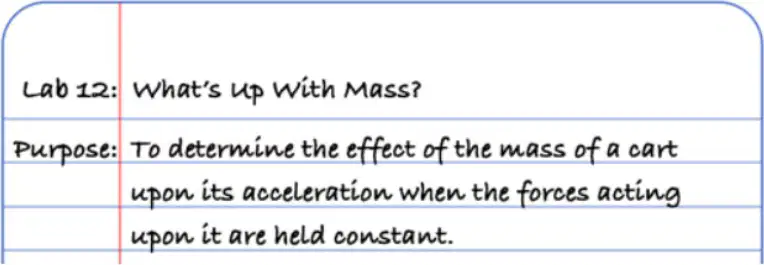
Scientific Method: A group of students is conducting the following experiment. Lab 12: What’s Up With Mass? Purpose: To determine the effect of the mass of a cart upon its acceleration when the forces acting upon it are held constant. What is the independent variable for the experiment above?
mass of the cart
acceleration of the cart
constant force applied
type of surface
Scientific Method: A group of students is conducting the following experiment. Lab 12: What’s Up With Mass? Purpose: To determine the effect of the mass of a cart upon its acceleration when the forces acting upon it are held constant. What is the dependent variable for the experiment above?
acceleration of the cart
mass of the cart
constant force applied
length of the cart
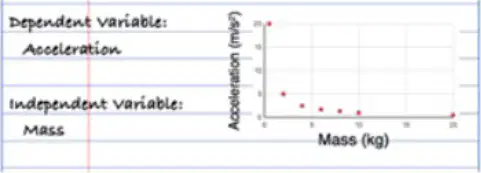
Anna Lytical and Nellie Newton conduct several trials in which they study the effect of varying the mass of a cart upon the acceleration of the cart when pulled with a constant force. Which notebook entry accurately identifies the variables and displays the best choice for a plot?
Notebook Entry A
Notebook Entry B
Significant Figures: Identify the correct amount of significant figures in −0.00567 °C.
2
3
4
5
Significant Figures: Identify the correct amount of significant figures in $198,200.
3
4
5
6
Significant Figures: Identify the correct amount of significant figures in 56.870 kg.
3
4
5
6
Significant Figures: Identify the correct amount of significant figures in 19.697 cm.
3
4
5
6
Significant Figures: Identify the correct amount of significant figures in 23,900 km.
2
3
4
5
Measurement: Measure the black bar shown on the ruler, using the correct number of significant figures and units.
3.0 cm
3.4 cm
2.8 cm
4.0 cm
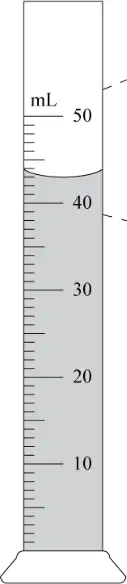
Measurement: Read the volume at the meniscus of the graduated cylinder, using the correct number of significant figures and units.
42.0 mL
44.0 mL
45.0 mL
48.0 mL
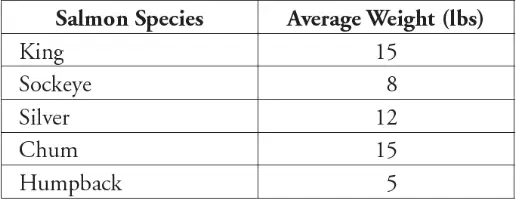
Graphing: Look at the data table of salmon species and their average weights (lbs). Which type of graph would BEST represent the data?
bar graph
line graph
scatter plot
histogram

The following data is taken from Mr. Gulch’s medical records. A data table lists Year and Mr. Gulch’s Weight (kg) for 2005–2011. Identify the dependent variable in the data table.
Year
Mr. Gulch’s weight (kg)

The following data is taken from Mr. Gulch’s medical records. A data table lists Year and Mr. Gulch’s Weight (kg) for 2005–2011. Identify the independent variable in the data table.
Year
Mr. Gulch’s weight (kg)
What should be included in a CER (Claim–Evidence–Reasoning) response? Select all that apply.
Claim
Evidence
Reasoning
Read the CER written below and answer the question. Question: What is the molar ratio of hydrogen gas to oxygen gas that makes the most amount of water? Conclusion (sentences labeled 1–6): 1 In our lab we tested different amounts of hydrogen and oxygen gas mixtures. 2 We found that the 1:5 ratio made the least amount of “pop” sound and the 2:4 ratio made the greatest amount of “pop” sound. 3 When hydrogen and oxygen react they come together in a certain ratio of molecules to make water. 4 The mole ratio in the balanced equation tells you the amount of hydrogen and oxygen that makes the most amount of product (water). 5 The reason why the 1:5 ratio was not the optimal ratio is because there is not enough hydrogen gas molecules to react with all the oxygen molecules. 6 Only in the 2:4 ratio do you have the correct amount of each molecule to make the most water. Which sentence number(s) include the evidence?
1
2
3
4
Periodic Table Organization: What is the symbol for Chlorine?
Cl
Ch
C
Cl2
Periodic Table Organization: What is the atomic number for Chlorine?
16
17
18
35
Periodic Table Organization: How many protons does Chlorine have?
17
18
35
7
Periodic Table Organization: How many electrons does Chlorine have?
17
18
35
7
Periodic Table Organization: How many electron shells (energy levels) does Chlorine have?
2
3
4
5
Periodic Table Organization: How many valence electrons does Chlorine have?
1
5
7
8
Parts of the Atom: Above are the symbols for two isotopes of Phosphorus (Phosphorus-31 and Phosphorus-33). What is different about each of them?
The number of protons
The number of neutrons
The number of electrons
The chemical symbol
Parts of the Atom: How many protons do each isotope have?
14
15
16
31
Parts of the Atom: How many electrons do each isotope have?
15
16
31
33
Parts of the Atom: How many neutrons do each isotope have?
16 for Phosphorus-31 and 18 for Phosphorus-33
15 for Phosphorus-31 and 17 for Phosphorus-33
31 for Phosphorus-31 and 33 for Phosphorus-33
18 for Phosphorus-31 and 20 for Phosphorus-33
Parts of the Atom: Draw a Bohr model that shows the electrons for Phosphorus.
Shells with 2, 8, and 5 electrons
Shells with 2, 7, and 6 electrons
Shells with 2, 8, and 8 electrons
Shells with 1, 8, and 6 electrons
Parts of the Atom: Draw a Lewis dot symbol for Phosphorus.
3 valence electrons shown
4 valence electrons shown
5 valence electrons shown
6 valence electrons shown
Parts of the Atom: Will Aluminum gain or lose electrons?
Gain electrons
Lose electrons
Neither gain nor lose electrons
Gain electrons then lose electrons
Parts of the Atom: What is the oxidation number for Phosphorus?
−3
+3
+5
−2
Metals, Nonmetals and Metalloids: Find Zirconium (#40) on the periodic table. What type of element is it? Would you expect Zirconium to be a good conductor of heat and electricity?
Metal; yes
Metal; no
Metalloid; yes
Nonmetal; no
Metals, Nonmetals and Metalloids: Find Iridium (#77) on the periodic table. What type of element is it? Would you expect Iridium to be a brittle solid?
Metal; yes
Metal; no
Metalloid; yes
Nonmetal; yes
Metals, Nonmetals and Metalloids: Find Fluorine (#9) on the periodic table. What type of element is it? Is Fluorine a gas, liquid or solid at room temperature?
Nonmetal; gas
Nonmetal; liquid
Metalloid; solid
Metal; gas
Metals, Nonmetals and Metalloids: Find Antimony (#51) on the periodic table. What type of element is it? Would you expect Antimony to be ductile?
Metalloid; yes
Metalloid; no
Metal; yes
Nonmetal; no
Families of the Periodic Table: What family is located in group 2A?
Alkali metals
Alkaline earth metals
Halogens
Noble gases
Families of the Periodic Table: What family has 7 electrons in their outer shell?
Halogens
Noble gases
Alkali metals
Transition metals
Families of the Periodic Table: Which is more reactive, Beryllium (#4) or Calcium (#20)?
Beryllium
Calcium
Both equally reactive
Neither is reactive
Families of the Periodic Table: Which is more reactive, Fluorine (#9) or Iodine (#53)?
Fluorine
Iodine
They have equal reactivity
It depends on which metal they react with
Families of the Periodic Table: What is the oxidation number for the Alkali Metals?
+1
+2
−1
0
Families of the Periodic Table: Which noble gas is the most dense?
Helium
Argon
Xenon
Radon
Families of the Periodic Table: Which transition metal in period 3 is the least dense?
Scandium
Copper
Zinc
There are no transition metals in period 3
Periodic Trends (Atomic Radius and Ionization Energy): Which element on the periodic table has the largest atomic radius? The smallest?
Francium largest and Helium smallest
Cesium largest and Hydrogen smallest
Uranium largest and Neon smallest
Potassium largest and Helium smallest
Which element has the larger atomic radius: Calcium (#20) or Barium (#56)?
Calcium (#20)
Barium (#56)
Which element has the larger atomic radius: Calcium (#20) or Arsenic (#33)?
Calcium (#20)
Arsenic (#33)
Which element has the greater ionization energy: Calcium (#20) or Barium (#56)?
Calcium (#20)
Barium (#56)
Which element has the larger ionization energy: Calcium (#20) or Arsenic (#33)?
Calcium (#20)
Arsenic (#33)
What type of bond is between a metal and a nonmetal?
Ionic bond
Covalent bond
Metallic bond
What type of elements become negative ions?
Metals
Metalloids
Nonmetals
In what type of bond are the electrons freely moving about in a “sea of electrons”?
Metallic bond
Ionic bond
Polar covalent bond
Metals have higher electronegativity values compared to nonmetals.
True
False
What is the difference in electronegativity between Sulfur (S) and Bromine (Br)?
About 0.1
About 0.4
About 0.8
About 1.2
What type of bond is between S and Br based on their electronegativity difference?
Ionic
Polar covalent
Nonpolar covalent
What is the difference in electronegativity between Titanium (Ti) and Oxygen (O)?
About 0.5
About 1.0
About 1.9
About 2.5
What type of bond is between Ti and O based on their electronegativity difference?
Ionic
Polar covalent
Nonpolar covalent
What is the difference in electronegativity between Phosphorus (P) and Chlorine (Cl)?
About 0.2
About 0.6
About 1.0
About 1.6
What type of bond is between P and Cl based on their electronegativity difference?
Ionic
Polar covalent
Nonpolar covalent
How many bonds do elements in group 5A typically form in covalent molecules?
One
Two
Three
Four
How many bonds do elements in group 7A typically form in covalent molecules?
One
Two
Three
Four
Select all molecules that have the molecular formula C2H6O.
Ethanol
Dimethyl ether
Acetic acid
Ethane
In the covalent molecule A3H8Bz, where Adamantium (A) is in group 4A and Bazoolium (Bz) is in group 6A, how many covalent bonds does the central atom A typically form?
Two
Three
Four
Five
In the covalent molecule A3H9M, where Mizium (M) is in group 5A, how many covalent bonds does the atom M typically form?
One
Two
Three
Four
What is the molecular geometry around the central atom in NF3?
Linear
Trigonal planar
Trigonal pyramidal
Tetrahedral
What is the molecular geometry around the central atom in AH4 when A is a group 4A element?
Bent
Trigonal planar
Trigonal pyramidal
Tetrahedral
What is the molecular geometry of H2Bz when Bz is a group 6A element?
Linear
Bent
Trigonal planar
Tetrahedral
Do metals gain or lose electrons when forming ions?
Gain electrons
Lose electrons
After becoming ions, what charge do nonmetals typically have?
Positive charge
Negative charge
Bolonium (Bo) is a metal in group 2A and Wonderflonium (Wo) is a nonmetal in group 7A. What is the correct empirical formula for the ionic compound they form?
BoWo
Bo2Wo
BoWo2
Bo2Wo2
Elephantium (E) is a nonmetal in group 5A. What is the formula for Bolonium Elephantide?
BoE
Bo2E3
Bo3E2
BoE3
What is the formula for Bolonium (Bo) nitrate ( NO31− )?
BoNO3
Bo(NO3)2
Bo2(NO3)3
Bo(NO3)3
An unknown substance dissolves in water and melts at a low temperature. What is the bonding type for this substance?
Ionic
Polar covalent (molecular)
Metallic
Network covalent
An unknown substance doesn't conduct electricity when solid but does dissolve in water and will conduct electricity when dissolved. What is the bonding type for this substance?
Ionic
Nonpolar covalent (molecular)
Metallic
Network covalent
The molecules in an unknown substance are very weakly attracted to each other. What is the bonding type for this substance?
Nonpolar covalent (molecular)
Ionic
Metallic
Polar covalent (molecular)
Why do nonpolar substances tend to be gases and not liquids or solids?
They have only weak London dispersion forces, making them easy to separate into gas.
They have strong ionic attractions that keep particles far apart.
They form extensive hydrogen-bonded networks that trap them as gases.
Metallic bonding causes electrons to move freely, producing gases.

