
 Worksheets
Environmental Semester 1 Final Review
Total questions: 82
Worksheet time: 41mins
Name
Class
Date
1.
The unique role a species plays in its environment is its _________.
a)
abiotic factor
b)
niche
c)
trophic level
d)
community
2.
Many species together in one place are called ______.
a)
a niche
b)
a population
c)
a community
d)
mutualism
3.
Rain carries soil into a nearby pond. This is an interaction between which two "spheres" of the earth?
a)
hydrosphere and atmosphere
b)
atmosphere and biosphere
c)
geosphere and hydrosphere
d)
atmosphere and geosphere
4.
Which of these is an example of an abiotic factor?
a)
sun
b)
bacteria
c)
plant
d)
human
5.
The _________ is the portion of the hydrosphere that is frozen.
a)
geosphere
b)
cryosphere
c)
atmosphere
d)
lithosphere
6.
_____ mimicry is when two harmful species mimic each other.
a)
Batesian
b)
Mullerian
c)
Ecological
7.
The atmosphere is made of the gases surrounding the earth. These gases are mostly composed of ____ and ___.
a)
carbon dioxide and hydrogen
b)
hydrogen and nitrogen
c)
carbon dioxide and oxygen
d)
nitrogen and oxygen
8.
Which kind of niche takes competition between organisms into account?
a)
realized
b)
unique
c)
fundamental
d)
competitive
9.
Vultures are an example of this type of consumer.
a)
decomposer
b)
primary consumer
c)
scavenger
d)
secondary consumer
10.
Which sphere of the earth is named using the Greek root meaning "ground"?
a)
hydrosphere
b)
atmosphere
c)
biosphere
d)
geosphere
11.
Which of these is not an example of an abiotic factor?
a)
soil
b)
temperature
c)
bacteria
d)
rainfall
12.
How much chemical energy is transferred from one trophic level to the next?
a)
10%
b)
20%
c)
30%
13.
_______ is a relationship where both organisms benefit.
a)
Mutualism
b)
Commensalism
c)
Parasitism
14.
_______ is a relationship where one organism benefits and the other is unaffected.
a)
Mutualism
b)
Commensalism
c)
Parasitism
15.
Which is NOT true about animal species?
a)
animals of the same species can interbreed and reproduce
b)
endangered species are in immediate jeopardy of extinction
c)
individual species are well documented on a central registry
d)
some species have been protected through trade restrictions
16.
What causes species extinction?
a)
increased reproduction
b)
habitat loss and degradation
c)
abundance of resources
d)
adaptation to new environments
17.
Which of the following is NOT a density-dependent factor?
a)
storms
b)
disease
c)
competition
d)
predators
18.
Over-exploitation of animals is likely to cause _____.
a)
speciation
b)
species extinction
c)
interspecific competition
d)
behavioral isolation
19.
What is the principle of competitive exclusion?
a)
One species will always outcompete another when sharing a limited resource.
b)
Species can share resources equally.
c)
Two species can coexist indefinitely.
d)
Competition leads to mutual benefit.
20.
What is the Endangered Species Act of 1973?
a)
To increase hunting of endangered species.
b)
A law that places international trade restrictions on threatened and endangered species.
c)
To categorize species by size.
d)
To document extinct species.
21.
How do populations typically increase?
a)
linearly
b)
exponentially
c)
geometrically
d)
logarithmically
22.
How does pollution affect species?
a)
encourages growth
b)
causes habitat expansion
c)
leads to endangerment or extinction
d)
has no impact
23.
Which of the following is an abiotic factor affecting population size?
a)
competition
b)
predators
c)
temperature
d)
food availability
24.
What is temporal isolation?
a)
Populations that mate at different times or seasons.
b)
Physical separation by geographic barriers.
c)
Differences in courtship rituals.
d)
Incompatibility of reproductive organs.
25.
What is a species?
a)
A group of organisms that cannot reproduce.
b)
A population of organisms that can interbreed and reproduce under natural conditions.
c)
A group of organisms living in the same habitat.
d)
A population of organisms that are always endangered.
26.
What is the carrying capacity?
a)
The maximum number of individuals an environment can support indefinitely.
b)
The minimum population size for survival.
c)
The number of offspring produced by a species.
d)
The ideal population size for a species.
27.
A ______________species at a lower risk but likely to become endangered in the future.
a)
threatened
b)
extinct
c)
endangered
28.
An ecologist is discussing two animals’ ability to reproduce with one another. Which is he talking about?
a)
natality
b)
fecundity
c)
fertility
d)
mortality
29.
Which type of strategists would you expect to have low levels of prenatal care and a short life expectancy?
a)
K strategists
b)
S strategists
c)
R strategists
d)
J strategists
30.
Long life expectancy usually correlates with all the following, except:
a)
high levels of parental care
b)
larger animals
c)
Type 1 & 2 survivorship curve
d)
rapid reproduction (lots of offspring)
31.
What causes a J curve to flatten into an S curve?
a)
exponential growth is beginning
b)
the death equals the birth rate
c)
logistic growth is beginning
d)
limiting factors affecting the population
32.
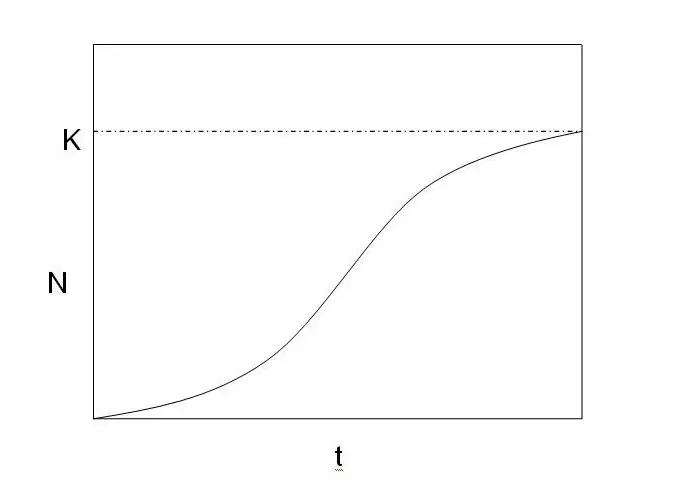
The graph below shows _____.
a)
both logistic and S curve
b)
logistic growth
c)
exponential growth
d)
S curve
e)
J curve
33.
In terms of biodiversity, coral reefs are marine equivalents to tropical rain forests.
a)
True
b)
False
34.
If Earth’s axis is tipping away from the sun, that means the Northern Hemisphere is in which season?
a)
spring
b)
summer
c)
autumn
d)
winter
35.
Which of the following air circulation cells is found from 0 - 30 degrees North latitude?
a)
Polar cell
b)
Hadley cell
c)
Ferrel cell
d)
El Nino
36.
The gas found in the largest concentration in the troposphere and atmosphere in general is ___.
a)
Oxygen gas
b)
Nitrogen gas
c)
Argon gas
d)
Carbon dioxide gas
37.
The phosphorus cycle is unique because it does not include which location?
a)
soil
b)
atmosphere
c)
plants
d)
animals
38.
Nitrogen in animals is in the form of organic molecules. What is the name of the process that turns these molecules into ammonia after the animals die?
a)
nitrification
b)
denitrificaiton
c)
nitrogen fixation
d)
decomposition
39.
___________ is the process by which nitrate is converted back into nitrogen and oxygen.
a)
Nitrification
b)
Nitrogen fixation
c)
Denitrification
d)
Photosynthesis
40.
Protists, fungi and bacteria can convert N2 into ____________.
a)
ammonia
b)
bacteria
c)
ammonium
d)
carbon
41.
Gaseous nitrogen has a _________ bond that makes it hard to break apart and use.
a)
single
b)
double
c)
triple
42.
Through which of the following is atmospheric Nitrogen converted to Nitrogen in the soil?
a)
lightning
b)
photosynthesis
c)
denitrification
d)
animal respiration
43.
Which of the following is part of the quick carbon cycle but not the slow carbon cycle?
a)
volcanoes
b)
atmosphere
c)
photosynthesis
d)
ocean sediments
44.
Which process takes carbon dioxide from the air and converts it into organic matter?
a)
respiration
b)
denitrification
c)
decomposition
d)
photosynthesis
45.
A location that releases more of a nutrient than it takes in is called a _________.
a)
source
b)
sink
c)
reservoir
46.
Which of the following is not a form of Nitrogen found in the soil?
a)
NO2
b)
NO3
c)
N2
d)
NH4
47.
Which of these is NOT true about an area that has been deforested?
a)
it has lower humidity
b)
it has more extreme day and night temperatures
c)
it had higher amounts of atmospheric carbon dioxide
d)
it has lower amounts of surface water runoff
48.
The atmosphere is the largest reservoir for which nutrient?
a)
nitrogen
b)
carbon
c)
phosphorus
49.
Which of these is NOT a characteristic of El Nino?
a)
Weaker upwelling on South American coastline
b)
Unusually weak trade winds or presence of westerlies
c)
Sea level higher in eastern Pacific than western Pacific
d)
flooding in Australia and Indonesia
50.
In the Northern hemisphere, the Coriolis effect causes wind to bend ____________.
a)
In a clockwise pattern
b)
In a counterclockwise direction
c)
towards the Southern hemisphere
51.
2. Which 2 of the following gases were formed during the combustion reaction in the candle lab?
a)
Carbon dioxide
b)
Oxygen
c)
Water vapor
d)
Nitrogen
52.
How are the layers of the atmosphere determined?
a)
By changes in atmospheric gases.
b)
By changes in temperature.
c)
By changes in magnetism.
53.
Air masses that move ____________ the equator end up falling.
a)
towards
b)
away from
54.
An area of the earth that has large bands of rising air and low pressure would likely contain _____.
a)
rainforests
b)
deserts
c)
La Nina
d)
icecaps
55.
Not every point on Earth’s surface is traveling at the same __________.
a)
mass
b)
distance
c)
speed
56.
The rotation of the earth and the unequal distribution of _________creates three major bands of wind around the globe.
a)
water
b)
land
c)
gases
57.
A cloud that moves from the equator towards the north will be moving _______than the ground below it.
a)
slower
b)
faster
c)
at the same speed
58.
Genetic biodiversity is the variation in the network of species present in a certain location and the way they interact with each other.
a)
True
b)
False
59.
A biome is cold, treeless and permanently frozen. Which type of biome is it?
a)
Tundra
b)
Taiga
c)
Alpine
d)
Chaparral
60.
Which of the following is an example of a climate?
a)
There is a cold front coming in this weekend.
b)
A snowstorm is forecasted ot hit the northeast US this week.
c)
It is usually hot in Texas in July.
d)
It rained 4 inches last week in Seattle, WA.
61.
Sea otters feed on sea urchins and help maintain their ecosystems by preventing sea urchins from overfeeding on kelp. Sea otters are an example of a(n) ___.
a)
keystone species
b)
indicator species
c)
pioneer species
d)
primary species
62.
Because frogs absorb both oxygen and toxins through their skin, they are very sensitive to air and water quality. This makes them an excellent ____.
a)
keystone species
b)
indicator species
c)
pioneer species
d)
primary species
63.
Which of the following is not true about mangrove trees?
a)
their leaves excrete excess salt from brackish water
b)
their large roots cause erosion
c)
their roots provide shelter for fish and shark species
d)
mangrove trees are threatened by tourism and shrimp farming
64.
Which of the following is not an example of secondary succession?
a)
Vegetation growing after a hurricane has destroyed a patch of land.
b)
Trees regrowing after deforestation.
c)
The recolonization of an area that has been burned by forest fire.
d)
The growth of algae on a newly created volcanic island.
65.
__________ biodiversity is the variation of DNA and genes within a species or population.
a)
Genetic
b)
Ecological
c)
Species
66.
Which would you expect to find along a line transect?
a)
The edges of an area being researched
b)
A division between habitats
c)
A sampling of organisms found in an area
d)
The total number of organisms in an area
67.
___ is the variety of species within a habitat or region and is the most commonly studied.
a)
Functional Diversity
b)
Ecosystem Diversity
c)
Genetic Diversity
d)
Species Diversity
68.
An organism has been introduced into a thriving ecosystem and it reproduces quickly because a predator does not recognize it as prey. The organism is most likely a(n) __.
a)
transect species
b)
invasive species
c)
pioneer species
d)
primary species
69.
Which would you expect to be a characteristic of pioneer species?
a)
quick reproduction/ growth
b)
need high levels of nutrients to grow
c)
grow tall with deep roots
d)
produce large seeds and showy flowers
70.
A biome experiences year-round warmth, is near the equator, and has both rainy & dry seasons. This biome is a ____.
a)
desert
b)
tundra
c)
rainforest
d)
taiga
71.
What two measurements are found on a climatogram?
a)
temperature in Celsius and temperature in Fahrenheit
b)
rainfall and vegetation types
c)
temperature and number of species
d)
rainfall and temperature
72.
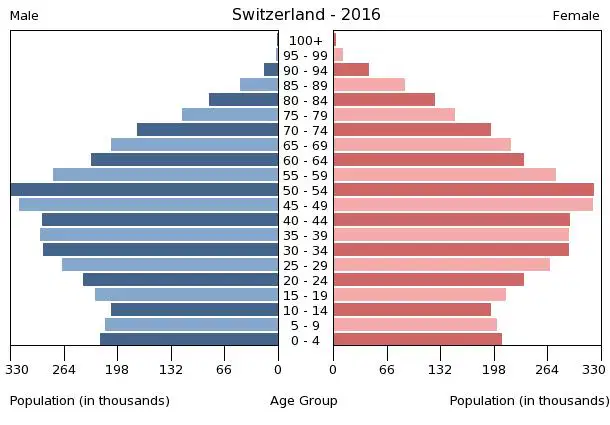
Look at the population pyramid below. The pyramid shows ________.
a)
an expanding population
b)
a stable population
c)
a declining population
d)
you can't tell from this information
73.
Which of the following is NOT a cause of speciation?
a)
behavioral isolation
b)
geographic isolation
c)
mechanical isolation
d)
economic isolation
74.
What is natality?
a)
the death rate
b)
the addition of new individuals (birth)
c)
the ability to reproduce
d)
the age structure of a population
75.
What is a survivorship curve?
a)
A graph showing the number of offspring produced
b)
A curve showing the probability of survival for a species
c)
A chart of species' extinction rates
d)
A diagram of population growth
76.
Organisms that eat both plants and meat are called ____.
a)
carnivores
b)
omnivores
c)
herbivores
d)
autotrophs
77.
_______ is a relationship when one organism is harmed and another benefits.
a)
Mutualism
b)
Commensalism
c)
Parasitism
78.
Which level of the energy pyramid is most likely to have the highest number of organisms?
a)
Producers
b)
Primary Consumers
c)
Secondary Consumers
d)
Tertiary Consumers
79.
We know that energy from the sun is transferred into an organisms because of _____.
a)
the first law of thermodynamics
b)
the second law of thermodynamics
c)
the third law of thermodynamics
80.
_____ are producers that obtain energy form the sun to make their own food.
a)
heterotrophs
b)
scavengers
c)
autotrophs
81.
_______ show the feeding relationships of organisms.
a)
food chains
b)
energy levels
c)
heterotrophs
82.
What are the 4 different "spheres" on Earth? Explain each of them with a short description.
4 lines
100 %

