
NEW
Font size
 Worksheets
8th Grade Benchmark 2
Total questions: 60
Worksheet time: 5hrs 0mins

SC.6.L.14.1
Structures in the human body work together to perform specific functions. The diagram shows the organization of structures found in the human body.
A picture of which structure belongs in the white box?
organelle
cell
tissue
organ
SC.6.L.14.1
When a group of tissues work together to achieve a specific function, it forms an organ. What is a group of organs that are working together to perform a common goal?
an organism
an organ system
a molecule
a cell
SC.6.L.14.2
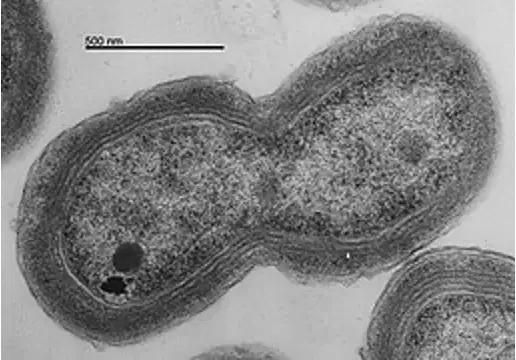
A student is watching a cell divide in order to reproduce.
Which statement describes how this organism is an example of the cell theory?
all organisms use energy
cells are the basic unit of life
all cells come from pre-existing cells
cells are too small to see under a microscope

SC.6.L.14.4
Animal cells are different from plant cells. The diagram below identifies five different structures in an animal cell.
Which structure is incorrectly shown because it is ONLY found in plant cells?
Nucleus
Cell wall
Mitochondrion
Cytoplasm
SC.6.L.14.4
Plant and animal cells have many similarities, one of which being that they both contain a cell membrane. In animal cells, the cell membrane acts as a passageway for molecules that enter and leave the cell. Based on this information, cell membranes in plant cells typically
function in a similar way.
are the site of cellular respiration.
use light, water, and carbon dioxide to produce energy.
provide a rigorous shape for the cell.
SC.6.L.14.5
In order to maintain homeostasis, the systems in the human body work together to keep specific levels of water in the body. Which of these BEST describes how the human body responds after drinking a large amount of water?
The circulatory system delivers less carbon dioxide to the muscular system, resulting in stiffening of the muscles.
The nervous system signals the muscles of the muscular system to contract and dehydrate the body.
The excretory system pulls more water out of the blood through the kidneys and produces more urine.
The skeletal system produces more blood cells that circulate through the blood vessels to increase water absorption.
SC.6.L.14.5
Students are investigating different human body systems. In a lab, they use a meat hammer to smash fruit, place the smashed fruit into a sealable plastic bag, add chemicals to the bag, and smush it around in their hands. They then pour the fruit mixture into special tubing that allows most of the liquid to come out, leaving only bits of solid fruit mash.
What body system can you conclude they are MOST LIKELY investigating?
The digestive system because they are breaking down food.
The excretory system because they are removing water.
The circulatory system because they are moving things throughout the body.
The nervous system because they are sending signals to control the body.

SC.6.L.15.1
Two scientists are comparing the differences between snapdragon plants and dragon flow plants. They both describe the unique way that bees interact with the flower of each plant by opening the petals and crawling into the center of each individual flower. Both scientists are shocked to hear that more than one flower has this unique adaptation. While comparing the leaves of both plants, the scientists are unable to find any differences. They eventually discover that they are describing the same plant with two different names.
What could be done to avoid this confusion?
By using the plant’s common name, the scientists could have easily recognized they were describing the same plant.
There is no way to avoid this type of confusion, plant identification is an imprecise science.
By using the plant’s domain, the scientists could have easily recognized they were describing the same plant.
By using binomial nomenclature, the scientists could have easily recognized they were describing the same plant.
SC.6.L.15.1
Horseshoe crabs, cardinals, and armadillos are classified together in the kingdom Animalia. Specific characteristics are used to classify these organisms.
Which is a characteristic used to classify these organisms as animals?
They are multicellular.
They are autotrophs.
They are parasites.
They are prokaryotes.
SC.7.L.15.2
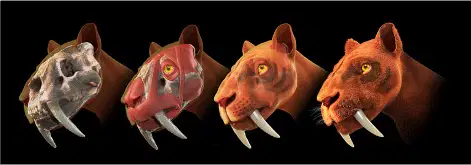
Many animals that once inhabited Earth are now extinct. One such animal is the saber-toothed cat. In addition to being extinct, it is also believed that there are no real descendants of the saber-toothed cat are alive today. Saber-toothed cats were large, ferocious cats that were likely strictly carnivorous, based on the diets of big cats alive today. Most big cats are apex predators, lacking any predators themselves.
Resources and mating opportunities remained high for the saber-toothed cat until it suddenly went extinct.
The saber-toothed cats likely moved to a new area and slowly evolved into tigers, mountain lions, and lions.
Something in their environment likely changed, and they were unable to adapt and survive.
Their environment was likely static, but they were overhunted by prehistoric predators.
SC.7.L.15.2
A certain boney fish species is an omnivore and exists only in an isolated lake. Which of the would MOST LIKELY result in the natural selection of this fish species over others after ten thousand years?
The lake dries up rapidly due to changes in the environment eliminating all fish living in the lake.
The fish species produces many offspring with many unique traits, and the food availability remains constant.
The fish species experiences external or internal factors greatly limiting reproduction, and the food availability changes quickly.
The fish species produces few offspring with no unique traits, and the food availability greatly decreases.
SC.7.L.16.1
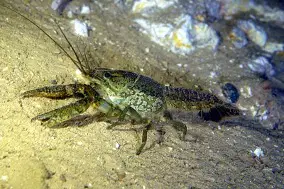
A marbled crayfish is a unique crustacean that reproduces asexually. Each female marbled crayfish lays a clutch of up to 700 eggs. The eggs are unfertilized, and all offspring are female.
Which BEST describes this type of reproduction?
Asexual through mitosis, where all of the offspring are clones of the parent
Sexual through meiosis, where all of the offspring are variations of the parent
Asexual through meiosis, where all of the offspring are variations of the parent
Sexual through mitosis, where all of the offspring are clones of the parent
SC.7.L.16.1
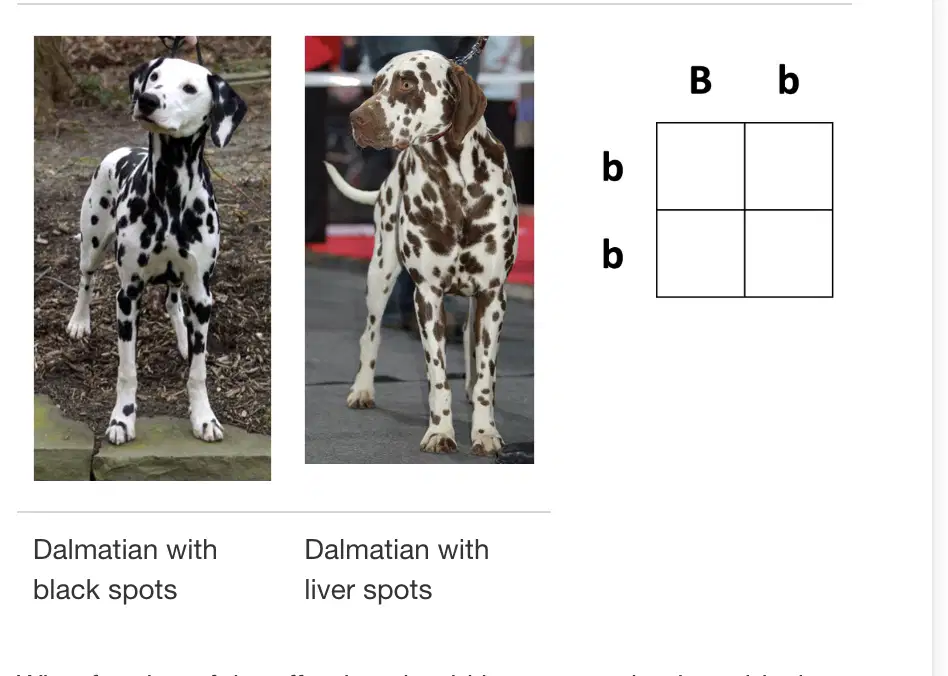
In Dalmatians, the gene for black spots (B) is dominant to the gene for liver spots (b). A Dalmatian with genotype (Bb) was crossed with a Dalmatian with genotype (bb), as shown in the Punnett square.
What fraction of the offspring should be expected to have black spots?


SC.7.L.17.2
Competition between wetland birds in the Everglades is fierce due to limited nesting sites, which are a crucial resource for successful reproduction. With thousands of birds migrating to the Everglades during the rainy season, the demand for nesting sites far exceeds the available supply. This results in intense competition, as birds engage in territorial disputes and aggressive behavior to secure a suitable nesting site for themselves and their offspring. The outcome of this competition directly impacts the reproductive success and survival of the bird populations in the Everglades.
Which statement provides evidence from the paragraph about competition between wetland birds in the Everglades?
Migrating directly impacts the reproductive success.
Thousands of birds migrate to the Everglades during the rainy season.
Wetland birds migrate to the Everglades during the rainy season.
Limited nesting sites in the Everglades lead to intense competition among wetland birds.
SC.7.L.17.2
A population of organisms is growing rapidly in an isolated environment. After several years of growth, the population suddenly stops growing and remains the same for a long period of time. The sudden decrease in growth was due to the organisms reaching the maximum capacity of a specific resource. This is called a
limiting factor.
death curve.
reducing agent.
stasis oasis.

SC.8.L.18.4
A diagram of the carbon cycle is shown.
Each arrow represents a process in this cycle. Which statement BEST describes the process that occurs at arrow X?
Animals release oxygen that is used by bacteria to produce carbon dioxide.
Animals release carbon monoxide that is used by bacteria for growth and reproduction.
Bacteria break down molecules in animals into carbon-based soil nutrients.
Bacteria combine carbon-based nutrients from plants and animals to produce glucose.

SC.8.E.5.3
The points labeled on the chart below represent the approximate distance, in kilometers (km), of different celestial bodies from Earth. The chart includes the center of the Milky Way, the Moon, Jupiter, and the Sun. The approximate distance of Mars is also shown.
Which point on the chart BEST represents the distance from Earth to the center of the Milky Way?
W
X
Y
Z
SC.8.E.5.3
Which table MOST LIKELY describes the characteristics of a star?


SC.8.E.5.7
The diagram represents a model of the universe.
What would X be in a geocentric model?
A black hole
The Moon
Earth
The Sun
SC.8.E.5.7
Io, one of Jupiter's largest moons, is a captivating celestial body renowned for its volcanic activity and colorful surface. It is the most volcanically active world in our solar system, with over 400 active volcanoes. The intense tidal forces exerted by Jupiter and its neighboring moons generate immense internal heat, fueling the eruptions that constantly reshape Io's landscape and produce its vibrant sulfur-rich plumes, making it a fascinating destination for planetary exploration. The average surface temperature on Io is -202°F.
Which of these would NOT contribute to the surface temperature of Io?
Size of Io
Thin atmosphere
Distance from the Sun
Volcanic activity
SC.8.E.5.9
Which celestial body's gravitational pull is primarily responsible for causing tides on Earth?
Venus
Jupiter
The Moon
The Sun

SC.8.E.5.9
Which statement correctly compares lunar and solar eclipses?
A lunar eclipse occurs as the Moon passes through the Earth's shadow, while a solar eclipse occurs as part of the Earth passes through the Moon's shadow.
A lunar eclipse occurs as the Moon passes through the Sun’s shadow, while a solar eclipse occurs as part of the Sun passes through the Moon's shadow.
A solar eclipse occurs as the Moon passes through the Sun’s shadow, while a lunar eclipse occurs as part of the Sun passes through the Moon's shadow.
A solar eclipse occurs as the Moon passes through the Earth's shadow, while a lunar eclipse occurs as part of the Earth passes through the Moon's shadow.

SC.7.E.6.2
The Mississippi River: The Big Muddy
Melanie Sherman
The Big Muddy
The grand old Mississippi River has been changing since it formed some 20 million years ago. As one of the United States' largest rivers, as many as two-thirds of states drain partially or entirely into the Big Muddy. As water travels across the land on its way to the mighty Mississippi River, large amounts of soil, dirt, and rock are broken off, picked up, and relocated along the way. All of this weathered and eroded soil and dirt gives the water in the Mississippi a brown color as it moves towards the Gulf of Mexico. Once the dirt and soil reach the Gulf of Mexico, it is deposited at the river’s mouth, forming the wetland area of the Mississippi River Delta. This delta is home to some of the most fertile land in the United States. Each year, the Mississippi River needs to be dredged. Dredging is the act of removing dirt from the river’s bed to increase or maintain the depth of the river. Once the sediments have been removed, they are relocated using a large pipeline.
Using sources, by which number in The Rock Cycle is the dirt and soil being dredged out of the Mississippi River each year MOST LIKELY represented?
Igneous rock
Sediments
Metamorphic rock
Magma
SC.7.E.6.2
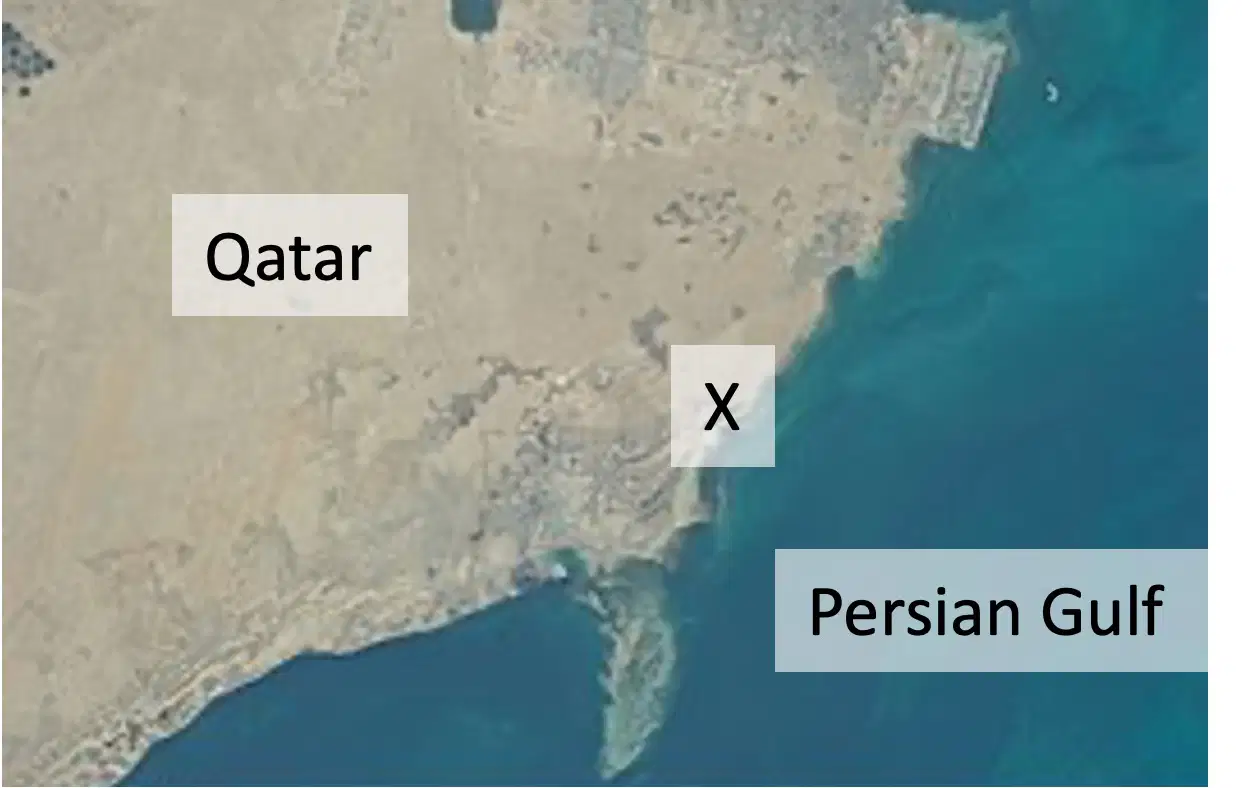
The photograph shows a satellite view of the desert coast of Qatar and the Persian Gulf.
Researchers predict that in the future, the land area of point X will be reduced by erosion. Which event will cause the MOST weathering and erosion to the land area at point X?
Increasing salinity of seawater near the land
Strong storm winds blowing across the land
Solids floating in seawater depositing on the land
Intense rays from the sun striking the land
SC.7.E.6.4
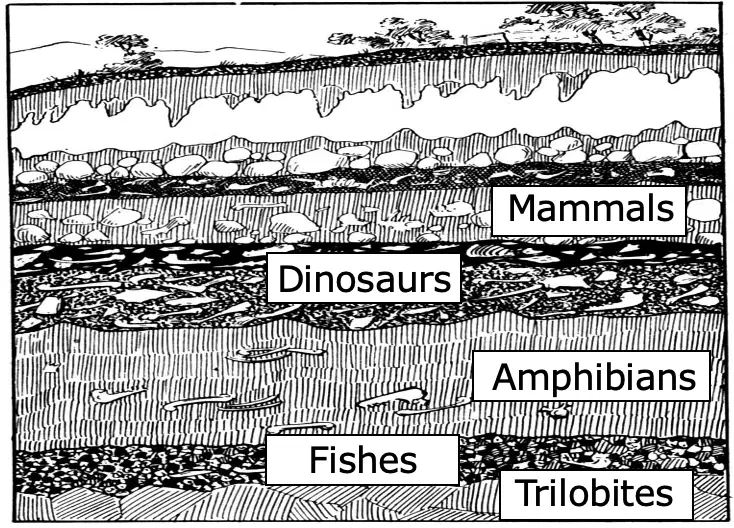
The diagram below represents a cross-section of a cliff. It shows several rock layers containing fossils.
Which layer is MOST LIKELY the oldest?
The layer containing fishes
The layer containing amphibians
The layer containing dinosaurs
The layer containing trilobites
SC.7.E.6.4
A scientist is trying to predict the age of some rocks. Which is the MOST accurate method for the scientist to predict the age of the rocks?
Investigating ice core samples
Using index fossils to date rock layers
Radioactive dating of the rocks
Using index fossils to date the fossils
SC.7.E.6.5
Which of these describes the layers of the solid Earth, from the innermost to the outermost layer?
The dense metallic liquid core, the hot convecting mantle, the lithosphere
The lithosphere, the dense metallic liquid core, the hot convecting mantle
The lithosphere, the hot convecting mantle, the dense metallic liquid core
The hot convecting mantle, the lithosphere, the dense metallic liquid core

SC.7.E.6.5
During a lab investigation, students construct a model to represent the movement of Earth’s tectonic plates. They filled a large plastic tub with water and placed one bottom corner of the tub into a warming plate. The warming plate created convection cycles in the water as the water heated and cooled.
What could the students add to the model for the water to represent Earth’s mantle?
One ball floating on the water to represent the Earth’s liquid core
Two sponges floating on the water to represent the plates of the lithosphere
Three rocks at the bottom of the tub, near the warmer to represent Earth’s lithosphere core
A thick layer of gravel at the bottom of the tub to represent the bottom of the ocean
SC.6.E.7.4
The climate of an area can be different from its weather. Which statement describes the climate of an area?
The low temperature in Tampa, FL on June 5, 2021, was 21°C (70°F).
The average rainfall from 1901–2000 was 53.65 inches.
Tomorrow morning will be partly cloudy.
The Suwannee River is predicted to flood after heavy rains this weekend.
SC.6.E.7.4
The Sun’s rays are quite damaging to living organisms. Light from the Sun in outer space is composed of about 50% infrared light, 40% visible light, and 10% ultraviolet light. Small amounts of direct UV light denature DNA and kills living cells. In many laboratories, scientists use UV light to sterilize pieces of lab equipment to ensure that no living organisms remain on them.
How are living organisms able to survive on Earth despite the large amounts of radiation produced by the Sun?
Organisms on Earth have evolved to prevent being damaged by the Sun’s radiation
The Moon shields the Earth from much of the radiation, allowing living things to thrive on Earth.
The Earth’s oceans absorb a large percent of the radiation since 71% of Earth is covered in oceans, allowing living things to thrive on Earth.
The Earth’s atmosphere filters out much of the radiation, allowing living things to thrive on Earth.

SC.6.E.7.5
The arrows in the picture below show several ways heat is transferred from the Sun as it strikes sand on the surface of a beach.
Which of these BEST describes the movement of heat represented by one of the arrows?
Arrow 1 represents light energy heating the surface sand through conduction.
Arrow 2 represents surface sand heating the cooler sand below through radiation.
Arrow 3 represents surface sand warming the air above through induction.
Arrow 4 represents warm air replacing cool air through convection.
SC.8.E.5.5
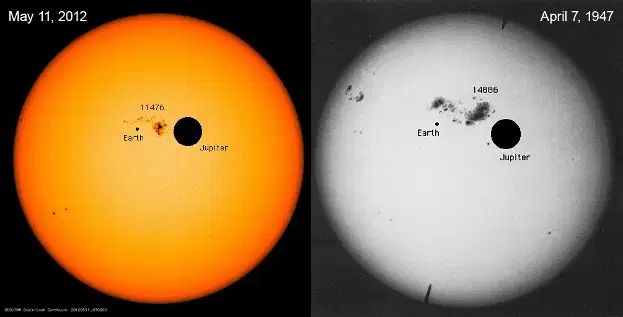
NASA scientists took the following images of the Sun and placed silhouette representations of Jupiter and Earth for a visual comparison.
What were they MOST LIKELY comparing in the two photos?
The rate of change in a solar prominence
The shape of a solar flare as it changed over 65 years
The size of two different sunspots
The changes in planetary shape and size
SC.8.P.8.4
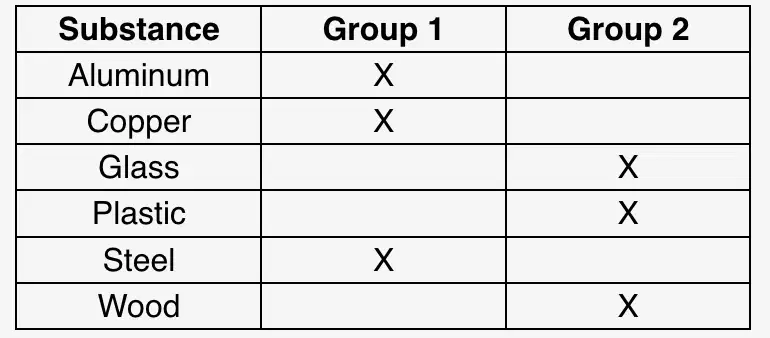
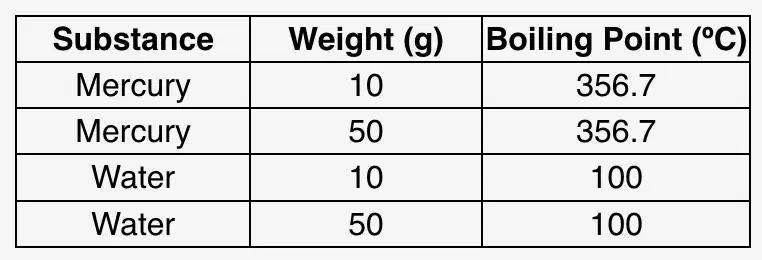
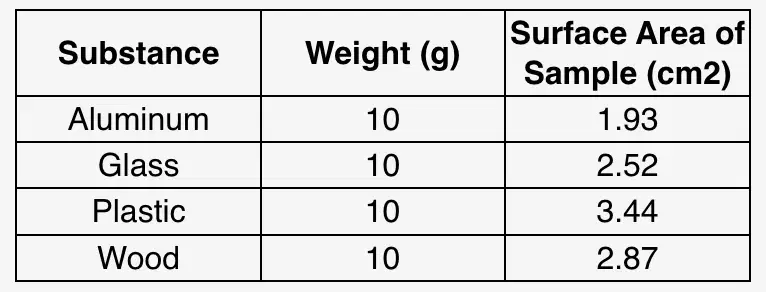
Sarah is comparing the physical characteristics of several substances. She wants to prove the following claim.
Claim: Some physical properties of a sample are independent of the amount of the sample.
Which table BEST proves this claim?

SC.8.P.8.4
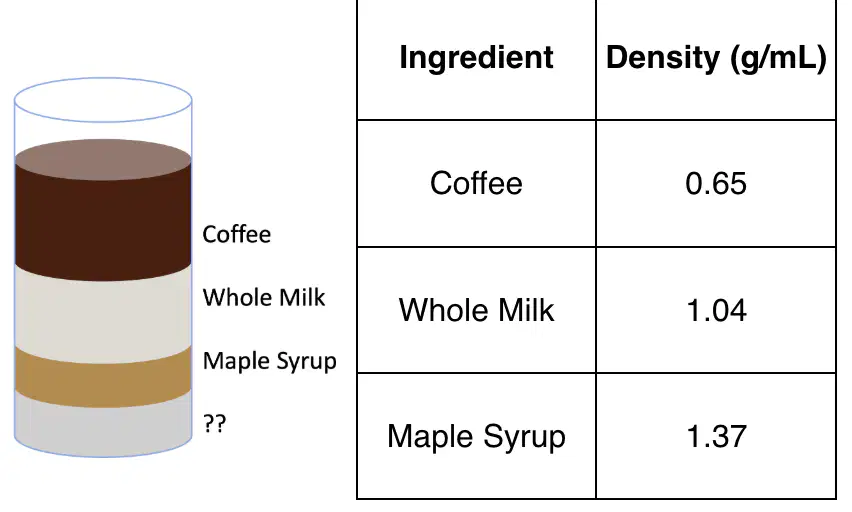
A chef is attempting to make a dessert drink that has distinctly separated ingredients. They add coffee, whole milk, and maple syrup to a cup, but they would like to have one more ingredient added that would sink to the bottom of the cup. The table shows the density of each ingredient.
Using the equation for density, P = M/V , assess which ingredient they could use to fill the very bottom of the cup.
9 mL ice with a mass of 10 g
5 mL water with a mass of 5 g
4 mL chocolate syrup with a mass of 6 g
12 mL cinnamon milk with a mass of 5 g
SC.8.P.8.5
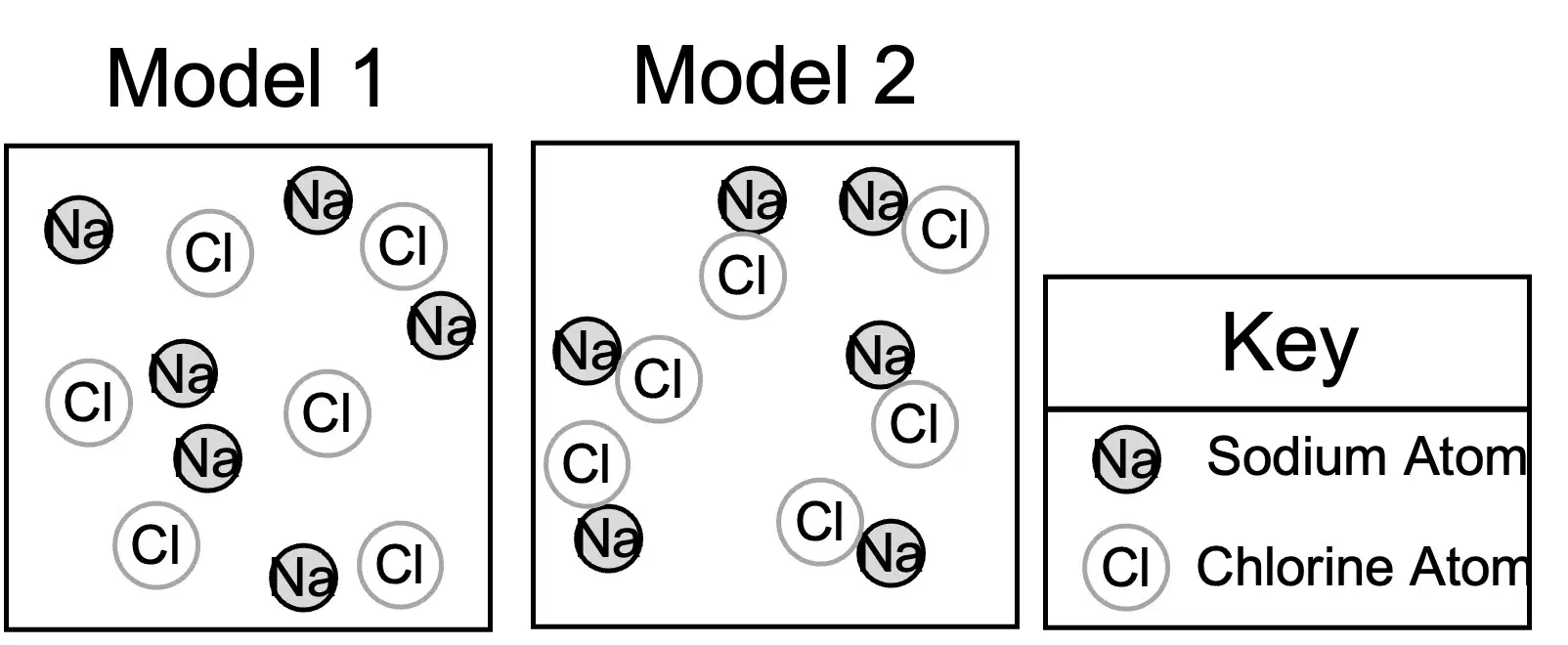
Sodium (Na) can be found as a soft, silver-white, metallic solid, and chlorine (Cl) can be found as a white powder. The diagram shows atomic models of two substances made of sodium and chlorine.
Select the statement that accurately describes one of these models.
Model 1 represents a pure substance and is likely to have a uniform color.
Model 2 represents a mixture and is likely to have an uneven color.
Both Model 1 and 2 represent mixtures and are likely to have an uneven color.
Model 2 represents a pure substance and is likely to have a uniform color.
SC.8.P.8.5
Lithium (Li), Sodium (Na), Potassium (K), Rubidium (Rb), and Francium (Fr) have similar properties. Which other element is MOST LIKELY to have similar properties?
Calcium (Ca)
Carbon (C)
Cesium (Cs)
Helium (He)

SC.8.P.9.2
Considering the laws of the conservation of mass, which molecule could be placed in the box to correctly complete the formula?




SC.8.P.9.2
When a sugar cube is placed in a pan on a hot stove, the sugar melts, the sugar burns and produces smoke, the sugar cube changes shape, and the air around the pan heats up. Which of these is an example of a chemical change?
the sugar melts
the sugar burns and produces smoke
sugar cube changes shape
and the air around the pan heats up
SC.7.P.10.1
Light from the Sun in outer space is composed of about 50% infrared light, 40% visible light, and 10% ultraviolet light. How is the energy of infrared light, visible light, and ultraviolet light different?
They have the same energy.
They have come from different areas of the Sun.
They produce the same image to the human eye.
They have different wavelengths.

SC.7.P.10.1
The graphic shows the capabilities of three different NASA space telescopes.
Which telescope can see the LOWEST energy waves?
the Spitzer Space Telescope
the James Webb Space Telescope
The Hubble Space Telescope
All three can pick up the same waves.
SC.7.P.10.3
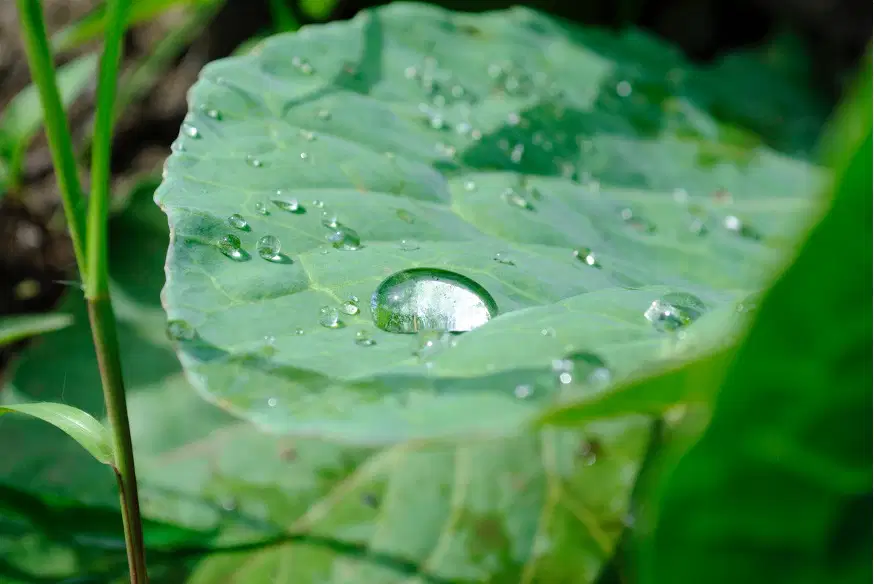
The image shows a large drop of water sitting on a leaf.
What causes the distortion of light seen in the water drop?
The reflection of light as it slows down while passing through the water drop.
The refraction of light as it slows down while passing through the water drop.
The rarefication of light as the smooth surface of the water drop allows the light to bounce off of it and back toward the viewer’s eye.
The absorption of light as the non-green rays of light are absorbed, leaving the color green to bounce back toward the viewer’s eye.
SC.7.P.10.3
Which material would cause a light wave to move the SLOWEST?
A very dense solid
A mid-dense liquid
A less-dense gas
A vacuum

SC.7.P.11.2
Jasmine constructed a simple hydro turbine. When water flows through the water wheel correctly, the water wheel is attached to a generator that turns on a light bulb.
Which BEST describes the energy transformation that takes place between the water wheel and the light bulb?
Mechanical energy transforms into electrical energy.
Chemical energy transforms into electrical energy.
Mechanical energy transforms into chemical energy.
Electrical energy transforms into mechanical energy.

SC.7.P.11.2
A roller coaster cart is sitting at the top of the biggest hill on the roller coaster track.
As soon as it starts moving down the track,
the kinetic energy starts to decrease.
the kinetic energy starts to increase.
the potential energy starts to increase.
the kinetic and potential energy remains the same because energy is not gained or lost in this system.
SC.7.P.11.4
A student sets a hot coffee cup on a cold tile table. What will happen?
The heat will move from the table to the cup.
The heat will move from the cup to the table.
The cold will move from the table to the cup.
The cold will move from the cup to the table.
SC.6.P.13.1
Natalie ran a comb through her hair several times and noticed that her hair began to stand on end. Which of these is responsible for her hair sticking up?
Gravity
Friction
Electric force
Magnetic force
SC.6.P.13.1
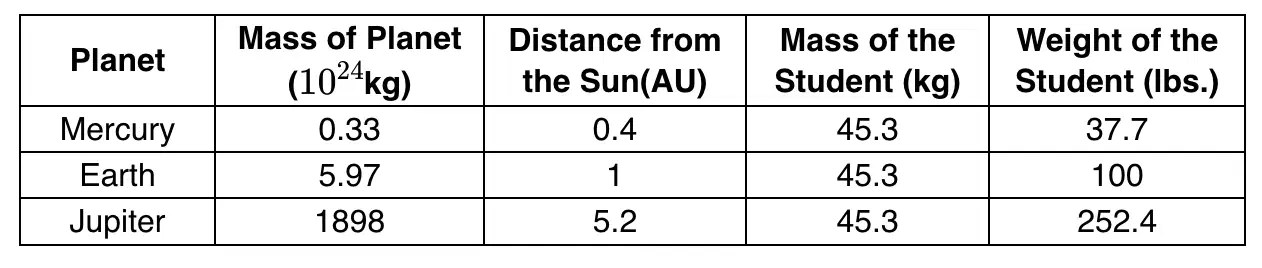
A student read that on different planets mass of an object remains constant while the weight of an object changes due to gravitational force. They made the table shown here to show the differences.
What conclusion can be drawn?
The gravitational pull from Jupiter must be greater based on the larger mass of the planet.
The gravitational pull from Earth must be less based on the distance from Jupiter to the Sun.
The gravitational pull from Earth must be greater based on the smaller mass of the planet.
The gravitational pull from Jupiter must be less based on the distance from Jupiter to the Sun.

SC.6.P.13.3
The diagram below shows forces acting on an emergency helicopter. Both its speed and height above the ground are constant.
The helicopter gets a call and needs to increase its speed forward (toward the left) and down to pick up an injured person. Assess the forces that will change.
The helicopter will need to have a higher thrust than drag, and a lower lift than gravity.
The helicopter will need to have a lower thrust than drag, and a lift that is equal to gravity.
The helicopter will need to have equal thrust and drag, and a higher lift than gravity.
The helicopter will need to maintain constant equilibrium.

SC.8.N.1.1
A student wants to design a lab that measures the temperature change of a single object over different durations of cooling. They take one object, heat it to a specific temperature by boiling it in water, then set it out on a room-temperature tile. They measure the temperature of the object in 5-minute time intervals over a total of 30 minutes.
What is the test variable (independent variable) in this experiment?
The initial temperature of the object
Time
The temperature of the environment
The material of the object

SC.8.N.1.1
The data shows the orbital period, orbital speed, distance from the Sun, and rotation period for each of the planets in our solar system.
Which lists four planets from SHORTEST day to LONGEST day?
Mars, Jupiter, Uranus, Venus
Neptune, Saturn, Mars, Earth
Jupiter, Saturn, Earth, Venus
Uranus, Mars, Venus, Mercury
SC.8.N.1.1
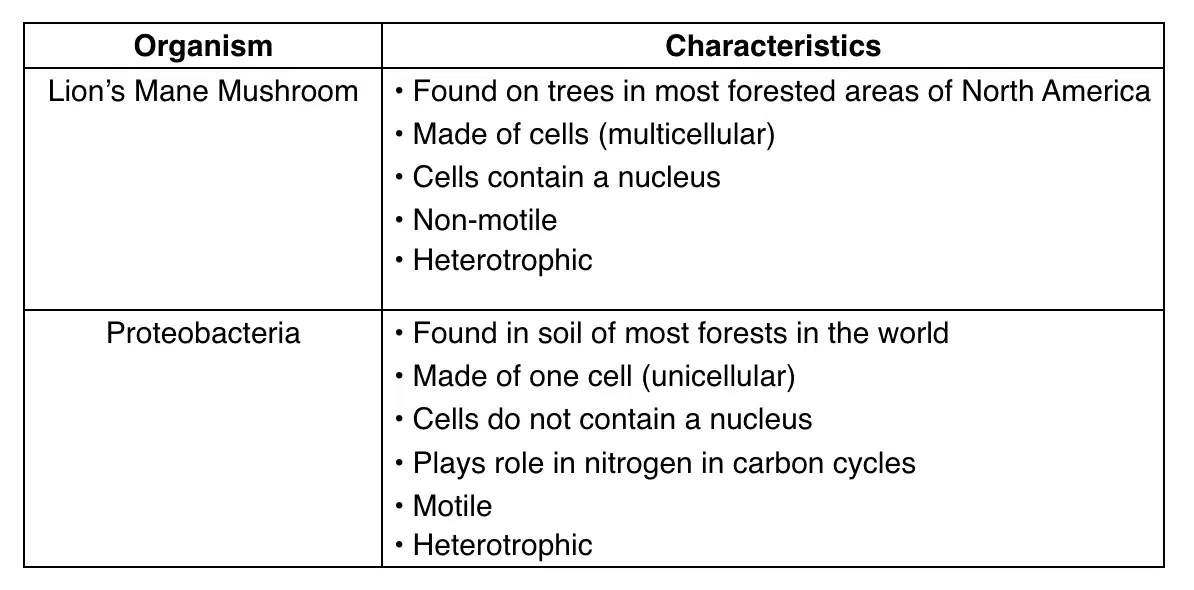
Students are comparing two different organisms and their characteristics.
Based on this information, which conclusion correctly classifies one of these organisms?
Proteobacteria must be in the kingdom Animalia because it is unicellular and heterotrophic.
Lion’s mane must be in the kingdom Plantae because it is non-motile and autotrophic.
Proteobacteria must be in the kingdom Plantae because it is found in the forest.
Lion’s mane must be in the kingdom Fungi because it is non-motile and heterotrophic.
SC.7.N.1.2
A group of scientists claims to have discovered a new drug that drastically decreases acne during puberty. The scientists have performed several laboratory experiments using the drug on shaved portions of rat skin with chemically-induced acne. Which statement explains the replication and repetition of their experiment?
The scientists have proved repetition but not replication of their experiment.
The scientists have proved replication but not repetition of their experiment.
The scientists have proved neither replication and repetition of their experiment.
The scientists have proved both replication and repetition of their experiment.

SC.7.N.1.2
The following statements were taken from the procedures of four different investigations.
Which investigation is an example of repetition?
Statement 1
Statement 2
Statement 3
Statement 4
SC.7.N.1.5
A student is using a computer model to observe the effects of weathering and erosion. The student finds the computer simulation to be boring and dull and wishes they could do a hands-on lab to see the effects of long-term erosion. Which of these is NOT a benefit of a computer simulation model over a lab investigation while studying these concepts?
It takes a lot more resources
It can speed up a process that takes thousands of years
It is likely more accurate
It is easier to set up and clean up in a classroom
SC.7.N.1.5
A biologist would like to study the behaviors of a living organism. What would be the BEST way for them to accurately study this?
Grow the organisms in a laboratory
Build a model of the organism out of plastic, wood, or metal
Observe the organisms in their natural setting
Perform chemical analysis of the organism's hair
SC.7.N.1.5
Which example does NOT describe an instance where technology is essential to science?
The Hubble Space Telescope takes pictures of celestial bodies that cannot be seen from Earth.
A botanist gradually crossbreeds flowers to produce a variety that is resistant to developing mildew on its leaves.
Artificial intelligence models can be used to analyze data without bias.
A virologist uses an electron microscope to view projections on the outside of a virus to study how it attaches to a host cell.
SC.6.N.2.2
Scientific knowledge changes as new information or evidence is discovered. Which of the following would be a result of new scientific research and information?
Binomial nomenclature is assigned to a recently identified plant species.
A large rock outcrop shows classic signs of weathering and erosion.
A chemical element discovered in a mine directly aligns to the element carbon in the periodic table of the elements.
A non-native turtle species will begin to reproduce rapidly after being introduced into a pond ecosystem.
SC.6.N.2.2
Which type of scientist is likely to use a petri dish in a laboratory to determine the effects of different antibiotics on the growth of bacteria?
A physicist
A chemist
A geologist
A biologist
SC.7.N.3.1
Which of these BEST describes the difference between a scientific law and a theory?
A scientific law is a tentative explanation that can change over time, while a scientific theory is an established principle that cannot be altered.
A scientific law explains why a phenomenon occurs, while a scientific theory describes a proven fact.
A scientific law is a well-supported principle derived from repeated observations or math, while a scientific theory is a well-substantiated explanation based on evidence and experimentation.
A scientific law is a broad generalization, while a scientific theory is a specific prediction about a particular phenomenon.
SC.7.N.3.1
Which of these MOST LIKELY describes a scientific law and not a scientific theory?
The explanation of how species and organisms have changed over time to become more diverse and better adapted to their environments
The mathematical formula for forces: F=MA, where F represents force, M represents mass, and A represents acceleration
The three tenets that outline the major characteristics of all living cells.
The explanation of how the universe initially formed

