
Font size
 Worksheets
Biotechnology 1 Semester 1 Final Exam Review Game
Total questions: 85
Worksheet time: 43mins
Which action best describes the function of the second stop on a micropipette plunger?
To draw up the liquid into the tip.
To eject the pipette tip from the barrel.
To calibrate the volume of the pipette.
To eject the last remaining drop of liquid from the tip.
You need to measure exactly 250 uL. Which micropipette would be the most appropriate choice?
P20
P200
P1000
P10
Convert 450 uL into milliliters (mL).
4.5 mL
0.45 mL
0.045 mL
45 mL
Which of the following is considered the least accurate tool for measuring a specific volume of liquid?
Volumetric Flask
Graduated Cylinder
Micropipette
Beaker
What is the primary purpose of "taring" or "zeroing" a balance before weighing a chemical in a weigh boat?
To ensure the balance is level on the table.
To subtract the mass of the weigh boat so only the chemical is measured.
To convert grams into milligrams automatically.
To calibrate the balance for the day.
Which piece of equipment uses high-pressure steam and heat to sterilize glassware and biohazardous waste?
Centrifuge
Incubator
Autoclave
Fume Hood
You are working with a volatile chemical that releases toxic fumes. Where should you perform this work?
On the open lab bench
In a laminar flow hood
In a chemical fume hood
Next to an open window
According to the pH scale, a solution with a pH of 9 is considered:
Strongly Acidic
Weakly Acidic
Neutral
Basic (Alkaline)
What is the pH of a solution with a hydrogen ion concentration [H+] of 1×10⁻³ ?
3
10
-3
7
Which of the following best describes the function of a buffer solution?
It changes the color of a solution to indicate pH.
It increases the rate of a reaction.
It resists changes in pH when small amounts of acid or base are added.
It completely neutralizes any acid added to it.
What information does a Safety Data Sheet (SDS) provide?
The price and catalog number of the chemical.
Hazards, handling, storage, and emergency procedures for a chemical.
The experimental protocol for using the chemical.
The expiration date of the specific bottle.

The GHS pictogram featuring a flame over a circle represents which hazard?
Flammable
Oxidizer
Explosive
Corrosive
Which Biosafety Level (BSL) is appropriate for working with moderate-risk agents that are present in the community and associated with human disease (e.g., Staphylococcus aureus)?
BSL-1
BSL-2
BSL-3
BSL-4
When interpreting a line graph, the variable that is manipulated by the scientist (the cause) is plotted on the:
X-axis
Y-axis
Legend
Title
Which type of graph is best suited for showing the percentage breakdown of a whole (e.g., the composition of trash in a lab)?
Line Graph
Bar Graph
Pie Chart
Scatter Plot
A student records the color of a bacterial colony as "bright orange." This is an example of:
Quantitative data
Qualitative data
Statistical data
Numerical data
Calculate the molar mass of Sodium Hydroxide (NaOH). (Atomic masses: Na=22.99, O=16.00, H=1.01)
40.00 g/mol
58.44 g/mol
36.46 g/mol
24.00 g/mol
How many grams of solute are needed to make 500 mL of a 10% (w/v) solution?
5 g
10 g
50 g
100 g
Which formula is used to calculate the volume needed to dilute a stock solution to a lower concentration?
D=m/v
C1V1=C2V2
A2+B2=C2
pH=−log[H+]
You have a 10M stock solution. You need to make 1.0 L of a 1M solution. How much stock solution do you need?
10 mL
100 mL
500 mL
1000 mL
In a salt water solution, the water is considered the:
Solute
Solvent
Precipitate
Buffer
Which unit is not typically used to express concentration in a biotech lab?
Molarity (M)
Percent mass/volume (%)
Micrograms per microliter (ug/uL)
Degrees Celsius
When using a centrifuge, what is the most important safety rule?
Run it with the lid open to watch the samples.
Balance the tubes symmetrically across the rotor.
Use glass tubes only.
Stop the rotor with your hand to save time.
Gel electrophoresis separates DNA molecules primarily based on their:
Size (length in base pairs)
Color
pH
Temperature
In gel electrophoresis, DNA is negatively charged, so it will migrate toward the:
Negative electrode (Black)
Positive electrode (Red)
Center of the gel
Bottom of the well
What does the acronym "PPE" stand for?
Professional Pipetting Equipment
Personal Protective Equipment
Private Protocol Entry
Primary Procedure Elements
If you spill a hazardous chemical on your skin, what is the recommended minimum time to flush the area with water?
1 minute
5 minutes
15 minutes
60 seconds
Which of the following is a quantitative observation?
The solution turned cloudy.
The reaction produced a foul smell.
The temperature rose by 5.2 degrees Celsius.
The precipitate was white.
What is the standard scientific notation for the number 0.0056?
5.6 x 10³
5.6x10⁻³
56 x 10-4
0.56 x 10⁻²
A Standard Operating Procedure (SOP) is best described as:
A log of who entered the lab.
A step-by-step set of instructions to perform a specific routine task.
A list of all chemicals in the storage room.
A report of experimental results.
When plotting enzyme activity vs. temperature, the peak of the curve represents:
The point where the enzyme is denatured.
The optimal temperature for enzyme activity.
The point where the enzyme freezes.
The lowest reaction rate.
What happens to an enzyme if it is heated significantly beyond its optimal temperature?
It works faster.
It replicates itself.
It denatures (loses its shape) and stops working.
It becomes a buffer.
If you measure 12.5 mL of water, how many microliters (uL) is this?
125 uL
1,250 uL
12,500 uL
0.0125 uL
Which pictogram represents a substance that is acutely toxic (fatal or toxic)?
Skull and Crossbones
Exclamation Mark
Gas Cylinder
Corrosion
A student falsifies data to make their results match their hypothesis. This is an example of:
Good data management.
Scientific misconduct/Unethical behavior.
Troubleshooting.
Peer review.
Calculate the mass of NaCl needed to make 0.5 L of a 2 M solution. (Molar Mass of NaCl = 58.44 g/mol).
29.22 g
58.44 g
116.88 g
233.76 g
Which of the following is the correct definition of Molarity?
Moles of solute per liter of solution.
Grams of solute per milliliter of solvent.
Moles of solvent per liter of solute.
Grams of solute per liter of solution.
When should you label a container containing a chemical solution you prepared?
After you use it.
Only if you plan to keep it overnight.
Immediately before or after filling the container.
When the instructor checks your station.
Which piece of equipment is used to grow bacterial cultures at a specific controlled temperature?
Autoclave
Centrifuge
Incubator
Refrigerator
What is the dependent variable in an experiment testing how different amounts of fertilizer affect plant height?
The amount of fertilizer.
The type of plant.
The height of the plant.
The amount of water given.
Which of the following pH values represents the strongest acid?
pH 6
pH 13
pH 2
pH 8
Which glassware is designed to hold and mix chemicals but is not precise enough for volumetric measurements?
Volumetric Flask
Erlenmeyer Flask
Volumetric Pipette
Graduated Pipette
To measure 1.2 mL of liquid most accurately, which pipette should you use?
A P1000 micropipette set to 1000 followed by a P200 set to 200
A 10 mL serological pipette
A 5 mL transfer pipette
A P20 micropipette
What defines the "Biohazard" symbol?
Three circles overlapping in a triangle formation
A diamond with a flame
A skull and crossbones
A test tube pouring liquid on a hand
If a solution has a density of 1.5 g/mL and you have 20 mL of it, what is the mass?
13.3 g
30 g
20 g
1.5 g
Which step comes first when using a pH meter?
Dip the electrode into the sample
Store the electrode in distilled water
Remove the electrode from the storage buffer and rinse with distilled water
Calibrate the meter with standard buffers
When diluting a strong acid, why should you always add acid to water, not water to acid?
Adding water to acid can cause splashing and rapid heat generation
Adding acid to water makes the solution weaker
It allows the acid to dissolve slower
It prevents the water from evaporating
Which document would you use to record your daily experimental observations, raw data, and thoughts?
SOP
Lab Notebook
MSDS
Calibration Log
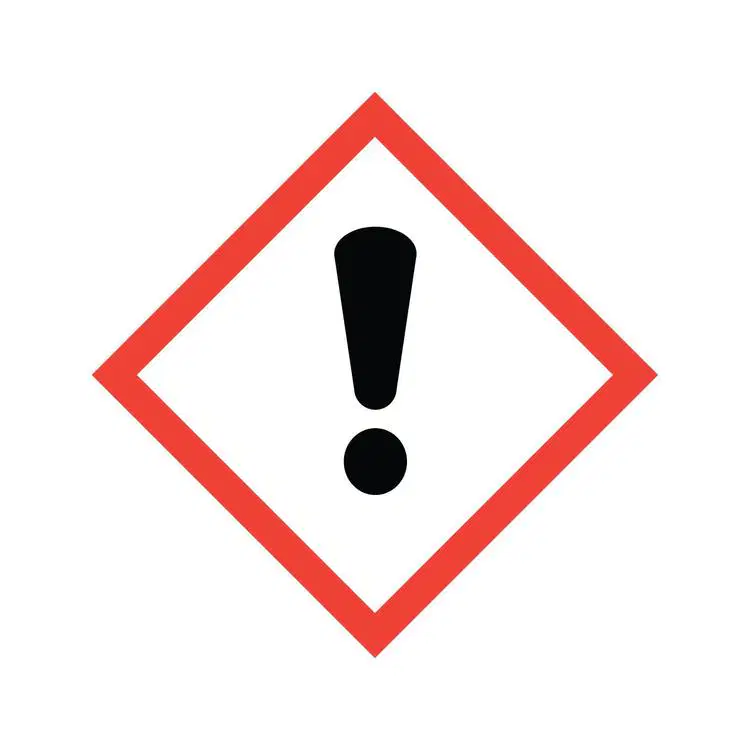
An "Exclamation Mark" pictogram on a chemical bottle indicates:
The chemical is radioactive
The chemical is an irritant or skin sensitizer
The chemical is under high pressure
The chemical causes birth defects
What is the mean (average) of the following data set: 2.0, 2.5, 3.0, 2.5?
2.0
2.5
3.0
10.0
Which scientist is credited with producing "Photo 51" using X-ray crystallography, which was essential in identifying the structure of DNA?
James Watson
Rosalind Franklin
Erwin Chargaff
Frederick Griffith
According to Chargaff's Rule, if a DNA molecule contains 20% Adenine, how much Thymine should it contain?
20%
30%
80%
0%
Which bond holds the two separate strands of DNA together (between the nitrogenous bases)?
Peptide Bond
Covalent Bond
Hydrogen Bond
Ionic Bond
A nucleotide, the building block of DNA, consists of which three components?
Sugar, Protein, and Fat
Phosphate group, 5-carbon sugar, and Nitrogenous base
Amino acid, R-group, and Carboxyl group
Glucose, Water, and Acid
What is the correct complementary DNA strand for the following sequence: 3’ A T C C G A 5’?
5’ A T C C G A 3’
5’ T A G G C T 3’
3’ U A G G C U 5’
5’ G C T T A G 3’
In the context of macromolecules, what is the monomer (building block) of a protein?
Monosaccharide
Nucleotide
Amino Acid
Glycerol
What is the primary function of lipids (fats) in a biological system?
Storing genetic information
Long term energy storage and membrane structure
Speeding up chemical reactions
Transporting oxygen
Enzymes work to speed up chemical reactions by:
Increasing the temperature of the solution
Lowering the activation energy required for the reaction
Changing the pH of the solution
Becoming part of the final product
On an enzyme molecule, the specific area where the substrate binds is called the:
Active Site
Product Zone
Nucleus
Allosteric Site
Which of the following is a strict rule for maintaining a legal scientific notebook?
Use a pencil so you can erase mistakes.
Use blue permanent ink only.
Tear out pages if you mess them up completely.
Leave blank lines between days to make it look neat.
If you attach a graph or data printout into your lab notebook, how should you sign it?
Sign only the back of the printout.
Sign the tape that holds it in.
Sign across the edge of the attachment so the signature extends onto the notebook page.
You do not need to sign attached items.
Why is water considered a "polar" molecule?
It freezes at 0 degrees Celsius.
It has a slight positive charge on the hydrogens and a slight negative charge on the oxygen.
It is found at the North and South Poles.
It contains salt.
What is the main difference between tap water and deionized (DI) water?
Tap water has had all organic contaminants removed.
DI water has had ions (like metals and salts) removed through resin cartridges.
Tap water is more pure than DI water.
DI water contains added fluoride for safety.
When preparing a solution, the substance that is dissolved (usually the solid) is called the:
Solvent
Solute
Buffer
Precipitate
You need to make 100 mL of a 30% (w/v) sucrose solution. How much sucrose do you weigh out?
0.3 grams
3.0 grams
30 grams
300 grams
You are making 100 mL of a 60% (v/v) glycerol solution. After pouring 60 mL of glycerol into the cylinder, how much water should you add?
100 mL
60 mL
40 mL
0 mL
What is the specific purpose of "Autoclave Tape"?
To seal the door of the autoclave shut.
To label the name of the bacteria.
To show if the autoclave actually worked by developing black stripes.
To repair broken glass before sterilizing.
Which pipette is best suited for transferring larger volumes of liquid, such as 10 mL or 25 mL?
P1000 Micropipette
Serological Pipette
Transfer Pipette
P20 Micropipette
What is the primary function of a "Water Bath" in the lab?
To wash dirty glassware.
To incubate samples at a constant temperature for a set time.
To freeze samples quickly.
To mix solutions vigorously.
In a Standard Operating Procedure (SOP), which section defines WHO is responsible for performing the task?
Scope
Purpose
Responsibility
References
Which Biosafety Level (BSL) would contain dangerous agents like Ebola or Smallpox, for which there are no vaccines or treatments?
BSL-1
BSL-2
BSL-3
BSL-4
How are agents in a BSL-3 laboratory, such as Tuberculosis or SARS-CoV-1, typically transmitted?
Through skin contact only.
Via inhalation (aerosols).
By eating contaminated food.
Through water sources.
Identify the correct scientific notation for the number 900,000.
9×10⁵
9×10⁶
90×104
0.9×10⁷
Which of the following is a "Qualitative" observation?
The bacteria colony is 4mm wide.
There are 12 colonies on the plate.
The bacteria is glowing green.
The incubator is at 37 degrees.
What is the source of "Agarose," the sugar used to make gels for electrophoresis?
Corn starch
Animal fat
Seaweed
Bacterial cell walls
Besides size and charge, what other factor influences how DNA separates in a gel?
Color
Shape
Smell
Texture
When removing gloves, what is the first step to ensure safety?
Pull the fingers of one glove with your teeth.
Grasp the outside of one glove at the wrist without touching bare skin.
Wash the gloves with soap and water before taking them off.
Slide a finger under the wrist of the first glove.
Which piece of safety equipment is best used to smother a grease fire or wrap around a person whose clothing is on fire?
Fire Extinguisher
Safety Shower
Fire Blanket
Fume Hood
What does the "NFPA Hazard Diamond" communicate?
The price of the chemical.
The specific storage location in the room.
The health, fire, instability, and specific hazards of a chemical.
The expiration date of the chemical.
You calculate you need 550 uL of solute. You only have a P1000 micropipette. What should the window read (top to bottom)?
0 - 5 - 5
5 - 5 - 0
0 - 5 - 0
0 - 0 - 5
Which of these chemicals are components of a buffer solution?
Salts
Strong Acids
Strong Bases
Indicators
Which biosafety level characterizes most high school laboratories?
BSL-1
BSL-2
BSL-3
BSL-4
What can an acidic buffer solution no longer hold when it reaches buffer capacity?
OH-
H+
H2O
CO3-
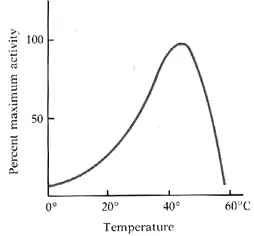
A researcher records enzyme activity at different temperatures and plots the results. The graph shows activity increasing up to 45°C and then decreasing at higher temperatures. What trend does this graph illustrate?
Enzyme activity has an optimal temperature
Enzyme activity is independent of temperature
Enzyme activity is independent of temperature
Enzyme activity decreases at all temperatures

What is the mass of CO2 given off from the yeast treated with 20 grams of sucrose?
0 grams
4 grams
6 grams
9 grams

