
 Worksheets
AP Sem One Exam
Total questions: 31
Worksheet time: 16mins
Which of the following is NOT one of the 4 major categories of tissues found in the human body?
nervous
epithelial
vascular
muscular
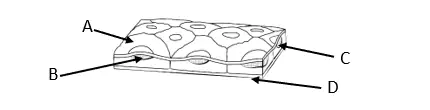
The picture above is known as
simple cuboidal epithelium
simple squamous epithelium
stratified cuboidal epithelium
stratified squamous epithelium
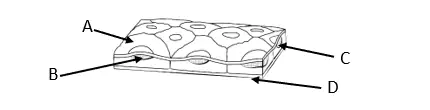
In the picture above, which is the basement membrane?
A
C
B
D
Which body cavity contains all others listed here?
pleural
mediastinum
thoracic
ventral
The type of tissue that contains goblet cells for secreting mucus is
squamous
columnar
cuboidal
keratinized
Sweat glands secrete entire cells into the sweat duct, then replace those cells through mitosis. What type of glands are sweat glands?
merocrine
holocrine
eccrine
endocrine
In contrast to an exocrine gland, a(n) _______________ gland releases substances into surrounding capillaries, rather than ducts.
merocrine
holocrine
apocrine
endocrine
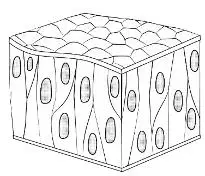
The type of epithelial tissue in the picture above is known as
pseudostratified.
stratified columnar.
simple cuboidal.
transitional.
If someone sliced you between the eyes and directly downwards, what type of plane would that be?
median/midsagittal
cranial
frontal
transverse
In which type of connective tissue is the ground substance calcified and hard?
bone
cartilage
blood
connective tissue proper
Which of the following is the correct order for the layers of skin from top to bottom?
hypodermis, epidermis, dermis
epidermis, dermis, hypodermis
epidermis, hypodermis, dermis
dermis, epidermis, hypodermis
Which layer of the epidermis is made of 20-30 layers of dead cells that are regularly shed when we bathe?
stratum corneum
stratum spinosum
stratum granulosum
stratum basale
The spider-shaped cells that protect the skin from UV radiation are called
sebaceous cells
follicle cells
melanocytes
osteocytes
The layer of your skin that contains all the blood vessels, nerves and sweat glands is the
stratum corneum
hypodermis
epidermis
dermis
Which of the following is NOT a function of the skeletal system?
bearing the weight of the body & binding structures together
protecting vital organs
conducting impulses from senses
storage of minerals and fats
manufacture of red and white blood cells
Which of the following bones is classified as an "irregular" shape?
phalanges
patella
humerus
vertebrae
The "little beams" that make up spongy (cancellous) bone are called the
concentric lamellae.
osteons.
interstitial lamellae.
trabeculae.
Children with Rickets have bones that are far too flexible because they lack ____________ to give their bones strength.
calcium
osteons
hematomas
collagen
Which of the following is the correct order of the vertebral column from cranial to caudal?
cervical, lumbar, sacral, thoracic, coccyx
sacral, thoracic, cervical, lumbar, coccyx
sacral, lumbar, cervical, thoracic, coccyx
cervical, thoracic, lumbar, sacral, coccyx
Red blood cells are formed in the
periosteum.
trabeculae.
medullary cavity.
articular cartilage.
Which type of joint is highly movable?
ball and socket
fibrous
synovial
osteoid
What is the name given to the type of joint found in your hip?
pivot
hinge
saddle
ball & socket
What is the name given to the type of joint found in your knee?
pivot
hinge
saddle
ball & socket
Your ankle is ___________ to your knee.
distal
caudal
dorsal
proximal
Which of the following types of muscle tissue is found within your digestive system and used to move food through your esophagus, stomach, and intestines?
smooth
cardiac
skeletal
gastrointestinal
What type of channel on the axon terminal is stimulated by an incoming action potential and allows Calcium to enter the axon?
chemically-gated
myosin-gated
voltage-gated
As a muscle fiber contracts, the sarcomere shortens and the fibers move closer to the ____________, or center of the sarcomere.
myosin
Z-line
actin
M-line
Which molecule provides the energy for the contraction described above?
Calcium
lactic acid
Troponin
ATP
A muscle fiber cannot contract until ___________ rushes in from a nerve cell to remove the blocking molecules and make the active site available to be engaged.
Calcium
lactic acid
Troponin
ATP
When your muscles require more oxygen than they are receiving, they will being the process of
lactic acid respiration
Calcium respiration
anaerobic respiration
aerobic respiration
When you pick up a heavy grocery bag, your arm muscles are working. In this situation your biceps brachii is the _____________ and your triceps brachii is the ____________.
origin, insertion
prime mover, antagonist
insertion, origin
antagonist, prime mover

